

BIRM-166’s Frozen Seedbank31421 BCE
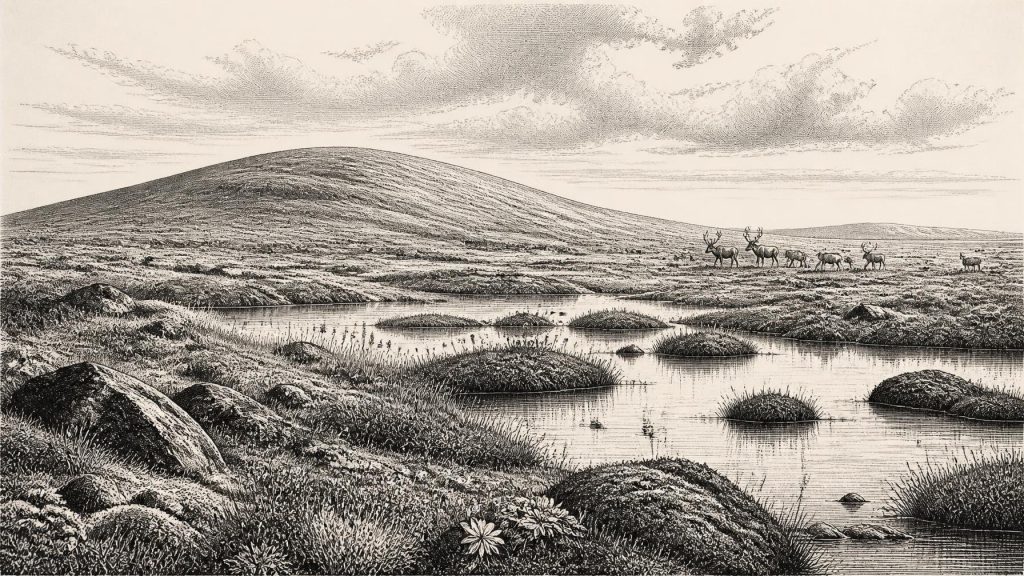
Around 31,421 BCE, Ireland’s past is reconstructed from environmental rather than historical evidence. Derryvree, County Fermanagh, preserves a cold, ice-free tundra wetland between glacial advances, dated broadly to 36,900–31,700 years ago. Its plants, including bogbean, indicate pools and short productive seasons. Crag Cave records intermittent milder conditions. Castlepook Cave’s fauna, accumulated over long periods, includes mammoth, reindeer, giant deer and predators, demonstrating rich but fluctuating ecosystems. A possibly cut-marked reindeer femur may indicate Upper Palaeolithic human activity, although its context is insecure. No settlement or society is evidenced. Subsequent glaciation obscured remains, leaving a fragmentary record of landscapes and visitation.
Dateline
“31,421 BCE” is a modern label, not a year that can be recovered from Ireland’s prehistoric record. No calendar, writing, named person or dated event survives from this depth of time. In archaeological terms, it falls roughly 33,370 years before AD 1950, the conventional reference point for radiocarbon dating, and belongs to the later part of the Late Pleistocene, within Marine Isotope Stage 3. Even that conversion must not be mistaken for precision: radiocarbon determinations of this antiquity calibrate to wide ranges, not individual years. The responsible history of Ireland at this point is therefore a history of sediments, animal bones, cave deposits and changing ice, rather than a conventional annual chronicle.
A Landscape Between Ice Advances
The closest well-studied environmental evidence comes from Derryvree, near Maguiresbridge in County Fermanagh. During roadworks in 1969, geologists found organic silts and fine sands sealed between two thick layers of glacial till in a drumlin. The sequence was crucial because it recorded an interval after one episode of glacier activity and before another. Its key radiocarbon determination, Birm-166, was reported as 30,500 radiocarbon years BP, with substantial uncertainty; later calibration places the deposit broadly at about 36,900–31,700 calibrated years BP. The notional date considered here lies inside that broad range, but cannot be located at a particular horizon, season or human generation within it.
Derryvree shows that its locality was ice-free when the organic sediments accumulated. Water lay in shallow pools and wet ground, while sediment, plant remains, pollen, insects and other biological traces built up gradually. The lower till beneath the deposit proves earlier ice movement; the till above proves that ice later returned and buried the wetland. This is strong evidence for a changing local landscape. It is not evidence that all Ireland was simultaneously free of ice, nor that every region experienced identical weather or vegetation. The Irish Ice Sheet was dynamic, its margins responding to climate, topography and the surrounding seas in ways that varied from place to place.
At around 33,000 calibrated years ago, the island stood before the better-known maximum expansion of the last British–Irish Ice Sheet, generally placed much later, around 27,000–23,000 years ago. Yet “before the maximum” did not mean mild or stable. North Atlantic climates during Marine Isotope Stage 3 shifted repeatedly between colder stadials and relatively warmer interstadials, sometimes on timescales short by geological standards. Greenland ice-core chronologies provide the clearest wider North Atlantic framework, but they do not turn an Irish deposit into an annual weather record. Derryvree is best read as local testimony to a cold, periglacial interval with liquid water and living vegetation, set within a volatile climatic age.
Wet Tundra in Fermanagh
The Derryvree fossils point to a largely treeless tundra or tundra-wetland environment. Sedges, mosses and plants suited to cold, open conditions occurred beside standing or slow-moving water. Among the striking finds was a seed of bogbean, Menyanthes trifoliata, a plant of shallow freshwater margins and fens. Its presence does not conjure a modern Irish bog: the deposit records a cold periglacial wetland, with open pools and seasonally severe conditions, not a woodland-fringed pastoral landscape. Insects and plant remains similarly indicate that the ground supported a productive, if short-lived, growing season.
This was not a blank white wilderness. The word “tundra” can conceal variation: wet hollows, sedge-covered margins, mineral soils, exposed gravel and patches of low vegetation would have offered different habitats. Frozen ground and frost action probably shaped drainage and surface stability. Snow cover, winter darkness, high winds and rapid summer change formed part of the ecological rhythm. The evidence allows confidence in open, cold-adapted vegetation around Derryvree; it does not permit a detailed reconstruction of every plant community across Ireland.
Caves in the south-west supply a complementary, though different, climate archive. At Crag Cave in County Kerry, episodes of calcite growth show that liquid water was intermittently able to percolate through the limestone during parts of the last glacial period. Because speleothems in shallow cave systems need unfrozen water and suitable soil conditions above them, their interrupted growth helps trace episodes of amelioration. They support the broader conclusion that Ice Age Ireland was environmentally changeable. They do not demonstrate that Fermanagh and Kerry shared the same local conditions at precisely the same moment.
Castlepook’s Animal Archive
County Cork offers the most evocative evidence for the animals that could inhabit Ireland during these fluctuating conditions. Castlepook Cave, near Doneraile in the Awbeg valley and sometimes called Mammoth Cave, produced an exceptional assemblage during excavations conducted by Richard Ussher and others in the early twentieth century. The collection includes remains attributed to woolly mammoth, reindeer, giant deer, brown bear, wolf, fox, Arctic fox, mountain hare, lemmings and spotted hyaena. Such animals did not necessarily live together at one instant. Cave accumulations can span millennia, and bones may have been introduced by hyaenas, wolves, water movement or natural deaths. The assemblage must therefore be treated as a long environmental archive, not a frozen scene from one day.
Nevertheless, it establishes an important point: at favourable points in the Late Pleistocene, Ireland could sustain large herbivores and the predators or scavengers associated with them. Reindeer imply extensive open grazing country; mammoth and giant deer indicate substantial plant resources across wider landscapes. Hyaenas and wolves reveal active food webs in which carcasses were contested and redistributed. A cave could serve as shelter or den for carnivores and as a trap for bones, rather than as a human home. Castlepook’s value lies precisely in this complexity: it preserves signs of an Irish ecosystem far richer in large mammals than the modern island.
The Reindeer Femur Question
One Castlepook object gives this remote period particular historical importance. A fragment of reindeer femur, re-examined from the old collections, has been reported as about 33,000 years old and bears a deep linear mark identified by zooarchaeologist Ruth Carden as consistent with cutting or chopping by a sharp stone tool. County Cork heritage material accordingly presents it as possible evidence that Upper Palaeolithic people processed a reindeer in Ireland, long before the island’s previously accepted post-glacial human record.
The claim is important, but its limits are equally important. The bone date tells us when the reindeer lived, not automatically the precise time at which the mark was made. The specimen comes from an old cave collection whose original excavation preceded modern standards of stratigraphic recording. No stone tool, hearth, dwelling floor, grave, ornament, human bone or securely associated occupation layer of this age has been found with it. Carnivore damage, geological movement and excavation history all complicate cave evidence. The modification may be anthropogenic, but the wider circumstances remain unproved.
If the interpretation is upheld, it would show an episode of carcass processing: someone used a sharp edge on a reindeer limb. It would not show whether that person killed the animal, found it already dead, removed meat or hide, extracted sinew or marrow, or handled the limb elsewhere before it entered the cave. Nor would it establish a permanent population, a settlement, a route of arrival or continuity with later inhabitants. The most defensible conclusion is that brief Upper Palaeolithic visitation is possible and perhaps increasingly plausible, while settled or repeated occupation remains unconfirmed.
What Cannot Be Written
There is no evidence for political institutions, chiefs, territories, diplomacy, warfare, trade systems, formal religion, monuments, art traditions or named communities in Ireland at this date. It would be misleading to fill those absences with analogies from better-documented Upper Palaeolithic societies elsewhere in Europe. People on the continent certainly possessed varied technologies, social relationships and symbolic practices, but Ireland’s evidence does not yet identify which, if any, were present here. Likewise, there is no basis for describing an Irish language, ethnicity, clan structure or ancestral link to later populations.
Economy can only be addressed at the most cautious level. The environmental record demonstrates resources—wetland plants, grazing animals, freshwater and possible shelter in limestone country—not a demonstrated Irish economy. If people reached the island, large game and carcass materials would have been valuable, but that is an inference from the possible cut-marked femur rather than direct proof of organised hunting. There is no evidence for exchange, farming, herding, pottery, metalworking or long-term settlement. The distance in time from the first securely recognised Mesolithic settlements after the final retreat of the ice is enormous.
An Archive, Not an Anniversary
What makes this date meaningful is not a recoverable event in 31,421 BCE, but the convergence of sparse archives. Derryvree preserves a freshwater tundra wetland sealed between ice advances. Crag Cave records intermittent phases when water could circulate through Irish limestone. Castlepook preserves a faunal record of reindeer, mammoth and carnivores, together with a single modified reindeer bone that may mark the earliest known human action in Ireland. These sources illuminate environmental possibility and archaeological uncertainty rather than a settled Ice Age society.
Later glaciation removed, buried or disturbed much of the evidence that any people may have left. That destruction helps explain why Ireland’s deep past is so fragmentary, and why old museum collections and small sediment exposures remain disproportionately important. Around this notional date, Ireland was a cold, changing Atlantic land: locally ice-free in some areas, vulnerable to renewed glaciation, inhabited by remarkable animals, and perhaps visited briefly by people. For now, that carefully bounded account is more compelling—and more truthful—than a fabricated year-by-year story.
Primary Sources
- A Middle Midlandian Freshwater Series at Derryvree, Maguiresbridge, County Fermanagh, Northern Ireland
- The Subdivision of the Quaternary Period in Ireland
- Trimlines, Blockfields and the Vertical Extent of the Last Ice Sheet in Southern Ireland
- Quaternary Geological Map of Ireland
- Castlepook Cave: County Geological Site Report
- Castlepook Caves
- Heritage Artefacts of County Cork
- New Insights on the Fauna of Ireland’s Younger Dryas
- The Irish Quaternary Fauna Project
- Pleistocene Vertebrates in the British Isles
- Episodic Speleothem Deposition Tracks the Terrestrial Impact of Millennial-Scale Last Glacial Climate Variability in SW Ireland
- The IntCal20 Northern Hemisphere Radiocarbon Age Calibration Curve (0–55 cal kBP)
- Radiocarbon Dating and Chronological Modelling: Radiocarbon Dating
- The Greenland Ice Core Chronology 2005, 15–42 ka. Part 1: Constructing the Time Scale
- A Stratigraphic Framework for Abrupt Climatic Changes During the Last Glacial Period Based on Three Synchronized Greenland Ice-Core Records
- Early Deglaciation of the British-Irish Ice Sheet on the Atlantic Shelf Northwest of Ireland
- Exploring Controls of the Early and Stepped Deglaciation on the Western Margin of the British-Irish Ice Sheet
- Growth and Retreat of the Last British–Irish Ice Sheet, 31,000 to 15,000 Years Ago: the BRITICE-CHRONO Reconstruction
- Growth, Dynamics and Deglaciation of the Last British-Irish Ice Sheet: the Deep-Sea Ice-Rafted Detritus Record
- Stratigraphic and Palaeo-Geomorphological Evidence for the Glacial-Deglacial History of the Last British-Irish Ice Sheet in the North-Western Irish Sea
- Menyanthes trifoliata
- Ireland’s Palaeolithic Archaeology – Fleeting Footprints in a Frozen Land