Derryvree’s Arctic Water-Milfoil31399 BCE
31,399 BCE is a modern label for later Marine Isotope Stage 3, not a recoverable Irish calendar year. Derryvree, County Fermanagh, preserves freshwater organic sediments between glacial tills, indicating a cold, treeless periglacial wetland during an ice-free local interval. Pollen, plants and insects document shallow pools and low-growing vegetation. Climate and ice varied, while lower sea levels did not necessarily create continental routes. Castlepook Cave records diverse cold-stage fauna, including mammoth, reindeer and predators. A marked reindeer femur may indicate brief human carcass processing, but cannot prove settlement, society, culture or permanent occupation. Evidence chiefly reveals a harsh, changing environment.

Dateline
A Date Beyond the Calendar
31,399 BCE is a useful modern label, not a year that can be recovered from Ireland’s archaeological record. It equates approximately to 33,348 calendar years before present, where “present” in radiocarbon practice means 1950. At this depth, even a well-dated specimen normally yields a probability range measured in centuries or millennia, rather than a particular season, generation or calendar year. The responsible setting is therefore Ireland during the later part of Marine Isotope Stage 3 (MIS 3), a fluctuating phase of the last Ice Age before the Last Glacial Maximum.
There is no evidence from which to name an Irish ruler, community, conflict, diplomatic encounter or religious rite for this notional year. Nor can historians identify a settlement, household, language or political territory. What can be investigated is a changing physical world: patches of open ground and freshwater, animal movements, cave accumulations, advancing and retreating ice, and the limited possibility that people briefly entered Ireland. The surviving record is thin because later ice sheets scoured, redeposited and buried so much of the earlier landscape.
Water Beneath the Drumlin
The most informative Irish evidence close to this broad horizon comes from Derryvree near Maguiresbridge, County Fermanagh. Roadworks exposed a remarkable sequence in a drumlin: organic freshwater silts and fine sands lay between a lower till and a later upper till. Till is the unsorted sediment deposited directly by glacier ice. The sequence therefore establishes an important order of events. Ice had occupied the locality; a non-glacial interval then permitted pools, wet ground and sediment to form; later ice advanced again and sealed the deposit.
An organic layer at Derryvree produced a conventional radiocarbon determination of 30,500 radiocarbon years BP, with a substantial stated uncertainty of +1,170/−1,030 years. Older published calibration discussions place the deposit broadly at about 36,900–31,700 calibrated years BP, approximately 34,950–29,750 BCE. The modern date of 31,399 BCE falls within that broad window, but this does not mean that the exposed pool can be assigned to this particular year. It means only that the Derryvree deposits provide the best direct Irish environmental analogy for the time in question.
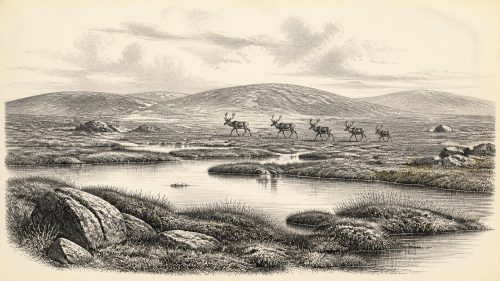
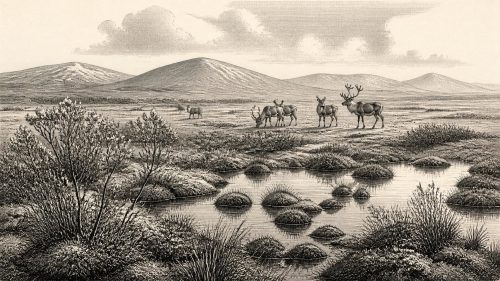
The sediments contain pollen, plant macrofossils, mosses and insects. Their combined testimony supports a cold, largely treeless, periglacial wetland rather than an Irish landscape of woodland, fields or blanket bog. Sedges and freshwater mosses grew beside shallow water; remains of bogbean, dwarf willow, mountain avens and water-milfoil show that damp margins and pools supported a varied, if low-growing, flora. Such evidence records plants at or near the deposit, not a complete map of Fermanagh. Nevertheless, it makes open tundra-like or muskeg-like ground, punctuated by freshwater, a well-supported reconstruction.
An Uneven Ice-Age Island
MIS 3 was not a single, steady climate. Across the North Atlantic region, colder stadial conditions alternated with comparatively milder interstadials on millennial timescales. Speleothems in Crag Cave, County Kerry, offer a separate Irish line of evidence for this instability. Calcite can grow in such a shallow cave only when liquid water can circulate and average conditions are sufficiently mild; uranium-thorium dates show episodic growth during the last glacial period. Derryvree’s freshwater deposits similarly demonstrate that severe cold did not mean every part of Ireland was continuously buried beneath glacier ice.
That conclusion needs firm limits. An ice-free freshwater interval at Derryvree is not proof that the whole island was ice-free at once, nor that its coastlines resembled those of today. At 31,399 BCE, Ireland, Britain, the Irish Sea basin and the continental shelf were being reshaped by changing ice margins, rivers, sea level and crustal movement. Sea level was appreciably lower than today during MIS 3, exposing or altering parts of the shelf. Yet lower sea level alone cannot demonstrate a broad, stable, walkable land bridge from continental Europe to Ireland at any specified moment. Routes differed through time and are now partly submerged, eroded or obscured by later deposits.
The great expansion of the last British–Irish Ice Sheet belongs chiefly to the later part of the glacial story. Recent reconstructions indicate extensive ice growth after this broad period, with maximum ice volume around 23,000 years BP and major Irish shelf advances after roughly 25,000–24,000 years BP. Thus the evidence near 33,348 cal BP describes a vulnerable landscape before the full Last Glacial Maximum, not a prelude that can be reduced to an inevitable, uniform freezing-over. Local water, snow cover, relief and proximity to ice all mattered.
Animals and Cave Histories
In southern Ireland, Castlepook Cave near Doneraile in County Cork provides the richest known archive of pre-Last Glacial Maximum vertebrate remains. Its galleries yielded more than two thousand bones, representing a long and complicated accumulation rather than one living animal community. The dated record extends across many thousands of years and includes woolly mammoth, giant deer, reindeer, brown bear, wolf, Arctic fox, lemmings and spotted hyaena. Re-dating has shown that several earlier radiocarbon determinations underestimated the age of some bones, reinforcing the need to treat individual specimens, rather than labels such as “Ice Age fauna”, with care.
These remains show that large mammals repeatedly reached Ireland during suitable phases of the last glacial period. They also reveal an ecological world very unlike modern Ireland. Reindeer imply open forage-rich country; mammoth and giant deer belong to broader cold-stage faunal networks; hyaenas and wolves indicate predators and scavengers. But cave bones cannot simply be read as a census of animals standing together outside the entrance. Carnivores could carry carcass parts into caves, water could disturb deposits, and nineteenth- and early twentieth-century excavation methods did not always preserve modern standards of context. Castlepook is compelling evidence for animal presence and cave use over time, but not a photograph of one day in County Cork.
The Reindeer Femur Question
A single reindeer femur from Castlepook has particular importance for human history. It has been publicly presented as dating to about 31,000 BCE and as carrying a deep mark interpreted by zooarchaeologist Ruth Carden as fresh-bone cutting or chopping by a sharp stone tool. If that reading and association are sustained, it would be evidence that people processed a reindeer in Ireland during the Upper Palaeolithic, far earlier than the previously secure, directly dated evidence of human activity at Alice and Gwendoline Cave in County Clare, dated to about 12,810–12,590 cal BP.
Its evidential limits are equally important. A date on bone dates the animal, not the exact moment the incision was made. One modified bone is not a habitation site. No securely associated hearth, stone-tool assemblage, dwelling surface, burial, art object or food store demonstrates a resident population in Ireland around 31,399 BCE. The cave’s complex formation history also demands caution. The most that can responsibly be said is that Castlepook raises the serious possibility of a brief Upper Palaeolithic human visit and carcass processing during this wider period. It does not establish a named people, a permanent colony or an organised hunting territory.
Society Without a Settlement Record
If people did reach Ireland, they would have been highly mobile hunter-gatherers using portable equipment and knowledge of seasonal animals, shelter and raw materials, as Upper Palaeolithic groups did elsewhere in north-west Europe. That is a reasonable comparative inference, not direct Irish proof. Ireland has not produced a securely dated lithic industry, house plan or repeatedly occupied camp from this horizon. Later glacial erosion can explain part of the absence, especially for exposed open-air sites, while acidic soils and disturbed cave deposits further reduce what survives. Absence of evidence cannot prove no person ever arrived; neither can it be transformed into evidence for an invisible settled society.
Accordingly, there is no demonstrated economy in the later historical sense: no agriculture, herding, market, craft workshop, mining or long-distance trade network can be identified in Ireland at this date. Any human subsistence, if the Castlepook interpretation is accepted, may have included opportunistic or planned acquisition of reindeer and perhaps use of meat, hide, sinew and bone. Even this must remain conditional, because the femur alone cannot reveal the scale of hunting, the number of people involved or whether the carcass was processed locally before carnivores moved a portion into the cave.
Culture, Belief and Historical Silence
No Irish evidence from around 31,399 BCE identifies ritual practice, myth, formal learning, art or a spoken language. It would be misleading to fill that silence with later Irish traditions, Celtic identities or medieval origin stories. Those belong to vastly different worlds. Nor should the absence of art or ritual objects be treated as evidence that any visitors lacked belief, imagination or social ties; it records only the failure of such material to survive or to be recognised in Ireland so far.
The most important development illuminated by this date is therefore environmental possibility. In part of later MIS 3, Ireland included cold open ground, freshwater wetlands and animal corridors between episodes of glaciation. Derryvree preserves the plants and insects of that world beneath a drumlin. Castlepook preserves its larger animals, together with a provocative but still limited indication of human action. Together they replace an imagined empty white island with a more complex landscape: harsh, changeable, locally habitable for specialised plants and animals, and perhaps occasionally visited by people whose wider lives remain beyond the reach of the evidence.
Primary Sources
- Early Midlandian–Middle Midlandian, Pleistocene, Northern Ireland
- A Reconsideration of the Radiocarbon Dating of the Marine Isotope Stage 3 Fauna from Southern Ireland
- The Irish Quaternary Fauna Project
- Episodic Speleothem Deposition Tracks the Terrestrial Impact of Millennial-Scale Last Glacial Climate Variability in SW Ireland
- Late Pleistocene Chronostratigraphy and Ice Sheet Limits, Southern Ireland
- Maximum Extent and Dynamic Behaviour of the Last British–Irish Ice Sheet West of Ireland
- Growth and Retreat of the Last British–Irish Ice Sheet, 31,000 to 15,000 Years Ago: The BRITICE-CHRONO Reconstruction
- The Timing and Magnitude of the British–Irish Ice Sheet Between Marine Isotope Stages 5d and 2
- The IntCal20 Northern Hemisphere Radiocarbon Age Calibration Curve (0–55 cal kBP)
- Recent Developments in Calibration for Archaeological and Environmental Samples
- Middle Midlandian Interstadial Deposits at Greenagho, Near Belcoo, County Fermanagh, Northern Ireland
- Freshwater Organic Deposits and Stratified Sediments Between Early and Late Midlandian (Devensian) Till Sheets, at Aghnadarragh, County Antrim, Northern Ireland
- Castlepook Cave: County Geological Site Report
- Heritage Artefacts of County Cork
- 2022:564 – Castlepook Cave, Castlepook South, Cork
- Menyanthes trifoliata L.
- Salix herbacea L.
- Dryas octopetala L.
- Myriophyllum alterniflorum DC.
- New Insights on the Fauna of Ireland's Younger Dryas and Early Holocene from Alice & Gwendoline Cave
- First Evidence of a Late Upper Palaeolithic Human Presence in Ireland
- The Marine δ18O Record Overestimates Continental Ice Volume During Marine Isotope Stage 3