
Maguirebridge’s Three-Leaf Pool31444 BCE
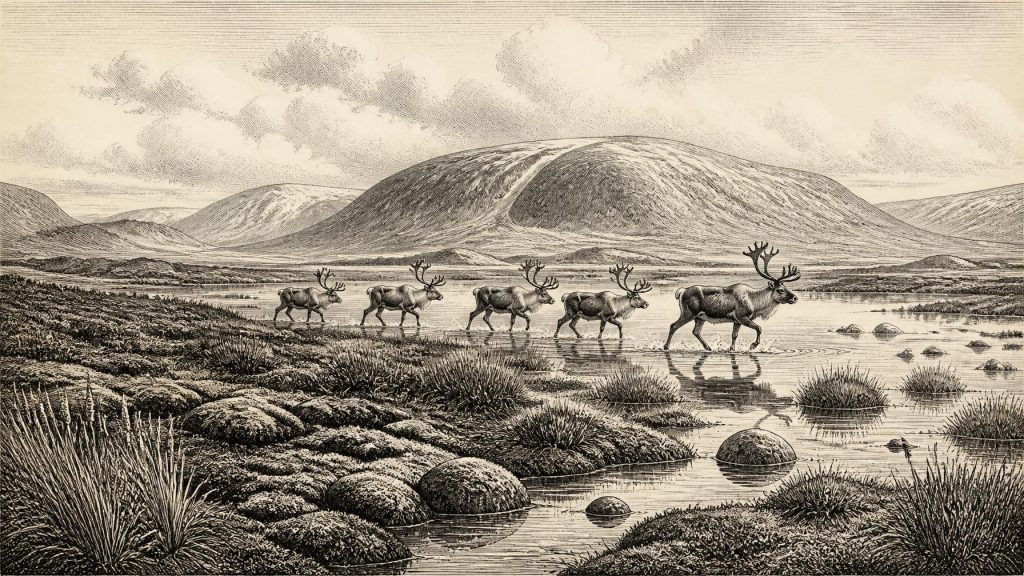
31,444 BCE is not a recordable Irish year but falls within the climatically unstable Late Pleistocene. Deposits beneath a drumlin at Derryvree, County Fermanagh, reveal an ice-free interval containing freshwater sediments, mosses, sedges, aquatic plants, insects and pollen, indicating cold, largely treeless tundra wetland. Later ice buried and eroded much evidence. Castlepook Cave, County Cork, preserves cold-adapted fauna including mammoth, reindeer, giant deer, hyena and lemmings, though its deposits span episodes. A marked reindeer bone may indicate early human butchery, but remains unconfirmed. No secure contemporary settlement, tools, culture or institutions are known; the evidence instead documents a changing landscape.
Dateline
The label 31,444 BCE offers a useful point of orientation, but it cannot denote a recorded Irish year. No written calendar, named community, political event or reliably year-specific human action can be attached to it. In archaeological terms, it falls about 33,394 years before AD 1950, within the Middle Midlandian part of Ireland’s Late Pleistocene and broadly within Marine Isotope Stage 3. Dates this remote are expressed as radiocarbon determinations and calibrated probability ranges, not as anniversaries. The closest illuminating Irish evidence is therefore a set of deposits whose ranges overlap this broad interval, above all the freshwater sediments preserved beneath a drumlin at Derryvree near Maguiresbridge, County Fermanagh.
That distinction matters. A layer can show that mosses grew beside water, insects lived through a summer season, or an animal died in a cave; it cannot ordinarily tell us what happened in a particular calendar year. Around this point in deep time, Ireland was neither the settled island of later prehistory nor a uniform wilderness locked beneath unbroken ice. It was part of a climatically unstable north-west European world in which ice margins, coastlines, vegetation and animal routes repeatedly changed. What survives is fragmentary, but the fragments reveal a cold and locally habitable landscape whose history was later partly buried and scoured by ice.
A Freshwater Window Beneath a Drumlin
In 1969, road cutting at Derryvree exposed a remarkable sequence through a drumlin. A lower till, deposited by glacier ice, lay beneath sands, silts and organic layers; another till sealed the sequence above. Between two advances of ice, therefore, there had been a period in which freshwater accumulated and plants, mosses and insects left remains. The principal radiocarbon determination from the organic deposit was 30,500 +1,170/−1,030 radiocarbon years BP. Modern calibration does not convert this into one simple BCE year: it produces a broad range, and calibration uncertainty is especially important at this age. The deposit is nevertheless directly relevant to the environmental setting around the requested date.
Derryvree’s evidence establishes several things securely. There was locally ice-free ground in south Fermanagh when the organic sediments formed. Water stood or moved slowly enough for fine sediment and plant matter to gather. The fossil assemblage records freshwater mosses, sedges and aquatic plants, including bogbean (Menyanthes trifoliata) and alternate water-milfoil (Myriophyllum alterniflorum). Insects and pollen point to a cold, northern, largely treeless setting. The older description of this environment as a “muskeg” conveys wet, peaty ground dotted with shallow water, rather than a forested lake country.
Interpretation must remain more cautious. The pollen was poorly preserved, and a small quantity of tree pollen does not demonstrate local woodland: grains can travel far on wind or be redeposited. The reasonable picture is of open tundra or tundra-steppe vegetation, interrupted by wet hollows, sedge-rich margins and freshwater pools. Exposed mineral soils, sparse herbs, dwarf shrubs and patches of moss would have made the landscape seasonally varied but difficult. The existence of aquatic plants and insects shows that summers were not uniformly frozen; it does not mean that the climate was mild.
Ireland Before the Greatest Ice Expansion
The wider glacial setting was dynamic. The Last Glacial Maximum, when the British–Irish Ice Sheet attained its most extensive later configuration, belongs mainly to a subsequent interval, broadly after about 29,000 years ago and with major maximum phases later still. At roughly 33,400 calendar years ago, Ireland was already in a cold stage and ice had formed and advanced in parts of the region, but the extent, thickness and timing of every Irish ice margin cannot be fixed at annual resolution. Recent research stresses that the pre-Last Glacial Maximum ice sheet underwent retreat–advance phases during Marine Isotope Stage 3. Derryvree is valuable precisely because it records one local interruption in glacial conditions.
For people living much later, drumlins became familiar components of the Irish landscape. At Derryvree, however, the drumlin is also an archive of destruction and survival. The upper till marks the return of ice that buried the wetland. Across much of Ireland, later glacial erosion removed or disturbed soils, campsites and bones. This helps explain why the island’s record for this era is so thin compared with continental Europe or parts of Britain. Absence of sites is not proof that people never arrived; equally, the scarcity of evidence prevents claims of a continuous population.
Lower sea levels reshaped the continental shelves and reduced some modern sea barriers, while glaciers and cold seas created others. Ireland’s present coastline is therefore a poor guide to routes available in the Late Pleistocene. Large mammals evidently reached the island during suitable phases. Their movements indicate ecological connections with Britain and the wider north-west European mainland, but they do not identify a single land bridge, a particular migration season, or a guaranteed human pathway. Any journey by people would have depended on changing terrain, weather, water crossings and the distribution of food.
The Castlepook Animal World
The strongest complementary evidence comes from Castlepook Cave, also called Mammoth Cave, in the Awbeg Valley near Doneraile, County Cork. Excavations in the early twentieth century recovered Ireland’s principal assemblage of mammals from the last cold stage. The National Museum of Ireland holds material from the cave, including a spotted hyena skull. The recorded fauna includes woolly mammoth, reindeer, giant deer, brown bear, wolf, foxes, mountain hare, lemmings and spotted hyena. Such animals belong to open, cold-adapted environments rather than to the oak and hazel woodlands of much later Ireland.
Castlepook should not be read as a census of one day, one season or one precisely dated landscape. Antiquarian excavation methods and the complex cave deposits mean that bones from different episodes may have been mixed. One mammoth bone produced a radiocarbon age of 33,400 ± 1,200 BP, while the broader cave fauna is generally placed within a long interval of cold-stage occupation by animals, often described as extending from at least about 45,000 to 20,000 years ago. The cave therefore confirms that Ireland could support or receive a varied large-mammal fauna during the Late Pleistocene, but it cannot prove that every listed species was present together in 31,444 BCE.
Nor should dramatic animals obscure the smaller world. Lemmings, hares, mosses, sedges and insects are often more precise indicators of ecological conditions than an isolated large bone. Their presence supports an interpretation of open ground with severe winters and short productive growing seasons. Mammoths and giant deer would have needed extensive forage; reindeer could exploit cold open country; predators and scavengers followed the opportunities provided by herbivore herds and carcasses. The landscape was not empty, but its productivity was sharply seasonal and vulnerable to climatic change.
The Human Question
There is no securely excavated dwelling, hearth, tool assemblage, grave, artwork or settlement from Ireland that can be assigned to this date. Accordingly, there is no basis for describing an Irish tribe, language, religion, leadership, diplomacy, trade network or conflict in 31,444 BCE. There were no states or political institutions evidenced on the island, and nothing supports retrospective ideas of Irish ethnicity, Celtic culture or ancestral kingdoms. The ordinary human categories useful for later periods simply do not fit the evidence.
A reindeer femur from Castlepook has made this silence more intriguing. The bone, from an older collection, has been reported as bearing deep marks consistent with processing by a stone tool and as dating to approximately 33,000 years ago. If the marks are confirmed as anthropogenic and contemporary with the bone, they may represent very early Upper Palaeolithic human activity in Ireland: perhaps the butchery of a reindeer by a small, mobile hunting party. That would be important evidence of a visit or brief occupation, not proof of permanent settlement.
The qualification is essential. The specimen’s original context was not excavated to modern standards, no associated lithic toolkit has been published from the same undisturbed layer, and the claim needs full specialist publication and continuing scrutiny. It is therefore best described as a potentially significant indication of human presence, not as a settled population or an established hunting society. Later evidence from Alice and Gwendoline Cave in County Clare securely demonstrates human butchery of bear in the terminal Pleistocene, many millennia after the period considered here; it cannot fill the earlier gap.
What Cannot Yet Be Written
Economy, in the narrow sense of farming, herding, markets or trade, has no evidence here. Agriculture, domesticated animals, pottery, metallurgy and monuments lay tens of thousands of years in the future. If people did reach Ireland during this cold interval, their subsistence would most plausibly have depended on wild resources, mobility and detailed knowledge of animal behaviour and weather, as elsewhere in Upper Palaeolithic Europe. That is an inference from comparable settings, however, rather than a demonstrated Irish social record.
The same restraint applies to belief and culture. Caves can acquire ritual importance in many periods, but animal bones in Castlepook do not establish ritual practice, storytelling traditions or cave art. No religious structure, symbolic object or personal ornament belongs securely to Ireland at this date. Learning survived, if people were present at all, through skills and memory rather than writing: the recognition of tracks, safe shelter, stone, edible plants, water and changing ice. Yet this remains a human possibility, not archaeological proof.
The most responsible history of Ireland around 31,444 BCE is consequently environmental and conditional. Derryvree documents a cold freshwater wetland between glacial episodes; Castlepook records a wider Ice Age fauna; a marked reindeer bone raises, but does not settle, the possibility of human visitors. Together they replace an imagined blank with a real, changing Pleistocene Ireland. They do not provide a year-by-year chronicle. Their importance lies in showing the ecological stage upon which Ireland’s far later, better documented human histories would eventually unfold.
Primary Sources
- Early Midlandian–Middle Midlandian, Pleistocene, Northern Ireland
- Palaeoecology
- Figure 6.— The subdivision of the Quaternary Period in Ireland
- A Middle Midlandian freshwater series at Derryvree, Maguiresbridge, County Fermanagh, Northern Ireland
- Spotted Hyena Skull
- Ice Age Ireland
- Prehistoric Details
- Castle pook Caves
- The Irish quaternary fauna project
- Pleistocene Vertebrates in the British Isles
- Radiocarbon constraints on the history of the western Irish ice sheet prior to the Last Glacial Maximum
- Dimensions and chronology of the last ice sheet in Western Ireland
- Growth and retreat of the last British–Irish Ice Sheet, 31,000 to 15,000 years ago: the BRITICE-CHRONO reconstruction
- The timing and magnitude of the British–Irish Ice Sheet between Marine Isotope Stages 5d and 2: implications for glacio-isostatic adjustment, high relative sea levels and ‘giant erratic’ emplacement
- The IntCal20 Northern Hemisphere radiocarbon age calibration curve (0–55 cal kBP)
- IntCal Publications
- The colonization of Ireland: A human ecology perspective
- First evidence of a Late Upper Palaeolithic human presence in Ireland
- New insights on the fauna of Ireland’s Younger Dryas and Early Holocene from Alice & Gwendoline Cave
- Quaternary Site Descriptions
- Menyanthes trifoliata
- Myriophyllum alterniflorum
- ESCR Site Summary
- Mesolithic – Iron Age