Mosses Under Maguiresbridge31448 BCE
31,448 BCE is a modern label for a broad Late Pleistocene interval, rather than a recordable Irish year. Sediments beneath Derryvree, County Fermanagh, document an ice-free freshwater wetland during MIS 3, later sealed by advancing ice. Mosses, pollen and insects indicate cold, open, wet, periglacial terrain with local ecological variety. Southern caves, especially Castlepook in County Cork, preserve diverse fauna including reindeer, mammoth, giant deer and predators. A cut-marked reindeer bone may indicate brief human carcass processing, but cannot prove settlement. Before the Last Glacial Maximum, Ireland’s evidence chiefly reveals dynamic environments, scarce archaeological traces, and possible transient human presence.
Dateline
The label 31,448 BCE is a modern chronological convenience, not a year that anyone in Ireland could have named, recorded or experienced as a date. No annual historical narrative can responsibly be written for it. In relation to the conventional radiocarbon reference year of 1950, it lies roughly 33,400 years before present, during the Late Pleistocene and broadly within Marine Isotope Stage 3 (MIS 3), a long, climatically unstable part of the last Ice Age. The evidence is dated in radiocarbon and calibrated ranges, not in calendar years. Its value is therefore not to identify an event on this particular year, but to illuminate the changing environments that existed in parts of Ireland around this broad horizon.
A Time Window, Not a Date
The closest especially informative Irish archive is at Derryvree townland, near Maguiresbridge in County Fermanagh. Road construction in 1969 cut through a drumlin and exposed freshwater silts and fine sands caught between two thick deposits of glacial till. Till is unsorted material laid down by glacier ice. The order of the layers is decisive: ice formed the lower till; an interval without local overriding ice allowed water, sediment and organic remains to accumulate; then a later ice advance sealed the wetland beneath another till.
Organic material from the Derryvree deposits produced a conventional radiocarbon age of 30,500, with a substantial uncertainty of +1,170 and −1,030 years. Radiocarbon ages are not equivalent to calendar ages, particularly so far back in the Pleistocene, when atmospheric carbon levels varied sharply. Published calibration places the horizon broadly between about 36,900 and 31,700 calibrated years before present, approximately 34,950–29,750 BCE. Thus 31,448 BCE lies within the range relevant to the deposit, but it cannot be assigned to a particular pool, season, plant or animal preserved there. Derryvree records an extended environmental phase, not a dated day in Irish history.
Freshwater Beneath the Ice
The Derryvree sequence disproves any simple picture of a permanently ice-covered Ireland. It does not show that every part of the island was ice-free at once, nor that conditions were mild. Rather, it demonstrates that northern Ireland included an ice-free freshwater setting during part of later MIS 3, before renewed glaciation covered it. The survival of such a deposit beneath a drumlin is exceptional: much earlier landscape evidence was eroded, transported or buried by later ice sheets.
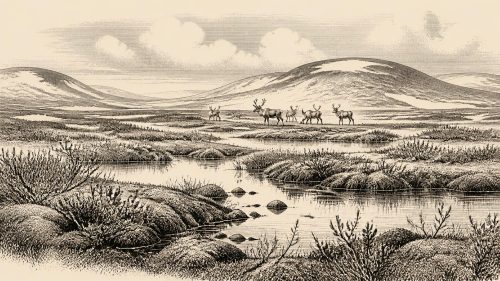
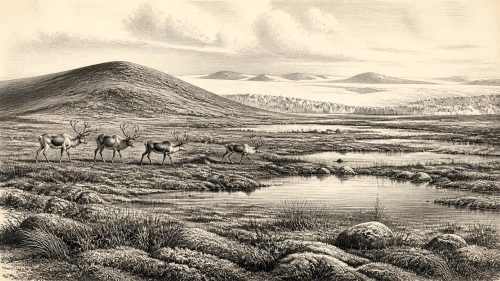
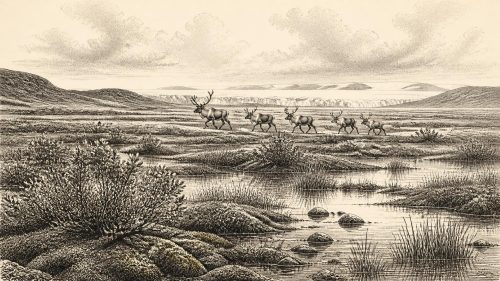
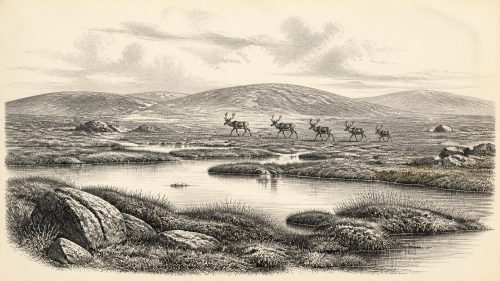
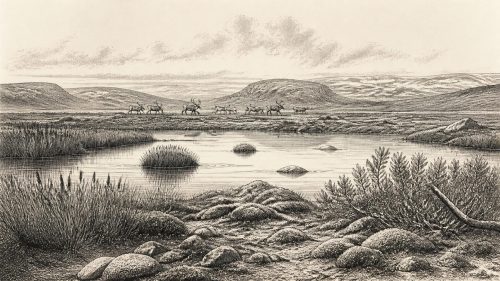
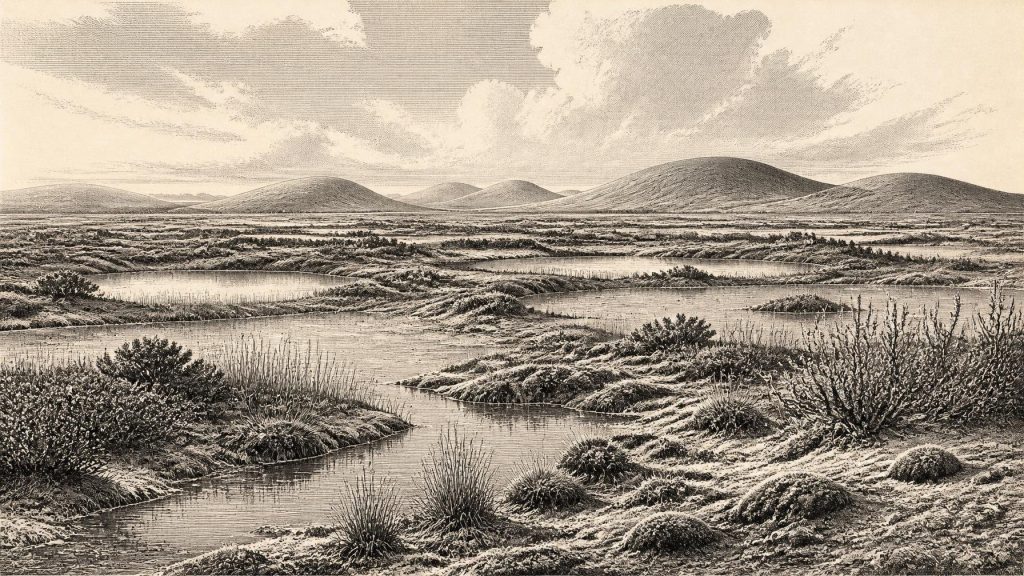
Plant remains, pollen and insects point to an open, treeless landscape with a strong periglacial character. Mosses, sedges, grasses, herbs and low shrubs could exploit damp ground around shallow water, while frost, short growing seasons and exposed terrain restricted the spread of woodland. The insect evidence has been interpreted as consistent with muskeg-like conditions: wet, plant-rich ground and pools, with mossy margins rather than a temperate lakeside woodland. This was a functioning ecosystem, but one shaped by cold and seasonal severity.
The word “tundra” is useful if used cautiously. It conveys an open, cold environment with low vegetation and frozen or seasonally frozen ground, yet the Irish terrain was not a uniform white plain. Watercourses, sheltered hollows, soil moisture and local relief created patches with different resources. The Derryvree deposit preserves freshwater life precisely because it formed where water and organic matter could gather. Its evidence does not permit a complete map of Ireland, but it establishes that parts of the island had ecological variety even amid severe climatic conditions.
Animals on an Open Island
Caves in southern Ireland provide a complementary record. Castlepook Cave near Doneraile, County Cork, long known as Mammoth Cave, produced a remarkable collection of Late Pleistocene animal remains during excavations conducted between 1904 and 1913. Reassessment and improved radiocarbon pretreatment have shown that some specimens from Castlepook and nearby caves are considerably older than earlier determinations suggested. They belong within MIS 3, well before the Last Glacial Maximum that followed.
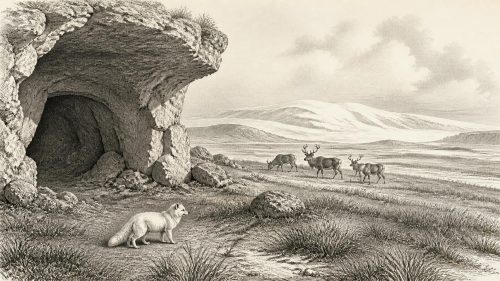
The Castlepook assemblage includes evidence for reindeer, woolly mammoth, giant deer, brown bear, wolf, Arctic fox, mountain hare, lemmings and spotted hyaena. Such a list must not be turned into a single imagined scene. The cave accumulated material over a long interval; different species and individual bones need not have been contemporary. Carnivores could have dragged prey or scavenged carcass remains into the cave, while water movement, excavation practice and later disturbance further complicate the record. Yet the assemblage securely shows that Ireland supported, at different times in this wider period, a far richer cold-stage fauna than the modern island.
Reindeer and mammoth indicate open ground capable of sustaining grazing animals; predators and scavengers indicate food chains rather than isolated wanderers. Spotted hyaena is especially significant because its remains are rare in Ireland and because hyenas often create complex bone accumulations in dens. Giant deer, popularly but misleadingly called “Irish elk”, was not uniquely Irish: it was a widespread Eurasian species. Ireland was therefore part of a changing north-west European ecological zone, although the precise routes by which each animal reached it remain difficult to reconstruct.
The Castlepook Human Question
One Castlepook specimen makes this period unusually important for Irish archaeology: a reindeer femur bearing a deep linear mark identified by zooarchaeologist Ruth Carden as consistent with cutting or chopping by a sharp stone tool while the bone was fresh. County Cork heritage interpretation places the specimen broadly at about 31,000 BCE, and the claim has prompted renewed interest in the possibility of Upper Palaeolithic activity in Ireland.
The interpretation is potentially momentous, but it is not a settled account of an Irish hunting camp. The bone came from an old cave collection rather than a modern excavation of a sealed occupation surface. A radiocarbon measurement dates the animal’s death within a range; it does not independently date the mark, identify its maker, reveal where the animal was killed, or establish how long people remained nearby. Nor are there securely associated stone tools, hearths, shelters, human burials or repeated occupation layers of comparable age at Castlepook. The bone may record a brief human encounter with a reindeer carcass; it cannot demonstrate permanent settlement or continuous occupation.
This distinction between evidence and interpretation matters. The physical evidence is the bone, its modification, its museum context and the wider faunal chronology. The inference is that one or more people used a stone edge in carcass processing. A further inference—that mobile hunters entered Ireland in pursuit of reindeer—is plausible in the wider Upper Palaeolithic world, but remains unproven locally. The reindeer’s remains could also have entered the cave through carnivore activity after the original butchery.
People, Society and Silence
There is no evidence from Ireland around this broad date for states, kings, territories, formal political institutions, diplomacy, warfare, trade routes or named communities. There is likewise no securely dated Irish monument, burial, cave art panel, ornament workshop, house floor or learning tradition from which religious life or social hierarchy can be reconstructed. Absence of evidence is not proof that any visitors lacked beliefs, language, kinship ties or practical knowledge. Upper Palaeolithic peoples elsewhere in Europe possessed sophisticated technologies and cultural traditions. But evidence from France, Britain or central Europe cannot simply be imported into Ireland to fill a compelling silence.
If people did enter Ireland during MIS 3, their survival would have depended on accumulated environmental knowledge: reading animal movements, finding water and shelter, handling stone, sharing food and navigating dangerous weather. Those are reasonable general implications of cold-climate mobility, not details recovered from an Irish camp. No population size can be estimated. No language can be named. No exchange in flint, hides, antler or meat can be traced. The economic history of Ireland at this point is therefore ecological rather than commercial: the availability of grazing, freshwater, seasonal plant growth and animal carcasses determined what any human visitor might have been able to do.
Before the Great Expansion of Ice
The date also falls before the maximum extent of the last British–Irish Ice Sheet, generally placed later, around 27,500–19,000 years ago, with major Irish Sea advances occurring around 27,000–25,000 years ago. Ice growth was neither instantaneous nor identical across the island. The Derryvree freshwater sediments and southern cave fauna are reminders that the build-up to the Last Glacial Maximum involved shifts between ice advance, ice-free ground, changing drainage and altered habitats. Later glaciation would scour and rearrange many earlier deposits, helping to explain the extreme scarcity of archaeological traces.
For Ireland around 31,448 BCE, then, the most defensible history is one of environmental possibility rather than a known human story. Beneath a Fermanagh drumlin, mosses, freshwater sediment and insect remains preserve evidence of a cold wetland. In Cork caves, bones preserve evidence of animals moving through an open Ice Age landscape. A marked reindeer femur raises the prospect of a fleeting human presence, but not yet of a settled population. These fragments are modest, yet they are historically important: they show that deep prehistoric Ireland was dynamic, inhabited by resilient ecosystems, and still only partly recoverable from beneath the work of ice.
Primary Sources
- A Middle Midlandian Freshwater Series at Derryvree, Maguiresbridge, County Fermanagh, Northern Ireland
- A Reconsideration of the Radiocarbon Dating of the Marine Isotope Stage 3 Fauna from Southern Ireland
- The Irish Quaternary Fauna Project
- Phylogeographic, Ancient DNA, Fossil and Morphometric Analyses Reveal Ancient and Modern Introductions of a Large Mammal: The Complex Case of Red Deer (Cervus elaphus) in Ireland
- First Evidence of a Late Upper Palaeolithic Human Presence in Ireland
- The Colonization of Ireland: A Human Ecology Perspective
- Ireland: Submerged Prehistoric Sites and Landscapes
- Heritage Artefacts of County Cork
- The Archaeological Heritage of County Cork
- 32564: Castlepook Cave, Cork
- IQUA Field Guide 16: Derryvree and Maguiresbridge
- IQUA Field Guide 17: Regional Pleistocene Geology
- Advance and Retreat of the Marine-Terminating Irish Sea Ice Stream into the Celtic Sea During the Last Glacial: Timing and Maximum Extent
- Maximum Extent and Readvance Dynamics of the Irish Sea Ice Stream and Irish Sea Glacier Since the Last Glacial Maximum
- The Evolution of the Terrestrial-Terminating Irish Sea Glacier During the Last Glaciation
- Timing and Pace of Ice-Sheet Withdrawal Across the Marine–Terrestrial Transition West of Ireland During the Last Glaciation
- Radiocarbon Constraints on the Age of the Maximum Advance of the British–Irish Ice Sheet in the Celtic Sea
- Exposure-Age Constraints on the Extent, Timing and Rate of Retreat of the Last Irish Sea Ice Stream
- New Insights on the Fauna of Ireland's Younger Dryas and Early Holocene from Alice & Gwendoline Cave
- Our Ancient Landscapes: Hunter-Gatherers in Ireland