
Castlepook’s Hyena Coprolites31286 BCE
About 33,235 years ago, during Marine Isotope Stage 3, Ireland experienced fluctuating cold conditions rather than a single climate. At Derryvree, County Fermanagh, freshwater sediments between glacial tills preserve evidence of open tundra, wet muskeg, pools, mosses and cold-adapted life during an ice-free interval. Crag Cave records episodic milder phases. Castlepook Cave, County Cork, yielded abundant remains of mammoth, giant deer, reindeer, bears, hyaenas and other Ice Age animals; coprolites and crushed bones indicate hyaena denning. Faunal evidence shows intermittent European connectivity, though routes remain uncertain. No secure evidence demonstrates human settlement then; Ireland’s earliest accepted human activity dates later.
Dateline
There is no responsible way to describe an event that happened in a calendar year called 31,286 BCE. This label is a modern backward projection, not a date used by anyone then, and the evidence is nowhere near precise enough to distinguish one year from the next. In relation to 1950, the conventional reference point for radiocarbon dating, it falls about 33,235 years ago. The most useful Irish evidence belongs to broad calibrated ranges of thousands of years. Ireland at this horizon lay within the Late Pleistocene, specifically Marine Isotope Stage 3 (MIS 3), in the long cold interval traditionally called the Midlandian in Ireland.
The nearest securely relevant environmental sequence is not an annal but a buried deposit at Derryvree, near Maguiresbridge in County Fermanagh. Organic freshwater silts and fine sands there returned a radiocarbon age of about 30,500 BP. Using modern calibration, the deposit is placed broadly at c. 36,900–31,700 calibrated years BP. The modern year-label 31,286 BCE therefore falls within that range, but this does not mean that the Derryvree sediments record that precise year. They document a phase of environmental conditions, accumulated over time, before a later ice advance covered the locality.
A Landscape Between Ice Advances
Derryvree was exposed in a road cutting through a drumlin in 1969. Its importance lies in its simple but powerful stratigraphy: freshwater sediments lay between two thick layers of till, the unsorted material deposited by glacier ice. The lower till proves that ice had previously occupied the area; the organic middle layer shows that the place was later free of local ice long enough for water, sediment and living communities to develop; the upper till shows renewed glaciation. This is evidence for a changing Ice Age landscape, not for uninterrupted warmth or for an Ireland wholly free of ice.
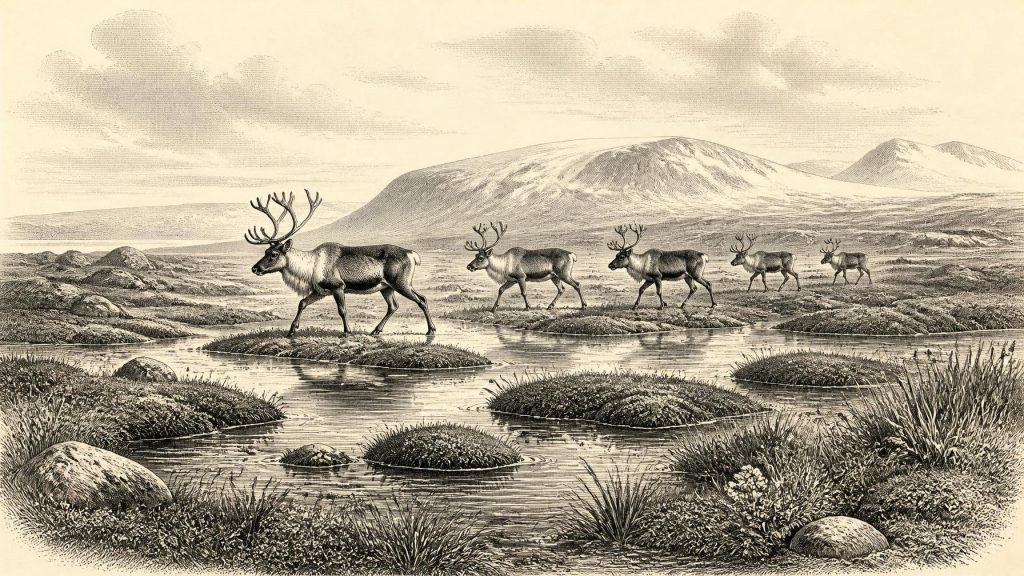
The plants, mosses, insects and other remains in the middle layer point to open tundra and wet muskeg rather than woodland. Shallow pools and waterlogged, plant-rich ground were bordered by mossy vegetation. Botanical evidence includes cold-adapted species such as mountain avens, while insect remains reinforce the picture of a severe periglacial setting. Summers could sustain liquid water, growing plants and insects; winters were harsh. In modern terms, it was a treeless northern landscape, but one with ecological variety at the scale of pools, sedge margins, exposed mineral ground and damp peat.
Such conditions should not be imagined as a single unchanging freeze. Greenland ice cores reveal abrupt climatic oscillations during the last glacial period, and Irish evidence registers their local consequences imperfectly. At Crag Cave in County Kerry, uranium-thorium dating of calcite formations shows that speleothems grew episodically during MIS 3. Because shallow-cave calcite needs infiltrating liquid water and conditions generally above freezing, these growth episodes indicate intervals of climatic amelioration. They cannot date Derryvree or Castlepook year by year, but together they show that Ireland’s Atlantic-edge climate could shift sharply between more and less favourable phases.
Animals at Castlepook
For animal life close to this broad horizon, Castlepook Cave near Doneraile, County Cork, is indispensable. Also known as Mammoth Cave, its narrow limestone galleries were investigated extensively in the early twentieth century. More than 2,000 bones have been recovered, making it Ireland’s richest known repository of vertebrate remains from before the Last Glacial Maximum. The collection includes woolly mammoth, giant deer, reindeer, brown bear and spotted hyaena, as well as wolf, Arctic fox and lemmings from parts of the wider Ice Age sequence.
Its evidence must nevertheless be read cautiously. A cave is not a census of the surrounding countryside. Carnivores can drag prey or carrion underground; animals can die in caves; water can redeposit bones; and early excavation techniques did not meet modern standards. Castlepook’s deposits were also disturbed by water. The presence of bones proves that particular animals reached, used, or were introduced into the cave system during parts of the period represented; it does not establish their population sizes, a stable community existing all at once, or a particular scene in 31,286 BCE.
The spotted hyaena is especially revealing. Historic excavators found crushed bone and fossil dung, or coprolites, in chambers they named Hyenahall and Elephant Hall. These are strong indications that hyaenas used areas of the cave as dens or feeding places. Reindeer remains were abundant, and the pattern is consistent with hyaenas transporting animal parts into shelter. Yet even here interpretation has limits: the cave accumulated material through repeated episodes. It supports the conclusion that a formidable bone-processing predator lived in southern Ireland during MIS 3, not a claim that every mammoth, deer and hyaena bone belonged to one encounter.
Modern re-dating has sharpened this warning. Improved pretreatment of bone samples produced Castlepook dates substantially older than some earlier measurements, placing parts of the fauna firmly within MIS 3. The results suggest that giant deer and spotted hyaena may have disappeared locally before the Last Glacial Maximum, perhaps around 40,000 calibrated years BP. A 2026 sedimentary ancient-DNA study from Castlepook has added promising evidence of wider Eurasian connections among Irish mammoths, hyaenas and bears. It remains a preprint rather than a peer-reviewed final publication, so its detailed conclusions should be treated as provisional; its chief value here is to underline how much the cave’s old sediments can still reveal.
Access to an Atlantic Peninsula
At this time Ireland’s geography differed markedly from today’s, because global sea level was lower during the Ice Age and glaciers repeatedly reshaped the coasts and adjacent seas. It is tempting to turn the mammal record into a simple story of a dry land bridge from Britain, but the evidence does not justify a precise route for this date. Animals evidently reached Ireland at various times in the Late Pleistocene. Whether they moved across exposed ground, temporary northern links, ice-associated corridors, short sea crossings, or combinations of these depends on changing sea level and ice geometry. The timing and nature of any connection remain matters for geological reconstruction, not certainty.
What can safely be said is that Ireland was not an ecological world wholly cut off from north-western Europe. The Castlepook fauna, including wide-ranging herbivores and predators, indicates intermittent faunal connectivity before the major expansion of the British–Irish Ice Sheet. Ireland was probably a peripheral, environmentally volatile part of a wider north-west European zone rather than a permanent refuge. This was not yet the full Last Glacial Maximum: large-scale reconstructions place the British–Irish Ice Sheet’s greatest volume around 23,000 years BP, later than the Derryvree interval. But ice growth was already complex, regional and capable of erasing much earlier surface evidence.
No Human Society Demonstrated
The central historical restraint is that no securely dated human settlement, hearth, stone-tool assemblage or human burial is known from Ireland at c. 33,235 calibrated years BP. Nor does the Castlepook fauna prove human hunting. One reindeer bone from the wider Castlepook material has been argued to bear a stone-tool cutmark and has featured in discussion of a possible very early human presence. That claim deserves continued testing, but a single modified bone without an associated occupation surface cannot demonstrate a resident population, its identity, its technology or its social life.
The earliest well-dated evidence for human activity presently accepted in Ireland is much later: cutmarks on a brown-bear patella from Alice and Gwendoline Cave in County Clare date to roughly 12,810–12,590 calibrated years BP. This terminal-Pleistocene discovery is important precisely because it illustrates the gap. Upper Palaeolithic people certainly lived elsewhere in Europe at the time of the Derryvree and Castlepook evidence, but their presence in Ireland around 31,286 BCE remains unproven. Absence of evidence is not proof that no exploratory visit ever occurred; it is, however, decisive against writing a human narrative as fact.
What Cannot Be Recovered
Consequently there is no evidence-based account of political affairs, diplomacy, warfare, kinship groups, language, ritual, art, formal learning, trade or permanent settlement in Ireland for this date. There were no states, named peoples or recorded leaders to identify. Even if people briefly entered the island, the material record currently cannot distinguish their choices from those of predators, scavengers, water or later disturbance. It would be misleading to assign them huts, clothing styles, beliefs, trading partnerships or conflicts merely because such things are known from Upper Palaeolithic societies elsewhere.
There is, however, a meaningful Irish history here: the history of a land repeatedly opened, occupied by life and transformed by ice. Derryvree preserves a wet tundra ecosystem between glacial episodes. Castlepook preserves the fragmentary remains of mammals, including hyaenas that left their own unmistakable traces in a Cork cave. Crag Cave records periods when water once again dripped through limestone and deposited calcite. These are not substitutes for lost human stories. They are the harder, stranger evidence from which any responsible account of Ireland around 31,286 BCE must begin.
Primary Sources
- A Middle Midlandian Freshwater Series at Derryvree, Maguiresbridge, County Fermanagh, Northern Ireland
- A reconsideration of the radiocarbon dating of the Marine Isotope Stage 3 fauna from southern Ireland
- Castlepook Cave: Cork County Geological Site Report
- Spotted Hyena Skull
- Episodic speleothem deposition tracks the terrestrial impact of millennial-scale last glacial climate variability in SW Ireland
- Growth and retreat of the last British–Irish Ice Sheet, 31,000 to 15,000 years ago: the BRITICE-CHRONO reconstruction
- Pattern and timing of retreat of the last British-Irish Ice Sheet
- Early deglaciation of the British-Irish Ice Sheet on the Atlantic shelf northwest of Ireland driven by glacioisostatic depression and high relative sea level
- Exploring controls of the early and stepped deglaciation on the western margin of the British Irish Ice Sheet
- The problem of a late quaternary landbridge between Britain and Ireland
- First evidence of a Late Upper Palaeolithic human presence in Ireland
- New insights on the fauna of Ireland's Younger Dryas and Early Holocene from Alice & Gwendoline Cave
- Sedimentary ancient DNA reveals Late Pleistocene faunal connectivity between Ireland and Eurasia
- The IntCal20 Northern Hemisphere Radiocarbon Age Calibration Curve (0–55 cal kBP)
- A stratigraphic framework for abrupt climatic changes during the Last Glacial period based on three synchronized Greenland ice-core records: refining and extending the INTIMATE event stratigraphy
- The Irish Quaternary Fauna Project
- Preliminary assessment of the archive of faunal remains from excavated Irish cave sites
- CASTLEPOOK CAVE, Castlepook South, Cork: Excavations 2022
- Castlepook Caves
- Figure 6.— The subdivision of the Quaternary Period in Ireland
- Maximum extent and dynamic behaviour of the last British–Irish Ice Sheet west of Ireland
- Ireland: Submerged Prehistoric Sites and Landscapes