The Derryvree Freshwater Lens31326 BCE
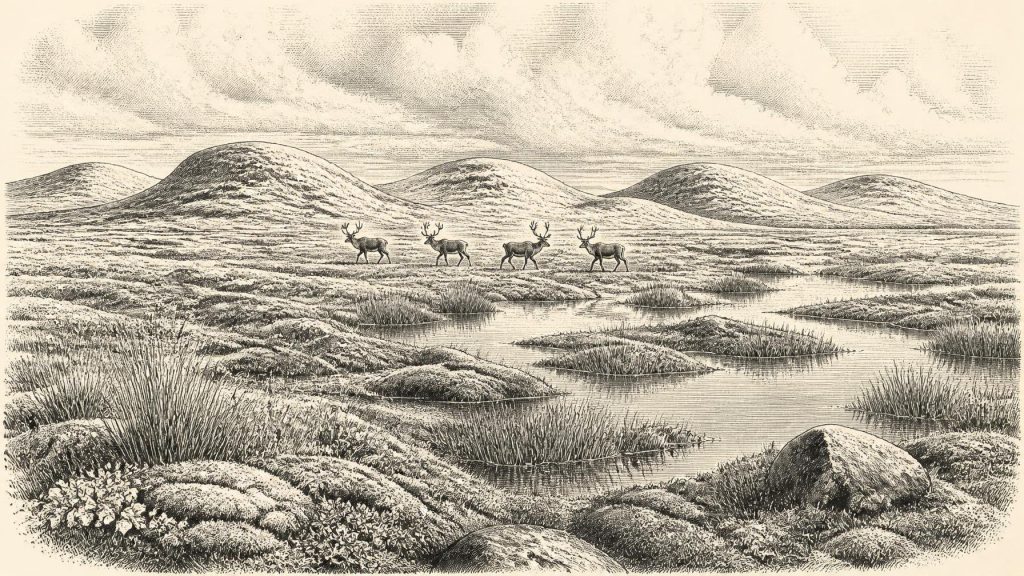
31,326 BCE is a modern label for later Marine Isotope Stage 3, not a recoverable Irish year. Derryvree, County Fermanagh, preserves freshwater sediments between tills, indicating an ice-free, cold tundra wetland during a broadly dated interval. Castlepook Cave, County Cork, contains MIS 3 remains of reindeer, mammoth, hyaena and other open-country fauna, although disturbed deposits prevent a single ecological snapshot. A cut-like mark on a reindeer femur may indicate early human butchery, but remains contested and cannot prove settlement. Glaciation and changing sea levels obscured evidence. Secure Irish human presence is far later; permanent society is unproven for this period.
Dateline
31,326 BCE is a modern numerical label, not a date that can be recovered as a named year from Ireland’s archaeological record. It corresponds approximately to 33,275 years before AD 1950, the conventional reference point for “cal BP” dating. At such depth in time, even the best evidence normally describes intervals of centuries or millennia. No excavated Irish settlement, burial, tool assemblage or historical tradition can responsibly be assigned to this particular year. The proper subject is therefore Ireland during the later part of the Last Ice Age: a changing, sparsely documented land known through cave bones, buried wetland sediments, pollen, insects, mineral deposits and the traces left by glacier ice.
This was within Marine Isotope Stage 3 (MIS 3), a long, climatically unstable phase of the Late Pleistocene, conventionally spanning roughly 57,000 to 29,000 years ago. Greenland ice-core chronologies show that northern climates could change sharply between cold stadials and relatively milder interstadials. Around the notional date represented by 31,326 BCE, those wider records place north-west Europe close to one of these rapid transitions. They do not, however, provide a weather report for a particular Irish valley, nor do they make it possible to date an Irish animal, pool or human visit to a single calendar year.
A Landscape Preserved Between Ice Sheets
The most illuminating Irish environmental evidence for this broad period comes from Derryvree, near Maguiresbridge in County Fermanagh. Roadworks in 1969 cut through a drumlin, exposing a remarkable sequence: freshwater silts, fine sands and organic layers lay between two thick deposits of till, the unsorted debris deposited by glacier ice. The order of those layers is crucial. An earlier glacier had crossed the district and laid down the lower till. In a subsequent ice-free interval, water collected and sediment, plants and small animals accumulated. Later ice advanced again and sealed the wetland beneath a new cover of till.
Organic material from the Derryvree deposit produced a conventional radiocarbon determination of 30,500 14C years BP, with a substantial uncertainty of +1,170 and −1,030 years. Such a result is not identical to a calendar age: radiocarbon years must be calibrated against internationally maintained curves that account for past variation in atmospheric carbon-14. Given the original uncertainty and the changing shape of the calibration curve at this depth in time, Derryvree should be placed broadly within later MIS 3 rather than treated as an event fixed to 31,326 BCE. Its importance is environmental, not annalistic.
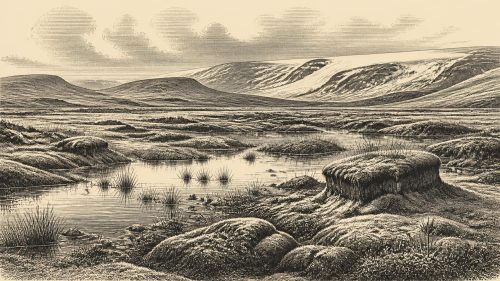
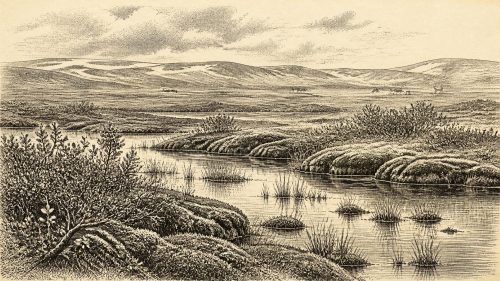
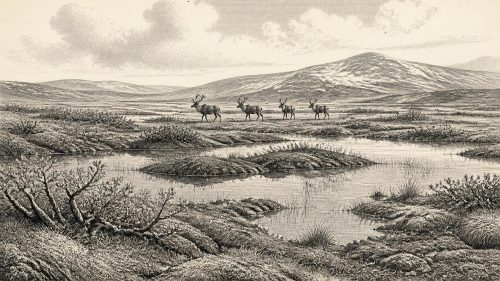
The plant and animal remains nevertheless provide a striking picture. Pollen was poorly preserved, but the surviving record was dominated by herbaceous plants associated with tundra. Mosses and other macrofossils, together with insect remains, point to a cold, waterlogged, periglacial setting: open vegetation, wet hollows, shallow pools and frost-affected ground rather than forest. Small patches of willow or other low shrubs may have found shelter where local conditions allowed, but there is no evidence for the wooded Ireland familiar from much later prehistory. A short growing season could still support mosses, sedges, aquatic plants and invertebrates, creating a functioning food web in a harsh landscape.
Cork’s Ice-Age Fauna
In southern Ireland, Castlepook Cave near Doneraile, County Cork, supplies the richest known concentration of mammal remains from before the Last Glacial Maximum. The cave was excavated principally between 1904 and 1913 under the direction of the naturalist Richard J. Ussher. Its galleries acquired evocative names including Elephant Hall and Hyenahall, reflecting the extraordinary bones found within them. Much material was removed before modern excavation standards existed, and fewer than 2,000 of the original tens of thousands of recorded bones are thought to survive. That damaged context is an enduring limitation on every conclusion drawn from the collection.
Even so, modern re-dating and zooarchaeological study have confirmed that part of the Castlepook fauna belongs to MIS 3. Its animals included reindeer, woolly mammoth, giant deer, brown bear, wolf, Arctic fox, mountain hare, collared lemming, Norwegian lemming and spotted hyaena. The National Museum of Ireland’s Castlepook hyaena skull is especially useful in countering modern assumptions about the island’s fauna: hyaenas, now associated principally with Africa, ranged into Ireland during parts of the Pleistocene. Mammoth, reindeer and lemmings likewise indicate an environment far colder and more open than the modern Irish countryside.
These fossils do not mean that all of those species shared one meadow, one season or one generation. Cave assemblages can form through carnivores dragging in prey, animals dying naturally, water moving bones through passages, roof collapse and later excavation disturbance. Individual specimens can be directly dated, but the collection as a whole accumulated across a long interval. New ultrafiltration methods have shown that some older radiocarbon results were thousands of years too young, an important reminder that scientific improvement can alter Ireland’s deep chronology. Castlepook is best understood as evidence for recurring animal presence and ecological connectivity, not as a snapshot of one lost day.
The Reindeer Femur Question
The possibility of human activity makes Castlepook unusually significant. A reindeer femur from the cave carries a deep linear alteration that zooarchaeologist Ruth Carden has interpreted as a mark made by a sharp stone implement on fresh bone. Public accounts have associated the specimen with an age of roughly 33,000 years. If the modification was made by a person at the time the animal was processed, it could represent an exceptionally early human visit to Ireland, vastly earlier than the securely dated terminal-Pleistocene evidence from Alice and Gwendoline Cave in County Clare.
That implication must be expressed carefully. The bone dates the life and death of a reindeer, not automatically the making of the mark. Nor was it recovered from a modern, intact excavation containing an associated hearth, stone-tool assemblage, shelter floor, human remains or repeated occupation deposits. A single groove must be assessed against damage caused by carnivores, sediment movement, trampling, breakage, weathering and excavation. The early twentieth-century removal of Castlepook’s deposits also makes reconstruction of its original layers exceptionally difficult.
Consequently, the femur is important possible evidence of Palaeolithic butchery, not proof of a settled Irish population in 31,326 BCE. The presently secure evidence for people in Ireland is much later: a butchered brown-bear patella from Alice and Gwendoline Cave has calibrated ranges of 12,810–12,590 and 12,810–12,685 cal BP. That later find demonstrates human presence during the terminal Pleistocene, but it cannot validate every earlier claim. Nor can the Castlepook femur identify its possible makers as Aurignacian, Gravettian or any other continental archaeological tradition, because Ireland has yielded no diagnostic tool kit from this earlier horizon.
People, Politics and Everyday Life
There is no evidence for political communities, leaders, territories, diplomacy, warfare or formal institutions in Ireland at this date. There are no houses, villages, graves, monuments, inscriptions, ornaments or images that can be assigned to it. It would be misleading to fill that silence with imagined Ice-Age clans. Likewise, there is no direct Irish evidence for religious practice, teaching, trade networks or artistic production around 31,326 BCE.
Interpretation can go only a little further. If people did reach Ireland during an ice-free window, they were more likely to have been highly mobile hunter-gatherers than permanent colonists. Elsewhere in Upper Palaeolithic Europe, people used stone, bone and organic materials and organised their movements around seasonal resources. But Ireland has not produced the objects needed to transfer that picture wholesale to Castlepook. At most, the disputed reindeer mark is compatible with a brief episode of carcass processing. It cannot reveal the size of a group, the length of a stay, the route taken or whether anyone returned.
Changing Routes and Vanishing Evidence
Faunal movement into Ireland shows that, at intervals, the island was not ecologically isolated from the wider north-west European world. Lower sea levels, shifting coastlines, ice margins and perhaps temporary northern connections or short sea passages all affected possible routes. Exactly how animals, and any people, crossed remains debated. The Irish Sea was not simply today’s map with the water removed: crustal depression beneath ice, local relative sea level and advancing glaciers all shaped a complex and changing geography.
The approach of the Last Glacial Maximum would soon transform that geography again. Large parts of Ireland were eventually overridden by the British–Irish Ice Sheet, which eroded earlier deposits and buried others beneath till. This helps explain why the record is so fragmentary. Derryvree survived because it was sealed between glacial deposits; Castlepook survived because limestone caves protected some bones; countless open-air sites, if they ever existed, may have been destroyed or now lie beneath marine sediments.
For 31,326 BCE, then, Ireland’s most responsible history is not a tale of rulers or events. It is a history of tundra pools beneath a Fermanagh drumlin, of reindeer and hyaenas in the limestone country near Doneraile, and of a single contested mark on bone. Together these remains show that Ice-Age Ireland could support varied life during favourable intervals. They do not yet show that it had a permanent human society. The distinction between those two conclusions is the central fact of this very early Irish past.
Primary Sources
- The exploration of Castlepook Cave, County Cork
- The Irish Quaternary Fauna Project
- A reconsideration of the radiocarbon dating of the Marine Isotope Stage 3 fauna from southern Ireland
- New insights on the fauna of Ireland's Younger Dryas and Early Holocene from Alice & Gwendoline Cave
- A Middle Midlandian Freshwater Series at Derryvree, Maguiresbridge, County Fermanagh, Northern Ireland
- Castlepook Cave
- Spotted Hyena Skull
- Archaeological Heritage of County Cork
- Archaeology Research Excavation Grant 2022: Castlepook Cave Final Report
- 2022:564 – Castlepook Cave, Castlepook South, Cork
- Growth and retreat of the last British–Irish Ice Sheet, 31,000 to 15,000 years ago: the BRITICE-CHRONO reconstruction
- Dimensions and chronology of the last ice sheet in Western Ireland
- Trimlines, blockfields and the vertical extent of the last ice sheet in southern Ireland
- Episodic speleothem deposition tracks the terrestrial impact of millennial-scale last glacial climate variability in SW Ireland
- Spatio-temporal dynamics of speleothem growth and glaciation in the British Isles
- The IntCal20 Northern Hemisphere Radiocarbon Age Calibration Curve (0–55 cal kBP)
- IntCal
- The Greenland Ice Core Chronology 2005, 15–42 ka. Part 1: constructing the time scale
- Consistently dated Atlantic sediment cores over the last 40 thousand years
- The problem of a late quaternary landbridge between Britain and Ireland
- Deglaciation, Earth crustal behaviour and sea-level changes in the determination of insularity: A perspective from Ireland
- Ireland: Submerged Prehistoric Sites and Landscapes