
BIRM-166’s Sedge Waters31289 BCE
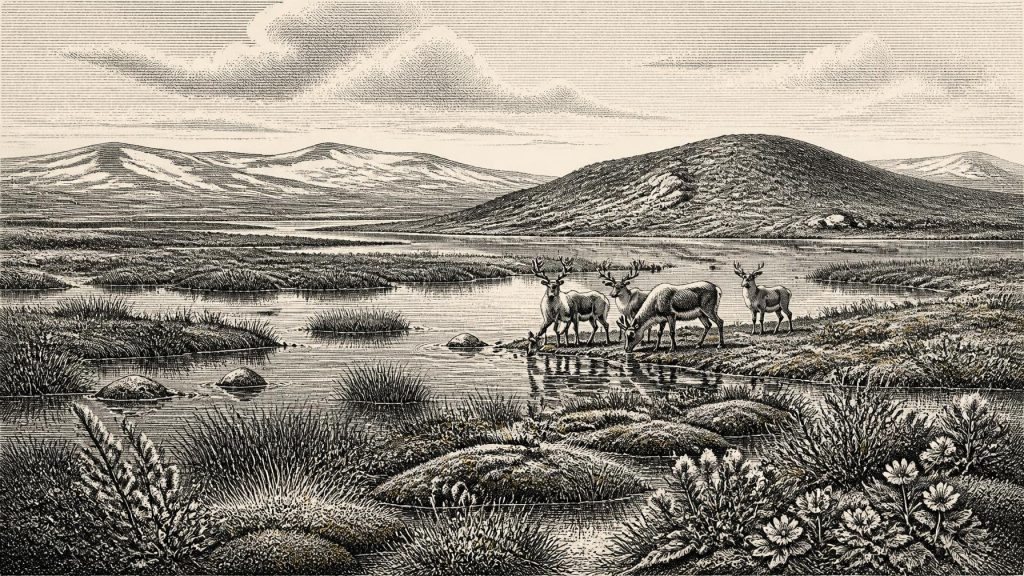
Around 31,289 BCE, Ireland’s history is reconstructed from uncertain Pleistocene environmental evidence, not recorded events. Derryvree in Fermanagh preserves organic freshwater sediments between glacial tills, indicating a cold, treeless, periglacial wetland with sedges, mosses, aquatic plants and seasonal frost. Comparable northern deposits demonstrate repeated ice advances and ice-free intervals. Castlepook Cave in Cork yielded MIS 3 fauna, including reindeer, mammoth, giant deer and hyaena. A possibly cut-marked reindeer bone suggests human carcass processing, but does not prove settlement. No identifiable societies, institutions, beliefs or continuous human occupation can be established; the evidence securely depicts a changing, wildlife-rich Ice Age landscape.
Dateline
The label “31,289 BCE” is a modern numerical convenience, not a date at which Irish archaeology can identify a particular event, season, individual or community. No calendar, writing or year-by-year record existed in Ireland at this depth of time. In radiocarbon terms it lies roughly 33,238 years before AD 1950, within the later Pleistocene and Marine Isotope Stage 3 (MIS 3). The responsible historical frame is therefore a wide calibrated interval, not a single year. The most useful Irish evidence comes from deposits and animal remains whose dates have uncertainties measured in centuries or millennia, and whose interpretation has sometimes changed as methods have improved.
An Ice-Age Interval, Not a Recorded Year
At this point Ireland was far from the familiar green, wooded island of later prehistory. It had not yet reached the Last Glacial Maximum, the cold peak during which the last Irish Ice Sheet expanded across much of the island, conventionally placed around 26,500–19,000 years ago. Yet it was already part of a volatile North Atlantic world in which temperatures, sea level, vegetation and the margins of ice sheets changed repeatedly. Climate shifts recorded in Greenland ice cores were rapid on geological timescales, while Irish cave deposits show that comparatively milder episodes could allow liquid water to circulate through shallow karst systems before colder phases returned.
That does not mean that all of Ireland was mild, habitable or ice-free at once. Conditions varied by region, altitude, exposure and proximity to ice. The dated evidence is patchy, and much of the landscape has been eroded, buried or reworked by later ice. Still, Irish stratigraphy rules out the simplest picture of an island continuously sealed beneath unbroken ice throughout the whole late Pleistocene. Around the broad horizon represented by 31,289 BCE, Ireland contained changing combinations of cold open ground, wetlands, lake or pool margins, cave systems, exposed rock and advancing or retreating ice.
Derryvree Between the Tills
The strongest local guide is Derryvree, near Maguiresbridge in County Fermanagh. Road works in 1969 cut through a drumlin and revealed organic silts and fine sands lying between two substantial tills: deposits left by separate episodes of glacial ice. That order of layers is crucial. It demonstrates an interval in which freshwater sediment and organic matter accumulated after one ice advance and before another. The deposit received the laboratory designation BIRM-166 and a conventional radiocarbon determination of 30,500 years BP, with a large uncertainty of roughly a thousand years either side.
When calibrated, that legacy measurement corresponds only broadly to approximately 36,900–31,700 calendar years BP. The nominal date of 31,289 BCE falls within the outer reach of this kind of chronology, but it cannot be presented as the date when the Derryvree pool formed, when a particular plant flowered, or when ice returned. Calibration converts a radiocarbon measurement into a probability range using independently constructed atmospheric curves; it does not create annual precision where none survives. Moreover, later reviews of Irish glacial chronology have rightly urged caution when using older radiocarbon assays as exact constraints. The evidence is powerful for sequence and environment, less so for a pinpointed date.
The plants and insects preserved at Derryvree nevertheless give the interval an unusually vivid character. Pollen, seeds, moss remains and beetle evidence indicate a treeless, cold-climate freshwater and muskeg setting rather than forest. Sedges and grasses were important, alongside plants suited to open northern ground and wet margins, including bogbean, mountain-avens, willow and lesser clubmoss. Fossil water-milfoil and other aquatic signals indicate standing or slow-moving fresh water. Mossy ground rich in decaying vegetation surrounded pools. This was not a barren white desert, but neither was it later Ireland’s leafy countryside: it was a strongly seasonal tundra-wetland mosaic under periglacial conditions.
Cold Ground and Living Water
Periglacial does not simply mean “near ice”. It describes a landscape shaped by severe cold, repeated freezing and thawing, sparse or low vegetation and ground processes such as frost action and solifluction. At Derryvree, the coexistence of freshwater organisms with cold-adapted terrestrial vegetation shows why such environments should not be imagined as lifeless. During favourable parts of the year, shallow pools, saturated mosses and sedge beds could support abundant small-scale ecological activity. In winter, however, the same setting may have been exposed to deep frost, snow cover, frozen soils and harsh winds.
Comparable evidence in Fermanagh adds regional context without making Derryvree a proxy for the whole island. Organic deposits at Hollymount, Greenagho and Aghnadarragh also record non-glacial intervals between or beneath till sheets. Their dates and correlations are not all equally secure, but collectively they show that northern Ireland experienced more than one cold, open, partly ice-free phase during the Midlandian, the Irish name traditionally used for the last glacial cycle. These archives preserve a history of environmental oscillation: ice advance, open-ground or wetland conditions, then renewed ice, rather than a single uninterrupted descent into the Last Glacial Maximum.
Castlepook’s Animal Record
County Cork provides a different sort of evidence. Castlepook Cave, near Doneraile, has long yielded an important but complicated assemblage of Pleistocene animal bones. Research on the cave’s fauna, aided by improved radiocarbon pretreatment, has shown that several earlier dates required revision and that some remains are substantially older than once believed. The assemblage establishes the presence in southern Ireland of large mammals during MIS 3, including reindeer, giant deer, mammoth and spotted hyaena. These animals did not necessarily occupy the cave together, or in the same generation. Cave deposits are accumulations, not photographs of one day.
The animals nonetheless help define the kind of country that existed somewhere within reach of the cave. Reindeer point to open, cold landscapes with seasonal grazing; mammoth and giant deer also belong to a late Pleistocene fauna unlike that of historic Ireland. Spotted hyaenas could carry and modify carcass parts, a reminder that bone concentrations may result from predators and scavengers as well as natural deaths, water movement, collapse or excavation disturbance. Castlepook was therefore part of a food web, but the precise geography of its herds, hunting grounds and seasonal routes cannot be reconstructed from the cave alone.
A reindeer femur from Castlepook has been publicised by County Cork heritage material as dating broadly to about 31,000 BC and as bearing a deep mark interpreted by zooarchaeologist Ruth Carden as a sharp stone-tool cut made during carcass processing. If that interpretation is sustained through detailed taphonomic study and securely contextual evidence, it could represent an exceptionally early indication that people handled a reindeer in Ireland. It deserves attention, but also restraint. The bone date identifies the age of the animal, not necessarily the exact moment the mark was made. No securely associated Upper Palaeolithic tool assemblage, hearth, dwelling floor, burial or repeated occupation layer of this age has been published from the cave.
People: A Possibility, Not a Population
For that reason, 31,289 BCE cannot responsibly be described as the year Ireland acquired settlers, hunters or an identifiable population. A single possible butchery trace would be evidence for one action, not for permanent residence. It would not reveal how many people were involved, where they came from, how they crossed or travelled around the Irish Sea region, what language they spoke, or whether they returned. Lower global sea levels altered the geography of the surrounding shelves, but did not automatically provide a simple, durable land bridge into Ireland. Any approach may have involved coastal travel, short sea crossings, changing ice margins or routes now submerged.
It is reasonable to say that mobile Upper Palaeolithic groups elsewhere in north-west Europe possessed sophisticated knowledge of animals, stone-working, clothing, fire, seasonal movement and social communication. It is not reasonable to transfer every feature of continental or British sites directly to Ireland. Irish evidence around this horizon contains no art, ornaments, structures, burials, named places or human remains from which a local culture can be securely described. Even later evidence for a human presence at Alice and Gwendoline Cave in County Clare, dated to around 12,800–12,600 calibrated years BP, is modest: a cut-marked brown-bear kneecap rather than a fully exposed settlement.
No Polities, No Recorded Beliefs
Political affairs, diplomacy, warfare, formal religion and learning leave no identifiable Irish record for this date. There were no known kingdoms, tribes, institutions, monuments, farms, markets or written traditions. Nor can archaeologists identify a cult or ritual from Derryvree’s plants or Castlepook’s bones. The absence is important, not an invitation to fill the silence with later Celtic, Gaelic or medieval ideas. Ireland’s later cultural history has no demonstrable continuity traceable to a particular group living, or perhaps briefly visiting, at this time.
The economy that can be responsibly discussed is ecological rather than social: plants grew, herbivores browsed and grazed, carnivores scavenged or hunted, and freshwater habitats formed amid frost-affected terrain. If people were present, reindeer carcass processing is a plausible activity; sustained hunting, exchange networks, boat-building or settlement patterns remain unproved. The most important development was environmental. Ireland stood within the long prelude to the maximum expansion of the last ice sheet, while its lakes, wetlands and caves retained scattered evidence of conditions that later glaciers would partly erase.
Thus the history of Ireland around 31,289 BCE is neither an empty page nor a conventional national story. It is a history recovered from silts beneath a Fermanagh drumlin, calcite in a Kerry cave, and animal bones in Cork limestone. These records show a cold, treeless and changing island with living freshwater niches and a distinctive large-mammal fauna. They also preserve an unresolved possibility: that small groups of people may have reached this Atlantic edge of Upper Palaeolithic Europe. For now, the evidence supports a landscape and its inhabitants more securely than it supports a human society.
Primary Sources
- A Middle Midlandian Freshwater Series at Derryvree, Maguiresbridge, County Fermanagh, Northern Ireland
- Early Midlandian–Middle Midlandian, Pleistocene, Northern Ireland
- The Subdivision of the Quaternary Period in Ireland
- Palaeoecology
- Middle Midlandian Interstadial Deposits at Greenagho, Near Belcoo, County Fermanagh, Northern Ireland
- Freshwater Organic Deposits and Stratified Sediments Between Early and Late Midlandian (Devensian) Till Sheets, at Aghnadarragh, County Antrim, Northern Ireland
- A Reconsideration of the Radiocarbon Dating of the Marine Isotope Stage 3 Fauna from Southern Ireland
- The Irish Quaternary Fauna Project
- Heritage Artefacts of County Cork
- Episodic Speleothem Deposition Tracks the Terrestrial Impact of Millennial-Scale Last Glacial Climate Variability in SW Ireland
- Late Pleistocene Chronostratigraphy and Ice Sheet Limits, Southern Ireland
- Dimensions and Chronology of the Last Ice Sheet in Western Ireland
- Dating Constraints on the Last British-Irish Ice Sheet: A Map and Database
- The Last Glacial Maximum
- The IntCal20 Northern Hemisphere Radiocarbon Age Calibration Curve (0–55 cal kBP)
- First Evidence of a Late Upper Palaeolithic Human Presence in Ireland
- New Insights on the Fauna of Ireland’s Younger Dryas and Early Holocene from Alice & Gwendoline Cave
- Our Ancient Landscapes: Hunter-Gatherers in Ireland
- The Late-Glacial Sequence in Britain and Ireland
- Late Pleistocene Chronostratigraphy and Ice Sheet Limits, Southern Ireland