Aghnadarragh’s Mammoth Gravel31182 BCE
Circa 31,182 BCE, Ireland lay within the unstable Late Pleistocene climate of Marine Isotope Stage 3, rather than a recoverable calendar year. At Derryvree, Fermanagh, organic freshwater sediments between glacial tills indicate an ice-free, treeless, marshy periglacial landscape during an interval broadly encompassing this date. Crag Cave demonstrates recurring climatic shifts, while Aghnadarragh records alternating glacial and non-glacial conditions, including mammoth-associated deposits. Fossils show connections with north-west European cold-adapted fauna. A marked Castlepook reindeer bone may suggest Upper Palaeolithic butchery, but remains unconfirmed. No evidence establishes settlements, polities or sustained human occupation; the record documents intermittent environments and fragile life.
Dateline
31,182 BCE is not a year that can be recovered from Ireland’s prehistoric record in the way that a later annalistic date can. No calendar was in use here, no written testimony survives, and no excavation can date an action to a single modern year so far back. The label is best understood as a modern point within a much broader interval: roughly 33,131 years before AD 1950, during the Late Pleistocene and Marine Isotope Stage 3. The appropriate evidence is therefore archaeological and environmental, and its dates are ranges rather than anniversaries.
The closest securely relevant Irish sequence is the organic deposit discovered beneath a drumlin at Derryvree, near Maguiresbridge in County Fermanagh. Its conventional radiocarbon determination, Birm-166, was 30,500 radiocarbon years before present, with a substantial uncertainty. When considered through later calibration and modelling, the deposit belongs broadly within about 31,700–36,900 calibrated years before present. That range encompasses the modern calendar label 31,182 BCE. It does not prove what occurred in that particular notional year, but it gives unusually direct evidence for an Irish landscape of approximately this age.
A Landscape Between Ice Advances
Derryvree was exposed in a road cutting in 1969. The section revealed freshwater silts and fine sands, including organic-rich layers, sealed between two thick sheets of glacial till. This stratigraphy matters. The lower till records an earlier episode when ice had overridden the locality; the organic sediments indicate that the ground was later free of glacier ice long enough for water, plants, insects and sediment to accumulate; and the upper till shows that ice subsequently returned. The site is not a snapshot of all Ireland. It is, however, compelling local evidence that part of Fermanagh could be ice-free during a cold phase before the greatest expansion of the last British–Irish Ice Sheet.
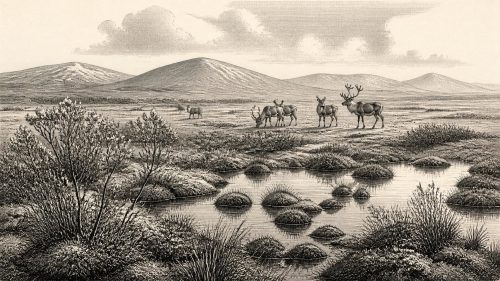
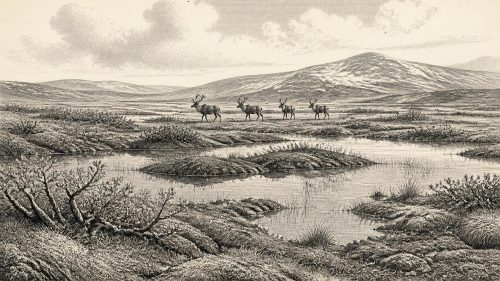
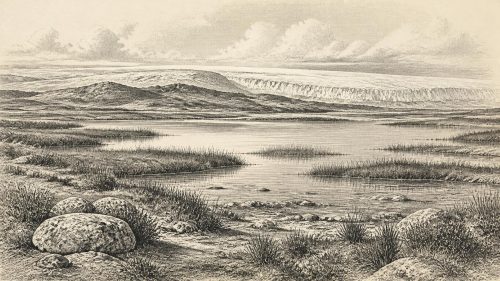
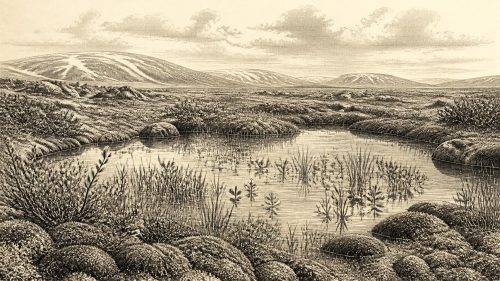
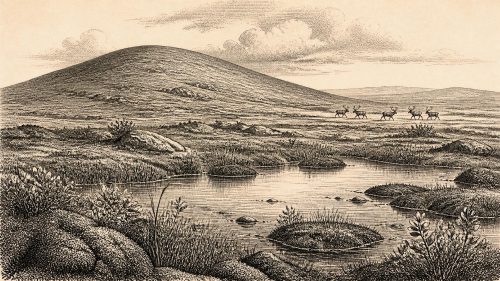
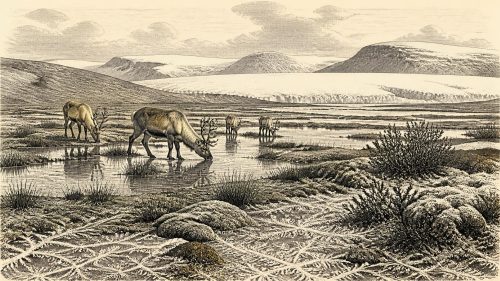
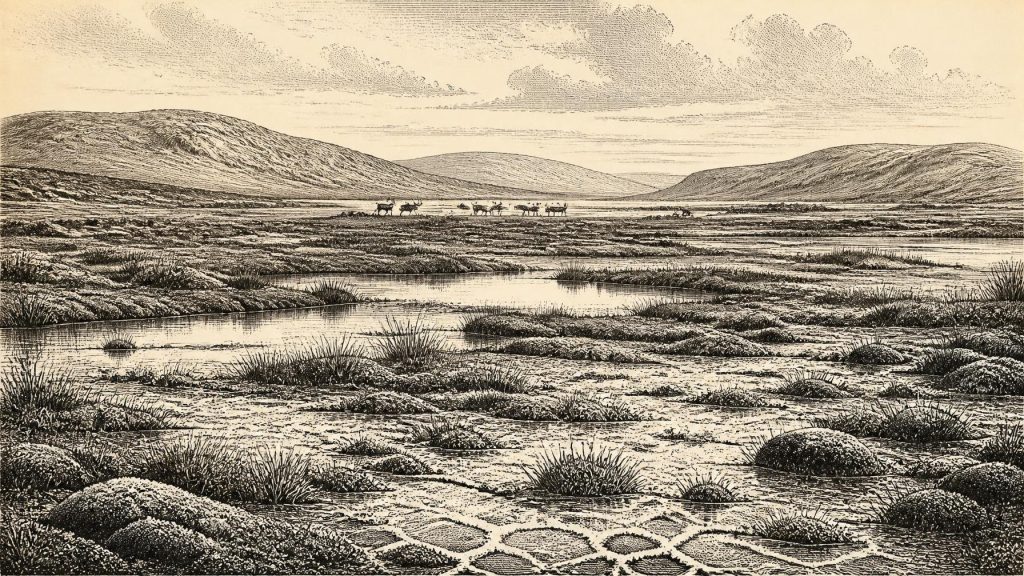
At this time Ireland was not the familiar green island of woods, fields and enclosed farms. The fossil evidence from Derryvree points to a treeless, open and periglacial setting. Grasses, sedges, herbs, mosses and low-growing cold-tolerant plants occupied wet ground around shallow pools. Insects and plant remains indicate a marshy or muskeg-like mosaic rather than a uniform frozen desert. Summer thaw could sustain standing water and a short growing season; winter conditions were severe enough for frost processes to shape the ground. The alternation of wet hollows, exposed mineral soil and sparse vegetation would have made the landscape highly seasonal.
That reconstruction must remain local. A road-cut sediment bed cannot map every valley, coast or upland across the island. Nor does an ice-free Fermanagh basin demonstrate that every part of Ireland was open country at the same moment. Yet Derryvree is especially valuable precisely because it is material evidence of land, freshwater and vegetation between glacial episodes. It cautions against imagining either an Ireland permanently entombed beneath ice or an island comfortably habitable throughout the whole Ice Age.
Cold-Stage Ireland in a Changing North Atlantic
The broader climate was unstable. Marine Isotope Stage 3, the interval before about 29,000 years ago, contained abrupt shifts recorded particularly clearly in Greenland ice cores. Irish cave deposits offer a regional counterpart. At Crag Cave in County Kerry, uranium-thorium dating shows that speleothems grew episodically during warmer intervals when liquid water could percolate through the shallow cave system. Their growth and interruption demonstrate that Ireland’s climate was sensitive to millennial-scale changes in the North Atlantic world. Such evidence does not translate directly into an annual Irish weather report, but it supports an image of repeated environmental reorganisation rather than one unchanging cold.
The date in question also falls before the fullest development of the Last Glacial Maximum, when the British–Irish Ice Sheet covered most of Ireland and adjacent shelves. Modern reconstructions show that the growth, maximum extent and retreat of that ice sheet varied sharply by sector; its maximum did not occur everywhere at precisely the same time. It would therefore be misleading to claim that a single ice margin stood at a particular Irish location in 31,182 BCE. What can be said is that Ireland was entering a climatically harsher part of the last glacial cycle, and that later ice advances would bury, rework and destroy much of the evidence from earlier open-ground intervals.
Other northern sites help establish this long perspective. Aghnadarragh, near Lough Neagh in County Antrim, preserves a layered Midlandian sequence of till, freshwater deposits and stratified sediments. Its deposits include material associated with woolly mammoth and record alternation between glacial occupation and non-glacial environments. Greenagho in Fermanagh and other inter-till localities add further, though often poorly dated, signs of cold and open conditions. Together, these sites show why Ireland’s Ice Age history cannot be reduced to a simple advance followed by retreat. Ice, water, sediment, vegetation and animal communities changed repeatedly.
Animals on the Open Ground
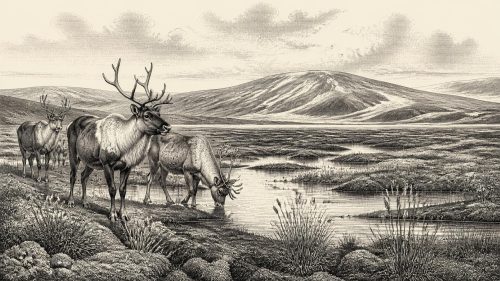
The animal record is fragmentary, but it makes the cold-stage setting more tangible. Cave collections and fossil finds from Ireland include remains attributed to reindeer, woolly mammoth, spotted hyaena, wolf, fox, hare and lemming, alongside other large herbivores and carnivores. Not every species occurred at every site or at the same date, and old collections often lack the secure stratigraphic information expected today. Nonetheless, the assemblages demonstrate that Ireland was connected to wider north-west European ecological networks during parts of the Late Pleistocene. Animals capable of living in open, cold environments could reach and use parts of the island.
Castlepook Cave near Doneraile in north Cork is particularly important. Excavations undertaken between 1904 and 1912 recovered a remarkable collection of Ice Age animal bones, including mammoth and reindeer. Some material has yielded pre-Last Glacial Maximum ages broadly in the 34,000–35,000 radiocarbon-year range, while later re-dating programmes have shown that cave assemblages may also contain much younger Late Glacial remains. A cave collection is therefore an archive accumulated across long spans, not proof of a single faunal community gathered in one season.
For everyday ecology, reindeer are suggestive. Their presence would fit open vegetation and the possibility of seasonal movement through a terrain where forage quality changed rapidly. Mammoth remains evoke the wider mammoth-steppe world familiar from continental Europe, but a bone in an Irish cave does not establish large resident herds or an uninterrupted population. Carnivores further complicate the picture: hyaenas and other scavengers could transport, break and modify bones. The evidence confirms that Ice Age animals entered Ireland; it cannot reconstruct their exact routes, numbers or migration calendars.
The Human Question at Castlepook
The most arresting possible human evidence is a reindeer femur from Castlepook. It has been publicly reported as roughly 33,000 years old and as carrying a deep mark interpreted by zooarchaeologist Ruth Carden as an incision or chop made with a sharp stone implement during carcass processing. If that interpretation is confirmed by further analysis and securely dated context, it would indicate that people handled a reindeer in Ireland during the Upper Palaeolithic, many millennia before the well-established post-glacial settlement record.
That conditional is essential. The specimen derives from an early twentieth-century cave collection rather than a modern excavation of an intact occupation surface. There is no securely associated hearth, stone-tool assemblage, dwelling, burial, human bone or repeated butchered deposit of the same age. A date on the bone establishes when the animal lived, not automatically the moment when a surface mark was made. Cave deposits may be disturbed by water, frost, collapse, burrowing and carnivore activity. The femur is consequently significant evidence under investigation, not a licence to describe a named hunting party, a camp or a permanent population in Ireland in 31,182 BCE.
No Polities, No Proven Settlements
There is no responsible basis for political history at this date. No rulers, territories, diplomatic relations, war bands or treaties can be identified. Nor is there evidence for farming, animal husbandry, houses, villages, exchange systems, seafaring networks, formal religion, monuments, art or writing in Ireland around this horizon. A marked animal bone, even if humanly modified, would speak only of a brief act of carcass processing. It would not demonstrate ownership of land, trade in meat or hides, organised conflict, or cultural continuity with later inhabitants.
The same restraint applies to society and learning. Any people who reached Ireland during a temporarily favourable phase would probably have been highly mobile hunter-gatherers, using knowledge and technologies comparable to Upper Palaeolithic groups elsewhere in north-west Europe. That is a contextual inference, not direct Irish proof. No excavated Irish assemblage of this age presently reveals the size of a group, its language, kinship, beliefs, food-sharing customs or seasonal round. Ireland’s securely evidenced, sustained human settlement belongs much later, after the final withdrawal of the great ice sheets.
The historical importance of 31,182 BCE therefore lies not in an invented event but in a demanding landscape and the survival of slender evidence. The freshwater silts at Derryvree preserve plants and insects from a cold wetland between glaciers. Aghnadarragh records the deeper rhythm of ice, sediments and large animals. Castlepook raises, but does not settle, the question of a very early human visit. Read together, they show an Ireland intermittently available to life, environmentally connected to Ice Age Europe, and still far beyond the reach of calendar-year history.
Primary Sources
- A Middle Midlandian Freshwater Series at Derryvree, Maguiresbridge, County Fermanagh, Northern Ireland
- Freshwater Organic Deposits and Stratified Sediments Between Early and Late Midlandian (Devensian) Till Sheets, at Aghnadarragh, County Antrim, Northern Ireland
- Episodic Speleothem Deposition Tracks the Terrestrial Impact of Millennial-Scale Last Glacial Climate Variability in SW Ireland
- Growth and Retreat of the Last British–Irish Ice Sheet, 31,000 to 15,000 Years Ago: the BRITICE-CHRONO Reconstruction
- Late Pleistocene Chronostratigraphy and Ice Sheet Limits, Southern Ireland
- Last Glacial Maximum Cirque Glaciation in Ireland and Implications for Reconstructions of the Irish Ice Sheet
- Dimensions and Chronology of the Last Ice Sheet in Western Ireland
- First Evidence of a Late Upper Palaeolithic Human Presence in Ireland
- New Insights on the Fauna of Ireland’s Younger Dryas and Early Holocene from Alice & Gwendoline Cave
- Red Deer (Cervus elaphus) in Ireland: Genetic Diversity, Population Structure and Recolonisation History
- The Subdivision of the Quaternary Period in Ireland
- Aghnadarragh
- Growth and Retreat of the Last British–Irish Ice Sheet, 31,000 to 15,000 Years Ago: the BRITICE-CHRONO Reconstruction
- Late Quaternary Stratigraphy and Glacial History of Southern Ireland
- The Quaternary of the Irish Midlands
- The Irish Quaternary Fauna Project
- Irish Pleistocene Biostratigraphy
- Archaeological Heritage of County Cork
- Ireland’s Palaeolithic Archaeology – Fleeting Footprints in a Frozen Land
- Reindeer Bone Found in Cork Cave Shows Human Activity in Ireland 33,000 Years Ago
- Irish Quaternary Association: Publications
- Irish Quaternary Association: Outreach and Education Resources