Derryvree’s Arctic Herbarium31017 BCE
Around 31,017 BCE, Ireland cannot be reconstructed as a precise historical year, but environmental evidence illuminates a broad Middle Midlandian interval. At Derryvree, County Fermanagh, freshwater silts between glacial tills preserve tundra-like wetland plants and animals, demonstrating a locally ice-free phase before renewed glaciation. Castlepook Cave, County Cork, contains time-averaged remains of reindeer, mammoth, giant deer, predators and other cold-stage fauna, indicating intermittent connections with north-west Europe. Shifting coastlines and expanding ice shaped habitats and movement. No secure human settlement is known; a possible butchered reindeer bone remains disputed. Later glaciation erased much evidence, leaving a fragmentary ecological archive today.

Dateline
31,017 BCE is a modern calendar label, not a year that can be recovered from the Irish archaeological record. No document, settlement layer, burial, hearth or named community can be placed in that precise year. At this depth in time, radiocarbon determinations carry wide uncertainties and must be calibrated; deposits may also represent accumulated material rather than a single moment. The most responsible approach is therefore to consider Ireland around 33,000 calendar years before AD 1950, within the later Pleistocene and Marine Isotope Stage 3, through broad calibrated ranges and securely dated sequences.
For this notional date, the crucial Irish evidence is environmental. It tells of an island at the north-western edge of Europe, exposed to abrupt climatic shifts and increasingly affected by the growth of the British–Irish Ice Sheet. It does not support conventional political history. There are no identifiable rulers, peoples, diplomatic relationships, wars, languages, religions, trading communities or systems of learning to describe. Nor is there secure evidence for a permanent human population in Ireland at this time. What survives instead is a fragile archive of silt, plant remains, animal bone, cave sediment and glacial landforms.
A Date Within a Wide Window
The nearest important chronological anchor is Derryvree, near Maguiresbridge in County Fermanagh. Road cutting through a drumlin in 1969 exposed a remarkable sequence: a lower layer of glacial till, freshwater silts and fine sands rich in organic remains, and then a second, later till. The order of these deposits demonstrates a local sequence of ice cover, an interval in which freshwater and wet ground developed, and renewed glaciation which sealed the evidence beneath the drumlin.
Organic material from the freshwater series produced a conventional radiocarbon result of 30,500 years before present, with an uncertainty of +1,170 and −1,030 years. Calibration does not translate this into a single calendar year. Rather, published treatment of the date places it broadly within a range of roughly 36,900–31,700 calibrated years before present. The modern label 31,017 BCE, approximately 32,966 years before AD 1950, lies within that wide probability range, but cannot be assigned to one particular plant, insect, season or episode at Derryvree.
This distinction matters. Derryvree does not prove that every part of Ireland was ice-free at once, nor does it provide a weather report for a chosen year. It does show that, during a broad middle-Midlandian interval before the Last Glacial Maximum, the Fermanagh locality supported an open freshwater and wetland environment between episodes of glaciation. The deposit is a powerful corrective to the simple image of an Ireland continuously buried beneath ice throughout the Ice Age.
Freshwater Beneath a Drumlin
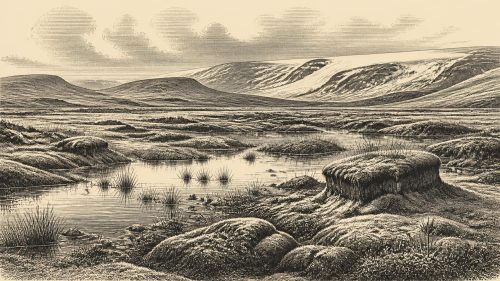
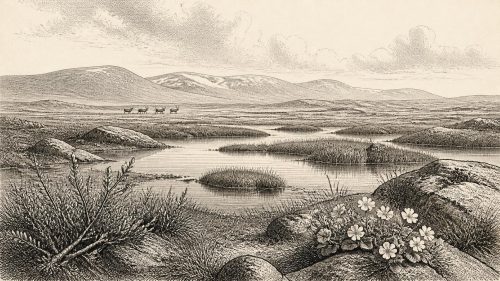
The plants and small animals preserved in the Derryvree silts indicate severe, treeless conditions. Mosses, sedges, aquatic plants and arctic-alpine vegetation point to a tundra-like, periglacial landscape rather than woodland. Pools, marshy ground and shallow water lay amid open country exposed to cold, wind and seasonal freezing. The setting may be compared broadly with northern or upland environments today, but it was not a modern ecosystem displaced southwards intact. Its organisms formed a distinctive late-Pleistocene community responding to changing moisture, temperature, soils and glacial proximity.
Such evidence offers the closest available view of everyday environmental conditions in northern Ireland around this broad period. Watercourses and pools would have mattered because they concentrated vegetation and attracted animals. Sedges and mosses stabilised damp ground; submerged and floating plants occupied the water itself. Yet it would be misleading to turn this into an idyllic wetland scene. Periglacial terrain could be unstable, frost-shattered and sparsely vegetated. Seasonal thaw, snow cover and wind were likely decisive forces in the lives of plants and animals.
The later advance of ice is equally important. A glacier subsequently overrode the locality and deposited the upper till. This both destroyed earlier surfaces and preserved the freshwater sediments below. Ireland’s Ice Age record is consequently selective: ice eroded many landscapes where people or animals might once have passed, while occasionally protecting small deposits beneath later sediment. Absence of a site is not proof that nothing happened there; it is often a consequence of an exceptionally destructive geological history.
Castlepook’s Time-Averaged Fauna
For larger animals, the major archive lies far to the south-west at Castlepook Cave, also called Mammoth Cave, near Doneraile in north County Cork. Excavations undertaken in the early twentieth century recovered a remarkable collection of Pleistocene remains, now principally held by the National Museum of Ireland. Reassessment and improved radiocarbon pretreatment have shown that important elements of the assemblage are older than earlier dating suggested, placing them within Marine Isotope Stage 3, before the Last Glacial Maximum.
Animals represented in the wider Castlepook record include reindeer, woolly mammoth, giant deer, brown bear, wolf, Arctic fox, mountain hare, lemmings and spotted hyaena. This is compelling evidence that Ireland was periodically part of a wider north-west European faunal world. Reindeer, lemmings and Arctic fox accord well with cold, open conditions. Mammoth and giant deer show that much larger herbivores could reach, and at least temporarily inhabit, Irish landscapes. Hyaena and wolf indicate predators and scavengers within the food web.
But the cave must not be mistaken for a single day’s census. Its deposits accumulated across long periods and were altered by carnivores, water movement, collapse, sediment disturbance and antiquarian excavation. Bones from several episodes can become mixed. A mammoth bone, a hyaena skull and a reindeer element need not represent animals living beside one another, still less animals present in precisely 31,017 BCE. The sound conclusion is narrower and stronger: pre-maximum Ireland supported, or was repeatedly reached by, a varied cold-stage fauna over an extended period.
Recent sedimentary ancient-DNA work from Castlepook adds a promising, though still provisional, line of evidence. A 2026 preprint reports genetic traces of a dozen ancient animal taxa and interprets the results as showing links between Irish mammals and wider Eurasian populations before the Last Glacial Maximum. It supports faunal connectivity, but remains awaiting peer review and cannot establish an exact route, a permanently dry land bridge, or the date of any individual animal movement.
Changing Coasts and Advancing Ice
Sea level was lower than today because vast volumes of water were locked in global ice sheets. Ireland’s coastline and the surrounding shelves were therefore different, and routes between Ireland, Britain and continental Europe changed repeatedly. The presence of large mammals demonstrates that dispersal was possible at some points in the late Pleistocene. It does not demonstrate one fixed, simple corridor. Movement may have depended on exposed shelves, changing sea passages, ice margins and short-lived favourable conditions. Animal movement also cannot be used automatically to infer easy human travel.
The nominal date falls before the fullest expansion of the last British–Irish Ice Sheet, whose overall maximum came later and whose different sectors did not advance or retreat in unison. Modern reconstructions show a complex, growing ice mass rather than a single uniform blanket spreading across Ireland on one date. At Derryvree, the inter-till freshwater series records a locally ice-free phase; elsewhere, ice, cold-based ice cover, exposed uplands, or rapidly shifting margins may have produced very different landscapes. Regional variation is fundamental to any reconstruction.
In the long view, the most consequential development was the approach of renewed glaciation. The world represented by Derryvree’s wetland and Castlepook’s fauna was vulnerable to intensifying cold, ice-sheet growth and the disruption of habitats and migration routes. Later glaciation transformed the physical map of Ireland, leaving drumlins, erratics, striated rock and altered drainage, while removing much of the evidence of landscapes that preceded it.
The Human Question
There is no securely excavated habitation site, tool assemblage, hearth, burial or continuous population in Ireland that can be assigned to this date. Accordingly, there is no evidential basis for reconstructing households, kin groups, authority, conflict, diplomacy, religious rites, art, teaching or organised exchange. Terms such as Gaelic, Celtic and Irish belong to incomparably later historical contexts and have no place in this Ice Age reconstruction. Farming, herding, pottery, metalworking, monuments and literacy were still many millennia in the future.
A potentially important but unresolved clue comes from Castlepook: a reindeer femur from an old collection has been reported as bearing a deep incision interpreted by Ruth Carden as a possible stone-tool butchery mark, on bone dated to broadly 33,000 years ago. If future analysis confirms both the mark’s human origin and its archaeological significance, it may indicate a Palaeolithic visit and carcass processing in Ireland during a broadly comparable phase. It would not, by itself, demonstrate settlement, population size, social structure or cultural continuity. Fresh excavation at Castlepook has identified surviving Pleistocene deposits, but its 2022 work reported no cultural artefacts.
The secure evidence for human activity in Ireland is much later: a butchered brown-bear bone from Alice and Gwendoline Cave in County Clare is dated to about 12,810–12,590 calibrated years before present. That discovery proves that late Upper Palaeolithic people reached Ireland, but it comes more than twenty millennia after the period considered here. It cannot fill the enormous chronological gap around 31,017 BCE.
Ireland at this point is therefore best understood as a changing ecological frontier rather than a nation with a recoverable year-by-year history. Derryvree’s buried silts preserve a cold wetland between glacial episodes; Castlepook preserves fragments of a wider animal world and a debated human possibility. Together they show that the island was neither timeless nor uniformly frozen. They also set the limits of responsible knowledge: the evidence illuminates environments and animal connections across long ranges of time, while the precise year remains beyond reach.
Primary Sources
- A Middle Midlandian Freshwater Series at Derryvree, Maguiresbridge, County Fermanagh, Northern Ireland
- The Irish Quaternary Fauna Project
- A Reconsideration of the Radiocarbon Dating of the Marine Isotope Stage 3 Fauna from Southern Ireland
- Castlepook Cave, Castlepook South, Cork: Excavation Report 2022
- Spotted Hyena Skull
- Growth and Retreat of the Last British–Irish Ice Sheet, 31,000 to 15,000 Years Ago: the BRITICE-CHRONO Reconstruction
- Extent and Timing of the Last Glacial Maximum (LGM) in Britain and Ireland: a Review
- Dimensions and Chronology of the Last Ice Sheet in Western Ireland
- Trimlines, Blockfields and the Vertical Extent of the Last Ice Sheet in Southern Ireland
- Exploring Controls of the Early and Stepped Deglaciation on the Western Margin of the British Irish Ice Sheet
- Timing and Pace of Ice-Sheet Withdrawal Across the Marine–Terrestrial Transition West of Ireland During the Last Glaciation
- The IntCal20 Northern Hemisphere Radiocarbon Age Calibration Curve (0–55 cal kBP)
- IntCal
- First Evidence of a Late Upper Palaeolithic Human Presence in Ireland
- New Insights on the Fauna of Ireland's Younger Dryas and Early Holocene from Alice & Gwendoline Cave
- Sedimentary Ancient DNA Reveals Late Pleistocene Faunal Connectivity Between Ireland and Eurasia
- Geology of Ireland
- Quaternary Geomorphology Map Service
- Figure 6.— The Subdivision of the Quaternary Period in Ireland
- The Problem of a Late Quaternary Landbridge Between Britain and Ireland
- The Island of Ireland: Drowning the Myth of an Irish Land-Bridge?
- Phylogeographic, Ancient DNA, Fossil and Morphometric Analyses Reveal Ancient and Modern Introductions of a Large Mammal: the Complex Case of Red Deer (Cervus elaphus) in Ireland