Castlepook’s Reindeer Frontier31029 BCE
Around 31,029 BCE, Ireland experienced unstable Late Pleistocene conditions before the Last Glacial Maximum. Derryvree, County Fermanagh, preserves evidence of an ice-free interval containing cold freshwater wetlands, tundra vegetation and periglacial environments, later buried by renewed glaciation. Castlepook Cave, County Cork, contains a long, mixed fauna record including reindeer, mammoth, giant deer, hyaena and bear, demonstrating connections with wider north-west European cold-climate ecosystems. A marked reindeer bone, dated near 33,000 years ago, may indicate human handling, but cannot prove settlement or organised hunting. Lower sea levels altered surrounding landscapes, although access routes remain uncertain. Evidence remains local, fragmentary and provisional.
Dateline
“31,029 BCE” is a modern chronological label, not a year that anyone in Ireland could have named or recorded. At this depth in time, calendar-year precision is unavailable. The label falls about 32,980 years before AD 1950, the conventional radiocarbon reference point, within the Late Pleistocene and Marine Isotope Stage 3 (MIS 3), a climatically unstable part of the last Ice Age. Ireland has no written history, no known ruler, no political community, and no securely dated settlement that can be assigned to this particular year. Its history must instead be reconstructed from buried sediments, fossil plants and insects, cave bones, glacial landforms and radiocarbon measurements with broad uncertainties.
The most responsible picture is therefore regional and provisional. Around this notional date, parts of Ireland may have been open, cold and largely treeless, while other districts were influenced by expanding ice or lay beneath it. The island’s geography, shorelines and connections with neighbouring lands differed greatly from those of today. Yet the surviving evidence is fragmentary, much of it disturbed by later ice, water and excavation. What it can illuminate is an Ice Age environment in which animal populations moved through changing habitats, and in which a possible human trace remains intriguing but unconfirmed as evidence for settlement.
A Date Within a Wide Range
The closest especially informative Irish environmental sequence comes from Derryvree townland near Maguiresbridge, County Fermanagh. Road works in 1969 cut through a drumlin and exposed a layered archive: one deposit of glacial till below, freshwater silts and fine sands with organic material in the middle, and a second till above. Till is the unsorted sediment left by glacier ice. The sequence demonstrates that ice had crossed the locality, that an interval followed in which freshwater deposits and vegetation accumulated, and that later glacial activity buried them beneath fresh ice-borne debris.
Organic material from the Derryvree deposits produced a radiocarbon determination of 30,500 years before present, with a substantial laboratory uncertainty. A radiocarbon age is not a calendar age: the amount of carbon-14 in the atmosphere has varied through time, and very old measurements must be calibrated against independently constructed chronological curves. Published assessments place the deposit broadly at about 36,900–31,700 calibrated years before present, approximately 34,950–29,750 BCE. Thus 31,029 BCE lies within the broad horizon that Derryvree can help illuminate. It does not date an individual pool, plant, animal or episode at the site, still less the whole island.
This distinction is fundamental. Derryvree was a local wetland archive preserved by exceptional circumstances, not a photograph of Ireland in a single year. Its value lies in showing that an ice-free interval occurred at this Fermanagh location during the later Pleistocene, and that a cold freshwater landscape existed there before renewed glaciation covered the evidence. The precise timing, extent and continuity of ice across Ireland around 33,000 years ago remain subjects of reconstruction rather than direct observation.
Wetlands in a Treeless Country
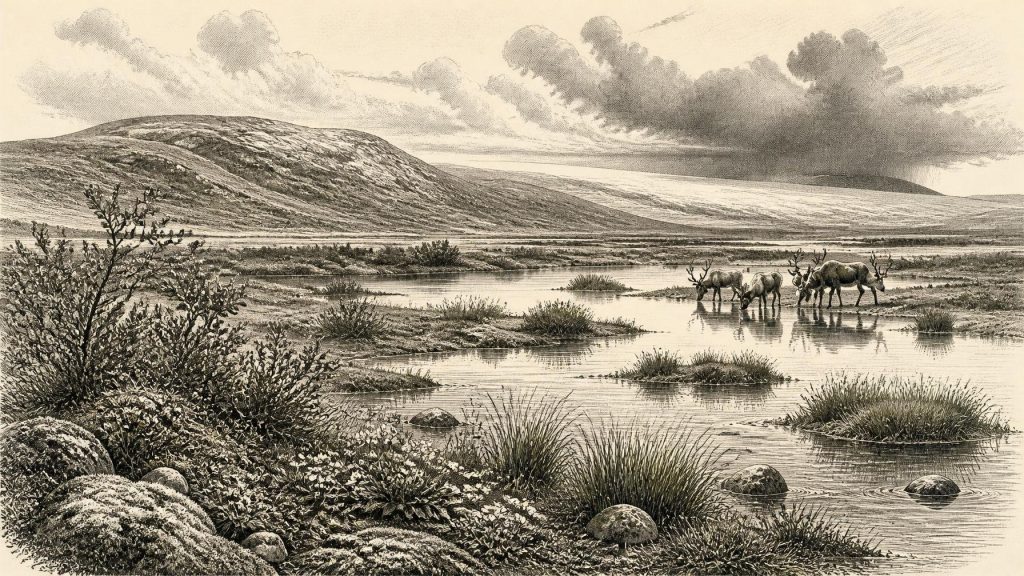
The Derryvree fossils indicate an open tundra or tundra-steppe environment under periglacial conditions: severe cold, repeated freezing and thawing, and a short growing season. Pollen was poorly preserved, but plant macrofossils and mosses are more revealing. They include sedges, dwarf willow, mountain-avens, Arctic clubmoss, bogbean and aquatic plants such as water-milfoil. These are not evidence for a uniform carpet of vegetation across Ireland. They are evidence that, beside freshwater at Derryvree, cold-adapted plants could survive in marshes, shallow pools and damp ground.
Such a landscape would have been low in trees or without woodland altogether. Open ground, sedge-rich margins and patches of mossy wetland offered very different resources from later post-glacial Ireland. Insects and other small fossils help support the inference of cold conditions, while the enclosing tills show that this living environment was temporary in geological terms. The people who later farmed Fermanagh inherited a country remodelled by ice; the drumlin itself, with its streamlined form and buried organic core, is part of that inheritance.
Environment was the decisive force in this period. The great ice-sheet maximum in Ireland came later, broadly between 27,000 and 23,000 calibrated years before present, though ice margins advanced and retreated unevenly and reconstructions continue to be refined. Around 31,029 BCE, Ireland was moving towards that more severe phase rather than experiencing a stable, island-wide climate. The appropriate image is not of an unchanging frozen wilderness, but of shifting local mosaics: ice, bare mineral ground, shallow water, tundra vegetation and sheltered cave systems.
Castlepook’s Animal Record
County Cork provides the other major window on this deep past. Castlepook Cave, near Doneraile, is Ireland’s richest known pre-Last Glacial Maximum cave-fauna archive. Excavations from the early twentieth century recovered more than 2,000 surviving bones, although much material had already been removed or later lost from collections. Re-dating has shown that the cave’s animal remains span a long and complex period, with individual specimens ranging broadly from about 45,700 to 19,950 radiocarbon years before present. It was not a single momentary deposit.
The cave preserves evidence of a striking cold-stage fauna: woolly mammoth, reindeer, giant deer, brown bear and spotted hyaena, with wolf, Arctic fox and lemmings represented in later Ice Age contexts. These animals do not mean that every species occupied every Irish valley at once. Cave assemblages accumulate through many processes: carnivores carry in prey and scavenged bones; animals die in or near caves; water moves material; and earlier excavators disturb layers. Nevertheless, the combined record establishes that Ireland, at different points before the glacial maximum, supported or received elements of the wider north-west European cold-climate fauna.
Reindeer are particularly relevant to the notional year. Their presence suggests open habitats and mobile grazing routes rather than dense forest. Mammoth and giant deer underline the ecological scale of the landscape, while spotted hyaena shows that large carnivores also operated in Ireland. A cave is therefore better understood as a repository within an animal landscape than as an ordinary domestic shelter. Castlepook offers powerful evidence for fauna and climate, but limited direct evidence for how humans used the land.
The Mark on a Reindeer Bone
A reindeer femur from Castlepook has been presented by its researcher and in County Cork heritage material as dating to about 33,000 years ago and bearing a deep mark interpreted as a fresh-bone cut or chopping action made with a stone tool. If that interpretation is sustained, it would be the earliest claimed evidence that people handled an animal in Ireland, broadly close to 31,029 BCE. It would be an important indication of a human visit during MIS 3, long before the well-established post-glacial settlement record.
Its limitations must be stated equally plainly. The dated object is the animal bone, not a documented calendar date for the marking event. No securely associated stone-tool assemblage, hearth, habitation floor, burial, food store or settlement has yet been recovered at Castlepook for this period. Recent excavation has confirmed that potentially important Pleistocene deposits survive, but it did not recover cultural artefacts. Nor can one modified bone establish whether a hunter or small party came once, travelled seasonally, crossed from Britain by a route now altered by ice and sea-level change, or belonged to a resident population.
The claim should therefore be treated as evidence under active archaeological investigation, not as licence to invent an Irish hunting camp, tribe or migration. The absence of a demonstrated settlement matters. It means that there is no responsible basis for describing political affairs, diplomacy, warfare, leaders, language, religious practice, artistic traditions, formal learning, trade networks or household organisation in Ireland at this date. Those categories belong to human societies, and the evidence does not yet show such a society here.
Movement, Insularity and Silence
Lower global sea levels during the Ice Age exposed areas of the present continental shelf around Ireland and Britain. But a lower sea is not automatically a walkable, continuous land bridge. Relative sea level depended on global water volumes, local uplift or subsidence under changing ice loads, and the shape of the seabed. Research on Irish palaeogeography warns that possible land connections were geographically complex and often short-lived. At about 31,029 BCE, moreover, expanding ice could make routes difficult even where shelf land was exposed. Human access remains a question, not an established fact.
If people did reach Ireland, their economy cannot be reconstructed beyond the most cautious possibility of obtaining meat or other materials from a reindeer carcass. It would be unsafe to claim organised reindeer hunting, routine trade in stone, or exchange with communities in Britain or continental Europe without tools, campsites or repeated evidence. The same restraint applies to culture and religion. There are no known Irish images, ornaments, ritual deposits, graves or structures from this horizon. The silence is real, but it is partly a product of preservation: later glaciers eroded landscapes, rising seas drowned former coastlines, and early investigations did not employ modern recovery methods.
An Environmental History, Not an Annal
Ireland around 31,029 BCE was not a blank page, but neither was it a historical year in the familiar sense. Derryvree preserves the remains of cold freshwater life between glacial episodes. Castlepook preserves a long, mixed record of large mammals living in, passing through or being carried into an Irish cave landscape. A single marked reindeer bone raises the possibility that humans were present, while falling far short of proving a settled community.
The central development was environmental change: unstable Ice Age conditions were narrowing the ecological opportunities available on the island before the later maximum of the British-Irish Ice Sheet. In that context, the most vivid historically supportable scene is not a named battle or chiefdom, but a cold wetland beside a shallow Fermanagh pool, and reindeer moving across open Cork country under the shadow of caves used by carnivores. The evidence is modest, local and uneven; handled carefully, it is enough to reveal an Ireland already shaped by profound climatic change.
Primary Sources
- A Middle Midlandian Freshwater Series at Derryvree, Maguiresbridge, County Fermanagh, Northern Ireland
- Palaeoecology
- Figure 6.— The Subdivision of the Quaternary Period in Ireland
- A Reconsideration of the Radiocarbon Dating of the Marine Isotope Stage 3 Fauna from Southern Ireland
- Castlepook Cave, County Geological Site Report
- Heritage Artefacts of County Cork
- Archaeology Research Excavation Grant 2022: Final Report
- 2022:564 – Castlepook Cave, Castlepook South, Cork
- Growth and Retreat of the Last British–Irish Ice Sheet, 31,000 to 15,000 Years Ago: the BRITICE-CHRONO Reconstruction
- Pattern and Timing of Retreat of the Last British-Irish Ice Sheet
- Last Glacial Maximum Cirque Glaciation in Ireland and Implications for Reconstructions of the Irish Ice Sheet
- New Data for the Last Glacial Maximum in Great Britain and Ireland
- Late Pleistocene Chronostratigraphy and Ice Sheet Limits, Southern Ireland
- Trimlines, Blockfields and the Vertical Extent of the Last Ice Sheet in Southern Ireland
- The Island of Ireland: Drowning the Myth of an Irish Land-Bridge?
- The Problem of a Late Quaternary Landbridge Between Britain and Ireland
- Deglaciation, Earth Crustal Behaviour and Sea-Level Changes in the Determination of Insularity: A Perspective from Ireland
- Ireland: Submerged Prehistoric Sites and Landscapes
- The IntCal20 Northern Hemisphere Radiocarbon Age Calibration Curve (0–55 cal kBP)
- The Irish Quaternary Fauna Project
- The Mesolithic in Ireland: When Was It?
- New Insights on the Fauna of Ireland’s Younger Dryas and Early Holocene from Alice & Gwendoline Cave