BIRM-166’s Cold-Stage Silts30940 BCE
At approximately 30,940 BCE, Ireland’s history is reconstructed from environmental archives rather than annual records. Derryvree’s BIRM-166 sediments, broadly dated to 36,900–31,700 calibrated BP, preserve an ice-free interval between glacial deposits in Fermanagh. Their plants, insects and mosses indicate a cold, treeless freshwater wetland of sedges, grasses, pools and tundra-like ground. Crag Cave speleothems show repeated climatic fluctuations between milder and colder phases. Castlepook Cave fauna, including mammoth, reindeer and hyaena, demonstrates ecologically connected open habitats. A possibly tool-marked reindeer bone suggests, but cannot prove, an early human visit. Expanding ice soon increasingly transformed and buried these landscapes across Ireland.
Dateline
Modern calendar-year precision is not available for Ireland in 30,940 BCE. No community on the island recorded years, events or rulers in a calendar that can be correlated with this label, and no excavated deposit can be dated closely enough to describe one particular season, let alone one day. The date is best treated as a modern point on a deep-time scale: roughly 32,900 calendar years before AD 1950, within the Late Pleistocene and Marine Isotope Stage 3 (MIS 3), a climatically unstable part of the last Ice Age.
The responsible history of Ireland at this horizon is therefore a history of ranges, sediments and fossils rather than of named people or events. The most informative evidence is a buried freshwater sequence at Derryvree, near Maguiresbridge in County Fermanagh, supplemented by cave-fauna evidence from Castlepook Cave near Doneraile, County Cork, and by cave-mineral records from Crag Cave in County Kerry. These sources do not provide a countrywide snapshot. Together, however, they show that Ireland’s environment was changing sharply as cold conditions intensified and the British–Irish Ice Sheet grew.
A Date Within a Range
The key Derryvree sample, BIRM-166, came from organic mud and fine sediment exposed in a road cutting through a drumlin in 1969. It returned a conventional radiocarbon age of 30,500 years BP, with a substantial uncertainty of +1,170 and −1,030 years. A radiocarbon measurement is not identical to a calendar age: atmospheric carbon-14 has varied through time, so results must be calibrated against an independently constructed curve. At this antiquity the outcome is necessarily a broad probability range, not an annual date.
Published calibrations and later discussions place the Derryvree organic deposit broadly around 36,900–31,700 calibrated years BP, approximately 34,950–29,750 BCE. The nominal year 30,940 BCE falls within that wide interval. This does not mean the sediment formed in that precise year, or that its plants and insects were all alive together. It means that Derryvree is the closest securely dated Irish environmental archive capable of illuminating conditions around this chronological horizon.
The layers at Derryvree make its importance especially clear. Beneath the organic beds lies one body of till, the unsorted debris left by glacier ice. Above them lies another. Between the two, freshwater silts, fine sands and moss-rich mud accumulated. The sequence demonstrates a local order of events: glacier ice had occupied the site; a period followed in which open water, vegetation and animal life left traces; then a later advance of ice buried and preserved the record. It is strong evidence for an ice-free interval at this part of Fermanagh, but not proof that all Ireland was simultaneously free of ice.
Wet Ground in an Open Country
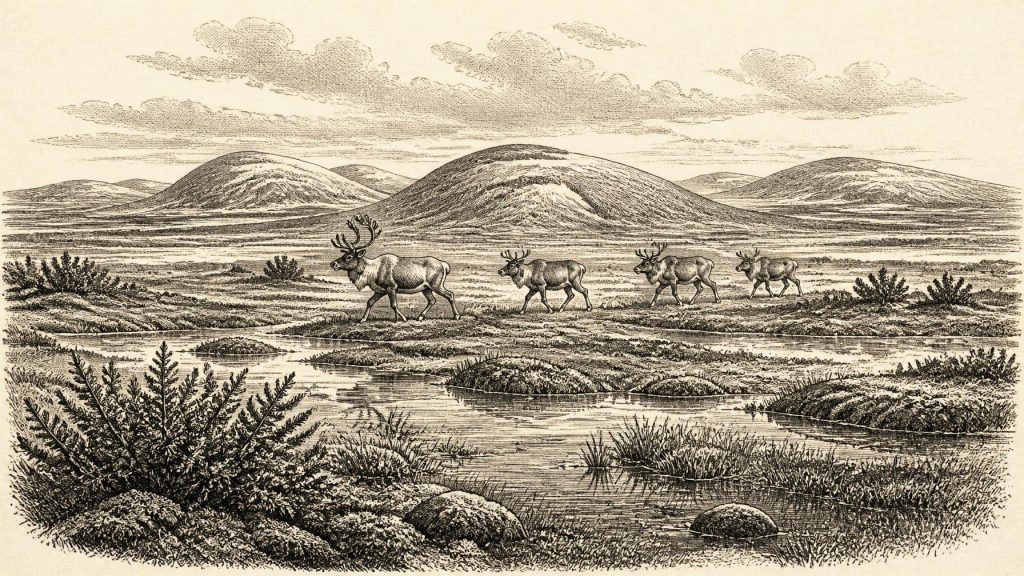
Derryvree was not the familiar wooded Ireland of later prehistory. Its pollen, plant macrofossils, mosses and insect remains point instead to a cold, exposed and largely treeless wetland landscape. Grasses and sedges were important, with juniper and herbs on open ground. Aquatic and waterside plants, including bogbean and alternate water-milfoil, indicate shallow freshwater. Mosses and lesser clubmoss, together with the sedimentary setting, support the interpretation of saturated ground, pools and marshy margins: a tundra-like or muskeg environment shaped by short growing seasons and severe winters.
That description is an interpretation assembled from ecological evidence, not a literal view of every valley. A buried wetland is a local archive. It tells us what grew in and around this particular waterlogged hollow, not that every Irish coast, upland and basin looked identical. Yet the deposit’s cold-adapted flora and fauna show that even during a harsh glacial phase, water and vegetation persisted in suitable places. Ireland was not simply a blank white expanse. It contained habitats with their own small-scale variety: open soil, wet sedge beds, mossy pools, shallow water and frost-affected ground.
Crag Cave provides a different kind of evidence from south-west Ireland. Stalagmites and other cave calcite grew episodically during MIS 3, then ceased growing during colder intervals. Growth required liquid water to percolate through the limestone and so indicates episodes when the ground above was neither sealed by glacier ice nor continuously frozen. Such records underline the instability of the climate. They do not establish the conditions of Derryvree in a particular year, but they show that the island was subject to repeated shifts between relatively milder interstadial phases and much more severe cold.
Animals at the Atlantic Edge
Castlepook Cave preserves the most striking Irish evidence for the animal communities of this wider period. Its historical collections include remains attributed to woolly mammoth, reindeer, spotted hyaena, brown bear, fox, hare, lemmings and other animals. Earlier dates on mammoth and hyaena material fall broadly in the Middle Midlandian, before the fullest expansion of the last ice sheet. The assemblage demonstrates that Ireland was connected ecologically to north-western Europe at intervals when these mammals could reach and occupy suitable habitats.
A cave bone collection must, however, be handled with care. Many Castlepook specimens were recovered during antiquarian excavations, before modern stratigraphic methods. Carnivores, especially hyaenas, could have carried carcass material into the cave; water, digging and later disturbance could mix material of different ages. The bones therefore do not describe one simultaneous herd or a single hunting episode. They establish the presence of particular species during a broad span, and they suggest an open landscape capable of supporting grazing animals, predators and scavengers.
There is no sound basis for identifying a fixed animal population, a managed hunting territory or a seasonal migration route within Ireland at 30,940 BCE. Nevertheless, the faunal record is important because it confirms opportunity as well as constraint. Reindeer and mammoth required plant food across open country; large carnivores relied on prey and carrion; cave shelter offered a focus for carnivore activity. The Irish landscape around this time could support more life than later maximum-glacial conditions would allow, even though that life was vulnerable to swiftly changing climate and expanding ice.
The Human Question
One reindeer femur from Castlepook has made this period archaeologically exceptional. A deep linear modification on the bone has been interpreted by zooarchaeologist Ruth Carden as a mark made on fresh bone by a sharp stone tool, and modern radiocarbon work has placed the animal at about 33,000 years ago. If the mark is confirmed as human-made, it would indicate that people processed a reindeer in Ireland during MIS 3, far earlier than the island’s previously accepted evidence for human activity.
That is a consequential possibility, but it remains a possibility rather than a settled population history. The dated bone does not come from a securely excavated occupation floor with associated stone tools, hearths, shelters, repeated activity surfaces or human remains. Its age dates the reindeer, not automatically the making of the mark or the identity of its maker. A sharp-edged break, carnivore damage or other natural process must be excluded through continuing specialist analysis. The appropriate conclusion is that Castlepook raises a serious question about an early human visit; it does not demonstrate a permanent settlement, named culture or island-wide community.
Accordingly, everyday social life cannot responsibly be reconstructed for Ireland itself. There is no direct Irish evidence here for families, language, dress, ritual, art, burial practice, teaching or formal leadership. If people did reach the island, their survival would presumably have depended on knowledge of weather, animal behaviour, fuel, shelter and stone-working, as among Upper Palaeolithic hunter-gatherers elsewhere in Europe. But that is a comparative inference, not a fact recovered from an Irish camp.
No Polities, No Trade Records
Political affairs, diplomacy and organised conflict are beyond the evidence. There were no states, written agreements, rulers or frontiers identifiable in Ireland at this date. Nor is there direct evidence for trade: no confirmed Irish assemblage of tools or ornaments can be used to chart exchange routes, and no securely attested settlement allows an economy to be described. It would be misleading to turn the changing position of sea, ice and land into a confident account of human crossings. These were environmental conditions that may have enabled or obstructed movement at different times, not proof of a regular route into Ireland.
What can be stated with greater confidence is that environmental change was the dominant historical force. Recent reconstructions of the British–Irish Ice Sheet indicate substantial growth from about 31,000 years ago, followed by more extensive glaciation in the succeeding millennia. Ireland’s ice cover did not advance as one perfectly uniform front: uplands, basins, coasts and neighbouring marine sectors responded differently. Still, the broader trajectory was towards a colder world in which advancing ice, altered drainage and periglacial processes repeatedly erased, buried or rearranged older landscapes.
For that reason, Derryvree’s silts are more than a technical geological curiosity. They preserve an interval that later ice almost obliterated: freshwater among drumlins, cold-climate vegetation on wet ground, and insects in a treeless landscape. Castlepook preserves a complementary animal record, while Crag Cave registers climatic interruption and recovery. Around 30,940 BCE, Ireland cannot be given a conventional annual chronicle. It can be understood, more faithfully, as a changing Late Pleistocene island whose sparse archives reveal living wetlands and large mammals on the threshold of much greater glaciation.
Primary Sources
- A Middle Midlandian Freshwater Series at Derryvree, Maguiresbridge, County Fermanagh, Northern Ireland
- The IntCal20 Northern Hemisphere Radiocarbon Age Calibration Curve (0–55 cal kBP)
- Irish Pleistocene Biostratigraphy
- The Irish Quaternary Fauna Project
- Rapid Response of Climatic Conditions During the Last Glacial: Evidence from U-Series Dated Irish Speleothems
- Episodic Speleothem Deposition Tracks the Terrestrial Impact of Millennial-Scale Last Glacial Climate Variability in SW Ireland
- Spatio-Temporal Dynamics of Speleothem Growth and Glaciation in the British Isles
- Growth and Retreat of the Last British–Irish Ice Sheet, 31,000 to 15,000 Years Ago: the BRITICE-CHRONO Reconstruction
- The Timing and Magnitude of the British–Irish Ice Sheet Between Marine Isotope Stages 5d and 2
- Character of Advance and Retreat of the Southwest Sector of the British-Irish Ice Sheet During the Last Glaciation
- Late Pleistocene Sediments, Landforms and Events in Scotland: a Review of the Terrestrial Stratigraphic Record
- Trimlines, Blockfields and the Vertical Extent of the Last Ice Sheet in Southern Ireland
- Figure 6.— The Subdivision of the Quaternary Period in Ireland
- Quaternary Site Descriptions
- Quaternary
- Castlepook Cave, Castlepook South, County Cork: Excavation Report 2022
- Ireland’s Palaeolithic Archaeology – Fleeting Footprints in a Frozen Land
- Selaginella selaginoides
- Myriophyllum alterniflorum
- The Irish Quaternary Fauna Project: Pleistocene Mammals in Ireland
- Proceedings of the Postglacial Colonization of Ireland Conference
- Exploring Controls of the Early and Stepped Deglaciation on the Western Margin of the British–Irish Ice Sheet