BIRM-166’s Cold Garden30720 BCE
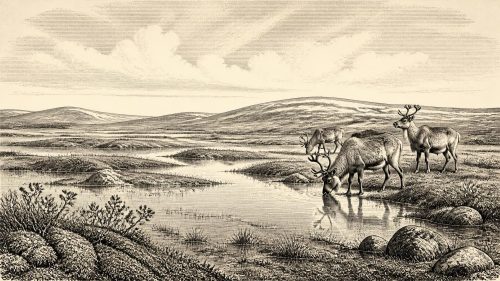
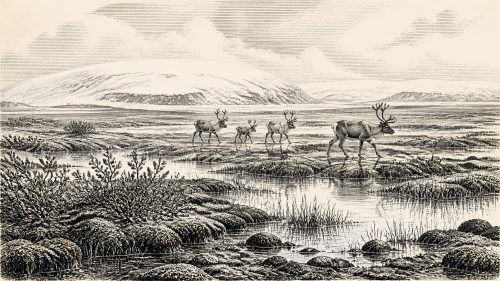
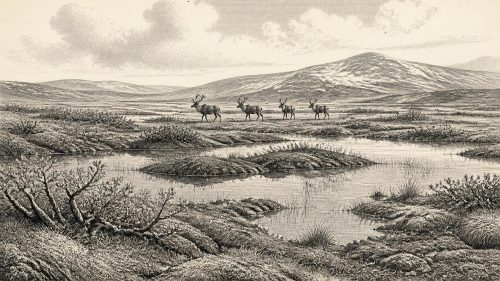
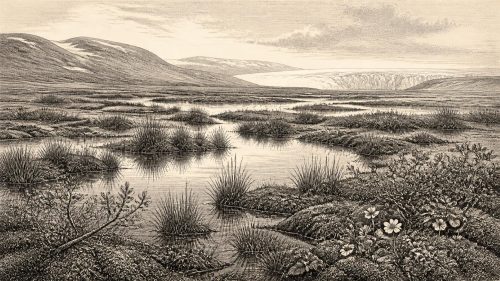
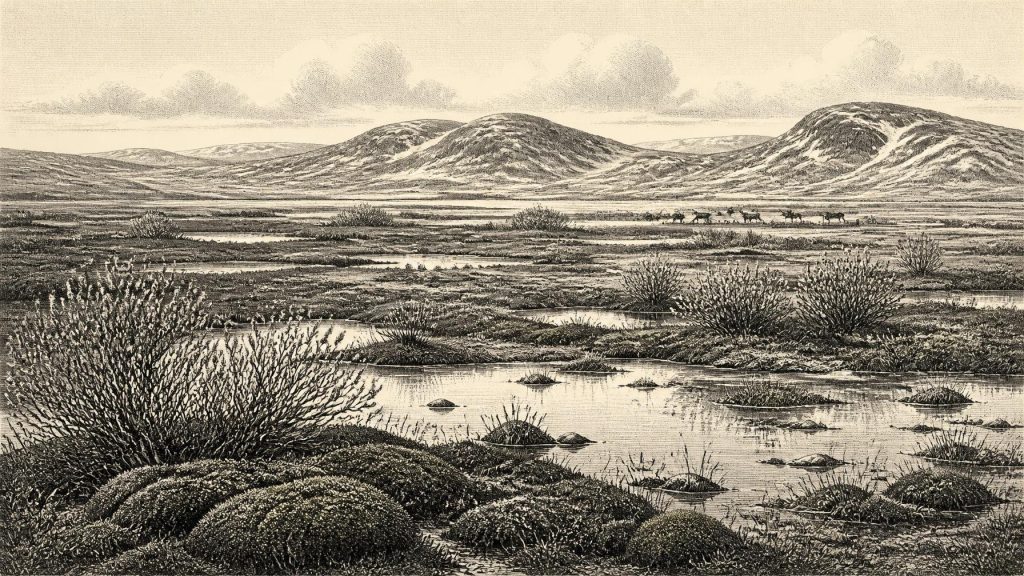
Derryvree, County Fermanagh, provides Ireland’s clearest evidence near 30,720 BCE, although the date represents a broad MIS 3 interval rather than a precise year. Roadworks exposed organic freshwater silts between glacial tills, dated broadly to 36,900–31,700 calibrated years BP. Fossil plants, mosses and insects indicate a treeless, periglacial wetland of sedges, grasses, dwarf willow and bogbean, later buried by ice. Castlepook Cave in Cork preserves cold-stage fauna including mammoth, reindeer and predators, but its deposits span time. A marked reindeer bone may suggest human activity, yet no secure settlement evidence exists. It is reconstructed through ecology, not events or polities.
Dateline
Modern calendar-year precision is not available for Ireland in 30,720 BCE. No contemporary people recorded a year, and no Irish layer can be tied responsibly to a single season or twelve-month period at such depth in time. The label is best treated as a point within the Late Pleistocene, approximately 32,670 calendar years before AD 1950, during Marine Isotope Stage 3 (MIS 3). What can be written is therefore not an annual chronicle of rulers or events, but a reconstruction from sediments, fossil plants, insects, animal bones, cave deposits and the traces of moving ice.
The most important Irish evidence close to this broad horizon comes from Derryvree, near Maguiresbridge in County Fermanagh. It is known to researchers through the radiocarbon determination BIRM-166 and through the exceptional fossil material preserved with it. Derryvree does not reveal what happened on one day in 30,720 BCE. It does, however, provide a rare window onto a period when at least one part of Ireland was not beneath permanent glacier ice, but supported cold-water wetlands and low tundra vegetation before later ice sealed the evidence away.
Water Between the Tills
Roadworks in 1969 cut through a drumlin at Derryvree and exposed a remarkable sequence: a lower glacial till, freshwater silts and fine sands rich in organic material, and an upper till. The basic order is clear. Ice had laid down the lower deposit; an interval followed in which water, plants and small animals occupied the hollow; and later glacial action buried the deposit beneath fresh sediment. The organic layer produced a conventional radiocarbon age of 30,500 +1,170/−1,030 radiocarbon years BP.
That laboratory result is not itself a calendar date. Radiocarbon ages must be calibrated, and uncertainty becomes substantial this far back. Modern discussion places the Derryvree evidence broadly around 36,900–31,700 calibrated years BP, approximately 34,950–29,750 BCE. The nominal date considered here falls within that wide range. It cannot be assigned to a particular bed, pool, animal or episode within the deposit, but it lies within the period for which Derryvree is directly relevant.
The sequence has long lent its name to the ‘Derryvree Cold Phase’, an older regional archaeological and geological label for part of Ireland’s Middle Midlandian record. The name is useful shorthand, but should not imply a single uniform cold snap across the island. MIS 3 was climatically unstable. Greenland ice cores show repeated abrupt shifts between colder stadials and milder interstadials, while Irish cave mineral deposits indicate that south-west Ireland responded sensitively to such changes. The evidence supports an unsettled, changing climate, not a fixed national weather map.
A Treeless Wetland Landscape
Derryvree’s fossil flora and fauna are the closest thing to an Irish landscape report for this era. The freshwater sediments contained pollen, plant remains, mosses and insects characteristic of an open, treeless setting. Grasses, sedges, herbs and low shrubs occupied the ground. Mosses flourished on wet surfaces. Fossils include bogbean or buckbean (Menyanthes trifoliata), a plant of wet ground and shallow freshwater, and dwarf willow, while the broader assemblage has been associated with arctic-alpine and tundra conditions.
Earlier investigators compared the environment to muskeg: a cold, waterlogged mosaic of organic mud, mossy vegetation, sedge margins and shallow pools. This comparison should be used carefully. It does not mean that a modern Canadian-style peatland existed unchanged in Fermanagh, nor that every part of Ireland looked the same. Rather, it describes a plausible combination of saturated ground, slowly moving or standing freshwater, abundant plant matter and frost-affected soils.
The resulting picture corrects two misleading extremes. Ireland was not continuously a blank, featureless sheet of ice throughout the last Ice Age. The Derryvree sediments demonstrate local ice-free ground and functioning freshwater ecology during the interval represented by the deposit. Yet neither was it a wooded refuge. There is no evidence here for forest, arable land or the dense animal and human populations of later prehistory. Long winters, short growing seasons, exposed terrain and seasonal freezing imposed severe limits on life.
Periglacial does not mean glaciated. It describes land shaped by intense freeze-and-thaw processes in the vicinity of ice masses. Water could collect where frozen or compacted ground hindered drainage; summer thaw could turn surfaces soft and unstable; wind and frost could disturb soils. The quiet, fine-grained silts at Derryvree are therefore the residue of an active and vulnerable landscape, one capable of supporting wetland life but later overridden or buried by ice.
Animals in a Changing Ireland
Southern Irish caves add another part of the story, though they must not be made to say more than they can. Castlepook Cave, also called Mammoth Cave, near Doneraile in County Cork is Ireland’s most important repository of mammal remains from the last cold stage. Its historic excavations recovered bones of mammoth, reindeer, giant deer, wolf, fox, Arctic fox, spotted hyaena, bear and lemmings, among other animals. The National Museum of Ireland holds significant material from the cave, including a spotted-hyaena skull.
These remains show that suitable parts of Ireland were reached by a striking cold-stage fauna during MIS 3. Mammoth and reindeer evoke open grazing country; lemmings and Arctic fox point towards cold environmental conditions; hyaena and wolf indicate predation and scavenging in a food web far removed from later Irish landscapes. But Castlepook was not a neatly excavated camp or a single undisturbed animal community. Bones accumulated in a cave over a long period, deposits were excavated early in the twentieth century, and later redating has shown that several older radiocarbon determinations required revision. Individual species and specimens need not have been contemporary.
It would therefore be wrong to paint a single herd of mammoths, reindeer, giant deer and predators at Derryvree in 30,720 BCE. The Fermanagh wetland and Cork cave are different sites with different histories. Together, they establish a wider proposition: Ireland contained, at varying times during MIS 3, cold open environments capable of sustaining freshwater life and of being entered by large mammals. They do not yield a complete island-wide census.
People: Evidence and Restraint
The human question is important precisely because the evidence remains so slight. A reindeer femur from Castlepook has been identified as bearing a deep mark interpreted by zooarchaeologist Ruth Carden as a cut made with a sharp stone tool on fresh bone. The specimen has been associated in heritage interpretation with an age around 33,000 years ago. If the mark is confirmed as human-made and contemporary with the animal’s death, it may indicate that Upper Palaeolithic people processed a reindeer carcass in Ireland during the broader MIS 3 interval.
That possibility must be distinguished from established settlement. The bone is a single item from an old cave collection with complicated depositional history. No securely associated stone-tool assemblage, hearth, shelter floor, grave, human skeleton, art panel or repeatedly used butchery place of this age has been published from Ireland. The bone cannot demonstrate a resident population, identify a language or ancestry, establish a seasonal migration route, or prove that people lived at Castlepook. Carnivores may also have carried or disturbed remains within the cave.
The responsible conclusion for Ireland around this date is therefore cautious. There may have been brief human visits during environmentally favourable windows, perhaps by highly mobile hunter-gatherers moving within a much wider north-west European world. A reindeer carcass, whether hunted or found, could have supplied meat, fat, marrow, hide, sinew and bone. This is an inference from the resource, not direct evidence for an Irish economy. No Irish tools can presently be linked to the alleged cut mark, and no trade, regular maritime exchange or enduring route across the Irish Sea can be demonstrated.
Lower sea levels undoubtedly altered coastlines and exposed parts of the continental shelf, but this alone does not prove a dry, easy land bridge from Ireland to Britain or the Continent at this precise time. Water barriers, ice fronts, rivers, marshy ground and rapidly changing coasts mattered. Any human passage would have depended on geography that remains only partly reconstructed and on skills for which no direct Irish material evidence survives.
No Polities, No Monuments
Political affairs, diplomacy and organised conflict cannot be recovered for this date. There are no named communities, boundaries, leaders, weapons caches or settlements from which to infer them. Equally, there is no Irish evidence for formal religion, monument building, ritual deposits, art or structured learning in this period. European Upper Palaeolithic communities elsewhere made sophisticated tools and art, but those achievements cannot be transferred automatically to Ireland.
This is not an empty history. It is a history in which ecology is the principal actor visible in the evidence. Water pooled in a Fermanagh hollow; sedges, mosses and bogbean grew; insects and other small organisms occupied wet and open habitats; large mammals moved through suitable regions; ice eventually returned and buried the record. The survival of BIRM-166 beneath till makes that temporary cold garden legible tens of millennia later.
For 30,720 BCE, then, Ireland should be understood as a changing Late Pleistocene landscape rather than a country with a recoverable calendar year. Derryvree supplies firm evidence of a treeless, periglacial freshwater environment within a broad calibrated range. Castlepook supplies strong evidence for an Irish cold-stage fauna and a provocative, but still limited, hint of early human activity. Between them lies the proper scale of the story: not invented events, but a landscape intermittently available to life at the edge of an advancing ice world.
Primary Sources
- A Middle Midlandian Freshwater Series at Derryvree, Maguiresbridge, County Fermanagh, Northern Ireland
- A reconsideration of the radiocarbon dating of the Marine Isotope Stage 3 fauna from southern Ireland
- Spotted Hyena Skull
- Prehistoric Details
- Archaeology Research Excavation Grant 2022: Castlepook Cave Final Report
- Heritage Artefacts of County Cork
- Figure 6: The Subdivision of the Quaternary Period in Ireland
- Trimlines, Blockfields and the Vertical Extent of the Last Ice Sheet in Southern Ireland
- Exploring Controls of the Early and Stepped Deglaciation on the Western Margin of the British-Irish Ice Sheet
- Pattern and Timing of Retreat of the Last British-Irish Ice Sheet
- Ireland: Submerged Prehistoric Sites and Landscapes
- Episodic Speleothem Deposition Tracks the Terrestrial Impact of Millennial-Scale Last Glacial Climate Variability in SW Ireland
- NGRIP/GRIP GICC05 Time Scale and δ18O Values
- NGRIP Greenland Ice-Core Data Index
- New Insights on the Fauna of Ireland’s Younger Dryas and Early Holocene from Alice & Gwendoline Cave
- The Mesolithic in Ireland: When Was It?
- Castlepook Cave, Castlepook South, Cork: Excavation Report 2022
- Occurrence of Mammalia Relicts at Site Castlepook Cave
- Pleistocene Vertebrates in the British Isles
- Menyanthes trifoliata