Doneraile’s Tundra Passage30673 BCE
30,673 BCE is a retrospective label, not a recoverable Irish year, within fluctuating Marine Isotope Stage 3. Ireland’s low sea levels, shifting ice margins and open terrain connected it ecologically to north-western Europe, though no proven human route existed. Derryvree, County Fermanagh, preserves freshwater silts between glacial tills, indicating tundra vegetation, wetlands and severe periglacial conditions. Castlepook Cave, County Cork, contains cold-stage fauna accumulated over periods rather than simultaneously. A cut-marked reindeer femur may indicate human butchery around 31,000 BCE, but lacks associated occupation evidence. The period therefore reveals an intermittently habitable, ice-shaped landscape and unresolved possibility of human visits.
Dateline
A Notional Year in Deep Time
The label 30,673 BCE is useful only as a modern point on a retrospective timeline. It does not identify a year that anybody in prehistoric Ireland could have named, recorded or remembered. At this depth of time, modern calendar-year precision is unavailable: there are no written sources, annual deposits or securely dated human events from which to build a conventional year-by-year narrative. In the archaeological convention that measures time from AD 1950, the label falls about 32,622 calendar years before present (cal BP). The responsible setting is the later part of Marine Isotope Stage 3, an unstable interval of the last Ice Age, rather than one recoverable Irish “year”.
What can be said rests on a small and uneven archive: organic layers trapped beneath later glacial sediments, cave bones accumulated over long periods, radiocarbon measurements, pollen and plant macrofossils, insect remains, and the landforms left by ice. These sources illuminate environments and broad intervals. They cannot provide named communities, political boundaries, rulers, diplomatic encounters, religious observance or a dated battle. The most important history of Ireland at this point is therefore environmental, while the question of whether people ever briefly entered this landscape remains open and exceptionally significant.
An Island in a Changing Ice-Age World
Ireland was then part of north-western Europe’s cold-stage frontier. The climate did not simply descend in a smooth progression towards the Last Glacial Maximum. It oscillated sharply between colder stadials and relatively less severe interstadials; temperatures, precipitation, sea level, vegetation and the extent of ice all changed over spans far longer than a human year but sometimes rapidly in geological terms. The major Last Glacial Maximum lay ahead, conventionally dated to roughly 26,500–19,000 cal BP, when the Irish Ice Sheet became far more extensive. Around the nominal date considered here, evidence suggests a landscape in transition rather than a single uniform ice-covered island.
Lower global sea levels exposed broad shelves around Ireland and altered the outlines of coasts, estuaries and channels. That did not automatically create a simple, dry land bridge usable at every moment between Ireland and Britain. The exact geography varied with sea level, local ice and sediment, while direct evidence for a route used by people at this particular time is absent. Nonetheless, Ireland was ecologically connected to the wider western European zone: animals reached it during favourable phases, and its changing shorelines, ice margins and open terrain formed part of a larger cold-climate corridor.
Derryvree’s Freshwater Evidence
The clearest Irish environmental archive relevant to this broad period lies at Derryvree, near Maguiresbridge in County Fermanagh. Road works in 1969 cut through a drumlin and exposed fine sands and organic freshwater silts sealed between two tills. The stratigraphy matters: the organic bed was deposited after one glacial advance and before another. It preserves a moment when freshwater and vegetation existed locally in a landscape later overridden or bordered by ice.
A conventional radiocarbon determination from the deposit, BIRM-166, was 30,500 +1,170/−1,030 radiocarbon years BP. That is not a calendar date and must not be converted mechanically into 30,673 BCE. Calibration against changing atmospheric radiocarbon levels, plus the sizeable uncertainty of the original result, places it only broadly in the middle-to-later part of the thirty-thousand-year range cal BP. It is best used as a regional benchmark for the harsh Ice-Age conditions that framed the nominal date, not as proof that Derryvree looked exactly the same in that particular calendar year.
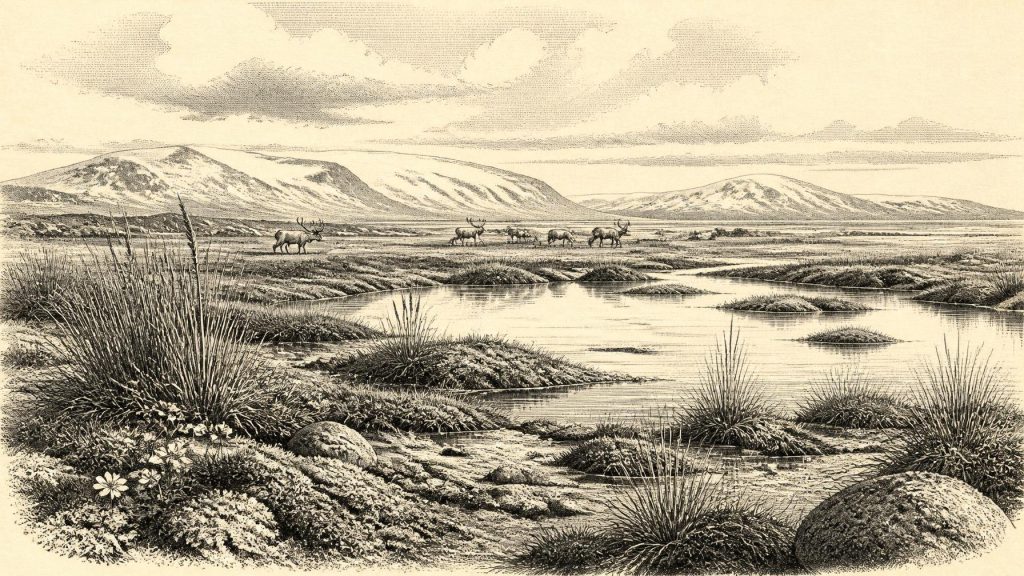
The evidence nevertheless has unusual force. Pollen, plant remains, mosses and insects indicate open tundra or tundra-like ground and a periglacial climate. Freshwater plants, sedges and mosses show that shallow water, wet margins and saturated hollows persisted. Finds including mountain-avens, dwarf-shrub and herbaceous taxa point to cold, exposed terrain rather than the dense woodland now associated with Ireland. Poor pollen preservation and the capacity of wind to move grains over distance impose limits: a little tree pollen is not proof of nearby forest. The secure conclusion is narrower and more valuable. Parts of Ireland could sustain cold-adapted vegetation and freshwater habitats between episodes of extensive glaciation.
Ice, Water and Seasonal Life
For any animal or visitor, seasonality would have governed daily survival. Long winters, frost action, sparse plant cover and exposed winds restricted forage and shelter. Summers, though short, could bring growth in wet depressions, beside pools and along streams. This was not a timeless white desert. Derryvree’s organic deposits demonstrate water and biological production, but they also show a landscape vulnerable to renewed ice advance and sediment burial. Later glaciers erased, disturbed or concealed much of the evidence that might otherwise reveal routes, camps or short-lived occupations.
There can be no responsible account here of farming, permanent fields, towns or domestic stock. Agriculture was many millennia in the future. Nor is there evidence for Ireland-wide trade, a social hierarchy, formal diplomacy or organised warfare. If humans entered the island, they would have operated within the practical economies of mobile Upper Palaeolithic hunter-gatherers known elsewhere in Europe: movement, close knowledge of animal behaviour, careful use of animal materials and portable stone tools. That is a contextual comparison, however, not direct evidence that such a group maintained a camp or social network in Ireland.
Castlepook Cave and the Animal Record
Castlepook Cave, also called Mammoth Cave, near Doneraile in north County Cork, offers the most striking southern counterpart to Derryvree. Excavations in the early twentieth century recovered a rich accumulation of Pleistocene animal remains, now of major importance to the National Museum of Ireland’s Natural History collections and to later re-dating programmes. The cave record includes remains attributed to woolly mammoth, reindeer, giant deer, brown bear, wolf, fox, Arctic fox, mountain hare, lemmings and spotted hyaena.
That impressive list must not be turned into a painted snapshot of one herd or one season. Cave assemblages form through several processes: carnivores bring in prey and scavenged parts; animals die in fissures or sheltered chambers; water moves bones and sediment; and early excavations did not retain the contextual detail expected today. Modern radiocarbon work has also shown that some older dates from Irish cave bone required revision after improvements in pretreatment. Castlepook demonstrates that a varied cold-stage fauna reached Ireland over a lengthy span, not that every species listed lived together in 30,673 BCE.
Even so, the fauna gives the landscape scale and texture. Reindeer imply grazing opportunities across open country and may have moved seasonally. Lemmings and Arctic fox fit severe, treeless conditions, while mammoth, giant deer, wolves and hyaenas reveal that Ireland intermittently supported, or was accessible to, a far richer large-mammal community than the later island. Predators and scavengers were not background details: they influenced where herbivores travelled, where carcasses accumulated and what entered caves. A cave could be a den, a trap, a refuge and a sediment archive at once.
The Reindeer Femur and the Human Question
The most provocative object is a reindeer femur from Castlepook bearing a deep incision interpreted by the zooarchaeologist Ruth Carden as a cut made by a sharp stone tool during carcass processing. County Cork heritage publications place the specimen broadly around 31,000 BCE, close enough to the present nominal date to make it the key possible indication of a human visit. If the interpretation is sustained, it would push evidence for human activity in Ireland dramatically earlier than the well-established terminal-Pleistocene evidence from County Clare.
Its limitations are equally important. The bone came from an old cave collection, not a modern excavation of a sealed occupation floor. Its date is the age of the animal bone, not automatically the date of the incision, the place where the animal died, or the duration of any human presence. No securely associated hearth, dwelling, stone-tool assemblage, burial, artwork or repeated occupation surface of comparable age has been recovered in Ireland. The mark may indicate that one or more people processed a reindeer, perhaps elsewhere before a carnivore or other agency carried the bone into the cave. It does not demonstrate permanent settlement, a population of known size, a language, ethnicity, polity or continuous occupation.
What Cannot Yet Be Recovered
Religion, ritual, learning and artistic traditions leave no identifiable Irish evidence for this interval. It would be wrong either to deny that people could have held beliefs or to supply imagined ceremonies from continental European parallels. Likewise, there is no basis for describing a political Ireland: no chiefs, territories, alliances or conflicts can be identified. The silence is archaeological, not proof that social life was absent wherever people may have travelled; it is a reminder that the evidence is inadequate for these questions.
The most defensible portrait is therefore of an intermittently habitable, cold and dynamic Irish landscape. Freshwater hollows in Fermanagh sustained tundra vegetation; open country supported cold-adapted animals; Cork caves preserved a time-depth of fauna; and one marked reindeer bone raises, but does not settle, the possibility of human butchery. Rather than an event in a numbered year, 30,673 BCE marks a threshold in Ireland’s deep past: a world shaped by ice, water, animals and uncertainty, whose surviving traces demand both curiosity and restraint.
Primary Sources
- A Middle Midlandian Freshwater Series at Derryvree, Maguiresbridge, County Fermanagh, Northern Ireland
- The Irish Quaternary Fauna Project
- A Reconsideration of the Radiocarbon Dating of the Marine Isotope Stage 3 Fauna from Southern Ireland
- The Last Irish Ice Sheet: Extent and Chronology
- Growth and Retreat of the Last British–Irish Ice Sheet, 31,000 to 15,000 Years Ago: the BRITICE-CHRONO Reconstruction
- Exploring Controls of the Early and Stepped Deglaciation on the Western Margin of the British Irish Ice Sheet
- Timing and Pace of Ice-Sheet Withdrawal Across the Marine–Terrestrial Transition West of Ireland During the Last Glaciation
- Reconstructing the Last Irish Ice Sheet 2: A Geomorphologically-Driven Model of Ice Sheet Growth, Retreat and Dynamics
- Trimlines, Blockfields and the Vertical Extent of the Last Ice Sheet in Southern Ireland
- Oscillating Retreat of the Last British-Irish Ice Sheet on the Continental Shelf Offshore Galway Bay, Western Ireland
- The Human Colonisation of Ireland in Northwest European Context
- First Evidence of a Late Upper Palaeolithic Human Presence in Ireland
- New Insights on the Fauna of Ireland’s Younger Dryas and Early Holocene from Alice & Gwendoline Cave
- The IntCal20 Northern Hemisphere Radiocarbon Age Calibration Curve (0–55 cal kBP)
- Palaeoecology: Guide No. 16, Fermanagh
- Introduction to the Late Quaternary and Holocene of Northern Ireland
- Dryas octopetala
- Archaeological Heritage of County Cork
- Heritage Artefacts of County Cork
- Castlepook Cave, Co. Cork: Archaeology Research Excavation Grant 2022