Castlepook Hares30669 BCE
Thirty thousand years ago, Ireland was a climatically unstable later-Pleistocene landscape rather than a land of recorded communities. Derryvree, County Fermanagh, preserves freshwater sediments between glacial tills, indicating treeless tundra, seasonal wetlands, hardy plants, insects and severe periglacial conditions during an ice-free interval. Castlepook Cave, County Cork, yielded mammoth, reindeer, giant deer, predators, hares and lemmings, demonstrating intermittent cold-stage habitats, although its mixed deposits span periods. A marked reindeer bone may indicate Upper Palaeolithic butchery, but human presence remains unconfirmed. Advancing British–Irish Ice Sheet glaciers later buried and disturbed evidence, leaving a fragmentary record of changing environments and mobile foragers.
Dateline
The label 30,669 BCE is useful for arranging a modern chronology, but it cannot identify an event in Ireland during a particular ancient year. No community then used this calendar, and neither archaeology nor environmental science can date Irish evidence to so exact a point. In the convention used by radiocarbon scientists, the date is roughly 32,600 years before AD 1950. It belongs to the later Pleistocene, broadly Marine Isotope Stage 3, a long and climatically unstable part of the last Ice Age. The responsible picture is therefore one made from wide calibrated ranges, layers of sediment, animal remains and changing ice—not from an annal of named people or happenings.
Two very different Irish archives make this period unusually vivid. Beneath a drumlin at Derryvree, near Maguiresbridge in County Fermanagh, roadworks exposed a freshwater deposit trapped between two substantial sheets of glacial till. At Castlepook, or Mammoth Cave, near Doneraile in north County Cork, excavations recovered a remarkable collection of Ice-Age animal bones. Neither deposit is a snapshot of 30,669 BCE. Together, however, they provide evidence for the kind of country that existed during the millennia around it: cold, open, biologically active in places, and increasingly vulnerable to the growth of the British–Irish Ice Sheet.
Time Measured in Ranges
The Derryvree sediments received a conventional radiocarbon determination of 30,500 ± 1,170/1,030 radiocarbon years BP. “BP” means before AD 1950, not before the present day, and radiocarbon years are not the same as calendar years. When calibrated, the determination translates into a broad calendar-age interval, commonly placed at approximately 36,900–31,700 calibrated years BP. The range encompasses centuries upon centuries; its younger end lies close to the modern label used here. It is evidence for an interval of local conditions, not proof that a particular plant flowered or animal passed through Fermanagh in 30,669 BCE.
That distinction matters especially because the dating and extent of early growth in the last British–Irish Ice Sheet remain debated. Later, at the Last Glacial Maximum, ice would cover Ireland much more extensively, reaching its largest known limits around 27,000–23,000 years ago. Around 32,600 years ago, however, the island’s circumstances were more regional and changeable. Derryvree records an ice-free freshwater environment after one glacial episode and before a later ice advance. Other evidence indicates that ice margins and ice streams elsewhere in the Irish Sea world were developing and shifting. A map with firm coastlines and a single, confident ice edge would misrepresent the state of research.
A Wet Tundra in Fermanagh
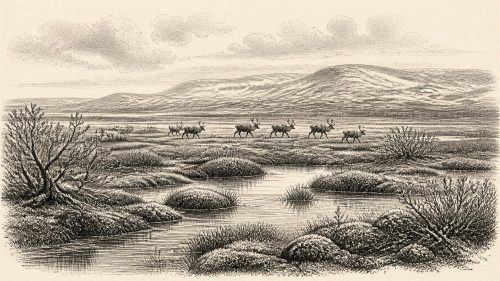
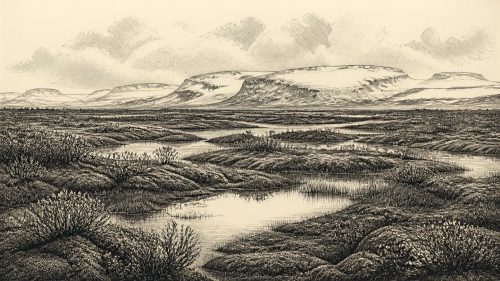
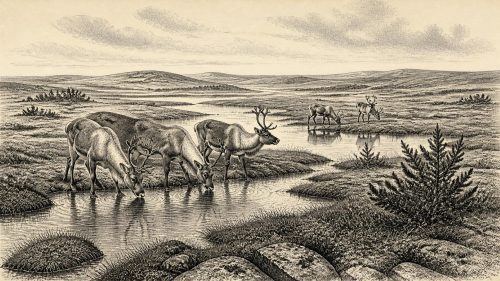
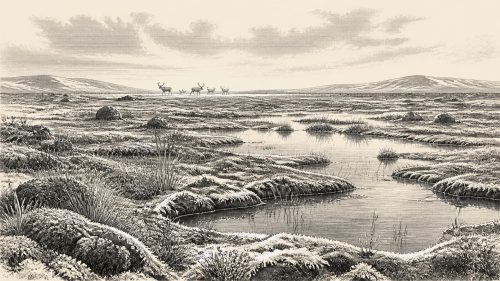
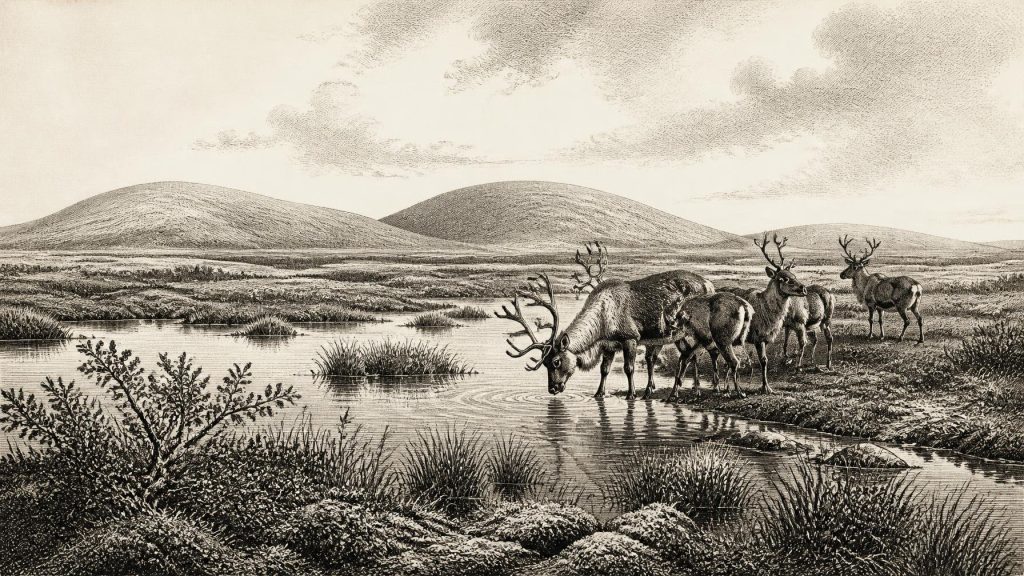
Derryvree is the clearest environmental anchor. Fine sand and silt accumulated in still or slow-moving freshwater, preserving pollen, mosses, seeds, aquatic plant remains and insects. The assemblage indicated open tundra and severe periglacial conditions: ground subject to deep seasonal freezing and thawing, rather than a woodland landscape. The evidence included plants associated with cold, exposed habitats, such as dwarf willow, mountain-avens and other hardy herbs, alongside mosses. A seed of bogbean, a wetland plant still familiar from Irish boggy ground, and remains of water-milfoil point to shallow fresh water or wet margins within this cold landscape.
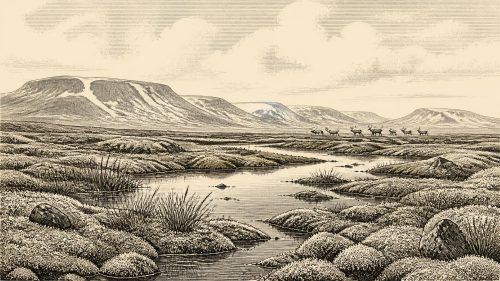
This was not necessarily a lifeless white desert. The aquatic and wet-ground record shows that, during a suitable season, water persisted and plants grew. Yet the surrounding land was likely sparse. Herb pollen was poorly preserved and is difficult to turn into a precise vegetation map, but the combined plant and insect evidence supports a largely treeless tundra mosaic: wet hollows and pools, sedgy or mossy ground, bare mineral surfaces and thinly vegetated slopes. The landscape would have changed strongly through the year. Short summers could generate meltwater, insect activity and plant growth; winters were much harsher, with frozen ground and limited food.
The setting also demonstrates a central fact of Irish environmental history: the surface visible today is not the surface that existed then. The Derryvree deposit was later overridden or sealed by ice-derived sediment. Drumlins, till plains and altered drainage lines are products of subsequent glacial action as well as older terrain. Ireland around 30,669 BCE should not be imagined through modern hedgerows, peatlands, fields or coastlines. Those belong to vastly later climates and human economies.
Mammoth Cave and Its Animals
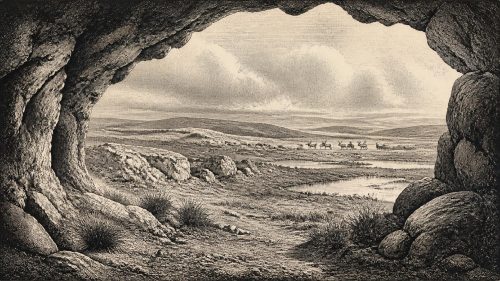
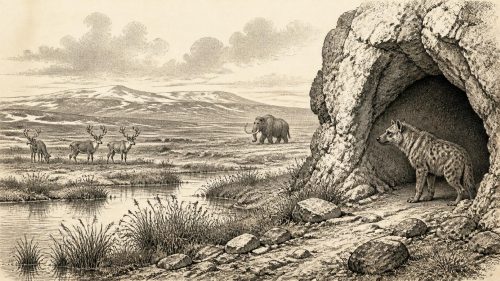
Castlepook Cave gives a complementary, though more complicated, view from the south. Its deposits and museum collections have produced woolly mammoth, reindeer, giant deer, brown bear, wolf, foxes, mountain hare, lemmings and spotted hyaena. A mammoth bone previously produced a radiocarbon age of 33,500 ± 1,200 BP, while the Irish Quaternary Fauna Project directly dated further specimens from the cave to different parts of the later Pleistocene. The cave fauna therefore shows that Ireland supported, at intervals, a distinctive cold-stage animal community between at least about 45,000 and 20,000 radiocarbon years ago.
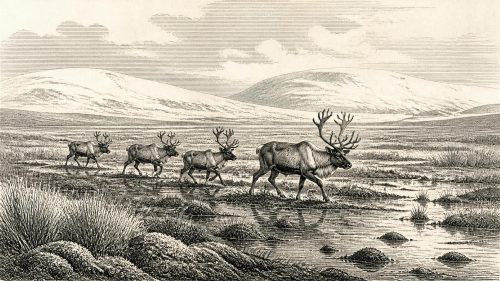
It does not demonstrate that every listed species stood together outside the cave in one year. Castle deposits were accumulated by many processes: animals died in or near passages; hyaenas and other carnivores carried material in; water could move bones; and early twentieth-century digging removed much of the stratigraphic information required today. Direct dates on individual bones are more secure than assumptions based solely on depth or association. Even so, the fauna makes a broad ecological point. Reindeer, mammoth and lemmings are consistent with cold, largely open country; hyaena, wolf and bear reveal a food web in which large carcasses and sheltered den sites mattered.
For people, Castlepook offers an intriguing but limited clue. A reindeer femur from the old collection has a deep linear mark interpreted by zooarchaeologist Ruth Carden as a cut or chop made by a sharp stone tool. Public reporting has associated the bone with an age of about 33,000 years. If the modification is confirmed as human-made and contemporary with the animal’s death, it would indicate carcass processing by people in Ireland during the Upper Palaeolithic, far earlier than the better-established terminal-Pleistocene evidence from County Clare. It would not establish a permanent settlement, population size, family group, camp, language or route of arrival.
People: Possibility, Not a Polity
No house floor, hearth, stone-tool assemblage, burial, artwork or securely stratified occupation site can be assigned to 30,669 BCE in Ireland. The reindeer bone is important precisely because the evidential bar is high. A date on bone establishes when the animal lived, while the interpretation of a surface mark must rule out carnivore damage, trampling, excavation damage and natural abrasion. Fresh work in the Castlepook cave system may improve the sequence through modern excavation and direct dating, but it has not yet converted this period into a conventional narrative of settlement.
Accordingly, political affairs, war, diplomacy, religion, formal learning and trade cannot responsibly be described for Ireland at this date. There is no evidence for chiefs, tribes, territories, alliances, shrines, ritual monuments or exchange networks. If small groups of Upper Palaeolithic people did reach the island or its then-changing western edge, they would have been highly mobile foragers operating in a difficult seasonal environment. That is an inference from the possible butchery trace and from wider north-west European hunter-gatherer lifeways, not a directly documented Irish society.
Nor should mobility be simplified into a claim that one could merely “walk to Ireland”. Global sea level was lower than today because water was stored in ice sheets, but the Irish Sea basin, connections to Britain and the position of ice margins changed over time. Glacial ice could obstruct some passages while exposed shelves, coasts and narrow-water crossings altered others. Animals demonstrably entered Ireland during the Pleistocene, showing that dispersal was possible; the exact routes, seasons and frequency remain uncertain.
Approaching a Colder World
The most important development around this date was environmental rather than political: Ireland was moving towards the severe conditions of the Last Glacial Maximum. The Derryvree wetland captures a temporary habitable niche in a cold continental climate. Castlepook’s fauna records an animal world that could exploit open habitats and limestone caves. But the future of both records was ice and disturbance. Expanding glaciers would erase, bury and rearrange much of the evidence, helping to explain why the human story remains so fragmentary.
Thirty millennia later, the value of these places lies in their restraint. Fermanagh’s silts show what grew and lived beside cold water; Cork’s cave bones show which mammals reached an intermittently hospitable landscape; one marked reindeer bone raises, but does not settle, the question of human presence. Around 30,669 BCE, Ireland was not yet a country of recorded communities. It was a changing Ice-Age terrain, where wetlands, tundra animals, caves and advancing ice preserve the faint preconditions of later human history.
Source References
Hover over a number to see the source. Select it to open the source.

- [1] A Middle Midlandian Freshwater Series at Derryvree, Maguiresbridge, County Fermanagh, Northern Ireland
- [2] The Irish Quaternary Fauna Project
- [3] Palaeoecology: Irish Quaternary Association Field Guide
- [4] Spotted Hyena Skull
- [5] Castlepook Cave, County Geological Site Report
- [6] Occurrence of Mammalia Relicts at Site Castlepook Cave
- [7] The Timing and Magnitude of the British–Irish Ice Sheet Between Marine Isotope Stages 5d and 2
- [8] Growth and Retreat of the Last British–Irish Ice Sheet, 31,000 to 15,000 Years Ago: the BRITICE-CHRONO Reconstruction
- [9] Timing, Pace and Controls on Ice Sheet Retreat: an Introduction to the BRITICE-CHRONO Transect Reconstructions of the British-Irish Ice Sheet
- [10] The Evolution of the Terrestrial-Terminating Irish Sea Glacier During the Last Glaciation
- [11] Stratigraphic and Palaeo-Geomorphological Evidence for the Glacial-Deglacial History of the Last British-Irish Ice Sheet in the North-Western Irish Sea
- [12] Trimlines, Blockfields and the Vertical Extent of the Last Ice Sheet in Southern Ireland
- [13] Ireland: Submerged Prehistoric Sites and Landscapes
- [14] Anthropogenic Changes to the Holocene Nitrogen Cycle in Ireland
- [15] Freshwater Organic Deposits and Stratified Sediments Between Early and Late Midlandian (Devensian) Till Sheets, at Aghnadarragh, County Antrim, Northern Ireland
- [16] New Insights on the Fauna of Ireland’s Younger Dryas and Early Holocene from Alice & Gwendoline Cave
- [17] Radiocarbon Date List VIII
- [18] Pleistocene Vertebrates in the British Isles
- [19] Ireland’s Palaeolithic Archaeology – Fleeting Footprints in a Frozen Land
- [20] Reindeer Bone Found in Cork Cave Shows Human Activity in Ireland 33,000 Years Ago
Primary Sources
- A Middle Midlandian Freshwater Series at Derryvree, Maguiresbridge, County Fermanagh, Northern Ireland
- The Irish Quaternary Fauna Project
- Palaeoecology: Irish Quaternary Association Field Guide
- Spotted Hyena Skull
- Castlepook Cave, County Geological Site Report
- Occurrence of Mammalia Relicts at Site Castlepook Cave
- The Timing and Magnitude of the British–Irish Ice Sheet Between Marine Isotope Stages 5d and 2
- Growth and Retreat of the Last British–Irish Ice Sheet, 31,000 to 15,000 Years Ago: the BRITICE-CHRONO Reconstruction
- Timing, Pace and Controls on Ice Sheet Retreat: an Introduction to the BRITICE-CHRONO Transect Reconstructions of the British-Irish Ice Sheet
- The Evolution of the Terrestrial-Terminating Irish Sea Glacier During the Last Glaciation
- Stratigraphic and Palaeo-Geomorphological Evidence for the Glacial-Deglacial History of the Last British-Irish Ice Sheet in the North-Western Irish Sea
- Trimlines, Blockfields and the Vertical Extent of the Last Ice Sheet in Southern Ireland
- Ireland: Submerged Prehistoric Sites and Landscapes
- Anthropogenic Changes to the Holocene Nitrogen Cycle in Ireland
- Freshwater Organic Deposits and Stratified Sediments Between Early and Late Midlandian (Devensian) Till Sheets, at Aghnadarragh, County Antrim, Northern Ireland
- New Insights on the Fauna of Ireland’s Younger Dryas and Early Holocene from Alice & Gwendoline Cave
- Radiocarbon Date List VIII
- Pleistocene Vertebrates in the British Isles
- Ireland’s Palaeolithic Archaeology – Fleeting Footprints in a Frozen Land
- Reindeer Bone Found in Cork Cave Shows Human Activity in Ireland 33,000 Years Ago