Munster Succession1194 CE
In 1194, Domnall Mór Ua Briain’s death destabilised Munster, where his son Muirchertach’s accession was undermined by capture and blinding, while other Ua Briain and Mac Carthaig kin suffered killings, raids and betrayal. Ecclesiastical authority featured in the death of Killaloe’s bishop and the killing at Cashel despite legatine protection. Elsewhere, resistance expelled foreigners from Uí Fhinntain, Cú Mide Ua Flainn was killed, and Gillibert Mac Goisdelb’s Erne expedition failed. Across the Irish Sea, Richard I’s defeat of John enabled Walter de Lacy to regain Meath, demonstrating how Angevin politics reshaped Irish lordships amid local conflict, rivalry and uncertain authority.
Dateline
In 1194, Ireland’s political map was neither settled nor neatly divided between “Irish” and “Norman” lands. Kingship still depended on family, military following, church patronage and the ability to protect dependants; the newer lordships founded by incomers were themselves subject to quarrels within the Angevin world. The year’s most consequential Irish development was the death of Domnall Mór Ua Briain, king of Munster, and the dangerously contested succession that followed. Yet annalists also recorded violence in the north, an abortive expedition to the Erne, and changes in the balance of power within the lordship of Meath. Taken together, their terse notices show a country in which authority was intensely local but connected to wider politics across the Irish Sea.
Reading a Difficult Year
The evidence for 1194 is substantial by contemporary standards, though it needs careful handling. The Annals of Ulster, Annals of Inisfallen, Annals of Loch Cé, Mac Carthaigh’s Book and the later Annals of the Four Masters preserve overlapping but not identical accounts. Their year-numbers do not always align: material placed under 1194 by one compilation can appear a year earlier in another. The safest approach is therefore to treat the principal notices as belonging to the 1194 annalistic horizon, while avoiding invented days, months or sequences where the sources provide none.
Such records are not neutral administrative reports. They chiefly memorialise kings, clerics, leading families, raids, killings and expeditions. Their silences are important too. No surviving Irish annal for this year supplies a national harvest report, prices, population figures or a general account of trade. Ordinary households nonetheless felt the consequences of the events which are recorded: a disputed succession could draw followers into service, disrupt cattle and food supplies, and expose churches, estates and routes to predatory movement. The year is best understood through these concentrated points of pressure rather than as a fully documented national chronicle.
The Death of Domnall Mór
Domnall Mór Ua Briain died in 1194. The Annals of Ulster calls him king of Munster, while the southern Annals of Inisfallen simply says that the king of Mumu died and that his son immediately took the kingship. The Annals of the Four Masters, drawing on a later compilation but preserving a striking formula, praises him as a bright beacon of peace and war, generosity and valour for the men of Munster and the wider southern half of Ireland. Even allowing for conventional panegyric, the language conveys his standing.
His death mattered because Domnall Mór had been a central figure in the struggle to preserve Ua Briain influence in Thomond and Munster after the arrival of Anglo-Norman forces. He had operated in a world of shifting alliances, fortified places and competing regional dynasties, not as the ruler of a territorially unified Irish kingdom. His authority rested especially in Thomond, north of the lower Shannon, but his political weight had extended far beyond it. The passing of such a ruler did not automatically create a settled inheritance. Gaelic succession was shaped by kin-group politics and the claims of eligible male relatives, and an adult son’s accession was only one element in securing power.
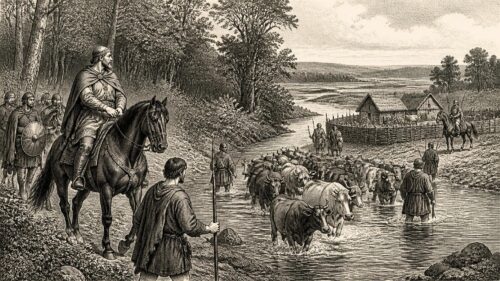
Muirchertach, Domnall’s son, is named as the new ruler in the annals. But the same year’s southern record makes plain how insecure his position was. Muirchertach was seized and treacherously blinded by the Gaill, the “foreigners” of the annals, usually meaning Anglo-Norman settlers and their forces in this context. Blinding was not merely an act of personal cruelty: physical integrity was deeply bound up with eligibility and fitness for rule. The notice thus describes a political assault on the new regime as well as an attack on one man. It would be wrong, however, to force the surviving text into a detailed narrative of who ordered it, the exact place of the capture or the immediate outcome; the annals do not provide those particulars.
Other killings underline the volatility of the transition. Tadc, son of Mathgamain Ua Briain, was put to death by foreigners at Cashel. The Annals of Inisfallen adds a particularly revealing qualification: this occurred despite the protection of the papal legate and of Patrick. That wording indicates that ecclesiastical protection and the authority associated with St Patrick’s cult were invoked, even if they failed to save him. Gilla Ailbi Ua Caím and a kinsman were also killed by foreigners, with the annalist attributing responsibility to the connivance of Mac Carthaig’s sons. Meanwhile Fíngen son of Mac Carthaig turned against a kinsman and was captured following a raid into Ciarraige and Ua hAeda territory. These were not isolated feuds at the edge of politics: they show rival kindreds manoeuvring amid the collapse of established leadership in Munster.
Conflict Beyond Munster
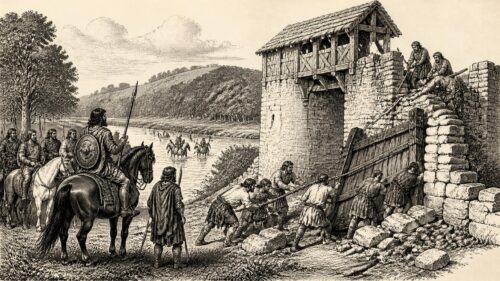
Violence also touched the north. The Annals of Ulster reports that foreigners came upon the island of Uí Fhinntain and were driven from it by force. The brief notice does not securely identify the participants, the precise location, or whether the island was attacked for strategic, economic or ecclesiastical reasons. Its value lies in what it firmly establishes: an armed incursion met organised resistance and failed. The event is a useful corrective to any picture of uninterrupted expansion by the incoming military lordships.
The same annal records the killing of Cú Mide Ua Flainn by foreigners. A related notice in Mac Carthaigh’s Book, entered under 1193, calls Cú Mide king of Uí Thuirtri and Fir Lí and attributes his death to the men of John de Courcy at Aentreibh. Because of the discrepancy in annalistic dating, the association should be stated cautiously. It nevertheless points to the turbulent zone around de Courcy’s Ulster lordship, where local dynasties, Scandinavian-Gaelic connections and settlers from Britain were all part of the political landscape.
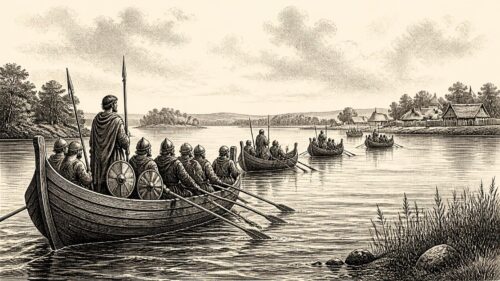
Another recorded expedition went north-westwards. Gillibert Mac Goisdelb led a hosting to Eas Ruaidh, the important ford and rapids at Ballyshannon on the Erne, but returned without advantage. A “hosting” was not necessarily a pitched battle: it could be a show of force, a bid for tribute, a raid or an attempt to compel submission. The report of failure is unusually informative. It shows that mobilisation was expensive and uncertain, and that even a leader capable of taking a force to such a strategic river crossing could come home empty-handed. In practical terms, men had been assembled, supplies consumed and political credit risked without a profitable result.
Angevin Repercussions in Meath
Events in England also had direct repercussions in Ireland. In 1193–94, Richard I’s younger brother John, lord of Ireland, rebelled while Richard was imprisoned and then returning from captivity. John’s defeat and submission in 1194 exposed the Irish arrangements made under his authority to revision. Ireland was not simply a distant possession ignored by royal politics: control over its revenues, offices and great lordships formed part of the contest between king, prince and magnates.
Walter de Lacy benefited from the reversal. Scholarly reconstructions based on charters, chronicles and later narrative evidence place his recovery of Meath in the aftermath of John’s collapse in 1194. A contemporary continental notice states that Walter received the lordship of Meath and captured Peter Pipard, John’s justiciar, with his knights. The broad sequence is secure, but the precise dating and mechanics of the transfer remain matters for caution. What is clear is that the great liberty of Meath returned to the control of the heir of Hugh de Lacy, rather than remaining subject to John’s officer.
This was far more than a private inheritance dispute. Meath was a large lordship whose holders commanded castles, estates, tenants and military obligations across the midlands and towards Dublin. Richard I’s intervention strengthened one magnate while reducing John’s immediate grip on Ireland. John de Courcy, whose power was rooted in Ulster, was also associated with Walter de Lacy in royal government during 1194–95. Their collaboration belongs to the changing political settlement after John’s rebellion, even though the two lordships retained their own local interests and mixed populations.
Church, Protection and Continuity
Church affairs emerge in 1194 chiefly through death and the language of protection. Constantine Ua Briain, bishop of Cill Dalua—Killaloe—died. His see stood within the core territory of the Ua Briain dynasty, making his loss significant at precisely the moment when royal succession was under stress. The separate recording of the bishop and king demonstrates how ecclesiastical and secular authority were intertwined without being identical. Bishops, monasteries and churches were spiritual institutions, but also holders of land, sanctuaries of learning and places through which rulers displayed patronage and legitimacy.
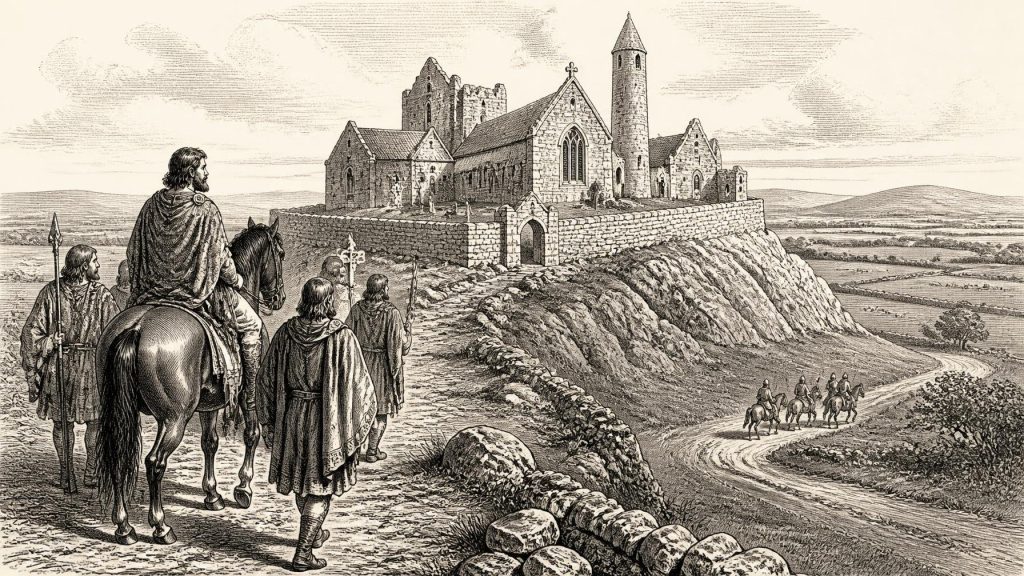
The killing at Cashel despite the legate’s protection makes the point more sharply. Cashel was an exceptionally important ecclesiastical and political centre in Munster. To violate a protected person there was to challenge a recognised restraint on violence. The annalist’s condemnation does not prove that protection was always effective; rather, it reveals the moral and legal expectation against which the act was judged. In a year of disputed succession, that expectation was itself politically meaningful.
A Year of Unfinished Outcomes
Nothing in the evidence warrants describing 1194 as a single decisive conquest or national turning point. Its importance lies instead in several unfinished outcomes. Domnall Mór’s death removed an experienced Munster ruler, while the blinding and killing of Ua Briain kinsmen exposed the ferocity of the struggle around his succession. Resistance forced foreigners off Uí Fhinntain, yet other local leaders were killed by them. Gillibert Mac Goisdelb’s march to Eas Ruaidh produced no gain. In Meath, Richard I’s victory over John altered the position of Walter de Lacy and demonstrated that decisions made across the sea could quickly reshape Irish lordship.
For contemporaries, 1194 was therefore a year in which power was palpable in bodies, fortresses, escorts, hostings and sanctuaries: a king died, an heir was maimed, protected status was breached, an island was defended, and a great midland lordship changed hands. The annals preserve these moments with frustrating brevity, but they show Ireland not as a passive field for outside intervention, but as a set of active and contested political societies whose leaders, churchmen and communities shaped events on their own ground.
Primary Sources
- The Annals of Ulster: Year U1194
- Annals of the Four Masters: Annal M1194
- Annals of Inisfallen: Annal AI1194
- Annals of Loch Cé A.D. 1014–1590: Annal LC1194
- Mac Carthaigh’s Book: Annal MCB1194
- The Annals in Cotton MS. Titus A. XXV
- CELT Project: The Annals of Ulster
- CELT Project: Annals of the Four Masters
- CELT Project: Annals of Inisfallen
- CELT Project: Annals of Loch Cé
- CELT Project: Mac Carthaigh’s Book
- King and Magnate in Medieval Ireland: Walter de Lacy, King Richard and King John
- John de Courcy
- Lacy, Hugh de
- John de Courcy and the Coinage of the Lordship of Ulster
- Survey Report No. 53: County Down Archaeological Survey
- 12th Century Reorganisation
- The Norman Conquest
- Calendar of Documents, Relating to Ireland: Preserved in Her Majesty’s Public Record Office, London, 1171–1307
- Parchment Conquest, 1171–1307