Femur From Mammoth Cave30607 BCE
About 30,607 BCE, Ireland lay within a cold, unstable Late Pleistocene landscape, but the date is a modern filing device rather than a precise historical year. Radiocarbon, stratigraphy and environmental records indicate variable ice growth, lowered seas, altered coasts and open periglacial habitats. Inter-till deposits at Derryvree, County Fermanagh, preserve freshwater plants and cold-adapted insects, demonstrating local non-glacial intervals. Cave finds confirm large mammals, including reindeer and mammoth, occurred in Ireland. A marked reindeer femur from Castlepook Cave may indicate human butchery around 31,000 BC, yet cannot prove settlement, society or continuous occupation. Evidence remains fragmentary, local and uncertain overall.
Dateline
30,607 BCE is a modern chronological label, not a recoverable year in Ireland’s past. No calendar, written record, named community or excavated occupation layer can be tied to this particular point. At this depth of time, archaeological chronology works through radiocarbon determinations, stratigraphy and environmental sequences, each with substantial margins of uncertainty. The responsible history of Ireland at this date is therefore an account of a broad Late Pleistocene interval—roughly the thirty-third millennium before present—rather than a report of events in a single year.
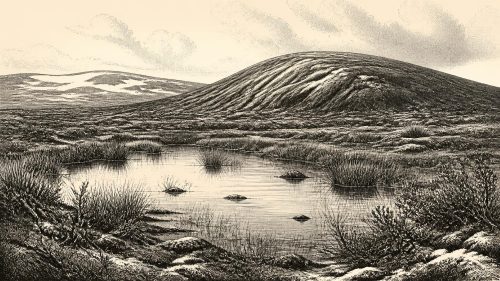
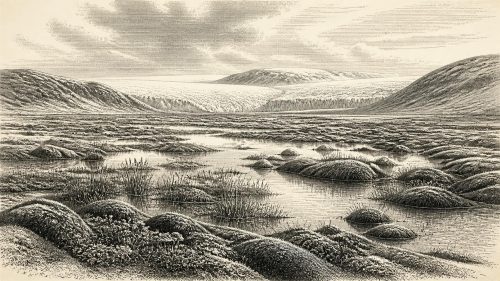
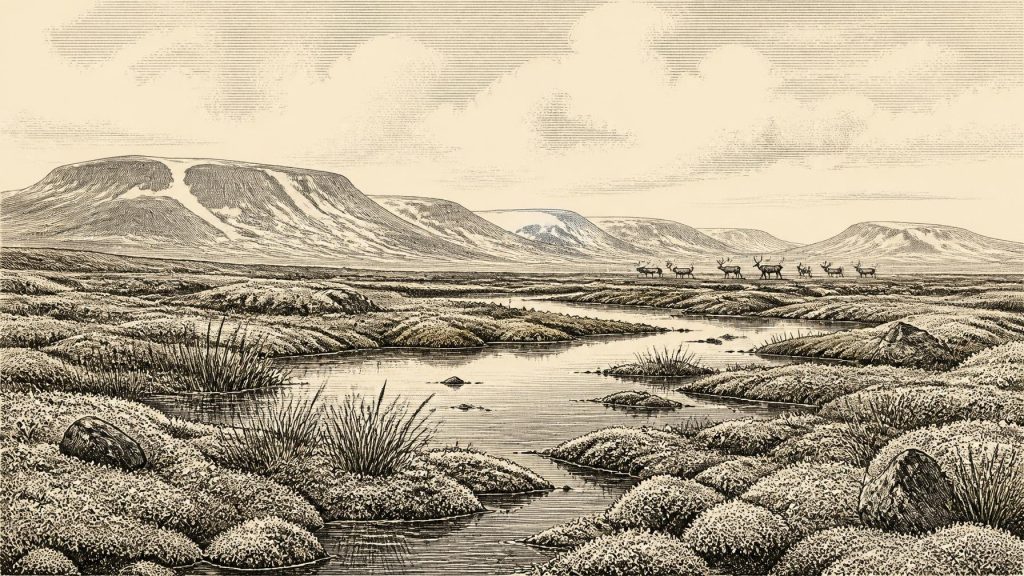
The date falls within the later part of Marine Isotope Stage 3, before the fullest expansion of the last British–Irish Ice Sheet. Conditions were cold, unstable and regionally varied. Ireland was not simply the familiar island of later history placed in a colder climate: ice, lowered sea level, shifting drainage and open vegetation made a markedly different geography. The best evidence suggests a landscape in transition, with growing ice in some uplands and northern districts, while some lower areas and sheltered basins could still support open freshwater environments and cold-adapted plants and animals.
Dating an Ice-Age Ireland
Radiocarbon dates must not be converted mechanically into calendar years. A radiocarbon result is expressed in years before present, where “present” conventionally means 1950, and must be calibrated because the amount of radioactive carbon in the atmosphere has altered through time. The internationally used IntCal20 curve extends far enough to address this period, but calibrated ranges remain broad. That is why 30,607 BCE can be used as a filing point for an annual archive, but cannot denote an Irish anniversary or a precisely dated human action.
The closest especially informative environmental record is at Derryvree near Maguiresbridge, County Fermanagh. There, road-cut exposures revealed organic-rich freshwater layers and fine sediments lying between two tills: deposits left by ice. The organic horizon produced the conventional radiocarbon determination BIRM-166, 30,500 radiocarbon years BP, with an uncertainty of +1,170/−1,030 years. Calibration places the evidence broadly within the mid-to-late thirties through early thirties thousand calibrated years BP, a range that overlaps the general horizon represented by this notional date. It does not establish what was occurring throughout Ireland, still less on a particular day or year.
Fresh Water Between Glaciers
Derryvree matters because it preserves an environmental interval between glacial advances. The organic deposits contain freshwater mosses, sedges and other plant remains, alongside insects of cold northern aspect. Such evidence is direct: these organisms or their remains were present in or around the waterbody. Their wider meaning is interpretative, but reasonable. Together they indicate cold, open, periglacial country with standing or slow-moving fresh water, not dense woodland and not continuous ice.
Related inter-till deposits at Hollymount near Maguiresbridge and at Greenagho near Belcoo reinforce the larger conclusion that Midlandian Ireland experienced episodes of cold, non-glacial conditions between phases of ice advance. Yet the evidence is necessarily local. A sedge-rich pool in Fermanagh is not a map of the whole island. It cannot demonstrate that every valley was ice-free, nor can it tell us how long an individual wetland lasted. What it does show is that the phrase “Ice Age Ireland” should not be imagined as a permanent, featureless white cover.
The plants implied a low, windswept environment. Mosses and sedges could exploit wet margins; hardy herbs and dwarf shrubs probably occupied better-drained ground. Seasonal contrast would have been severe. Long winters, frozen ground, spring meltwater and short growing seasons shaped the available habitats. The later ice sheets would erode, bury and rearrange much of this older terrain, which helps explain why such survival of organic evidence is exceptional.
Ice, Coasts and Animal Movement
At this time the last British–Irish Ice Sheet had not yet reached its later maximum, but its growth was under way. Modern BRITICE-CHRONO reconstructions begin at 31,000 years BP because earlier controls are sparse; their modelled and empirical reconstructions show ice accumulation in parts of northern Ireland and upland Ireland, with considerable uncertainty in the exact margins. They also underline an important regional fact: ice-sheet growth was not uniform. Different sectors advanced, thickened and later retreated at different times.
Sea level was substantially lower than today because water was locked in global ice sheets. The coastlines of the present island and Irish Sea basin were therefore different, though low sea level did not automatically make Ireland part of continental Europe. Ice, sea channels, marshy lowlands and local topography all affected movement. Any animal or person moving through this north-western European world encountered a changing patchwork of exposed ground, water, ice margins and potentially hazardous crossings rather than a simple land bridge.
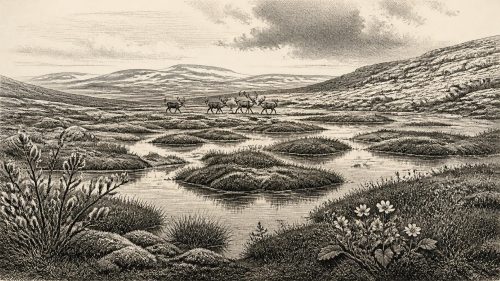
Irish cave collections show that large mammals did occur on the island during pre-Last Glacial Maximum phases. Reindeer, mammoth, brown bear, wolf, spotted hyaena and deer are among the species represented in the wider Pleistocene record. These finds do not mean that all species lived together at every place or moment; cave deposits often combine bones accumulated over long spans, through carnivore activity, natural deaths, water movement and excavation disturbance. Nevertheless, their presence demonstrates that Ireland formed part of a broader cold-climate faunal zone rather than an ecological void.
The Castlepook Reindeer Question
The find most closely associated with the broad period of 30,607 BCE is a reindeer femur from Castlepook Cave, or Mammoth Cave, near Doneraile in north County Cork. County Cork heritage material dates it to about 31,000 BC and records zooarchaeologist Ruth Carden’s assessment that a deep mark on the bone was made by a sharp stone tool during butchery. If that identification and chronology are sustained by further study, it would provide potentially very early evidence that people processed a reindeer carcass in Ireland.
The distinction between that claim and a settled population is crucial. The femur is not a house floor, hearth, lithic assemblage, burial or camp. No securely associated stone tools, structures, food store, artwork or human remains of this age have been published from Castlepook. The bone was recovered in early twentieth-century cave excavation, long before current standards of three-dimensional recording, sediment sampling and taphonomic analysis. Later work has rightly renewed interest in the cave, but also stresses how much information old cave collections can have lost.
The most cautious conclusion is therefore that the marked femur may record a brief human encounter with an animal, perhaps elsewhere before part of the carcass reached the cave. It cannot establish an arrival date, a named Upper Palaeolithic group, a permanent settlement or descent from possible visitors to later Irish communities. It remains important precisely because the claim is narrow and testable. Further excavation, microscopic analysis of the mark, direct dating and publication of its context are needed before larger narratives are justified.
No Polities, No Proven Trade
There is no evidence from around this horizon for political institutions, rulers, diplomacy, territorial boundaries or organised warfare in Ireland. Nor can archaeologists responsibly identify an Irish religion, language, art tradition or learned culture at 30,607 BCE. The absence is not proof that people lacked beliefs, social ties or knowledge; it is a limit of the surviving record. A single possible butchery mark cannot disclose kinship, ritual, leadership or speech.
The same restraint applies to economy and trade. If people did visit Ireland, they may have moved through a wider hunting landscape in which animal migrations, seasonal resources and access to stone mattered. But no Irish assemblage from this period demonstrates exchange networks, boat-building, tool production or a sustained hunting economy. Reindeer and other animals were resources in an ecological sense; they cannot, without associated archaeological evidence, be turned into an economy or society.
Settlement is equally unproven. The Derryvree deposits show a wetland environment, not a village. Castlepook’s bone is a possible trace of carcass processing, not a dwelling. The first substantial archaeological evidence for human lifeways in Ireland belongs vastly later, after the ice had retreated and Mesolithic communities left recognisable camps, tools and repeated activity areas. Around 30,607 BCE, the historical record consists instead of sediments, fossils, landforms and carefully qualified inferences.
An Island of Evidence and Uncertainty
The significance of this period lies in that combination of possibility and limitation. Northern Fermanagh preserves a cold freshwater world between glaciers. Cork caves preserve fragments of a larger mammal community and a provocative possible sign of human butchery. Ice-sheet reconstructions reveal a rapidly changing physical setting, while modern calibration reminds us that scientific dates are ranges, not ancient diary entries. These sources allow Ireland to be placed securely in the dynamic north-west European Ice Age, but they do not permit a fictional year-by-year narrative.
For 30,607 BCE, then, the best-supported Irish story is one of open cold landscapes, wetlands surviving in some places, roaming fauna, altered coasts and ice advancing on a regional scale. A reindeer femur from Mammoth Cave may preserve the faintest trace of people within that world. It is an extraordinary possibility, but not yet a populated history. The proper emphasis remains on the evidence itself—and on the patience required to turn a scattered Ice-Age archive into responsible knowledge.
Primary Sources
- Early Midlandian–Middle Midlandian, Pleistocene, Northern Ireland
- Growth and Retreat of the Last British–Irish Ice Sheet, 31,000 to 15,000 Years Ago: The BRITICE-CHRONO Reconstruction
- The Irish Quaternary Fauna Project
- First Evidence of a Late Upper Palaeolithic Human Presence in Ireland
- New Insights on the Fauna of Ireland’s Younger Dryas and Early Holocene From Alice & Gwendoline Cave
- Heritage Artefacts of County Cork
- Prehistoric Details
- Our Ancient Landscapes: Hunter-Gatherers in Ireland
- Castlepook Cave, County Cork, 2022
- IntCal20 Issue
- IntCal: Radiocarbon Calibration
- Radiocarbon Dating and Chronological Modelling: Radiocarbon Dating
- New Data for the Last Glacial Maximum in Great Britain and Ireland
- Trimlines, Blockfields and the Vertical Extent of the Last Ice Sheet in Southern Ireland
- Dating Constraints on the Last British-Irish Ice Sheet: A Map and Database
- Figure 6.—The Subdivision of the Quaternary Period in Ireland
- References and Recommended Reading
- Middle Midlandian Interstadial Deposits at Greenagho, Near Belcoo, County Fermanagh, Northern Ireland
- Freshwater Organic Deposits and Stratified Sediments Between Early and Late Midlandian (Devensian) Till Sheets, at Aghnadarragh, County Antrim, Northern Ireland
- The Geological Heritage of County Leitrim
- Phylogeographic, Ancient DNA, Fossil and Morphometric Analyses Reveal Ancient and Modern Introduction Events for the Red Deer (Cervus elaphus) in Ireland
- A North-Western Habitat: the Paleoethology and Colonisation of a European Peninsula