Mammoth Cave’s Cold Fauna30967 BCE
At about 30,967 BCE, Ireland lay in the volatile later Marine Isotope Stage 3, before extensive Last Glacial Maximum ice cover. Derryvree, County Fermanagh, preserves freshwater sediments showing treeless tundra vegetation, wetlands and cold-adapted plants. Castlepook Cave, County Cork, contains a mixed faunal record including mammoth, reindeer, giant deer, predators and scavengers, indicating open cold-steppe environments. A cut-marked reindeer femur may indicate brief Upper Palaeolithic butchery, but cannot establish permanent human occupation. Dates and deposits remain uncertain, while cave assemblages accumulated over long periods. Growing ice later transformed landscapes and destroyed or concealed much potential evidence of people and animals.
Dateline
The label 30,967 BCE gives a useful place in a modern chronological sequence, but it cannot describe a recorded Irish year. No written dates, named people, political communities or events survive from this depth of time. Archaeologists instead work with deposits, animal bones, plant remains, landforms and laboratory dates, each carrying a margin of error. Arithmetically, 30,967 BCE falls about 32,916 years before AD 1950, the conventional starting point for “BP” dating. It belongs to the later part of Marine Isotope Stage 3 (MIS 3), a climatically volatile interval of the Last Glacial Period, shortly before the Last Glacial Maximum transformed Ireland beneath an extensive ice sheet.
The responsible history of Ireland at this point is therefore not a year-by-year narrative but a carefully bounded reconstruction of a cold, changing environment. Two very different archives are particularly important. At Derryvree near Maguiresbridge in County Fermanagh, sediments trapped between glacial tills preserve a freshwater and wetland world. At Castlepook Cave, near Doneraile in north County Cork, bones accumulated in a limestone cave record animals adapted to open, cold country. A single reindeer bone from Castlepook has also been interpreted as possible evidence of human butchery. It is potentially momentous, but it remains far too slight to prove a settled population.
Dating a Calendarless Landscape
Modern calendar precision should not be projected back into the Pleistocene. A radiocarbon age is not automatically a calendar age: the quantity of radioactive carbon in the atmosphere varied through time, so results must be calibrated against independently constructed curves. At such antiquity, both the original measurement and the calibration carry substantial uncertainty. The Derryvree organic deposit produced a conventional radiocarbon result of about 30,500 radiocarbon years BP, with an uncertainty of roughly a thousand years. One later synthesis expresses its calibrated position broadly in the mid-30,000s calendar years BP, approximately 34.8–37.0 thousand years before 1950.
That range is older than the notional year used here, rather than an exact match for it. Yet it remains one of the nearest securely relevant Irish environmental records for this broad phase of the Ice Age. Castlepook’s faunal sequence is likewise a long-lived archive, not a sealed deposit from one season or one generation. Re-dating has shown that some older cave dates required revision and that several animals formerly thought later were present much earlier in MIS 3. The lesson is fundamental: a precise-looking BCE year is a filing device, whereas the evidence speaks in overlapping ranges, deposits and phases.
Wet Ground Beneath Fermanagh
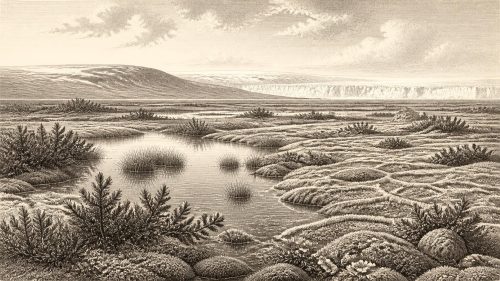
Derryvree was exposed during road works in a drumlin landscape. Beneath later glacial sediments lay beds of sand, silt and organic mud, evidence that water had stood or moved slowly across the site before advancing ice buried it. Plant macrofossils, mosses, pollen and small animal remains make this deposit unusually valuable. Much of the Irish Pleistocene landscape was later scoured, redeposited or sealed by ice; a protected organic layer can therefore preserve a local ecological record that has vanished almost everywhere else.
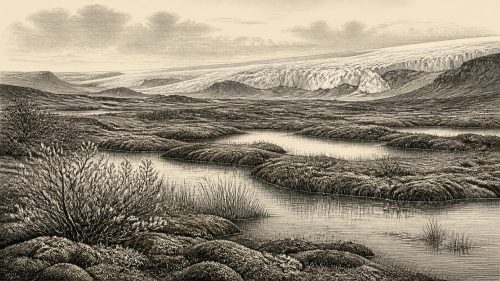
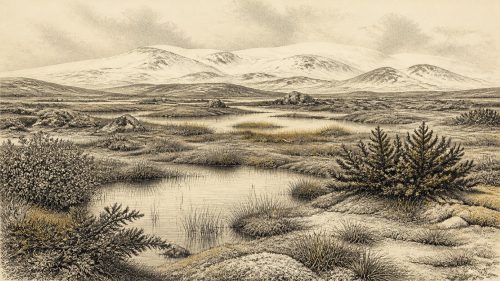
The assemblage indicates a treeless, cold landscape, but not a uniform desert of snow and bare rock. Wet hollows supported sedges, mosses and aquatic plants, while low-growing Arctic and alpine vegetation occupied the surrounding ground. Bogbean, water-milfoil, dwarf willow, mountain avens, clubmosses and other cold-tolerant plants have all featured in interpretations of the Derryvree evidence. This was a mosaic: shallow freshwater, marshy margins, exposed mineral soils and periglacial ground, responding sharply to changes in temperature, moisture and the position of ice.
Such evidence illuminates environment and regional change, not human settlement. There are no houses, fields, hearths, cultivated plants, pottery or tools at Derryvree. Nor can the deposit identify an Irish “people” with a language, religion or political order. Its importance lies in demonstrating that parts of the island could, during a cold non-forest phase, sustain freshwater habitats and a varied tundra-like flora before later glaciation overwhelmed or reshaped large areas.
The Cave at Doneraile
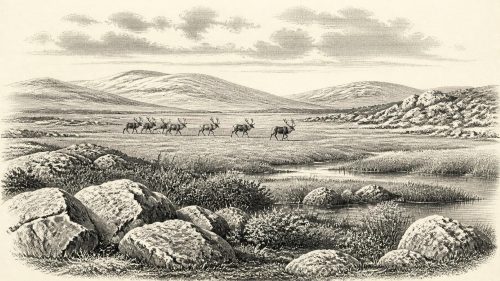
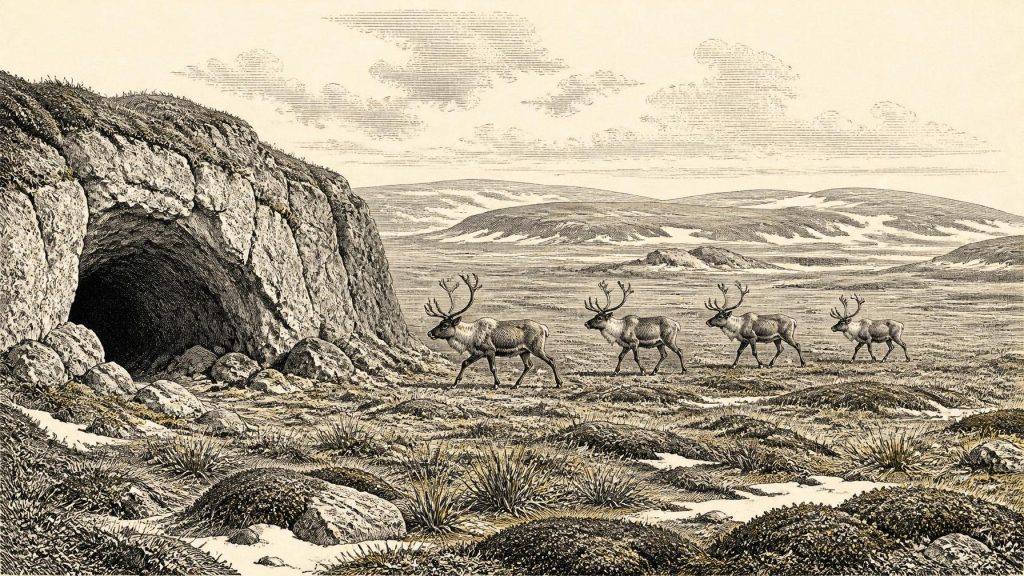
Castlepook Cave, historically called Mammoth Cave, provides the richer animal archive. Its deposits yielded remains of woolly mammoth, reindeer, giant deer, brown bear, wolf, foxes, mountain hare, lemmings and spotted hyaena. This combination conveys an open, cold-steppe or tundra environment with large grazing animals, predators and scavengers. It does not mean that every species lived together at the cave on the same day. Cave deposits commonly mix material introduced over long periods by carnivores, water, roof collapse and human excavation. Still, the fauna confirms that Ice-Age Ireland supported animals now absent from the island and, in some cases, from north-west Europe.
Spotted hyaena is especially revealing. Castlepook was not simply a human shelter waiting to be discovered; it was also a place to which carnivores could drag carcass parts, feed, den or leave bones. Tooth damage, breakage and the distribution of skeletal elements are therefore as important as species names. The cave was explored in the early twentieth century, before the refined recording standards now expected in excavations. Its old collections remain scientifically valuable, but the original positions and associations of many bones cannot always be reconstructed. Recent fieldwork has sought undisturbed deposits that may clarify this complex history.
The broader landscape beyond the cave was unlikely to resemble modern wooded Cork. Trees were scarce or absent in the coldest exposed settings, and the terrain offered seasonal grazing, sheltering hollows, rock outcrops and frozen or waterlogged ground. The exact coastline, sea level and travel routes were very different from today. Lower global sea levels altered the Irish Sea region, but the physical accessibility of Ireland varied with time, local ice and changing marine barriers. The evidence does not justify a simple claim that people walked easily from continental Europe to Cork.
A Reindeer Bone and a Large Question
The most arresting object associated with this horizon is a reindeer femur from Castlepook. County Cork heritage material assigns it broadly to about 31,000 BCE and records a deep incision which zooarchaeologist Ruth Carden has interpreted as having been made with a sharp stone tool while a fresh carcass was processed. If that interpretation is upheld, the bone would be evidence that Upper Palaeolithic people handled a reindeer in Ireland tens of millennia before the island’s better-established terminal Pleistocene archaeology.
Its significance must be matched by caution. The bone does not come from a modernly excavated occupation floor with a hearth, stone-tool assemblage, dwelling remains and securely associated food debris. A date on the animal establishes when the animal lived, not necessarily when the mark was made, where it was killed, or how long any people remained nearby. No Palaeolithic flint tools have yet been securely recovered in Ireland in association with this proposed episode. The most careful conclusion is that Castlepook offers a plausible and potentially transformative trace of brief human activity, not proof of permanent settlement, a village, or continuous occupation.
Society Beyond the Evidence
Because the human case is so limited, ordinary historical categories must be treated honestly. There is no evidence for Irish rulers, territories, diplomacy, warfare, law, trade networks, formal religion or artistic traditions at 30,967 BCE. Neither can domestic routines be recovered directly. If people did reach the island, the reindeer femur is consistent with a very small, mobile hunting party processing a carcass; that is an interpretation drawn from the mark, not a demonstrated social system. It cannot identify the hunters’ sex, age, language, kinship, beliefs, origin or route of arrival.
Comparison with contemporaneous Upper Palaeolithic communities elsewhere in Europe can suggest possibilities—portable stone tools, close knowledge of animal behaviour, seasonal movement and reliance on clothing and fire in severe climates—but it cannot fill Ireland’s evidential silence. Such practices must not be imported as facts. Ireland’s record around this date has no securely identified camp, burial, artwork or manufactured object from which culture and learning can be described. The most defensible story is one of ecological opportunity and uncertainty at Europe’s north-western edge.
Ice Was Approaching
This uncertainty mattered because the physical stage was changing rapidly. The later Last Glacial Maximum, conventionally placed around 27,000–23,000 calendar years BP in Irish reconstructions, saw the British–Irish Ice Sheet cover Ireland and extend across much of its continental shelf. Around the present chronological horizon, the ice sheet was in a period of growth and reorganisation, while evidence for exactly how far ice had reached in every Irish region remains debated. It would be misleading to portray all of Ireland as either wholly ice-free or wholly ice-covered in 30,967 BCE.
What can responsibly be said is that Derryvree preserves evidence of an earlier or broadly comparable cold freshwater interval, Castlepook preserves a remarkable MIS 3 fauna, and the expanding ice ultimately erased much of the land surface on which people and animals might otherwise have left traces. Ireland at this point was not yet a historical society in the documentary sense. It was a shifting Pleistocene landscape of wetlands, open ground, reindeer and predators, with one disputed-looking but serious clue that humans may briefly have entered the picture before the great ice advance closed this window of evidence.
Primary Sources
- A Middle Midlandian Freshwater Series at Derryvree, Maguiresbridge, County Fermanagh, Northern Ireland
- A reconsideration of the radiocarbon dating of the Marine Isotope Stage 3 fauna from southern Ireland
- Castlepook Cave: County Geological Site Report
- 2022:564 – Castlepook Cave, Castlepook South, Cork
- Heritage Artefacts of County Cork
- The Exploration of Castlepook Cave, County Cork, Being the Third Report from the Committee Appointed to Explore Irish Caves
- The Exploration of Castlepook Cave, Co. Cork. With 3 Plates
- Occurrence of mammalia relicts at site Castlepook Cave
- The Irish Quaternary Fauna Project
- Late Quaternary Stratigraphy and Glacial History of Southern Ireland
- Palaeoecology: Irish Quaternary Association Field Guide 16
- Figure 6: The Subdivision of the Quaternary Period in Ireland
- Quaternary
- Exploring Controls of the Early and Stepped Deglaciation of the Western Margin of the British-Irish Ice Sheet
- Growth and Retreat of the Last British-Irish Ice Sheet, 31,000 to 15,000 Years Ago: The BRITICE-CHRONO Reconstruction
- The Timing and Magnitude of the British–Irish Ice Sheet Between Marine Isotope Stages 5d and 2
- Timing and Pace of Ice-Sheet Withdrawal Across the Marine–Terrestrial Transition West of Ireland During the Last Glaciation
- Maximum Extent and Dynamic Behaviour of the Last British–Irish Ice Sheet West of Ireland
- The IntCal20 Northern Hemisphere Radiocarbon Age Calibration Curve (0–55 cal kBP)
- The IntCal20 Northern Hemisphere Radiocarbon Age Calibration Curve (0–55 cal kBP)
- Anthropogenic Changes to the Holocene Nitrogen Cycle in Ireland
- Ireland: Submerged Prehistoric Sites and Landscapes
- The Mesolithic in Ireland: When Was It?
- New Insights on the Fauna of Ireland's Younger Dryas and Early Holocene from Alice & Gwendoline Cave