Mammoth Cave’s Uncertain Hunters30739 BCE
Dateline
30,739 BCE is a modern calendar label, not a date that Ice Age people in Ireland could have recognised or that archaeology can isolate with annual precision. Converted to the conventional radiocarbon reference point of AD 1950, it lies roughly 32,700 calendar years before present. That numerical conversion must not be mistaken for a securely dated event. For Ireland at this depth of time, the responsible history is one of broad calibrated ranges, changing climates and fragmentary deposits. The most relevant setting is the later part of Marine Isotope Stage 3, within the last glacial period, when conditions could alter sharply over centuries and millennia.
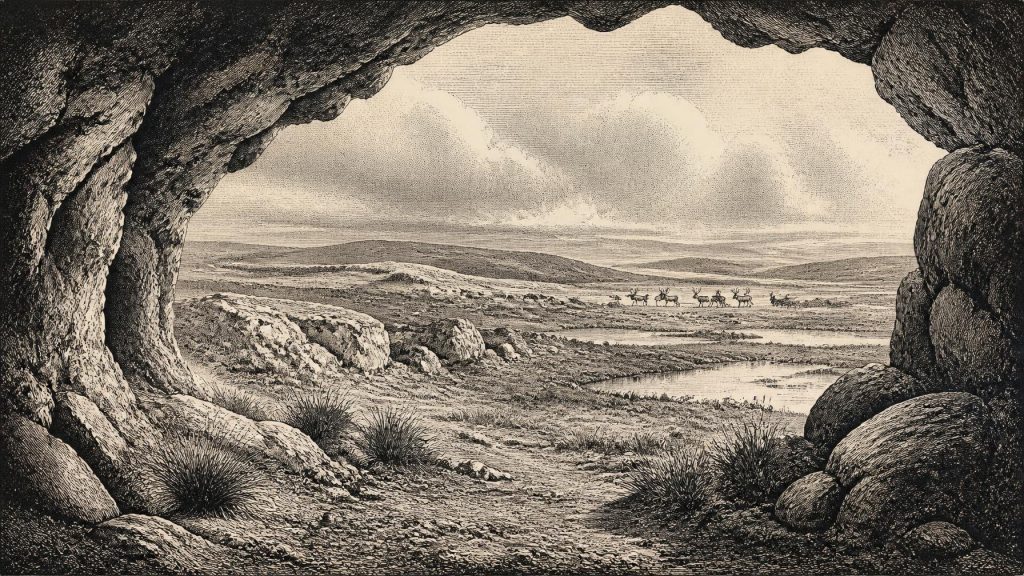
The evidence does not support a king, community, battle, treaty or named individual in Ireland in this particular year. It does not establish a village, farm, burial ground, ritual monument or trade route. Indeed, it cannot yet prove that people were present on the island at all at precisely this point. What it can show is that Ireland was part of a north-west European Ice Age world in which animals reached the island, climates fluctuated and ice was becoming an increasingly decisive force. The limestone caves around Doneraile in north County Cork, especially Castlepook Cave—long known as Mammoth Cave—are the principal archive for approaching that world.
A Date Without an Event
Calendar years BCE are useful editorial tools, but radiocarbon laboratories report ages in years before present, where “present” conventionally means AD 1950. Those radiocarbon ages must then be calibrated against independently dated records of past atmospheric carbon. Around 30,000 radiocarbon years ago, calibration is especially important: radiocarbon and calendar time differ by several millennia, and ranges are broad. It is therefore better to say that deposits, animals or climatic episodes belong to intervals of the late Pleistocene than to assign them to 30,739 BCE as though a contemporary annal survived.
Even the closest Irish environmental comparison is not a one-year record. At Derryvree near Maguiresbridge, County Fermanagh, a road cutting exposed freshwater silts and sands sealed between two tills. The organic layer produced the classic Birm-166 radiocarbon determination of 30,500 BP, with a substantial uncertainty. Its plants and small animals indicated cold, open conditions, including tundra elements. Calibrated, the deposit belongs broadly to the mid-to-late thirties of thousands of calendar years before present, rather earlier than the editorial year considered here. It illuminates the kind of cold-stage environment that could occur in Ireland, not the weather, vegetation or inhabitants of every Irish district in 30,739 BCE.
Caves, Bones and Deep Time
Castlepook Cave is more directly relevant geographically and archaeologically. Excavated in the early twentieth century by the Royal Irish Academy’s cave-exploration committee, it yielded a remarkable concentration of late Pleistocene animal remains. The collections now held largely by the National Museum of Ireland include woolly mammoth, reindeer, giant deer, brown bear, wolf, Arctic fox, hare, lemmings and spotted hyaena. A hyaena skull alone is a striking corrective to any picture of an empty, uniformly frozen Ireland.
Yet the cave is not a snapshot. Bones were introduced over long periods by carnivores, natural deaths, water, slope processes and earlier excavation. Some deposits were disturbed before modern stratigraphic methods existed. Old radiocarbon dates also require caution because improved pretreatment of bone collagen has shown that several Irish cave dates were thousands of radiocarbon years too young. A 2020 redating programme moved significant Castlepook fauna firmly into MIS 3 and suggested that giant deer and spotted hyaena may have disappeared locally before the Last Glacial Maximum, around 40,000 calibrated years BP. Thus, the assemblage securely demonstrates an Ice Age fauna in southern Ireland across changing phases; it cannot place every listed species beside the cave in one season, let alone one numbered year.
Recent sedimentary ancient-DNA research from Castlepook strengthens the case for pre-maximum connections between Irish animals and wider Eurasian populations. It has detected ancient animal DNA in cave sediments and recovered mitochondrial sequences for Irish mammoths and hyaenas. As a 2026 preprint, however, this work remains subject to peer review. Its value for this date is chiefly methodological and biogeographical: it supports faunal connectivity before the Last Glacial Maximum, while leaving the detailed timing, routes and duration of individual movements open to revision.
An Open, Cold Landscape
Evidence from Castlepook, Derryvree and comparable north-west European sequences points towards an environment very unlike modern Ireland. It was not an island of oak woodland, enclosed fields or blanket bogs. In cold phases, exposed ground supported herb-rich grassland, sedges, dwarf shrubs, mosses and other tundra or steppe-tundra vegetation. The Derryvree freshwater flora includes plants associated with cold, open ground and shallow water. Such communities could feed grazing and browsing mammals, while lakes, marshes and river margins created local variation within an otherwise severe landscape.
Climate did not simply worsen in a smooth descent towards the Last Glacial Maximum. Greenland ice-core records and regional geological studies show abrupt alternations between relatively milder interstadials and colder stadials during MIS 3. Ireland’s evidence is too sparse to translate those global shifts into a precise local temperature for 30,739 BCE. The defensible interpretation is a volatile climatic regime: seasons were harsh by modern standards, treelines were greatly reduced or absent in many places, and habitats could change as ice margins, snow cover, drainage and sea level changed.
Large mammals reveal ecological possibility rather than a complete food web. Reindeer were adapted to seasonal, open terrain; mammoths to cold grassland environments; hyaenas and wolves to landscapes able to sustain large prey and scavenging opportunities. Their presence indicates that Ireland was not biologically sealed off throughout the period. At the same time, the island’s record is much poorer than Britain’s and need not represent a permanent, species-rich population. A cave can preserve the traces of repeated short visits more readily than it records absences elsewhere.
Routes Across a Changing Sea
Lower global sea levels exposed far more of the continental shelves than exists today, but low water did not automatically create an easy continuous land bridge from Ireland to Britain or continental Europe. The palaeogeography of the Irish Sea basin in MIS 3 remains contested, and glacial corridors may have opened and closed as ice and sea level changed. Fossil animals nevertheless demonstrate that crossings occurred at some stage. They may have followed temporary terrestrial links, narrow coastal passages, ice-associated routes or combinations of these. The precise route cannot be read from a single bone.
This uncertainty matters for human history. If people reached Ireland, they may have arrived by following animal movements, travelling along changing coasts or using watercraft; none of these possibilities has been demonstrated for Castlepook. Neither should the animal record be converted automatically into a story of hunters pursuing reindeer across a dry plain. Faunal movement is evidence of connectivity, not evidence of a known human migration corridor or an organised exchange network.
The Reindeer Femur Question
The most provocative object is a reindeer femur from Castlepook bearing a mark interpreted by some researchers as damage made by a sharp stone tool during butchery. It has been associated in public discussion with an age of about 33,000 radiocarbon years ago. If the modification is confirmed as anthropogenic and securely related to the dated animal, it would indicate a human visit to Ireland far earlier than the well-established Mesolithic settlement of the early Holocene.
That is a significant possibility, but not a licence for certainty. One marked bone is not a lithic assemblage, hearth, habitation surface, grave, artistic tradition or sustained settlement. There is as yet no securely associated set of stone tools from Castlepook, nor a demonstrable camp from the thirty-third millennium BCE. Fresh excavation begun in the 2020s has identified undisturbed Pleistocene bone-bearing sediments in parts of the cave and is seeking precisely such contextual evidence. Until it is found, the femur is best understood as a possible trace of brief human activity, not proof that Ireland possessed a resident hunting population in 30,739 BCE.
Society Beyond Recovery
For that reason, the normal categories of political affairs, diplomacy and organised conflict have no evidential content here. There are no polities to describe and no material basis for identifying leaders, territorial boundaries or relations between groups. Equally, religion, language, art, learning and kinship cannot be reconstructed from the surviving Irish evidence. It would be tempting to supply a familiar Upper Palaeolithic story of small mobile bands, seasonal hunting, hide-working and oral tradition. Such activities are plausible analogies from better-recorded continental Europe, but they remain interpretation rather than Irish fact.
The same distinction applies to economy and settlement. The mammal assemblage makes a hunting-and-scavenging landscape conceivable if people visited; it does not demonstrate who acquired an animal, how meat was shared, whether hides were used or whether a group returned. There was no agriculture, livestock husbandry, metalworking, pottery or built village documented in Ireland at this date. Nor is there evidence of trade in objects. The only securely visible economy is that of wild animals moving through a difficult environment and carnivores using a cave system.
Ice on the Horizon
The longer-term development is clearer than the human one. The British–Irish Ice Sheet was growing unevenly, with different sectors advancing and reaching their greatest extent at different times. Major reconstructions place the main maximum and subsequent retreat broadly between 30,000 and 22,000 years before present, while regional studies show that ice behaviour varied greatly around Ireland and its shelves. At 30,739 BCE, therefore, the climatic deterioration that would transform much of the island was under way, but it is misleading to picture all Ireland beneath a single uniform ice cap on that exact date.
Later glaciation also helps explain the archaeological silence. Ice erosion, meltwater, sediment burial and rising seas destroyed or concealed many former land surfaces. The absence of campsites is meaningful, especially beside the rich Upper Palaeolithic records of parts of Britain and continental Europe, but it is not absolute proof that no person ever crossed into Ireland. Caves and protected sediment pockets have survived as rare archives precisely because most open landscapes did not.
Ireland around 30,739 BCE is therefore a threshold rather than a chapter of settled human history. The strongest evidence is environmental: cold freshwater sediments in Fermanagh; a cave fauna in Cork that included formidable grazers and predators; and a landscape connected intermittently to a changing wider world. The possible human evidence is a single contested clue. Its importance lies not in supplying a dramatic first Irish society, but in requiring historians to keep the question open while distinguishing what the bones show from what later imagination would like them to say.
Primary Sources
- A reconsideration of the radiocarbon dating of the Marine Isotope Stage 3 fauna from southern Ireland
- A Middle Midlandian Freshwater Series at Derryvree, Maguiresbridge, County Fermanagh, Northern Ireland
- The Irish Quaternary Fauna Project
- Growth and retreat of the last British–Irish Ice Sheet, 31,000 to 15,000 years ago: the BRITICE-CHRONO reconstruction
- The colonization of Ireland: A human ecology perspective
- The timing and magnitude of the British–Irish Ice Sheet between Marine Isotope Stages 5d and 2: implications for glacio-isostatic adjustment, high relative sea levels and ‘giant erratic’ emplacement
- The evolution of the terrestrial-terminating Irish Sea glacier during the last glaciation
- Character of advance and retreat of the southwest sector of the British-Irish Ice Sheet during the last glaciation
- The deglaciation of the western sector of the Irish Ice Sheet from the inner continental shelf to its terrestrial margin
- Oscillating retreat of the last British-Irish Ice Sheet on the continental shelf offshore Galway Bay, western Ireland
- Timing and pace of ice-sheet withdrawal across the marine–terrestrial transition west of Ireland during the last glaciation
- Spotted Hyena Skull
- Archaeology Research Excavation Grant 2022: Castlepook Caves Project
- New insights on the fauna of Ireland's Younger Dryas and Early Holocene from Alice and Gwendoline Cave
- Sedimentary ancient DNA reveals Late Pleistocene faunal connectivity between Ireland and Eurasia
- The IntCal20 Northern Hemisphere Radiocarbon Age Calibration Curve (0–55 cal kBP)
- The IntCal20 approach to radiocarbon calibration curve construction: a new methodology using Bayesian splines and errors-in-variables
- Origin of British and Irish mammals: disparate post-glacial colonisation and species introductions
- A critical review and re-investigation of the Pleistocene deposits between Cranfield Point and Kilkeel, Northern Ireland: Implications for regional sea-level models and glacial reconstructions of the northern Irish Sea basin
- Heritage Artefacts of County Cork
- Archaeological Heritage of County Cork