Fermanagh’s Intertill World30475 BCE
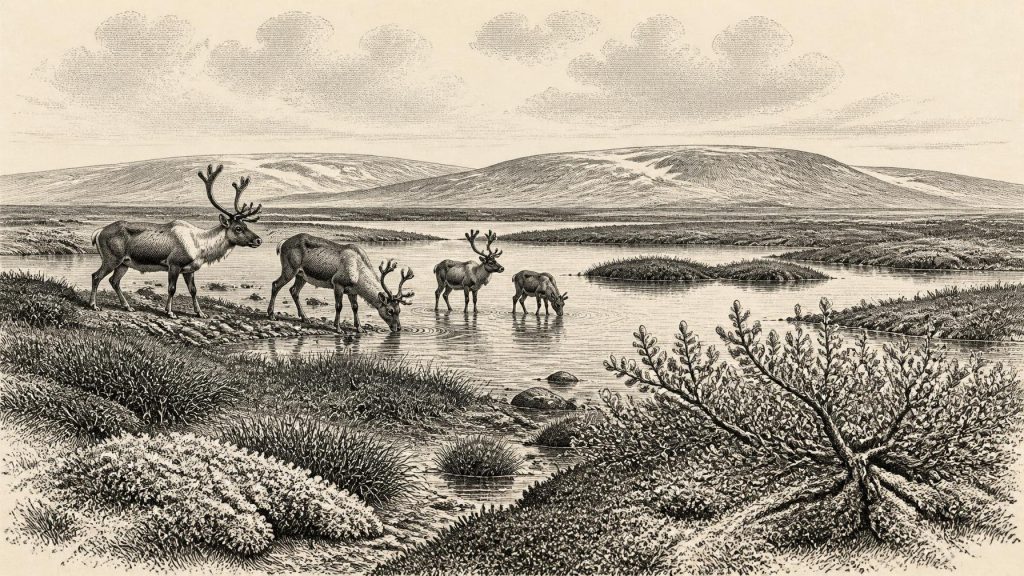
At the notional date of 30,475 BCE, Ireland has no recoverable annual history; evidence instead describes Late Pleistocene environmental intervals. At Derryvree, County Fermanagh, organic sediments between two glacial tills record an ice-free freshwater wetland during Marine Isotope Stage 3, supporting tundra-steppe vegetation, shallow pools and brief productive summers. Cave remains, especially from Castlepook, County Cork, indicate reindeer and other Ice Age mammals, although accumulated bones cannot reconstruct precise communities. A cut-marked reindeer femur may signal early human activity, but remains contested and proves neither settlement nor culture. Subsequent ice expansion destroyed or buried evidence, leaving a fragmentary, climate-driven record.
Dateline
“30,475 BCE” is a modern calendar label, not a year that can be recovered from an Irish record. There were no written chronicles, calendars, political institutions or dated settlements from which to identify an event in that particular year. At this depth in time, Ireland is approached through glacial deposits, fossil plants and insects, animal bones, cave sediments and radiocarbon measurements. These sources describe long intervals, often with substantial uncertainty, rather than an individual season or generation.
The nominal date falls within the Late Pleistocene, conventionally within Marine Isotope Stage 3, a climatically unstable part of the last glacial cycle. The most informative Irish environmental evidence is the Derryvree freshwater sequence near Maguiresbridge, County Fermanagh. Its organic silts and fine sands produced the radiocarbon determination Birm-166, 30,500 radiocarbon years before present, with a large published uncertainty. Calibration places the deposit broadly at about 36,900–31,700 calibrated years BP, or roughly 34,950–29,750 BCE. Thus 30,475 BCE belongs within the range illuminated by Derryvree, but cannot be assigned to a particular layer, plant, pool or day.
A Wetland Between Ice Sheets
Derryvree was exposed during roadworks in 1969, when a cutting passed through a drumlin, one of the smooth, elongated hills shaped beneath moving glacier ice. The section revealed two thick tills: stony, poorly sorted sediments left directly by ice. Between them lay freshwater silts, fine sands and organic material. The sequence supplies a clear relative history. Glacier ice had first occupied the locality and deposited the lower till. Later, the site was ice-free long enough for standing or slow-moving freshwater, sediment and living things to leave a record. Eventually, another glacial advance covered and preserved that evidence beneath the upper till.
This is a strong local conclusion, but it is not a map of all Ireland. Derryvree does not prove that the entire island was ice-free at once, nor that conditions were uniform beyond its basin. Its importance lies in demonstrating that the simple image of a permanently ice-buried Ireland is wrong for this earlier part of the last glacial cycle. At least in north-central Ireland, exposed ground and freshwater habitat existed during an interval before the more extensive expansion of the last British–Irish Ice Sheet.
The date also belongs to a long approach towards the Last Glacial Maximum, not to its coldest peak. Later ice sheets profoundly altered the Irish landscape, eroding older deposits, burying some beneath tills and leaving many chronological questions unresolved. That destructive history makes surviving intertill organic horizons unusually valuable. Derryvree is less a snapshot than a narrow, accidentally protected window onto a landscape otherwise largely removed by later ice.
Open Ground and Shallow Water
The fossils at Derryvree indicate an open tundra or tundra-steppe setting under a severe, frost-influenced climate. They do not support a forested Ireland. Sedges, mosses and cold-adapted herbs occupied damp ground, while aquatic and waterside plants demonstrate that the landscape included fresh water rather than only bare frozen sediment. The presence of water-milfoil and bogbean is particularly useful: these plants point to shallow pools, quiet water or wet margins. Mountain-avens, dwarf willow, clubmosses and other Arctic-alpine elements evoke sparse, low vegetation adapted to cold and short growing seasons.
Such evidence permits a responsible reconstruction of habitats, not a claim that every hillside looked the same. A shallow basin could preserve water and vegetation while nearby ground was drier, stonier and more exposed to wind. Seasonal contrasts were probably decisive. Summer thaw allowed plants, insects and wetland life to flourish briefly; winter frost, snow cover and frozen ground restricted growth and altered drainage. The biological record shows that this was not a lifeless white wilderness, but neither was it a wooded, agriculturally useful countryside.
The wider glacial setting helps explain the character of the landscape. Ice margins, meltwater, permafrost and frost-shattered ground could all create patchy environments over short distances. Rivers and pools were liable to shift. The returning ice which later sealed the Derryvree sequence reminds us that the wetland existed in a changing climatic system, not a stable age of temperate plenty.
Animals in a Changing Ireland
Cave assemblages from southern Ireland add a different kind of evidence. Castlepook Cave, near Doneraile in north County Cork, is especially important because it has produced bones of large Ice Age mammals. Reassessment and improved radiocarbon pretreatment have shown that several older cave dates required revision, usually towards greater age. The resulting record indicates that Ireland supported a more varied mammalian fauna during Marine Isotope Stage 3 than its modern fauna suggests.
Reindeer are central to the evidence, but Castlepook has also yielded remains associated with animals such as brown bear, giant deer, Arctic fox, Arctic lemming, spotted hyaena and woolly mammoth. These remains should not be imagined as one herd or one encounter. Cave bones accumulated through many processes across long periods: animals could die in caves, seek shelter there, be dragged in by carnivores, or have their remains moved by water and sediment. Moreover, much of the material was excavated before modern recording methods. It can establish regional animal presence and broad ecological possibilities, but it seldom reconstructs a single food chain in a precisely dated locality.
Even so, the fauna makes the Derryvree environmental picture more intelligible. Reindeer and Arctic-adapted small mammals fit open, cold country; hyaenas and bears indicate a more complex predatory landscape than a simple inventory of plant fossils conveys. Mammoth and giant deer remains are reminders that, in suitable habitats and at suitable times, Ireland formed part of the wider north-west European Ice Age world. The Irish Sea was then affected by lower global sea levels, but routes between Ireland, Britain and continental Europe changed with coastlines, ice and water. The evidence does not permit a confident reconstruction of a single crossing route at this date.
The Castlepook Question
One Castlepook reindeer femur is exceptionally significant, and exceptionally difficult to interpret. The bone, held by the National Museum of Ireland, has been reported as about 33,000 years old and bears a deep linear modification that zooarchaeologist Ruth Carden has interpreted as damage from a sharp stone implement used on fresh bone. If that diagnosis is sustained, it would be evidence that people processed a reindeer in Ireland far earlier than the formerly accepted terminal-Pleistocene record.
The qualification matters. A modified bone can indicate a human act, but it does not by itself demonstrate a camp, a dwelling, a population, a named archaeological culture or continuous settlement. No securely associated hearth, stone-tool assemblage, habitation floor, burial, food store or artwork currently establishes an Upper Palaeolithic community at Castlepook around this time. The bone came from an older cave collection, and cave contexts require careful taphonomic work because carnivore activity, sediment movement, breakage and excavation history can complicate interpretation.
Accordingly, 30,475 BCE should not be presented as the year Ireland was “settled”, nor as the year a particular hunting party arrived. The most cautious interpretation is that the marked femur is a potentially transformative indicator of brief human activity in the broad period. Ongoing work at Castlepook aims to test that possibility through renewed excavation, dating and microscopic study. It is evidence under investigation, not a licence to invent a population’s language, ancestry or movements.
No Polities, No Trade Record
There is no basis for describing political affairs, diplomacy or organised warfare in Ireland at this date. No chiefs, territories, alliances, fortified places or conflicts can be identified from the evidence. Nor is there evidence for agriculture, herding, metalworking, permanent villages, exchange networks or long-distance trade conducted from Ireland. The environmental resources visible at Derryvree were wild plants, freshwater and animal habitats, not an economy documented by artefacts or stores.
Religion, art and formal learning are equally beyond recovery here. Caves later acquired cultural meanings in many societies, but no Irish ritual use, burial practice, cave art or symbolic object of this age has been securely demonstrated. If people did briefly reach the island, they would have possessed knowledge and social traditions of their own; archaeology simply cannot specify them from one disputedly modified bone. Absence of evidence is not proof of cultural absence, but it is a firm limit on what an Irish historical account can responsibly claim.
An Evidence-Bound Ireland
The Ireland illuminated by 30,475 BCE is therefore principally an environmental and archaeological one: a cold, variable landscape where freshwater wetlands could develop between episodes of glaciation; low vegetation and short productive seasons sustained a specialised tundra ecology; and large mammals moved through at least some regions. Derryvree offers the clearest local record, while Castlepook raises the unresolved prospect of an early human visit.
The major historical development was not a royal accession or battle, but instability in land, climate and life. Within several millennia, ice would expand more extensively and obscure much of this earlier world. What remains is fragmentary but eloquent: silts beneath a drumlin, seeds and mosses from a vanished wetland, and bones from caves. They demand caution, yet they show that Ireland at this notional date was neither empty of ecological history nor knowable at the precision of a modern calendar year.
Primary Sources
- A Middle Midlandian Freshwater Series at Derryvree, Maguiresbridge, County Fermanagh, Northern Ireland
- Quaternary Deposits and Glacial Stratigraphy in Ireland
- The Irish Quaternary Fauna Project
- A Reconsideration of the Radiocarbon Dating of the Marine Isotope Stage 3 Fauna from Southern Ireland
- New Insights on the Fauna of Ireland’s Younger Dryas and Early Holocene from Alice & Gwendoline Cave
- Trimlines, Blockfields and the Vertical Extent of the Last Ice Sheet in Southern Ireland
- Exploring the Climate of the Last British-Irish Ice Sheet
- Growth and Retreat of the Last British-Irish Ice Sheet, 31,000 to 15,000 Years Ago
- The IntCal20 Northern Hemisphere Radiocarbon Age Calibration Curve (0–55 cal kBP)
- IntCal Publications
- IntCal: Radiocarbon Calibration Curves and Data
- Heritage Artefacts of County Cork
- Archaeology Research Excavation Grant 2022: Castlepook Cave Final Report
- Castlepook Cave, Co. Cork, 2022 Excavation Report
- Myriophyllum alterniflorum in Fermanagh: Fossil Occurrence at Derryvree
- Geology and Geomorphology of Fermanagh
- The Subdivision of the Quaternary Period in Ireland
- The Brown Bear (Ursus arctos L.) in Ireland
- The Irish Cave Bones Project, or How We Found the Palaeolithic of Ireland
- The IntCal20 Northern Hemisphere Radiocarbon Age Calibration Curve (0–55 cal kBP)