Derryvree’s Calcareous Marsh30403 BCE
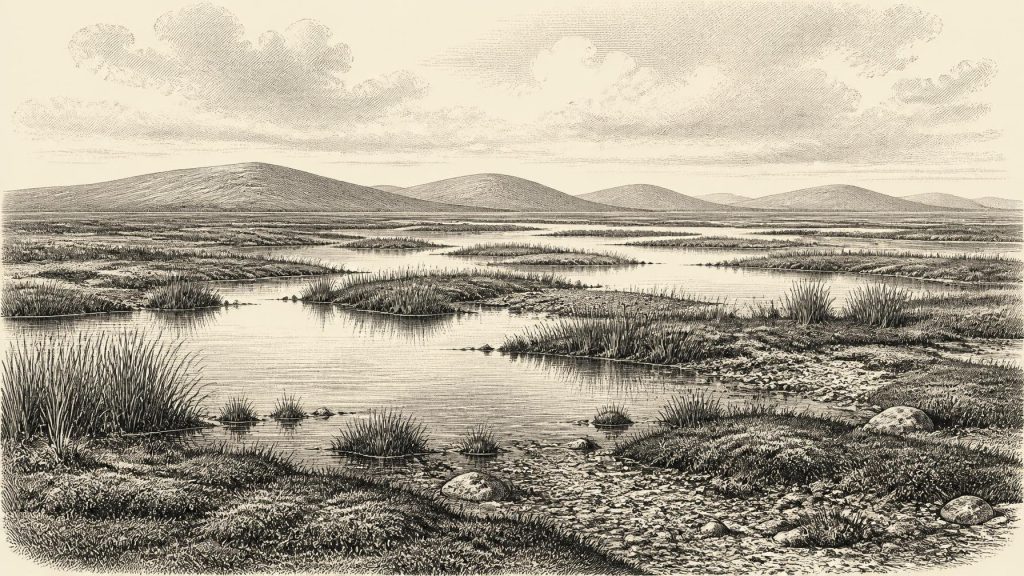
The nominal date 30,403 BCE cannot be identified precisely in Ireland’s record. Derryvree, County Fermanagh, preserves organic freshwater sediments between glacial tills, dated broadly to 36,900–31,700 calibrated years BP. Their pollen, plants and insects indicate a cold, open tundra wetland with pools, mosses and sedge-rich margins. Ireland was approaching renewed ice-sheet expansion, though conditions and ice cover varied regionally. Cave fauna demonstrate that suitable landscapes supported large mammals and predators. No secure evidence establishes human occupation at this time. A possibly cut-marked Castlepook reindeer bone may indicate an early visit, but remains uncertain. Later glaciation erased or buried much evidence.
Dateline
30,403 BCE is a modern chronological label, not a date that can be recovered from an Irish calendar, settlement sequence or historical account. No written record, political tradition or archaeological layer can identify a particular year this far back. In conventional calendar arithmetic it lies roughly 32,350 years before the radiocarbon dating baseline of 1950, but the evidence available for Ireland is dated in much broader ranges. The most relevant archive is a freshwater deposit at Derryvree, near Maguiresbridge in County Fermanagh, whose radiocarbon determination of 30,500 years BP carries a large uncertainty and calibrates broadly to about 36,900–31,700 calibrated years BP. That range can responsibly illuminate the world around this nominal year; it cannot tell us what happened in 30,403 BCE itself.
A Landscape Between Ice Advances
Derryvree is important precisely because it preserves an interval of living ground between episodes of glaciation. In 1969, roadworks cut through a drumlin and exposed organic silts and fine sands lying between two substantial sheets of till: sediment laid down directly by ice. The sequence establishes a clear relative history. An earlier glacier had occupied the locality; later, an ice-free freshwater environment formed there; eventually, ice returned and buried that environment beneath a further till sheet. The thin organic horizon is therefore a rare survival from a landscape that later glacial action largely removed, reworked or sealed.
The fossils in those silts are direct evidence, but their meaning requires care. Plant remains, pollen and insects show that the Derryvree locality supported cold-adapted freshwater and wetland communities. The original investigators described a full-glacial flora and fauna, consistent with open tundra and a periglacial climate. Later discussion has interpreted the insect evidence as a muskeg-like setting: wet, mossy ground with shallow pools and abundant decaying vegetation. This was not a wooded Irish countryside. It was a treeless or almost treeless mosaic of water, sedge-rich margins, herbs, mosses and exposed mineral ground, shaped by severe winters, short growing seasons and repeated freezing and thawing.
“Calcareous marsh” is a useful image for the local setting, provided it is not mistaken for a complete map of Ireland. Water percolating through glacial and limestone-rich sediments could have fed pools and wet ground, while the surrounding terrain was open and cold. Such places could be biologically productive during the brief warmer part of the year: insects, aquatic plants, mosses and small creatures found niches in waterlogged hollows even where the wider landscape offered little shelter. Derryvree records this particular northern inland environment, not an unbroken wetland across the island.
Approaching the Last Ice Sheet
The date falls during the later Pleistocene, before the maximum expansion of the last Irish Ice Sheet. The island was part of the wider British–Irish Ice Sheet system, but that system did not advance everywhere at once. Modern reconstructions combine offshore landforms, marine cores, onshore sediments and several dating methods. They indicate that Ireland was largely ice-free until roughly 32,000 years ago, after which ice expanded rapidly and, over subsequent millennia, occupied the island and adjoining continental shelf. The broad Last Glacial Maximum is generally placed later, around 26,500–19,000 calibrated years BP, although individual Irish sectors reached and left their maximum limits at different times.
For the nominal year in question, the responsible conclusion is therefore transitional rather than absolute. Derryvree’s broad calibrated range encompasses it, and the deposit supports the inference that north-central Ireland had ice-free ground or lay near an ice margin during part of this long interval. It does not prove that every region of Ireland was clear of ice at the same moment. Nor does it establish a stable climate. Cave calcite records from Crag Cave in County Kerry show that millennial-scale climatic shifts affected south-west Ireland during the last glacial cycle. Conditions could alter markedly over centuries and millennia, while a single radiocarbon result cannot resolve seasonal or annual weather.
Sea level was much lower than today because vast quantities of water were held in ice sheets. Ireland’s present coastline did not exist in its familiar form: coastal plains and shelves now submerged were exposed or differently configured, while ice and changing sea routes complicated movement. Yet it would be misleading to turn this into a simple land-bridge story. The precise shape, timing and passability of connections between Ireland, Britain and continental Europe varied with ice, sea level, rivers and terrain. For humans or animals, an apparent connection on a map was not necessarily an easy route through a cold and hazardous landscape.
Animals and the Cave Record
Southern Irish caves offer another, very different, line of evidence. Castlepook Cave near Doneraile in north County Cork has produced remains of mammals associated with Marine Isotope Stage 3, the long interval preceding the Last Glacial Maximum. Re-dating has demonstrated that some older cave determinations needed revision, but it also confirms the importance of Castlepook for documenting a pre-maximum Ice Age fauna. Spotted hyaena, giant deer, woolly mammoth, reindeer, brown bear, wolf, foxes, hares and lemmings have all figured in the cave’s wider faunal record. Not every species need have lived together or at precisely the same time, and a cave accumulation can reflect carnivore activity, natural death, redeposition and excavation history as well as the surrounding fauna.
Nevertheless, the cave evidence makes an important point. Ireland was not necessarily a sterile sheet of ice throughout the entire period before the glacial maximum. At suitable times and places, its open landscapes could support large herbivores, predators and scavengers. Reindeer are especially suggestive of open, cold country, while lemmings and arctic foxes point towards northern or continental climatic conditions. Hyaenas add another caution: their presence may indicate denning or scavenging at a cave rather than a straightforward census of the living landscape outside. The animal assemblages demonstrate ecological possibility, not a settled human landscape.
The Question of People
There is no securely excavated dwelling, hearth, stone-tool assemblage, burial, artwork or human skeleton in Ireland that can be assigned to around 30,403 BCE. This absence matters. It means that no responsible account can describe named communities, permanent settlements, clans, territories or a routine human economy for the island at this point. Nor is there evidence for farming, domestic animals, pottery, metalwork, monuments, formal religion, literacy, trade networks or political institutions. Terms such as diplomacy, warfare and government simply do not apply to the Irish record as presently known.
The question is not wholly closed, however. A reindeer femur from the historic collections of Castlepook Cave has been reported as bearing an incision interpreted by zooarchaeologist Ruth Carden as a cut mark made during carcass processing with a sharp stone tool. Public accounts connected the bone with an age of about 33,000 years ago. If both the dating and the anthropogenic interpretation withstand further scrutiny, it would be potentially dramatic evidence for a very early human visit to Ireland. It would suggest that people may have reached a cold island-edge environment far earlier than the well-attested post-glacial inhabitants.
That possibility must remain distinct from proof of occupation. Castlepook’s deposits were excavated in the early twentieth century and have a complex formation history. A single modified bone, even if accepted, cannot tell us how many people were involved, whether they stayed briefly or seasonally, how they travelled, what language they spoke, or whether they returned. It cannot establish a local population. The stronger evidence for human activity in Ireland belongs much later: a butchered brown-bear bone from Alice and Gwendoline Cave in County Clare dates to about 12,810–12,590 calibrated years BP, and substantial settlement evidence belongs to the Mesolithic still later.
Everyday Life Without a Household
If people did enter Ireland during the broad Derryvree–Castlepook interval, their likely priorities can be inferred only in the most general sense from Ice Age hunter-gatherer lifeways elsewhere in north-west Europe: mobility, warm clothing, fire, careful use of animal resources and knowledge of seasonal terrain. Such comparisons are interpretative aids, not evidence that Irish visitors made particular tools or practised particular rituals. The Irish evidence itself is too slight to reconstruct households, gender roles, kinship, belief or learning.
The dependable history of this nominal year is consequently environmental. Water persisted at Derryvree between ice advances. Cold-adapted plants and insects occupied a tundra wetland. Fauna in Irish caves show that, in parts of the wider pre-maximum interval, large mammals and predators used Irish landscapes. Expanding ice would soon transform or erase many such habitats, while later glaciation would destroy much of the material trace that people might have left. The silence of the archaeological record is therefore not proof that nobody ever came; it is a reason to distinguish what the evidence demonstrates from what it merely allows us to imagine.
Primary Sources
- A Middle Midlandian Freshwater Series at Derryvree, Maguiresbridge, County Fermanagh, Northern Ireland
- Trimlines, Blockfields and the Vertical Extent of the Last Ice Sheet in Southern Ireland
- The Last Irish Ice Sheet: Extent and Chronology
- A Reconsideration of the Radiocarbon Dating of the Marine Isotope Stage 3 Fauna from Southern Ireland
- Episodic Speleothem Deposition Tracks the Terrestrial Impact of Millennial-Scale Last Glacial Climate Variability in SW Ireland
- First Evidence of a Late Upper Palaeolithic Human Presence in Ireland
- New Insights on the Fauna of Ireland's Younger Dryas and Early Holocene from Alice & Gwendoline Cave
- Phylogeographic, Ancient DNA, Fossil and Morphometric Analyses Reveal Ancient and Modern Introductions of a Large Mammal: The Complex Case of Red Deer (Cervus elaphus) in Ireland
- Deglaciation Chronology of the Donegal Ice Centre, North-West Ireland
- The Deglaciation of the Western Sector of the Irish Ice Sheet from the Inner Continental Shelf to its Terrestrial Margin
- Reconstructing the Last Irish Ice Sheet 2: A Geomorphologically-Driven Model of Ice Sheet Growth, Retreat and Dynamics
- Pattern and Timing of Retreat of the Last British-Irish Ice Sheet
- Late Pleistocene Chronostratigraphy and Ice Sheet Limits, Southern Ireland
- Radiocarbon Constraints on the Age of the Maximum Advance of the British-Irish Ice Sheet in the Celtic Sea
- New Data for the Last Glacial Maximum in Great Britain and Ireland
- Advances in Irish Quaternary Studies
- Figure 6: The Subdivision of the Quaternary Period in Ireland
- Ireland: Submerged Prehistoric Sites and Landscapes
- Heritage Artefacts of County Cork
- The Mesolithic in Ireland: When Was It?