Dwarf Shrubland30430 BCE
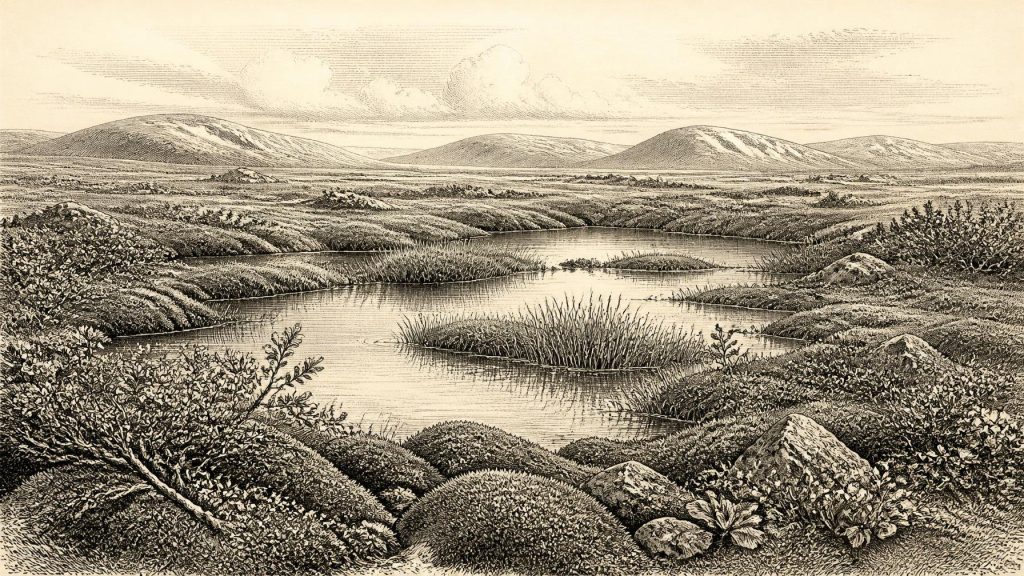
Around 30,430 BCE, Ireland is known only through broad calibrated ranges and fragmentary environmental evidence. At Derryvree, County Fermanagh, freshwater silts between glacial tills show that ice retreated long enough for tundra wetland communities to develop. Pollen, plants and insects indicate treeless ground with grasses, sedges, dwarf willow, arctic-alpine flora and aquatic pools, before later ice returned. Castlepook Cave, County Cork, preserves mixed Middle and Late Pleistocene fauna, including mammoth, reindeer, giant deer and predators, demonstrating cold-stage habitats. A possibly cut-marked reindeer bone suggests brief human visits, but no secure evidence supports settlement, culture or permanent occupation in this period.
Dateline
The label “30,430 BCE” cannot identify a recoverable Irish event, season or generation. No calendar, written record or archaeological sequence offers modern year-by-year precision at this depth of time. It is a useful point within a much larger prehistoric interval: about 32,380 years before the conventional radiocarbon reference year of 1950. The responsible evidence is therefore expressed in calibrated ranges and stratigraphic sequences, not anniversaries. For Ireland, the most illuminating evidence is a freshwater deposit at Derryvree near Maguiresbridge, County Fermanagh, whose broad calibrated age-range encompasses this notional date.
A Date Within a Range
Derryvree was exposed during roadworks in 1969, when a cutting passed through a drumlin, one of the streamlined hills formed by glacial action. Beneath its surface lay two distinct sheets of till: unsorted clay, stones and debris deposited by ice. Between them were freshwater silts, fine sands and organic material. Their sequence is plain even if the exact dates are not. Ice had occupied the locality; an interval followed in which water, vegetation and small animals occupied a basin; then ice returned and sealed the deposit beneath a later till sheet.
The principal radiocarbon determination from this organic horizon, BIRM-166, was reported as 30,500 radiocarbon years before present, with a large uncertainty. Radiocarbon years are not calendar years, because the atmospheric concentration of carbon-14 has changed through time. Modern calibration places the Derryvree evidence broadly around 36,900–31,700 calibrated years before present, approximately 34,950–29,750 BCE. Thus 30,430 BCE lies within the wide chronological neighbourhood illuminated by the deposit, but cannot be assigned to a particular layer, plant, animal or episode of sedimentation.
This was part of Marine Isotope Stage 3, a climatically unstable segment of the last glacial cycle. The term “Derryvree Cold Phase” has sometimes been used for the relevant Irish evidence. It is useful as a local geological shorthand, but should not suggest that the whole island experienced one unchanging climate or that Derryvree records a single short cold snap. Ireland’s ice margins, rivers, permafrost and exposed terrain changed over long periods. Conditions in Fermanagh cannot simply be projected onto every coast, upland and limestone cave.
A Treeless Freshwater World
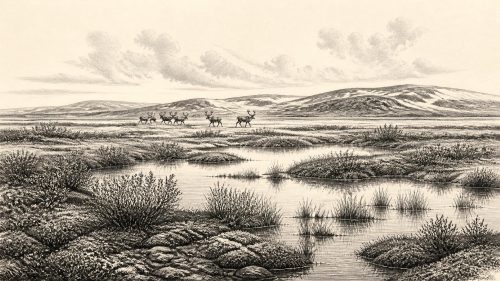
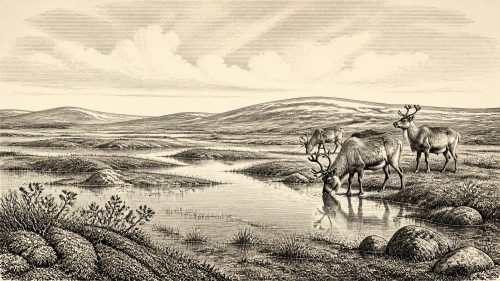
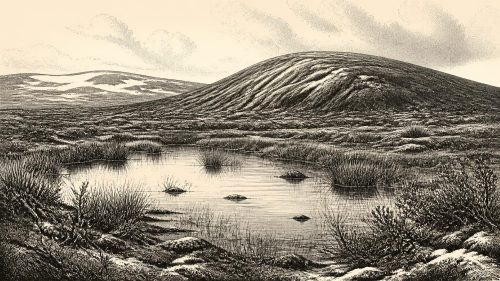
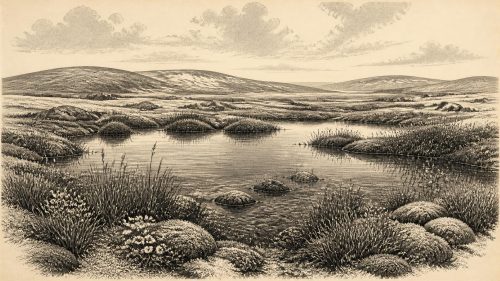
The Derryvree sediments nevertheless offer an unusually vivid picture of one cold-stage landscape. Pollen, plant macrofossils, mosses and insect remains indicate open, treeless tundra or muskeg-like ground around shallow freshwater. Grasses and sedges were important; juniper and herbs occurred, while evidence also includes dwarf willow, mountain avens, lesser clubmoss, bogbean and alternate water-milfoil. These were not the plants of a forested Ireland. Together they point to a low, exposed landscape in which short growing seasons, saturated ground and severe winters limited tall woody growth.
Yet the deposit is not evidence of a lifeless frozen desert. Bogbean and water-milfoil are particularly important because they demonstrate local freshwater habitats. Moss-rich margins, pools and wet sediment could support a patchwork of aquatic and damp-ground plant communities even within a harsh regional climate. The insect assemblage has likewise been interpreted as consistent with open, organic-rich wetland and pools. Derryvree therefore complicates the simple image of an island uniformly buried beneath permanent ice. At least at one point in this broad interval, a Fermanagh basin had become ice-free long enough for freshwater sediments and a cold-adapted living community to accumulate.
That conclusion has limits. The upper till shows that later ice overwhelmed the setting. The preserved wetland should not be mistaken for a stable landscape lasting unchanged for millennia, and it does not prove that all of Ireland was similarly open. It instead captures the fluctuating frontier between ice, meltwater, frozen ground and biological survival. In the millennia after the date represented here, the British–Irish Ice Sheet expanded towards its later maximum extent. The greatest ice volume lay ahead, although the timing of advance and maximum conditions differed greatly between sectors.
Animals in the Southern Caves
County Cork provides the other principal Irish line of evidence for this wider period. Castlepook Cave, also known as Mammoth Cave, near Doneraile, produced a remarkable but complicated collection of Pleistocene animal remains during early twentieth-century excavations. Radiocarbon programmes and later re-dating show that parts of its faunal assemblage belong to Marine Isotope Stage 3, although the cave deposits were disturbed and bones from different ages became mixed. It is consequently unsafe to treat the assemblage as a single moment, a single hunting episode or a tidy picture of one local ecosystem.
Even so, the collection establishes that, during broad intervals before the Last Glacial Maximum, southern Ireland supported or received a distinctive cold-stage fauna. Mammoth, reindeer, giant deer, spotted hyaena, brown bear, wolf, foxes and lemmings are among the animals represented in the wider cave record. Such animals imply open habitats, substantial seasonal contrasts and mobile food webs rather than dense woodland. Carnivores, scavengers and herbivores did not necessarily inhabit precisely the same places or dates, but their remains demonstrate that Ireland was connected to wider north-west European ecological processes.
Animals also reveal how uneven the archive is. A bone dates the death of an animal, not necessarily the moment it entered a cave or the age of neighbouring material. Improved laboratory pretreatment has altered the apparent ages of some Castlepook bones, underlining why old measurements and old excavations require continual reassessment. The most secure statement is therefore modest: parts of Ireland were available to large mammals during phases of the Middle and Late Pleistocene, but the exact distribution, abundance and duration of their populations remain uncertain.
People: A Question, Not a Settlement
The possibility of human presence deserves particular care. A reindeer femur from Castlepook has been interpreted by zooarchaeologist Ruth Carden as bearing a deep cut or chop made with a sharp stone implement on fresh bone. If that identification is confirmed, and if the mark is contemporary with the animal’s death, it may indicate that Upper Palaeolithic people processed a reindeer carcass in Ireland during the broader Marine Isotope Stage 3 interval. A carcass could have supplied meat, fat, marrow, hide, sinew and bone; this is a reasonable inference from hunter-gatherer practice elsewhere, not direct proof of an Irish camp or economy.
The find cannot demonstrate permanent occupation. No securely associated stone-tool assemblage, hearth, dwelling floor, burial, human skeleton, art panel or repeatedly used butchery site of this age has been established in Ireland. Nor does a single marked bone identify a people, language, kin group or ancestry. Cave deposits can be disturbed by carnivores, water, collapse and earlier excavation, while surface modifications must be distinguished carefully from non-human damage. The appropriate conclusion for 30,430 BCE is that brief human visits are possible within the wider period, not that Ireland had a known settled population.
Lower sea levels had changed coasts and exposed areas now beneath the sea, but this does not establish an easy dry route from Ireland to Britain or continental Europe at this particular time. Any passage would have depended on shifting shorelines, water barriers, ice fronts, rivers and seasonal terrain. There is no direct Irish evidence from this horizon for boats, regular crossings, exchange networks or long-distance trade. Political affairs, diplomacy and organised warfare are similarly beyond the evidence: there are no named communities, territories, chiefs, alliances or conflicts to recover.
What Cannot Be Reconstructed
Religion, formal learning and artistic culture leave no securely dated Irish trace for this point in time. There are no shrines, graves, ritual deposits, carvings or images that can responsibly be connected with 30,430 BCE. Nor is there evidence for farming, livestock, crop cultivation, metalworking or permanent villages. Any people who may have reached the island would have lived by highly mobile foraging, but even that description remains conditional because their presence itself is unproven. The principal history is environmental: ice and water repeatedly remade the land, while cold-adapted plants and animals occupied temporary ecological opportunities.
For that reason, Derryvree matters more than any invented event could. Its silts preserve a small, real interval of freshwater life beneath later glacial deposits: grasses and sedges around wet ground, dwarf willow and arctic-alpine plants in open country, and pools capable of supporting aquatic vegetation. Castlepook adds evidence of a wider cold-stage animal world, while raising a consequential but unresolved question about people. Around 30,430 BCE, Ireland was neither a documented society nor a blank space. It was a changing Ice Age landscape, known through fragile evidence whose power lies precisely in what it can—and cannot—say.
Source References
Hover over a number to see the source. Select it to open the source.

- [1] A Middle Midlandian Freshwater Series at Derryvree, Maguiresbridge, County Fermanagh, Northern Ireland
- [2] A Reconsideration of the Radiocarbon Dating of the Marine Isotope Stage 3 Fauna from Southern Ireland
- [3] The Irish Quaternary Fauna Project
- [4] Growth and Retreat of the Last British–Irish Ice Sheet, 31,000 to 15,000 Years Ago: the BRITICE-CHRONO Reconstruction
- [5] Exploring Controls of the Early and Stepped Deglaciation on the Western Margin of the British–Irish Ice Sheet
- [6] Trimlines, Blockfields and the Vertical Extent of the Last Ice Sheet in Southern Ireland
- [7] New Data for the Last Glacial Maximum in Great Britain and Ireland
- [8] The IntCal20 Northern Hemisphere Radiocarbon Age Calibration Curve (0–55 cal kBP)
- [9] New Insights on the Fauna of Ireland’s Younger Dryas and Early Holocene from Alice & Gwendoline Cave
- [10] Early Midlandian–Middle Midlandian, Pleistocene, Northern Ireland
- [11] Quaternary
- [12] Figure 6.— The Subdivision of the Quaternary Period in Ireland
- [13] Outreach and Education Resources
- [14] Menyanthes trifoliata
- [15] Salix herbacea
- [16] Dryas octopetala
- [17] Selaginella selaginoides
- [18] Myriophyllum alterniflorum
- [19] Castlepook Cave, Co Cork: Archaeology Research Excavation Grant 2022 Final Report
- [20] 2022:564 - Castlepook Cave, Castlepook South, Cork
- [21] Heritage Artefacts of County Cork
- [22] Mammoth Cave, Castlepook
Primary Sources
- A Middle Midlandian Freshwater Series at Derryvree, Maguiresbridge, County Fermanagh, Northern Ireland
- A Reconsideration of the Radiocarbon Dating of the Marine Isotope Stage 3 Fauna from Southern Ireland
- The Irish Quaternary Fauna Project
- Growth and Retreat of the Last British–Irish Ice Sheet, 31,000 to 15,000 Years Ago: the BRITICE-CHRONO Reconstruction
- Exploring Controls of the Early and Stepped Deglaciation on the Western Margin of the British–Irish Ice Sheet
- Trimlines, Blockfields and the Vertical Extent of the Last Ice Sheet in Southern Ireland
- New Data for the Last Glacial Maximum in Great Britain and Ireland
- The IntCal20 Northern Hemisphere Radiocarbon Age Calibration Curve (0–55 cal kBP)
- New Insights on the Fauna of Ireland’s Younger Dryas and Early Holocene from Alice & Gwendoline Cave
- Early Midlandian–Middle Midlandian, Pleistocene, Northern Ireland
- Quaternary
- Figure 6.— The Subdivision of the Quaternary Period in Ireland
- Outreach and Education Resources
- Menyanthes trifoliata
- Salix herbacea
- Dryas octopetala
- Selaginella selaginoides
- Myriophyllum alterniflorum
- Castlepook Cave, Co Cork: Archaeology Research Excavation Grant 2022 Final Report
- 2022:564 – Castlepook Cave, Castlepook South, Cork
- Heritage Artefacts of County Cork
- Mammoth Cave, Castlepook