Elephant Hall Fauna30431 BCE
The label 30,431 BCE denotes a Late Pleistocene interval rather than an Irish year. Derryvree, County Fermanagh, records a locally ice-free freshwater phase between glacial advances, supporting wet, treeless tundra vegetation, insects and aquatic life. Crag Cave indicates repeated climatic shifts. At Castlepook Cave, County Cork, remains of mammoth, reindeer, giant deer, hyaena and other cold-adapted animals demonstrate intermittent large-mammal ecosystems in open landscapes. A possibly cut-marked reindeer bone raises, but does not prove, human presence. No secure settlements or social evidence exist. Later ice altered or destroyed records, leaving an environmental history of dynamic climate, fauna and advancing glaciers.
Dateline
30,431 BCE is a modern chronological label, not a recoverable Irish year. Nobody in Ireland left a calendar, name, settlement record or event that can be fixed to it. The most responsible approach is to place the label within a broad Late Pleistocene time-window: roughly 32,380 calendar years before AD 1950. That falls within Marine Isotope Stage 3, a long, unstable phase of the last glacial cycle. Radiocarbon results of this age do not translate neatly into single calendar years; their calibrated ranges can span centuries or millennia. Ireland at this point is known through sediments, pollen, mosses, insects, cave deposits, animal bones and changing ice, not through written history.
A Date Within a Wider Interval
The closest chronological guide is Derryvree, near Maguiresbridge in County Fermanagh. Roadworks in 1969 cut through a drumlin and exposed an extraordinary sequence: glacial till at the base, freshwater sands and organic silts above it, and another thick till sealing the deposit from above. The order is decisive. Ice had occupied the site; a period followed in which a wet landscape accumulated sediment, plants and small animal remains; then glacier ice returned or expanded across it. The organic deposit, Birm-166, produced a conventional radiocarbon age of 30,500 years before present, with an uncertainty of more than a millennium. Subsequent calibration places it broadly at about 36,900–31,700 calibrated years before present. The modern label 30,431 BCE falls inside that wide range, but cannot be attached to a particular layer, season, person or generation.
This is an important distinction between evidence and interpretation. Derryvree securely demonstrates an ice-free freshwater interval at one Fermanagh locality between glacial episodes. It does not prove that every part of Ireland was ice-free at once, nor does it offer a complete map of the island. Glaciers later destroyed, displaced or buried much evidence from this era. Consequently, a thin bed of silt beneath a drumlin has an importance out of all proportion to its size: it preserves a rare local chapter from an otherwise fragmentary Irish Pleistocene record.
Wet Tundra Under a Severe Climate
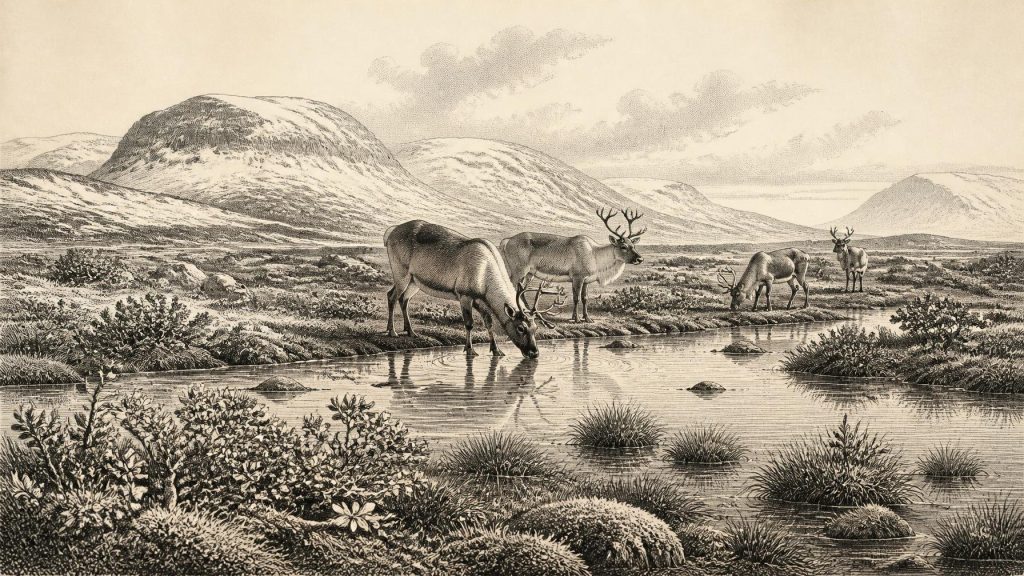
The fossil assemblage at Derryvree points to an open, treeless and wet environment rather than a wooded prehistoric Ireland. Grasses, sedges, dwarf shrubs, herbs, mosses and cold-adapted aquatic plants grew around shallow pools and saturated ground. Among the remains identified were plants associated with Arctic-alpine or tundra conditions, including bogbean, dwarf willow, mountain avens and water-milfoil. Insects and mosses add texture to the reconstruction: this was not simply bare ground beside ice, but a patchwork of wet hollows, muddy margins, vegetation and open water during a short growing season.
“Muskeg” is often used for this kind of landscape: waterlogged, plant-rich ground with mosses and sedges, interrupted by pools. It should not suggest comfort or abundance in a modern sense. The evidence indicates a periglacial climate, with intense winter cold, frost action and a vegetation cover low to the ground. Summer warmth was sufficient for plants, insects and freshwater life, but no forest sheltered the land. Derryvree therefore illuminates the ecological possibilities available during a cold interval, rather than depicting a stable or benign climate.
Elsewhere, the wider climate was changing on a millennial scale. Stalagmites from Crag Cave, County Kerry, record episodes of growth during parts of Marine Isotope Stage 3, when conditions permitted water to circulate through limestone and calcite to form. Their interrupted growth is itself significant: cave mineral formation was sensitive to shifts between relatively ameliorated intervals and harsher, colder phases. Such records reinforce the point that Ireland’s environment was dynamic. It is not responsible to imagine 30,431 BCE as a fixed climatic snapshot, but neither should it be imagined as a uniformly ice-covered island.
Ice, Land and Changing Coasts
Ireland was approaching a much more extensive phase of glaciation, although the peak of the last British–Irish Ice Sheet lay later. Modern reconstructions indicate rapid growth of interconnected ice masses during the later part of Marine Isotope Stage 3 and into the following millennia. By around 30,000 years ago, ice had become a major geographical force across the region, with an ice centre developing over Northern Ireland in the broader reconstruction. At Derryvree, the upper till shows that ice ultimately crossed the locality after the freshwater interval. What cannot be settled from the deposit is the exact year, route or speed of that later advance.
Sea level was lower than today because water was stored in continental ice sheets. Shorelines and coastal plains consequently lay farther offshore, while the relationship between Ireland, Britain and the continental landmass changed over long periods. Yet it would be unsafe to turn this broad fact into a simple story of a walkable route at this exact date. The evidence discussed here establishes environmental change and animal movement, not a particular crossing, road or human migration corridor. Ireland’s Pleistocene geography must be treated as a changing regional setting, not as a modern map with the sea removed.
Castlepook’s Animal World
In north Cork, Castlepook Cave near Doneraile provides the most evocative Irish faunal evidence relevant to this deep period. Early excavators named chambers such as Elephant Hall and Hyaena Hall after the remains found within them. The cave assemblage includes woolly mammoth, reindeer, giant deer, brown bear and spotted hyaena; wolf, Arctic fox, mountain hare and lemmings also occur among material attributed to Ice Age conditions. A mammoth bone has yielded a radiocarbon age of about 33,400 ± 1,200 years before present, while a spotted-hyaena specimen produced an age of about 34,300 ± 1,800 radiocarbon years before present. These dates overlap broadly with the era considered here, but they do not mean that every animal lived together in one season or that the cave deposits form a single undisturbed occupation floor.
That caution is essential. Caves are not ordinary settlements: carnivores can drag in carcass parts, water can rearrange sediments, and nineteenth- and early twentieth-century excavations did not always record context to modern standards. Castlepook nevertheless establishes something substantial. Southern Ireland supported, at one or more times before the Last Glacial Maximum, a large-mammal community suited to cold, open country. Reindeer and mammoth imply substantial grazing landscapes; hyaenas and wolves reveal powerful predators and scavengers; lemmings and Arctic fox indicate conditions far removed from modern Ireland. The cave is a repository of animal histories, not a census of one day.
The Question of People
The most consequential possible human trace is a reindeer femur from Castlepook reported to bear a deep mark consistent with processing by a sharp stone implement. The bone has been presented as roughly 33,000 years old in public accounts, making it dramatically earlier than Ireland’s better-established terminal Pleistocene evidence for human activity. If the mark is confirmed as anthropogenic and contemporary with the animal bone, it would show that people handled a reindeer in Ireland during the Upper Palaeolithic. It would not, by itself, demonstrate a permanent population, a village, a hunting territory or a named cultural group.
The difference matters. A cut mark concerns one action on one bone; the bone’s radiocarbon date concerns the death of the animal; neither automatically dates the action to an exact year. No securely dated camp, hearth, stone-tool workshop, house, burial ground or human skeleton is presently known from Ireland for 30,431 BCE. There is no Irish evidence from which to reconstruct leaders, political institutions, warfare, diplomacy, religious rites, language, artistic traditions or systems of exchange. Comparisons with Upper Palaeolithic hunter-gatherers in Britain and continental Europe may suggest what mobile groups elsewhere could do, but analogy cannot supply facts missing from the Irish record.
If people were present, the most restrained interpretation is that they may have made brief, mobile visits to an environmentally demanding north-western edge of Europe, probably using animal resources and leaving little that later ice did not erase. That is an inference, not a demonstrated settlement history. The evidence permits no claim of farming, trade, metalworking, domesticated animals, monuments or organised religion. Economy, if humans were involved at all, would have concerned immediate subsistence: the acquisition and processing of animal materials such as meat, hide, sinew, marrow and bone.
An Environmental History, Not a Chronicle
For Ireland around 30,431 BCE, the most important development was neither a battle nor a ruler’s accession. It was the precarious coexistence of open wet tundra, freshwater pools, large mammals, carnivores and advancing ice. Derryvree gives a local view of life between glacial deposits; Castlepook offers a southern cave archive of the animals that moved through cold landscapes; Crag Cave preserves a separate signal of climatic oscillation. Together they show an island region capable, intermittently, of supporting complex ecosystems before later ice transformed the terrain again.
The silence about society is itself historical evidence. This was long before the Mesolithic communities that later left Ireland’s first substantial archaeological record. At 30,431 BCE, modern calendar precision is unavailable and certainty must stop where the material record stops. The responsible picture is therefore modest but compelling: an unstable Late Pleistocene Ireland, locally ice-free in places, rich in cold-adapted life, and possibly visited by people whose presence survives only as a difficult, still-important question on a reindeer bone.
Primary Sources
- A Middle Midlandian Freshwater Series at Derryvree, Maguiresbridge, County Fermanagh, Northern Ireland
- Irish Pleistocene Biostratigraphy
- Quaternary Site Descriptions
- Quaternary Glaciations of Northern Europe
- Pleistocene Glaciations in Ireland
- Growth and Retreat of the Last British–Irish Ice Sheet, 31,000 to 15,000 Years Ago: the BRITICE-CHRONO Reconstruction
- Maximum Extent and Dynamic Behaviour of the Last British–Irish Ice Sheet West of Ireland
- Episodic Speleothem Deposition Tracks the Terrestrial Impact of Millennial-Scale Last Glacial Climate Variability in SW Ireland
- Spatio-Temporal Dynamics of Speleothem Growth and Glaciation in the British Isles
- Cork County Geological Site Report: Castlepook Cave
- The Exploration of Castlepook Cave, County Cork
- Occurrence of Mammalia Relicts at Site Castlepook Cave
- Pleistocene Vertebrates in the British Isles
- The Irish Quaternary Fauna Project
- Heritage Artefacts of County Cork
- Castlepook Cave, Co. Cork, 2022
- Ireland’s Palaeolithic Archaeology – Fleeting Footprints in a Frozen Land
- Prehistoric Details
- The IntCal20 Northern Hemisphere Radiocarbon Age Calibration Curve (0–55 cal kBP)
- The IntCal20 Approach to Radiocarbon Calibration Curve Construction: A New Methodology Using Bayesian Splines and Errors-in-Variables
- IntCal Publications
- The Quaternary of Northern Ireland: Introduction
- The Subdivision of the Quaternary Period in Ireland
- New Insights on the Fauna of Ireland’s Youngest Pleistocene