The Castlepook–Derryvree Interval30405 BCE
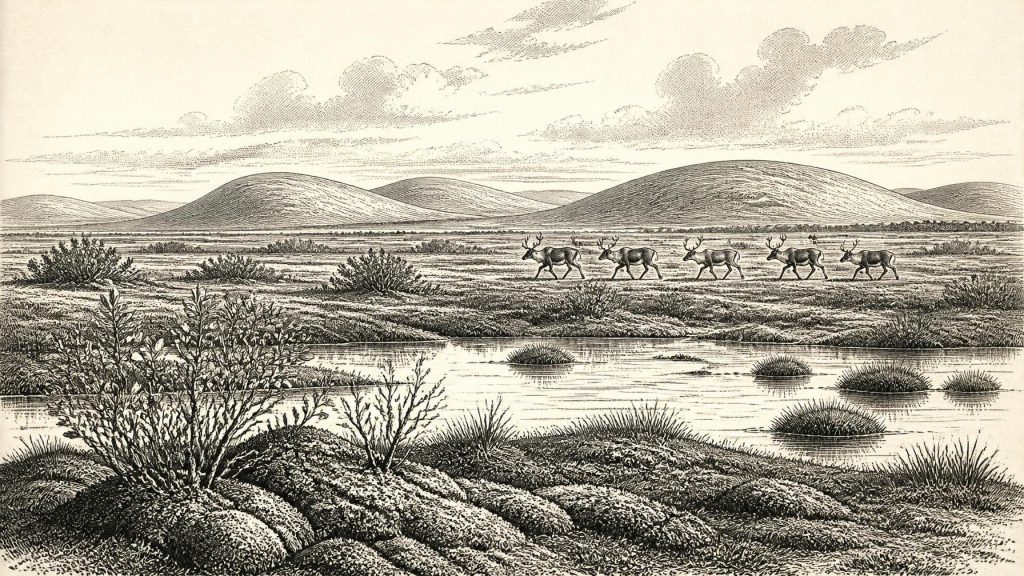
About 30,405 BCE, Ireland was a fluctuating Late Pleistocene environment, not a documented society. Calendar-year precision is impossible; evidence derives from sediments, fossils, cave deposits and ice reconstructions. At Derryvree, County Fermanagh, organic freshwater silts between glacial tills record an ice-free interval, supporting cold-adapted wetland plants in treeless tundra-like conditions. Castlepook Cave, County Cork, preserves vertebrate remains including mammoth, giant deer, reindeer and predators, accumulated across many millennia rather than one moment. A possibly cut-marked reindeer bone suggests, but does not prove, Upper Palaeolithic human activity. Ice advances later buried or erased evidence, leaving a changing landscape interpreted cautiously now.
Dateline
Modern calendar-year precision is not available for Ireland in 30,405 BCE. The number is a useful point of reference for a time roughly 32,400 calendar years before AD 1950, not an anniversary that can be matched to a recorded event, season or individual. There were no written chronicles, states, Irish political communities or dated occupation layers from which to construct an annual narrative. The responsible evidence consists of buried sediments, fossil plants and insects, animal bones, cave deposits and reconstructed ice movements. Its dates are calibrated ranges and probabilities, not exact historical timestamps.
A Cold-Stage Landscape
This was the Late Pleistocene, within Marine Isotope Stage 3 and the Irish sequence traditionally called the Midlandian cold stage. It was not yet the fullest extent of the Last Glacial Maximum, conventionally placed later, around 26,000–19,000 years ago. Nevertheless, the growth, retreat and reorganisation of ice across Ireland and the surrounding seas had already made the land a highly unstable environmental frontier. Ice did not advance evenly across every district at the same moment. Open ground, periglacial terrain, local wetlands and glacier-fed sedimentary basins could exist in some places while other areas were affected by ice or lay close to its margins.
Nor should “Ireland” suggest the later island nation. It denotes the landmass that would become the island of Ireland, without its later borders, peoples or political meaning. Sea level was markedly lower because vast quantities of water were locked in continental ice sheets, altering coastlines and exposing parts of the continental shelf. That fact does not, by itself, prove a simple dry-land route from Britain or continental Europe at this particular time: ice, changing sea basins, rivers and coastal topography all mattered. Movement through this region would have depended on conditions that changed over centuries and millennia, not on a fixed map.
The Derryvree Evidence
The most illuminating Irish environmental record for this broad interval comes from Derryvree, near Maguiresbridge in County Fermanagh. Roadworks exposed an exceptional sequence in a drumlin: glacial till below, fine sands and organic-rich freshwater silts in the middle, and a later till above. The ordering is the crucial evidence. An earlier episode of glacier activity left the lower till; a period without overriding ice allowed water, sediment and organic matter to accumulate; then a renewed ice advance buried and protected the deposit beneath more glacial debris.
A radiocarbon determination from the organic layer, BIRM-166, produced an age of 30,500 radiocarbon years before present, with a substantial uncertainty. In radiocarbon terminology “present” means AD 1950, and a radiocarbon age cannot simply be converted into a BCE year by subtraction. Atmospheric carbon-14 has varied through time, requiring calibration. Published work has placed the Derryvree evidence broadly within a calibrated range of roughly 36,900–31,700 years before present; later modelling likewise places the ice-free phase around 33,500 years before present, with a wide margin of uncertainty. The numbered year 30,405 BCE falls within the broad chronological neighbourhood illuminated by this evidence, but Derryvree cannot tell us what occurred in that one year.
The organic silts reveal a severe but living freshwater environment. Plant and insect evidence has been interpreted as a treeless, cold-stage wetland or muskeg, with sedges and mosses beside pools and saturated ground. Fossils reported from the wider deposit include cold-adapted or arctic-alpine plants such as dwarf willow, mountain-avens and bogbean, together with aquatic vegetation including water-milfoil. These remains are direct evidence that particular plants grew in or near the basin at some point during the deposit’s formation. The larger picture—a mosaic of open tundra-like ground, shallow water, seasonal thaw and a short growing season—is a well-supported interpretation, but it remains an interpretation drawn from those local traces and regional comparison.
Derryvree is especially valuable because later ice sealed the wetland. It also sets firm limits on what may be claimed. The silts do not represent a village floor, cultivated field or hunting camp. They provide no evidence for houses, hearths, tools, graves, clothing or language. Nor do they show that every part of Ireland shared the same conditions. They demonstrate that one Fermanagh locality supported freshwater life during an interval between glacial episodes, while the wider island remained subject to powerful climatic and ice-sheet change.
Animals at Castlepook
County Cork supplies the other major archive. Castlepook Cave, near Doneraile—also known as Mammoth Cave—is Ireland’s richest known site for Late Pleistocene vertebrate remains. Historic excavations recovered a large but complex collection, including woolly mammoth, giant deer, reindeer, brown bear, spotted hyaena, wolf, fox, hare and lemmings. Such fauna shows that, at various times before and during the last major glacial cycle, parts of the Irish landscape could support or be reached by substantial herbivores and their predators. Open vegetation, mobility and seasonal opportunity mattered more than any settled, forested landscape familiar today.
Yet Castlepook must not be treated as a single momentary animal census. The cave accumulated bones over a long period; predators may have brought prey remains into chambers, water could have moved material, and antiquarian excavation did not preserve every relationship between find and layer to modern standards. Improved radiocarbon work has shown that the fauna spans many millennia. Therefore, it would be unsound to state that all its animals lived together in 30,405 BCE, or that its fauna supplies a precise description of Derryvree at the same time.
A reindeer femur from the Castlepook collections has made the cave important to the question of early people. A deep mark has been interpreted by zooarchaeologist Ruth Carden as a possible incision made with a sharp stone edge while fresh bone was being processed. If confirmed, it would be striking evidence of human handling of a reindeer in Ireland during the Upper Palaeolithic, far earlier than the island’s long-established post-glacial settlement record. The result is promising rather than conclusive for a continuous human presence. The bone was recovered from an older collection rather than a newly excavated, sealed occupation surface, and no securely associated hearth, stone-tool assemblage, dwelling, burial or camp has been demonstrated for this age.
Human History at Its Limit
For 30,405 BCE, there is consequently no responsible evidence for political affairs, chiefs, diplomacy, warfare, territorial rule, trade networks or institutions in Ireland. There is also no direct Irish evidence for religious observance, art, formal learning or ritual. It would be misleading to import the richly documented Upper Palaeolithic societies of France, Iberia or central Europe and label them Irish. Those societies can suggest what skilled hunter-gatherers elsewhere knew about animals, stone, shelter, hide-working and movement through cold country, but analogy is not proof.
If people entered Ireland during this wider period, they may have done so briefly and intermittently, following animal movements or exploiting a short-lived opportunity in an open landscape. Reindeer, where available, could have offered meat, fat, marrow, hide, sinew, antler and bone; limestone caves could have afforded temporary shelter or acted as natural traps and carnivore dens. These are practical possibilities, not documented Irish economic practices. Even the possible cut mark cannot establish whether an animal was hunted, scavenged or processed after dying elsewhere, nor whether those involved returned.
The strongest history of this date is therefore environmental. Freshwater plants persisted in a Fermanagh basin between phases of ice movement. Cold-climate mammals ranged through, or intermittently reached, landscapes represented in the Cork cave record. Advancing ice later erased or buried much of what existed, leaving scattered deposits rather than an annual chronicle. Around 30,405 BCE, Ireland was not a society waiting to be named; it was a changing Pleistocene world of water, open ground, animals and encroaching ice, known through fragile evidence and best described with proportionate caution.
Primary Sources
- A Middle Midlandian Freshwater Series at Derryvree, Maguiresbridge, County Fermanagh, Northern Ireland
- The Glacial Deposits of the Maguiresbridge Area, County Fermanagh, Northern Ireland
- A Reconsideration of the Radiocarbon Dating of the Marine Isotope Stage 3 Fauna from Southern Ireland
- The Irish Quaternary Fauna Project
- New Insights on the Fauna of Ireland’s Younger Dryas and Early Holocene from Alice & Gwendoline Cave
- Castlepook Cave: Cork County Geological Site Report
- Heritage Artefacts of County Cork
- 2022:564 – Castlepook Cave, Castlepook South, Cork
- Ireland’s Palaeolithic Archaeology – Fleeting Footprints in a Frozen Land
- The Subdivision of the Quaternary Period in Ireland
- Exploring Controls of the Early and Stepped Deglaciation on the Western Margin of the British-Irish Ice Sheet
- Growth and Retreat of the Last British–Irish Ice Sheet, 31,000 to 15,000 Years Ago: the BRITICE-CHRONO Reconstruction
- Last Glacial Maximum Cirque Glaciation in Ireland and Implications for Reconstructions of the Irish Ice Sheet
- The Timing and Magnitude of the British–Irish Ice Sheet Between Marine Isotope Stages 5d and 2
- Quaternary
- An All-Ireland Quaternary Map
- The IntCal20 Northern Hemisphere Radiocarbon Age Calibration Curve (0–55 cal kBP)
- Guidelines on Procedures for Assessment and Treatment of Geology, Hydrology and Hydrogeology for National Road Schemes
- Clogher Valley
- The Geology of the Irish Sea: UK Offshore Regional Report
- Irish Pleistocene Biostratigraphy
- Quaternary/IE_GSI_Quaternary_Sediments_50K_IE26_ITM