Elephant Hall’s Long Horizon30311 BCE
Thirty-thousand-three-hundred-and-eleven BCE is not a recoverable Irish historical year but falls within a broad later Pleistocene interval of climatic instability. At Derryvree, County Fermanagh, freshwater organic deposits between tills indicate an ice-free, treeless cold wetland episode, dated imprecisely to approximately 36,900–31,700 calibrated years BP. Castlepook Cave, County Cork, preserves faunal remains from several periods, including mammoth, giant deer, reindeer, predators and smaller cold-adapted animals, demonstrating varied open habitats. Lower sea levels enabled intermittent animal movements to Ireland, though routes remain uncertain. Possible human evidence is contested and cannot establish settlement. Ireland was an environmentally dynamic landscape, repeatedly reshaped by ice.
Dateline
The label “30,311 BCE” is a modern way of locating a very deep past, not a date that anyone in Ireland could have recognised or recorded. It corresponds roughly to 32,260 calendar years before AD 1950, but no evidence can identify an event, a person, a journey or a season in that particular year. At this depth of time, even the best scientific chronologies are ranges rather than annual records. The responsible subject is therefore Ireland in the later part of the Pleistocene, within Marine Isotope Stage 3: a country repeatedly reshaped by cold climate, fluctuating ice and sea level, and the movements of animals across north-west Europe.
A Date Within a Broad Window
The most relevant Irish environmental sequence comes from Derryvree near Maguiresbridge, County Fermanagh. Roadworks exposed a drumlin section in which freshwater silts, fine sands and organic deposits lay between two tills: unsorted sediments deposited directly by ice. This physical order is important. It shows that ice had occupied the locality, that a period without local overriding ice allowed water and organic material to accumulate, and that ice later returned and sealed the deposit.
A conventional radiocarbon determination from the Derryvree organic horizon, BIRM-166, gave 30,500 ± 1,100 radiocarbon years BP. A radiocarbon age is not a calendar age: atmospheric carbon-14 has varied through time, so results require calibration. When expressed against modern calibration curves, this old and imprecise determination belongs to a broad interval of approximately 36,900–31,700 calibrated years BP. The modern year-label 30,311 BCE falls near the younger end of that wide window, but it cannot be attached to a particular layer, pool, plant, animal or human generation. Derryvree is evidence for an ice-free freshwater episode in one Fermanagh locality; it is not a diary of a single year, nor proof that the whole island shared one uniform climate at once.
That caution matters because Ireland’s glacial history was complex. Ice margins advanced and retreated across different regions at different times, while the island’s mountains, basins, western seaways and southern lowlands responded differently. Around this broad period, the future Last Glacial Maximum was approaching, but its most extensive phase lay later. It is misleading to imagine either an entirely ice-covered Ireland or a stable, familiar green island. The evidence instead points to a changing mosaic of ice, periglacial ground, exposed sediment, shallow water and locally sheltered habitats.
Derryvree’s Cold Wetland
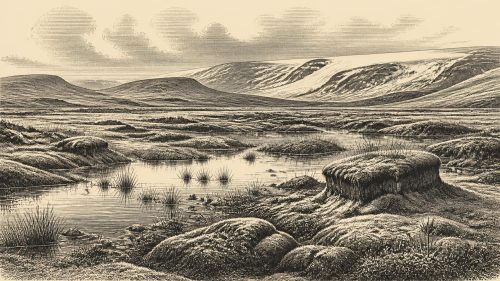
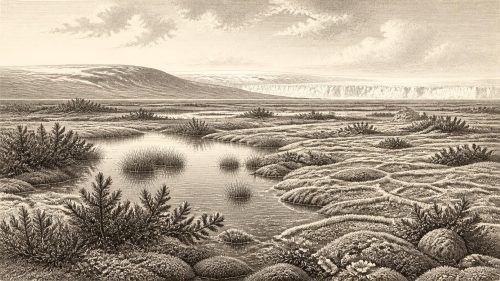
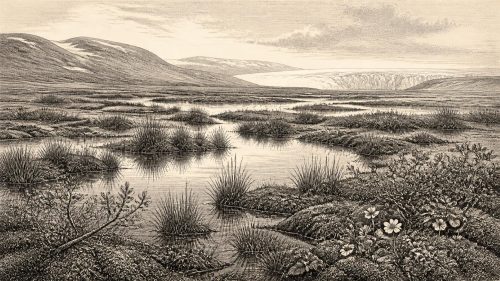
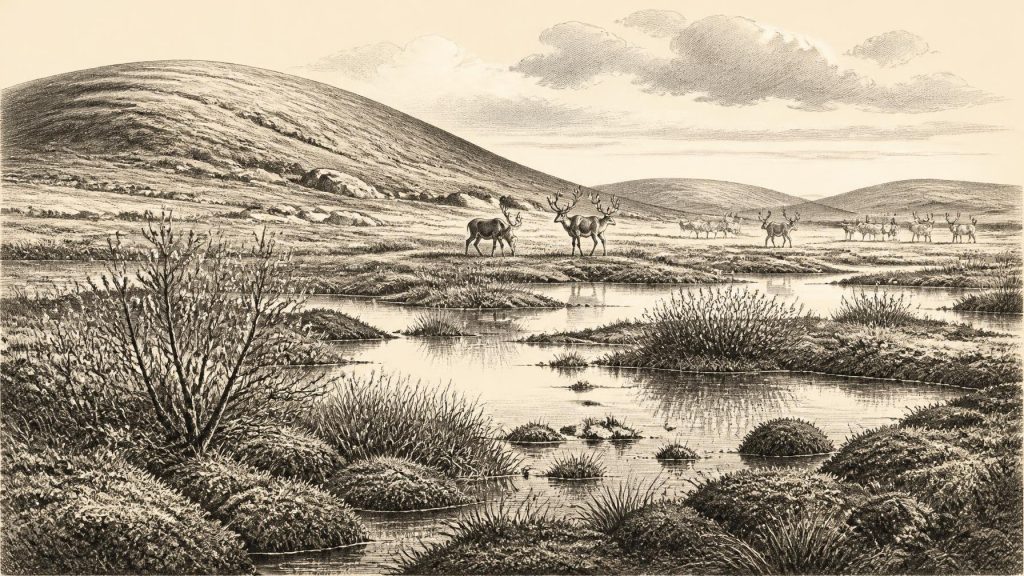
The Derryvree deposits preserve direct environmental traces: plant remains, pollen, mosses and sediment accumulated in and beside freshwater. They indicate a treeless, cold and open setting, often described as tundra-like or muskeg-like. Such descriptions are comparisons with modern ecological conditions, not claims that Fermanagh was identical to any present-day northern landscape. Waterlogged hollows could support mosses, sedges and aquatic vegetation, while low shrubs and herbs occupied better-drained ground. Frost action and short growing seasons limited the development of woodland.
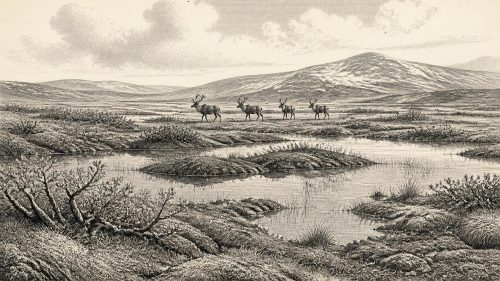
The freshwater record is especially valuable because it preserves the modest parts of a landscape that rarely appear in dramatic Ice Age imagery: wet margins, shallow pools, plant beds and mineral-rich silts. These were not signs of a benign climate. A pool may persist amid severe winters, strong winds and a brief summer. Yet such places concentrated water and forage. The inference that they offered useful habitat is reasonable; the proposition that a particular herd drank there in 30,311 BCE is not.
Environmental change also affected the island’s geography. Global sea levels were lower than today because great volumes of water were stored in ice sheets. Ireland was consequently less isolated in ecological terms than it is now, although the exact combinations of dry land, shallow sea, ice and viable movement corridors changed through time. The presence in Ireland of large mammals and carnivores demonstrates that populations reached the island during warmer or less severe phases of the glacial cycle. It does not justify a simple picture of an uninterrupted land bridge or a single migration route.
The Castlepook Fauna
In north Cork, Castlepook Cave near Doneraile—also known as Mammoth Cave—provides the most striking Irish faunal archive relevant to this wider age. Early twentieth-century excavators recovered a very large and mixed collection of animal bones. Later radiocarbon programmes, and more recent re-dating using improved pretreatment methods, have shown that the assemblage represents multiple episodes rather than one prehistoric community living together in a single landscape.
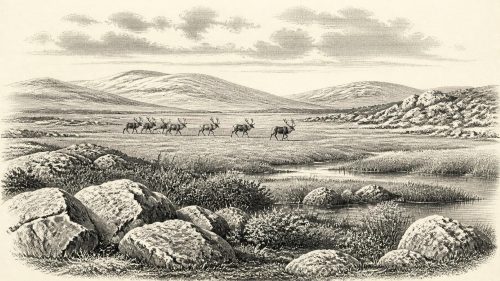
Among the animals documented from Castlepook are woolly mammoth, giant deer, reindeer, brown bear, wolf, Arctic fox, mountain hare, lemmings and spotted hyaena. Several are cold-adapted species; others point to varied open habitats capable of supporting large herbivores and predators. Re-dating has pushed some Castlepook specimens substantially earlier than older measurements suggested, reinforcing the conclusion that parts of southern Ireland supported a diverse Marine Isotope Stage 3 fauna. Spotted hyaena and giant deer may have disappeared locally before the later maximum of the last glaciation.
The cave, however, must not be treated as a time capsule of one moment. Bones can be carried in by carnivores, washed or disturbed by water, reworked by collapse, or moved during excavation. Some animals may have used the cave; others may have died outside it and entered only as fragments. The names given to chambers, including Elephant Hall and Hyaena Hall, are modern excavation labels, not prehistoric places of assembly. Castlepook confirms the presence of species over long spans of time. It cannot show mammoths and hyaenas standing together outside the cave on the same day.
People: A Possibility, Not a Population
Human history is the sharpest limit on what can be said. A reindeer femur from Castlepook has been interpreted by researchers as carrying a possible stone-tool mark, and its dating raised the prospect of human activity in Ireland around 33,000 radiocarbon years ago. If that interpretation is ultimately sustained, it would indicate a brief Upper Palaeolithic human presence far earlier than Ireland’s formerly accepted archaeological record. It would not establish a permanent settlement, a named group, or continuous occupation through the later glacial maximum.
Nor does that contested and chronologically separate specimen prove that people were in Ireland in 30,311 BCE. The date is substantially earlier when calibrated, the bone lacks a securely excavated modern context, and a mark on bone requires close taphonomic assessment before it can be identified confidently as butchery. Recent excavation at Castlepook located surviving sediments but reported no cultural artefacts. For this horizon, the honest conclusion is that human visitation remains possible, perhaps even plausible in the wider period, but is unproven for this particular year and insufficient to reconstruct households, camps or population numbers.
No Politics, No Recorded Belief
There is no evidence for political affairs, diplomacy, rulers, warfare, formal religion, language or learning in Ireland at this date. Those categories belong to societies with durable social traces, and none has survived here for this period. Even if people occasionally entered the island, their social organisation cannot be recovered from the present evidence. It would be unjustified to project later Irish identities, Celtic culture, clan structures, farming communities or religious traditions into this landscape.
If people did visit, their economy would have depended on mobility and immediate resources: hunting, scavenging, gathering and the practical use of stone, wood, bone and hide. This is an inference drawn from Upper Palaeolithic lifeways elsewhere in north-west Europe, not direct proof from Ireland. No Irish tools, hearths, dwellings, ornaments, graves or artworks can securely be assigned to 30,311 BCE. There is likewise no evidence for trade in the later historical sense. Movement of animals and perhaps people across a changing north-west European landscape is the relevant framework, not commerce between settled Irish communities.
An Island of Ecological Openings
The strongest history for this date is environmental. Derryvree records freshwater and cold-adapted vegetation during an interval between ice advances. Castlepook records a wider fauna that included imposing herbivores and formidable carnivores. Together they show that Pleistocene Ireland was not simply empty white ice, nor a settled human homeland. It contained temporary ecological openings, sometimes rich enough to sustain wetland plants, grazing animals and predators, but vulnerable to rapid climatic deterioration and renewed glaciation.
The later expansion of the British–Irish Ice Sheet would erase or bury much of this world. That destructive history helps explain the extraordinary scarcity of Irish evidence. What survives is fragmented: bones collected from caves, organic silts pressed beneath tills, pollen grains, mosses, seeds and a handful of dates with large uncertainties. Their significance lies precisely in their restraint. Around 30,311 BCE, modern calendar precision is unavailable. What can responsibly be said is that Ireland belonged to a dynamic Ice Age world in which cold open habitats and freshwater refuges briefly existed between episodes of ice, and in which large mammals demonstrably reached the island while any human presence remains an unresolved frontier of research.
Primary Sources
- A Middle Midlandian Freshwater Series at Derryvree, Maguiresbridge, County Fermanagh, Northern Ireland
- The Glacial Stratigraphy of the Sperrin Mountains and Its Relation to the Glacial Stratigraphy of North-West Ireland
- The Irish Quaternary Fauna Project
- A Reconsideration of the Radiocarbon Dating of the Marine Isotope Stage 3 Fauna from Southern Ireland
- Exploring Controls of the Early and Stepped Deglaciation on the Western Margin of the British-Irish Ice Sheet
- Deglaciation Chronology of the Donegal Ice Centre, North-West Ireland
- Pleistocene Glaciations in Ireland
- Figure 6.— The Subdivision of the Quaternary Period in Ireland
- Spotted Hyena Skull
- Ice Age Ireland
- 2022:564 – Castlepook Cave, Castlepook South, Cork
- Prehistoric Details
- Stone Age
- The IntCal20 Northern Hemisphere Radiocarbon Age Calibration Curve (0–55 cal kBP)
- Radiocarbon Dating and Chronological Modelling
- Independent Tephrochronological Evidence for Rapid and Synchronous Oceanic and Atmospheric Temperature Rises Over the Greenland Stadial-Interstadial Transitions Between ca. 32 and 40 ka b2k
- New Insights on the Fauna of Ireland's Younger Dryas and Early Holocene from Alice & Gwendoline Cave
- The Colonization of Ireland: A Human Ecology Perspective
- Introduction to the Glacial Sand and Gravel Landscapes of Northern Ireland
- Guide to the National Museum of Ireland