Fermanagh’s Frost Mosses31687 BCE
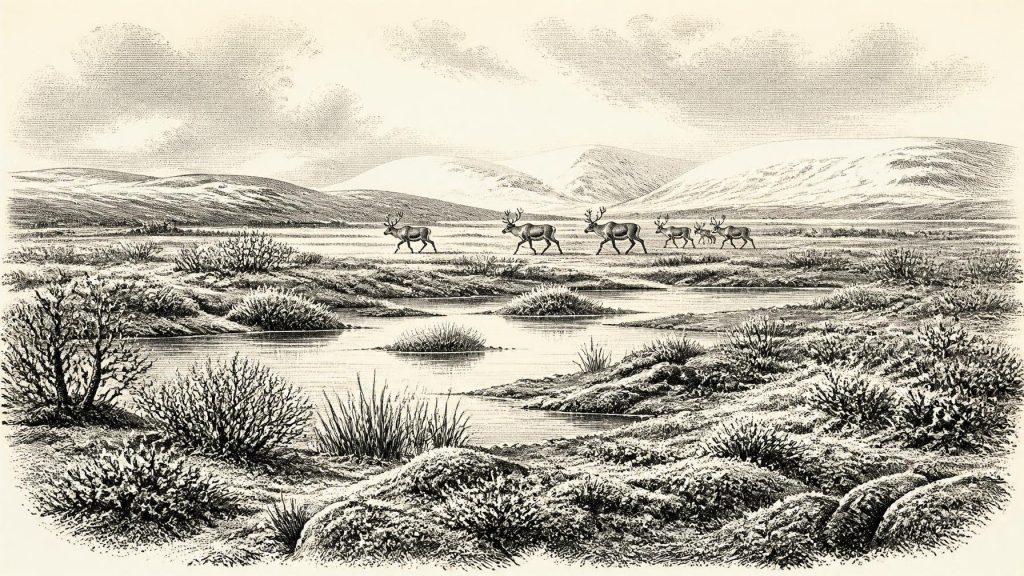
31,687 BCE is not a recoverable Irish year, but falls within later Marine Isotope Stage 3, before the Last Glacial Maximum. Derryvree, County Fermanagh, preserves freshwater sediments dated broadly to 36,900–31,700 cal BP, indicating an intermittently ice-free tundra wetland of mosses, sedges, grasses and shrubs. Castlepook Cave, County Cork, contains diverse Ice Age fauna, including mammoth, giant deer, reindeer, bear and hyaena, accumulated over millennia. A modified reindeer femur may record early human butchery, yet remains unconfirmed. No settlements or social institutions are evidenced. Ireland was a climatically unstable, variably habitable landscape of advancing ice, wildlife and possible human visits.
Dateline
“31,687 BCE” is a modern chronological label, not a recoverable year in Ireland’s prehistoric record. No calendar, written testimony, annual environmental sequence or securely dated settlement allows events to be placed in this particular year. Converted mechanically to the archaeological convention of years before AD 1950, it falls at about 33,636 years before present (cal BP). That conversion is only a way of locating the label within deep time, not a precise scientific date. The responsible historical subject is therefore Ireland during a broad interval in the later part of Marine Isotope Stage 3 (MIS 3), a climatically unstable phase of the Last Ice Age.
A Date Within Ranges
At this depth of time, radiocarbon dating produces ranges rather than anniversaries. A laboratory measures the remaining carbon-14 in suitable organic material; because atmospheric carbon-14 has varied greatly through time, the result must be calibrated against internationally maintained reference curves. Uncertainties in the original measurement, contamination, the nature of the sample and irregularities in the calibration curve all matter. A bone date normally estimates when the animal died, while a layer of silt may represent accumulation over years, centuries or longer. Neither can identify a named event in a numbered BCE year.
The most useful Irish environmental sequence close to this horizon was found at Derryvree, near Maguiresbridge in County Fermanagh. Road works in 1969 cut through a drumlin and exposed organic freshwater silts and fine sands trapped between two thick, distinct tills: sediments left by separate episodes of glacial ice. The organic series gave a conventional radiocarbon age of 30,500 radiocarbon years BP, with a large error range. Later calibration has placed it broadly at about 36,900–31,700 cal BP. The nominal year considered here, roughly 33.6 thousand cal BP, lies within that wide interval, but the deposit cannot be assigned to the year itself.
Derryvree establishes an important point. At some point during this lengthy span, the locality was not beneath overriding glacier ice. Fresh water collected; fine sediment accumulated; plants, insects and other organic matter entered the basin; and later ice advanced across the district and sealed the evidence. It does not prove that all Ireland was simultaneously ice-free, or that Fermanagh’s conditions prevailed unchanged in Cork, the western seaboard or the Irish Sea basin. Ice sheets are regional, dynamic systems, and the surviving evidence is fragmentary.
An Open, Wet Landscape
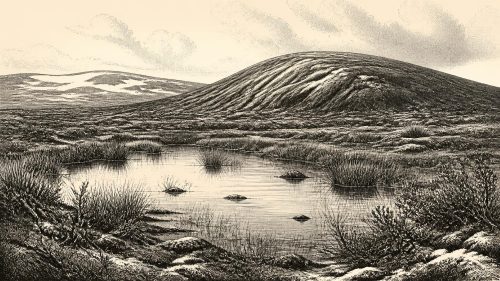
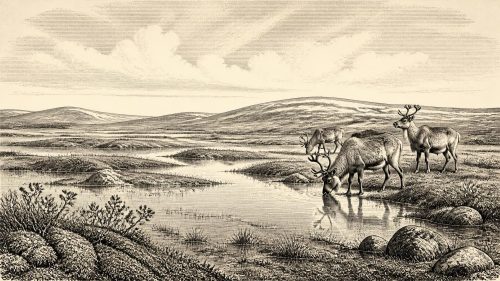
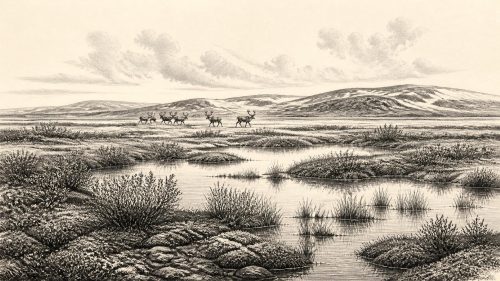
The Derryvree flora and fauna indicate open tundra vegetation and a periglacial climatic regime: a landscape shaped by persistent cold and seasonal freezing, rather than the familiar wooded, farmed Ireland of later millennia. Pollen and plant macrofossils point to herbs, grasses, sedges, mosses and low-growing shrubs. Wet hollows and shallow freshwater margins could sustain especially rich patches of moss and sedge, even where exposed ground elsewhere was sparse. The evidence does not support a continuous blanket of snow or an empty polar desert. Nor does it support oak woodland, enclosed fields, peat-cuttings or any recognisable rural landscape.
Such ground would have changed with drainage, slope, shelter and season. Frost could fracture exposed rock and disturb surface sediments; streams and meltwater moved material through valleys; shallow basins offered standing water. The drumlin that preserved Derryvree is itself a reminder that the terrain visible today is partly the result of repeated glacial remodelling. Later ice eroded older surfaces, shifted sediments and obscured many places where earlier evidence might once have survived. This destructive history helps explain the extraordinary scarcity of Palaeolithic traces in Ireland, though it cannot be used as a licence to imagine lost camps wherever evidence is absent.
The wider climatic setting was becoming more severe and unstable. Reconstructions of the British–Irish Ice Sheet show major expansion during the later stages of MIS 3, with the Scottish component advancing rapidly around 32,000–31,000 years BP and the ice sheet subsequently growing to its greatest volume around 23,000 BP. The date considered here belongs before that maximum, during a long transition rather than a simple before-and-after moment. Ireland may therefore be understood as a changing mosaic of ice, ice margins, exposed terrain, waterways and cold-adapted habitats whose exact arrangement cannot be mapped year by year.
Castlepook’s Animal Archive
In north County Cork, Castlepook Cave near Doneraile offers the chief faunal counterpart to Derryvree’s wetland sequence. This maze-like limestone cave system was excavated chiefly in the early twentieth century and has produced more than 2,000 bones. It is Ireland’s richest known archive for vertebrate life leading up to the Last Glacial Maximum. The wider dated assemblage spans a very long period, approximately 45,700 to 19,950 years BP, and should not be treated as a single simultaneous animal community.
Nevertheless, it demonstrates that during portions of the pre-maximum Ice Age Ireland supported, or was accessible to, a striking range of mammals. The cave’s fauna includes woolly mammoth, giant deer (Megaloceros giganteus), reindeer, brown bear and spotted hyaena, while later cold-stage material includes Arctic fox, wolf, collared lemming and Norwegian lemming. “Irish elk” is a traditional name for giant deer, but the species was neither confined to Ireland nor closely related to the living animals called elk in North America. Its fossils are significant for Ireland’s natural history, not proof of an ancient Irish national animal.
Castlepook also demonstrates why cave evidence demands care. Caves can be dens, traps, water channels and sediment repositories, not simply places where people lived. Spotted hyaenas and other carnivores could drag carcass parts underground; teeth, trampling, water movement, sediment pressure, excavation and later handling can all alter bones. The presence of mammoth or reindeer remains shows that these animals reached the wider region during the long interval represented by the deposit. It does not establish that every listed species grazed together outside the cave in 31,687 BCE.
The Fragile Human Clue
A reindeer femur from Castlepook has made this period especially important. Re-examined within the National Museum of Ireland collections, it has been reported as bearing a deep modification interpreted by zooarchaeologist Ruth Carden as a cut or chop made with a sharp stone tool while a fresh carcass was being processed. Public heritage accounts have associated the bone with an approximate age of 33,000 years ago, or around 31,000 BCE in broad calendar notation. If the modification is confirmed as human-made and reliably related to the age of the animal, it would indicate a remarkably early Upper Palaeolithic human episode in Ireland.
That conditional wording is essential. The femur came from an old cave collection, rather than from a modern excavation of an undisturbed occupation floor containing tools, hearths and food debris in recorded relationship to one another. The date would concern the reindeer’s death, not necessarily the exact time, place or agent of any later marking. One bone cannot reveal whether people killed the animal, found a carcass, removed meat, opened the limb for marrow, collected hide or sinew, or processed it elsewhere before carnivores or natural processes carried the bone into the cave.
No securely associated Irish stone-tool assemblage, dwelling, hearth, burial, human skeleton, art panel or repeated settlement layer of this age has yet been published. Renewed fieldwork at Castlepook has sought intact deposits, further modified bone, lithics, sediment evidence and ancient DNA precisely because such material could test the claim. The marked femur is therefore a potentially transformative clue, not proof of a permanent Palaeolithic population.
Society Beyond Recovery
For this broad period, there is no evidential basis for describing an Irish polity, ruler, war, alliance, diplomatic exchange, language, religion or formal learning. There are no known villages, cultivated fields, monuments, graves or trade goods from Ireland that can be assigned around 33.6 thousand cal BP. Terms such as “tribe”, “chief”, “nation” and “Irish people” would impose much later political and cultural categories upon a record that cannot sustain them.
If people did reach the island, comparison with Upper Palaeolithic societies elsewhere in north-west Europe makes small, highly mobile foraging groups a reasonable inference. Such visitors would have needed close practical knowledge of cold-weather shelter, stone raw materials, animal behaviour, fuel and seasonal routes. But those are expectations drawn from better-preserved European evidence, not observations of an excavated Irish camp. There is no Irish evidence from this time for ritual practice, storytelling, ornament, music or teaching, and silence in the record must not be mistaken for proof that such capacities did not exist.
Nor can economy be reconstructed as trade in any meaningful sense. Reindeer, mammoth and giant deer point to animal movement and ecological connectivity with neighbouring lands, but animal dispersal is not commerce. Any human crossing to Ireland, if it occurred, would raise questions about routes and watercraft, yet there is no surviving boat, harbour, landing site or imported object from this horizon. The dependable historical picture is environmental: an intermittently habitable cold-stage landscape, populated by animals and perhaps touched by rare human visitors.
What This Year Can Mean
The central development around this notional date was not a battle, reign or foundation. It was Ireland’s exposure to profound climatic transformation before the Last Glacial Maximum. At Derryvree, freshwater sediments preserve a window onto tundra wetland during an ice-free interval. At Castlepook, bones preserve the evidence of a richer Ice Age fauna than later Ireland possessed, together with one intriguing possible trace of human animal-processing. These archives are powerful precisely because they are small, damaged and difficult to interpret.
For 31,687 BCE, modern calendar-year precision is unavailable. The most responsible conclusion is neither that Ireland was a settled human homeland nor that it was wholly lifeless beneath permanent ice. It was a variable Ice Age country in which cold-adapted ecosystems existed in at least some regions; glaciers were advancing within the broader North Atlantic world; and the possibility of a brief human encounter remains open, compelling and unproven. Future excavation, refined radiocarbon dating and analysis of surviving cave sediments may alter that balance of evidence. For now, Fermanagh’s frost mosses and Cork’s cave bones set the limits of the story.
Primary Sources
- A Middle Midlandian Freshwater Series at Derryvree, Maguiresbridge, County Fermanagh, Northern Ireland
- A Reconsideration of the Radiocarbon Dating of the Marine Isotope Stage 3 Fauna from Southern Ireland
- The Irish Quaternary Fauna Project
- Castlepook Cave: County Geological Site Report
- The Geological Heritage of County Cork
- Growth and Retreat of the Last British–Irish Ice Sheet, 31,000 to 15,000 Years Ago: The BRITICE-CHRONO Reconstruction
- Growth and Retreat of the Last British–Irish Ice Sheet, 31,000 to 15,000 Years Ago: The BRITICE-CHRONO Reconstruction
- Trimlines, Blockfields and the Vertical Extent of the Last Ice Sheet in Southern Ireland
- BRITICE-CHRONO: Introduction
- BRITICE Glacial Map, Version 2: A Map and GIS Database of Glacial Landforms of the Last British–Irish Ice Sheet
- The IntCal20 Northern Hemisphere Radiocarbon Age Calibration Curve (0–55 cal kBP)
- IntCal Publications
- First Evidence of a Late Upper Palaeolithic Human Presence in Ireland
- New Insights on the Fauna of Ireland’s Younger Dryas and Early Holocene from Alice & Gwendoline Cave
- The Colonization of Ireland: A Human Ecology Perspective
- Ireland: Submerged Prehistoric Sites and Landscapes
- The Archaeology of Caves in Ireland
- Preliminary Assessment of the Archive of Faunal Remains from Excavated Irish Cave Sites
- Castlepook Caves Project: Archaeology Research Excavation Grant 2022 Final Report
- Castlepook Caves Project: Archaeology Research Excavation Grant 2023 Report
- Castlepook Cave, Co. Cork, 2022 Excavation Record
- Occurrence of Mammalia Relicts at Site Castlepook Cave
- County Geological Heritage Audit Reports
- Geological Heritage Data and Maps