Derryvree’s Calcareous Silts30310 BCE
30,310 BCE is a label within a MIS 3 chronological range, not a recoverable Irish year. At Derryvree, County Fermanagh, freshwater silts between glacial tills record an ice-free interval before ice burial. Radiocarbon evidence broadly places these deposits within the horizon. Plant remains indicate a cold, open, treeless periglacial landscape of shallow water, mosses, sedges and tundra vegetation. Cave records elsewhere preserve Late Pleistocene fauna, although their dates and contexts differ. Possible butchery marks suggest intermittent human visitation, not settlement. No evidence supports polities, trade or events. Derryvree preserves a fleeting, biologically active freshwater landscape before expanding glaciers reshaped Ireland.
Dateline
30,310 BCE is not a recoverable historical year in Ireland. It is a modern calendar label, not a date used by people then, and no Irish deposit can be assigned to that particular year, season or generation. In simple arithmetic it lies roughly 32,259 years before AD 1950, the conventional ‘present’ of radiocarbon dating, but radiocarbon years and calendar years are not interchangeable. The responsible setting is the later part of the Late Pleistocene, within Marine Isotope Stage 3 (MIS 3), a climatically volatile interval of the last Ice Age before the Last Glacial Maximum. Ireland’s evidence is sparse, local and mostly environmental: buried freshwater sediments, cave calcite, glacial deposits and animal bones. It can illuminate landscapes and ecological possibilities; it cannot supply kings, communities, battles or an annual chronicle.
A Date Within a Wide Range
The strongest Irish chronological anchor for this broad period is Derryvree, near Maguiresbridge in County Fermanagh. Road works in 1969 cut through a drumlin and exposed a remarkable sequence: an older glacial till below, freshwater silts and fine sands with organic material in the middle, and a later till above. The order of these layers is important. Ice had covered the site, then withdrew or ceased to occupy it long enough for freshwater sediment and vegetation to accumulate, before a later glacier overran and sealed the deposit. This is evidence for a local ice-free interval, not a map of conditions across every part of Ireland.
The organic layer produced the conventional radiocarbon determination BIRM-166, 30,500 radiocarbon years before present, with a substantial uncertainty of +1,170 and −1,030 years. Published calibrations place it broadly around 36,900–31,700 calibrated years before present, approximately 34,950–29,750 BCE. The requested year falls within that broad calibrated window, but not at a pinpointed horizon within it. A sediment bed may represent a considerable span of time; material can be mixed or redeposited; and calibration itself expresses probabilities, not certainty. The useful conclusion is therefore modest but significant: around this portion of MIS 3, south Fermanagh contained a freshwater environment during an interruption between glacial advances.
Water, Silt and Tundra Plants
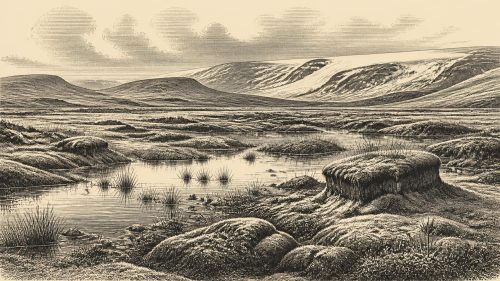
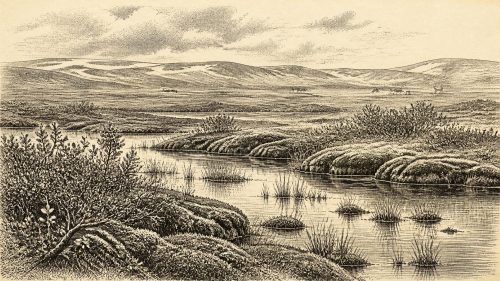
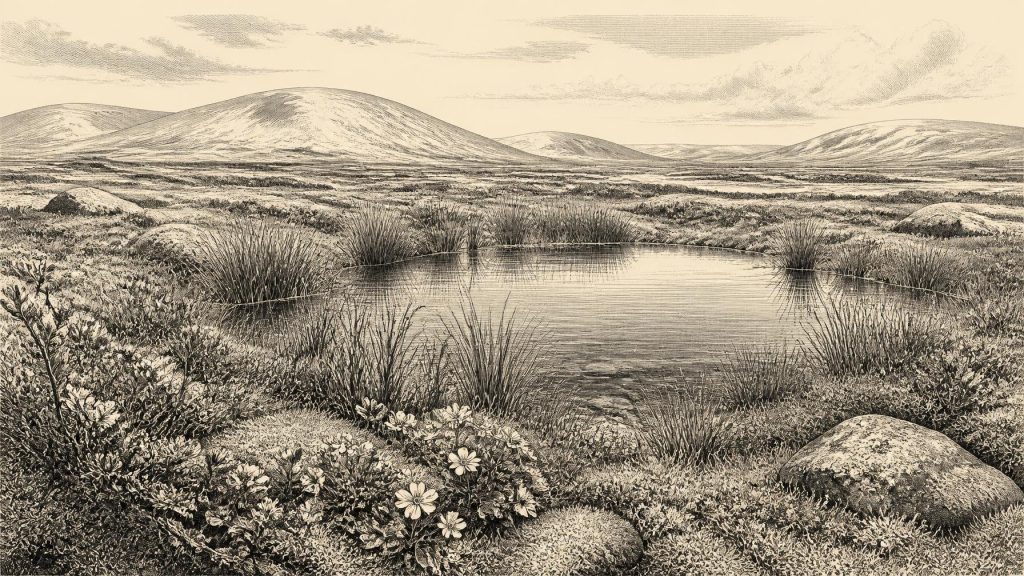
Derryvree’s fossils offer the closest view of an Irish habitat relevant to this date. The silts and fine sands accumulated in still or slowly moving freshwater, probably within a wet basin or pool-fringed landscape. Their plant remains and pollen point to a cold, open, largely treeless environment with a periglacial climate: one shaped by prolonged frost, seasonal thaw and ground close to glacier margins, rather than by dense woodland. The assemblage includes mosses and herbaceous plants associated with tundra conditions, alongside aquatic or wet-ground species.
Among the recorded fossils are mountain avens (Dryas octopetala), dwarf willow, sedges, water-milfoil and bogbean or buckbean (Menyanthes trifoliata). These should not be arranged into a picturesque, complete modern-style plant community. Fossil preservation is selective, pollen was poorly preserved, and each species has its own ecological tolerance. Nevertheless, together they support a landscape of open ground, damp hollows, shallow fresh water and low-growing vegetation. In better-drained patches, plants would have been exposed to wind, frost disturbance and short growing seasons. In wetter places, mosses and sedges could take advantage of meltwater and mineral-rich silt.
That ecology matters because it corrects two misleading extremes. Ireland was not necessarily a uniform, permanent ice sheet at this moment; neither was it a mild, forested island. Derryvree indicates a cold but biologically active local landscape. The later glacier that buried the organic bed preserved a fleeting environmental archive while also destroying or obscuring much else. The familiar drumlin country of Fermanagh is thus partly a record of later ice movement, but inside one drumlin lay evidence of an earlier freshwater world.
An Unstable Ice-Age Island
In wider geological terms, 30,310 BCE belongs to a phase of rapid climatic shifts across the North Atlantic region. Greenland ice-core chronologies divide MIS 3 into alternating colder stadials and relatively milder interstadials. Irish sequences cannot always be matched securely to one named Greenland event: their dates are broad, their deposits are discontinuous and local conditions mattered. Yet Derryvree’s water-laid organic sediments, and episodes of speleothem growth at Crag Cave in County Kerry, show that Ireland responded to such instability. Calcite formations in caves require water moving through soil and limestone; their episodic growth during MIS 3 is consistent with intervals less hostile to infiltration than the full glacial maximum that followed.
This does not mean that conditions were comfortable or predictable. Periglacial terrain could be harsh even when ice was absent locally. Winters were severe, vegetation was low and seasonal resources were limited. Glaciers and ice streams were expanding in the broader British–Irish region as the Last Glacial Maximum approached. Reconstructions of the British–Irish Ice Sheet show considerable uncertainty about the timing and pattern of advance before its maximum, especially on land. The later maximum, broadly between about 26,000 and 20,000 years ago, reshaped much of Ireland and removed, reworked or buried earlier deposits. That destructive history is a major reason why evidence for this older period is so rare.
Animals in the Southern Caves
Southern Irish caves provide another, different archive. Castlepook Cave near Doneraile, County Cork, is the country’s richest known site for Late Pleistocene vertebrate remains. Its early excavations recovered bones of woolly mammoth, giant deer, reindeer, brown bear, wolf, arctic fox, lemmings and spotted hyaena. These animals do not represent a single herd, season or moment. Cave deposits accumulated through carnivore activity, animals dying or sheltering in caves, water movement, sediment disturbance and early excavation methods that did not meet modern standards. Their remains nonetheless establish that a varied cold-stage fauna reached Ireland during MIS 3.
Re-dating has complicated, rather than simplified, the picture. Modern radiocarbon pretreatment has shown that several Castlepook specimens are considerably older than previously thought; research suggests that giant deer and spotted hyaena may have disappeared locally before about 40,000 calibrated years ago. Some dated reindeer, mammoth and bear remains nevertheless demonstrate that Irish habitats before the Last Glacial Maximum could support large herbivores and their predators or scavengers. It would be unsafe to state that every species recorded at Castlepook lived beside the Derryvree pool at 30,310 BCE. The sites are far apart, their deposits have separate histories and their dates span millennia. Together, however, they make an open, cold, animal-rich Ireland more plausible than an entirely lifeless one.
People: Possibility, Not Settlement
The human question requires particular restraint. A reindeer femur from Castlepook, re-examined in recent research, has been reported to bear a mark consistent with cutting by a sharp stone tool. If that interpretation is confirmed, it may be evidence that a person butchered an animal in Ireland before the Last Glacial Maximum. Research excavations have consequently sought secure stratified deposits, charcoal, stone artefacts and further modified bone. This is an important line of enquiry, but it is not yet proof of an established Irish Palaeolithic population at this date.
No securely associated hearth, stone-tool assemblage, dwelling floor, human burial or repeatedly occupied camp has been demonstrated for Ireland around 30,310 BCE. A modified bone, even if humanly made, would record an episode of animal processing rather than a settled community. Its bone date would also date the animal’s death, not precisely the act of cutting. Ireland may have been visited intermittently by highly mobile hunter-gatherers moving through the north-western edge of Europe, but that remains interpretation rather than demonstrated settlement history. The archaeological record cannot presently tell us whether any people were in Ireland during the particular span represented by this calendar label.
No Polities, No Proven Trade
Accordingly, there is no responsible account of political affairs, diplomacy, named conflict, organised religion, formal learning or trade for Ireland at this time. There are no written records, monuments, settlements or artefact networks from which to infer chiefs, territorial groups, languages, rites or exchange routes. Nor should the presence of large mammals be turned into a story of hunting parties without direct evidence. The only ‘conflict’ securely visible in the record is ecological: animals competed, predators fed, frost broke ground and ice repeatedly transformed habitats. Human social life, if people briefly entered Ireland at all, remains beyond recovery.
What can be said is both narrower and more remarkable. Around the broad chronological horizon into which 30,310 BCE falls, an ice-free freshwater basin existed at Derryvree in Fermanagh. Low tundra plants grew around cold water; mammals occupied at least some Irish landscapes during the wider MIS 3 interval; and cave systems preserved fragments of a lost fauna. Within a few thousand years, expanding ice would dramatically alter the island again. Derryvree’s calcareous silts therefore do not reveal an event of one year. They preserve something rarer: evidence that, before the great ice advance, part of Ireland briefly held water, vegetation and life.
Primary Sources
- A Middle Midlandian Freshwater Series at Derryvree, Maguiresbridge, County Fermanagh, Northern Ireland
- Palaeoecology: Irish Quaternary Association Field Guide No. 16
- Trimlines, Blockfields and the Vertical Extent of the Last Ice Sheet in Southern Ireland
- Exploring the Last British–Irish Ice Sheet: The Deglaciation of Donegal Bay and the Malin Sea
- Pleistocene Glaciations in Ireland
- Growth and Retreat of the Last British–Irish Ice Sheet, 31,000 to 15,000 Years Ago: The BRITICE-CHRONO Reconstruction
- Timing and Pace of Ice-Sheet Withdrawal Across the Marine–Terrestrial Transition West of Ireland During the Last Glaciation
- Late Pleistocene Chronostratigraphy and Ice Sheet Limits, Southern Ireland
- Last Glacial Maximum Cirque Glaciation in Ireland and Implications for Reconstructions of the Irish Ice Sheet
- Episodic Speleothem Deposition Tracks the Terrestrial Impact of Millennial-Scale Last Glacial Climate Variability in SW Ireland
- Spatio-Temporal Dynamics of Speleothem Growth and Glaciation in the British Isles
- A Reconsideration of the Radiocarbon Dating of the Marine Isotope Stage 3 Fauna from Southern Ireland
- The Irish Quaternary Fauna Project
- Castlepook Cave: County Geological Site Report
- The Exploration of Castlepook Cave, Co. Cork. With 3 Plates
- Archaeology Research Excavation Grant 2022: Castlepook Cave Final Report
- 2022:564 – Castlepook Cave, Castlepook South, Cork
- Archaeological Heritage of County Cork
- The IntCal20 Northern Hemisphere Radiocarbon Age Calibration Curve (0–55 cal kBP)
- New Insights on the Fauna of Ireland’s Younger Dryas and Early Holocene from Alice & Gwendoline Cave
- Myriophyllum alterniflorum DC.
- Dryas octopetala L.
- Menyanthes trifoliata L.