Trim’s New Lieutenant1424 CE
Dateline
In 1424, Ireland’s political map was defined less by a single national struggle than by a series of overlapping lordships, rival dynasties and negotiated allegiances. The English crown governed most directly from Dublin and its surrounding lordship, but royal office depended upon the cooperation of magnates whose power reached well beyond the formal limits of crown administration. Gaelic rulers, Hiberno-Irish dynasties and English settlers all made and remade local political worlds through warfare, tribute, marriage, submission and the possession of castles.
The year is especially notable for the arrival in Ireland of Edmund Mortimer, earl of March and Ulster, as the young king Henry VI’s lieutenant. It also saw a hard campaign in Ulster associated with James Butler, earl of Ormond, Mortimer’s deputy; a diplomatic settlement in Breifne; and deaths that reveal the importance of learned households, ecclesiastical office and military retainers in Gaelic society. The evidence is uneven. The annals preserve striking reports, but often do not supply precise dates within the year, troop numbers or the full motives of those involved. Their language also reflects their own political and cultural viewpoints.
A Lieutenant Reaches Ireland
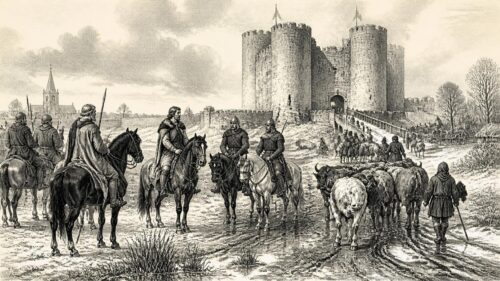
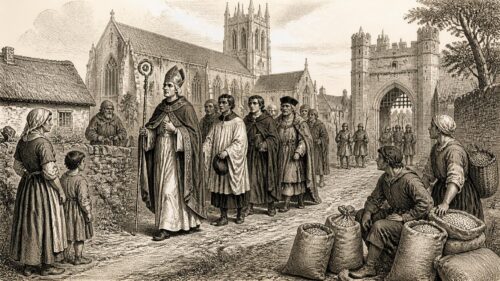
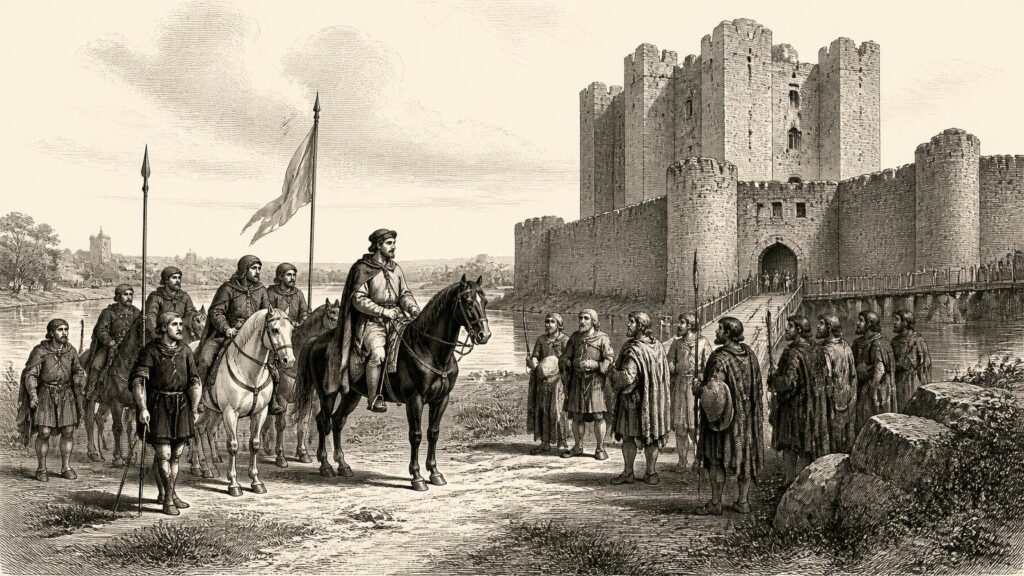
Edmund Mortimer had been appointed lieutenant of Ireland in May 1423, yet governed initially through deputies rather than coming in person. By 1424, James Butler, fourth earl of Ormond, was acting as one of those deputies, alongside Edward Dauntsey, bishop of Meath. Mortimer’s eventual arrival was therefore significant: a great nobleman with the titles of earl of March and Ulster, and with extensive inherited interests in Ireland, was finally present to exercise royal authority himself.
The Annals of the Four Masters place his arrival about Michaelmas, the feast of 29 September. Modern biographical scholarship likewise places his arrival in September 1424. This was not an English conquest of Ireland, nor did Mortimer take control of the island. Rather, it was an attempt to reinforce a fragile royal administration by bringing a powerful lord to Trim, one of the principal centres of the English lordship in Meath. Trim Castle and the surrounding liberty were particularly appropriate bases for a Mortimer earl: the family had long-standing connections with the area.
Mortimer’s presence was also bound up with politics in England. Henry VI was still a child, and the English monarchy was governed through a regency council. Mortimer possessed a notably strong hereditary claim to the English throne, although he had served the Lancastrian dynasty loyally. Sending such a prominent man to Ireland served administrative purposes, but it also removed him from the increasingly tense politics of the English court. Ireland was thus connected directly to the wider government of the English realm, not treated as a remote political afterthought.
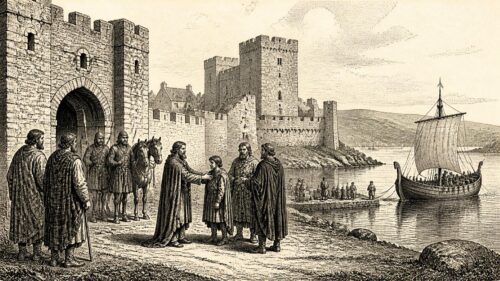
The immediate result was a gathering of authority around Trim. Later evidence shows that several Gaelic magnates had recently submitted to Mortimer when he died there in January 1425. That death belongs to the following calendar year, not to 1424, but it helps explain why his autumn arrival mattered. During the closing months of 1424, submissions and negotiations offered the lieutenant a means of displaying royal influence without assuming that every neighbouring lordship had become securely obedient.
Ormond’s Ulster Campaign
Before Mortimer’s arrival, and probably in connection with his deputyship, Ormond led an intervention in Ulster intended to revive the authority traditionally claimed by the earls of Ulster. The surviving annalistic account is hostile to the expedition and calls its English newcomers “Saxons”, while also distinguishing the settlers and lords of Meath as Galls, or foreigners. Such wording should not be repeated as a neutral description, but it makes clear how the campaign appeared from a Gaelic perspective: it was an armed and disruptive intrusion.
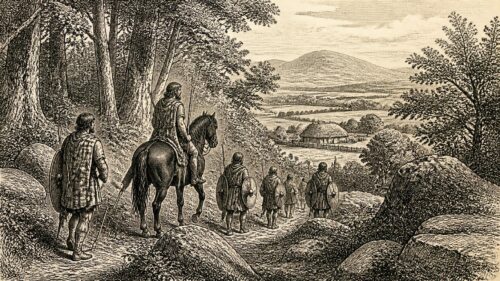
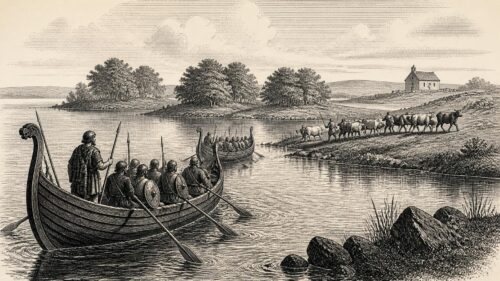
The force included men newly arrived with Ormond and men drawn from the English lordship. It carried out depredations in Machaire Armagh and Machaire Mucna, fertile and strategically important districts in Ulster. Depredation was not merely random plunder. In medieval Irish warfare, the seizure of cattle, foodstuffs and movable wealth could punish an opponent, feed an army, advertise superiority and compel negotiations. Yet its burden fell heavily upon ordinary households whose animals, crops, stores and seasonal labour sustained local communities.
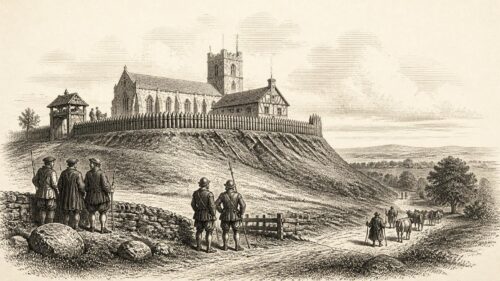
A further attack struck the Magennis lordship. Ormond’s forces demolished Magennis’s castle at Loch Bricrenn and killed the constable of his gallowglasses together with almost all of the castle’s ward. The brief report conveys the military character of the age. Castles were not simply symbols of lordly prestige: they guarded routes, sheltered stores and people, and anchored claims to territory. Gallowglasses, heavily armed professional warriors of Gaelic and Hebridean origin, were valued retainers. The killing of their constable and the destruction of a garrison damaged both the lord’s immediate security and his standing among allies and dependants.
The campaign produced no straightforward settlement. The annals report that leading figures in Ulster assembled to resist, with Niall O’Donnell, O’Neill and Eóghan O’Neill prominent among them. Yet the coalition was not universal. MacNeill Boy, O’Hanlon and Manus MacMahon sided with the English force. MacNeill Boy expelled Magennis from his territory, whereupon Magennis joined the wider Irish opposition. This shifting pattern is crucial. The conflict was not a simple contest between English and Irish blocs. Local rivalries, old claims, opportunities for advancement and rival dependencies shaped decisions as much as broad cultural labels did.
Hugh Magennis died of plague in the same year, according to the Annals of the Four Masters, and his son Rory was chosen in his place. The coincidence of political displacement, warfare and succession made the Magennis position especially exposed. It would be unsafe to claim that plague caused the political crisis, or that it spread through all Ulster. What can responsibly be said is that the annals record disease among important people at a moment when lordship was already being contested by arms.
Breifne and the Price of Peace
In Breifne, centred broadly on parts of modern Cavan, Leitrim and neighbouring districts, 1424 brought a more clearly negotiated political outcome. A prolonged dispute within the O’Rourke kindred had followed the death of Aodh Buidhe O’Rourke. Tadhg O’Rourke faced Art O’Rourke, while Eóghan O’Reilly of East Breifne possessed the influence to determine which claimant could effectively rule West Breifne.
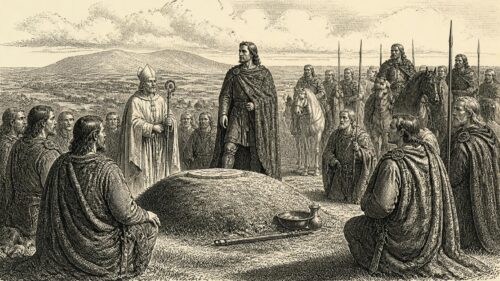
Tadhg submitted to Eóghan O’Reilly. In return, O’Reilly confirmed him in the kingship of West Breifne in place of Art. When Art resisted, the combined forces of Tadhg and O’Reilly devastated his territory and compelled his submission. The agreement ended neither competition nor dependence: Tadhg had secured his position, but he had done so by accepting O’Reilly’s superiority. The settlement demonstrates that Gaelic kingship was neither automatic inheritance nor a fixed territorial office. It rested on family claims, military support, the consent or acquiescence of leading allies, and the practical ability to make rivals yield.
Such diplomacy was inseparable from violence, but it should not be reduced to violence alone. Submission could preserve a lord’s place where continued war risked greater destruction. The O’Rourke–O’Reilly settlement was an exercise in regional statecraft, worked out through personal relationships and armed pressure rather than through impersonal institutions. Its fragility would become apparent later, but in 1424 it temporarily gave Tadhg control of West Breifne.
Plague, Learning and Hospitality
The annals’ notices of death reveal institutions that are otherwise easy to overlook. Mael Sechlainn Mac Cabe, described as constable of the two Breifnes, Fermanagh and Oriel, died of plague. The Annals of Ulster called the news grave and portentous for the learned people of Ireland. This phrase does not permit a precise reconstruction of Mac Cabe’s scholarly role, but it strongly suggests that his death mattered beyond the military households he served. Powerful families sustained networks of poets, historians, lawyers, clerics and teachers; a leading constable could be closely connected to such circles through patronage, kinship and service.
Gilla Ísa Mac Tiernan also died in 1424. He was remembered as heir to the chieftainship of Tullaghduff and, notably, as a man generous to learned companies and pilgrims. The tribute points to a social expectation placed upon elite households: hospitality was a political virtue. Feeding travellers, clergy and men of learning reinforced reputation and helped make lordship visible in daily life. It also implies movement across the country by pilgrims, students, poets and professional families, even amid warfare.
Church and secular society remained closely entwined. Conor O’Farrell, bishop of Ardagh, was recorded as dead in the Annals of the Four Masters, praised for learning, charity and dignity. In Connacht, Ulick Burke, Mac William of Clanricarde, also died. These notices do not provide a full account of succession or administration, but they show the simultaneous loss of a bishop and a major lord in different regions. Religious office, lordly authority, household generosity and learned culture were not separate compartments of life; they overlapped through patronage, kinship and local power.
A Limited Royal Recovery
For contemporaries, the most visible events of 1424 may have been the burning of settlements, the capture or demolition of castles, plague deaths and contested inaugurations. For historians, the year’s larger significance lies in the limits it exposes. Mortimer’s arrival at Trim gave the crown’s Irish government renewed prestige. Ormond’s Ulster campaign demonstrated that the administration could raise men, strike hard and exploit local divisions. But the campaign also united many Ulster lords against it, while other Irish rulers dealt with their own rivals through alliances beyond Dublin’s control.
Ireland in 1424 was therefore neither a land wholly beyond English authority nor one securely ruled from the king’s castle at Dublin. It was a landscape of competing jurisdictions. Royal officers, earls, Gaelic kings, churchmen, gallowglass captains and learned households all exercised forms of authority that depended on negotiation as much as force. Mortimer’s autumn arrival at Trim briefly concentrated those pressures in one place. The events of the year show how difficult it was for any lord, English or Irish, to turn temporary advantage into lasting command.
Primary Sources
- The Annals of Ulster, Year U1424
- Annals of the Four Masters, Annal M1424
- Annála Connacht, Annal 1424
- Annals of Loch Cé, Volume II
- Mac Carthaigh’s Book
- Annals of the Four Masters, Irish Text, Annal M1424
- CELT: Translated Texts
- Mortimer, Edmund
- Butler, James
- O'Rourke (Ó Ruairc), Tadhg
- O'Rourke (Ó Ruairc), Donnchadh
- O'Kelly (Ó Ceallaigh), Tadhg
- O'Kelly (Ó Ceallaigh), Maolsheachlainn
- Ó Ceallaigh, Muircheartach (Mauricius, Maurice)
- Calendar of Ormond Deeds, Volume III, 1413–1509
- Calendar of Ormond Deeds, 1172–1603: National Library of Ireland Catalogue
- The Dating of the Irish Annals
- Chronological Synchronisation of the Irish Annals
- Irish Script on Screen: MS C iii 1, The Annals of Connacht
- The Fifth Earl: Edmund Mortimer, Earl of March
- An Unwilling ‘Pretender’: Reassessing the Unfortunate Career of Edmund Mortimer, Earl of March (1391–1425)
- A Task Too Great for One Dynasty? The Mortimer Earls of March