Castles, Fleets and Hostages1124 CE
In 1124 Tairdelbach Ua Conchobair, Connacht’s dominant king, faced a broad alliance led by rulers of Desmond, Leinster, Meath and Bréifne. He transported a fleet around Doonass, campaigned along the Shannon, established a longphort, raided rebellious territories and executed Desmond hostages, forcing opponents to disperse. Connachtmen built fortifications at Galway, Cúl Maile and Dún Leodha, strengthening strategic routes. Regional killings, raids and an accident involving Tara’s king reflected continuing instability. Church reform advanced through Malachy’s consecration as bishop of Connor, Bangor’s church and Clonmacnoise’s tower. Limerick suffered a devastating fire. Tairdelbach retained supremacy, but required constant warfare, negotiation and infrastructure.
Dateline
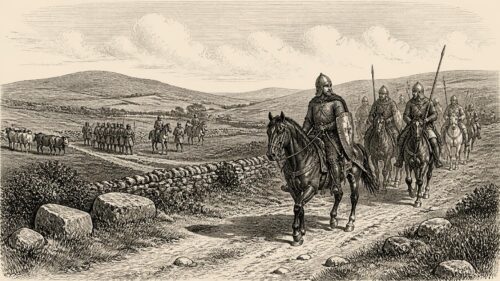
Ireland in 1124 was dominated by the restless ambitions of Tairdelbach Ua Conchobair, king of Connacht and the strongest claimant to the kingship of Ireland. The year’s chronicles describe fleets hauled around rapids, months-long royal encampments, newly constructed fortifications, cattle raids, rebellion and the execution of hostages. They also record church building, the advancement of the reformer Malachy and a disastrous fire at Limerick. Together these entries reveal a country in which royal power depended upon movement: kings travelled with armed households, ships and supplies, while political loyalty was continually tested through tribute, hostages and military service.
A King With Opposition
The death of Domnall Ua Lochlainn in 1121 had removed Tairdelbach’s principal rival for supremacy. The annals consequently call the Connacht ruler “king of Ireland”, although this was not a settled national monarchy. His authority rested upon the submission of provincial and regional kings, many of whom obeyed only while confronted by his army. Medieval scholars therefore describe his position as high-king “with opposition”.
That opposition became unusually broad in 1124. Cormac Mac Carthaigh of Desmond, Énna Mac Murchada of Leinster, Murchad Ua Máel Sechlainn of Meath and Tigernán Ua Ruairc, ruler of Bréifne and the Conmaicne, all appear among Tairdelbach’s enemies. Their alliance joined dynasties with different interests but a shared reason to fear an overking who intervened in successions, demanded hostages and carried war far beyond Connacht.
The political crisis followed the death at Cashel of Tadc Mac Carthaigh, described by the Annals of Ulster and Annals of Tigernach as king of Desmond. The chroniclers emphasised that he died after penitence, a conventional but meaningful acknowledgement that a ruler had prepared for death through religious observance. Cormac Mac Carthaigh was now the principal southern ruler resisting Tairdelbach’s attempts to control Munster.
War Along the Shannon
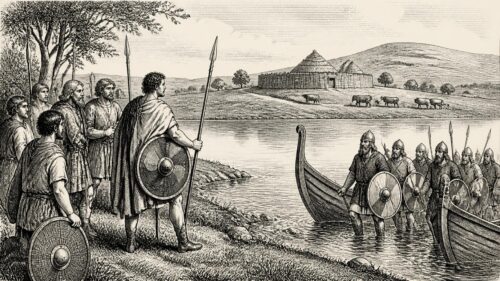
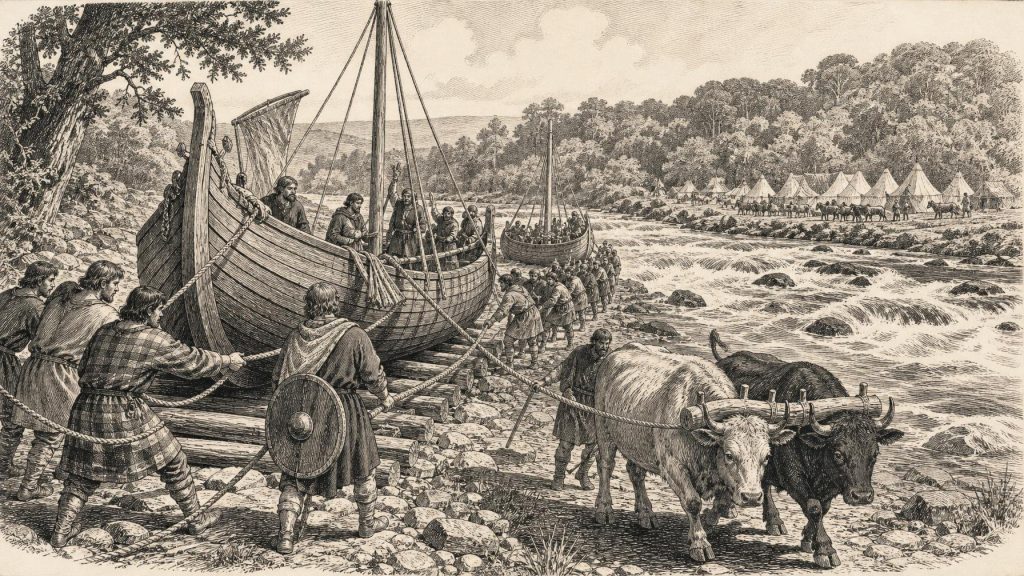
One of the year’s most remarkable operations began on Lough Derg. Tairdelbach assembled a fleet there and had its vessels drawn past the dangerous rapids at Doonass, below the lake. The ships then proceeded into the lower Shannon towards Foynes, in the territory of Uí Chonaill. His forces plundered that district and gained control of, or compelled the submission of, the Desmond fleet. Mac Carthaigh’s Book adds that forces from Leinster, Osraige, Ormond and Éile were involved and that spoils were brought from the Déise to Tairdelbach’s encampment.
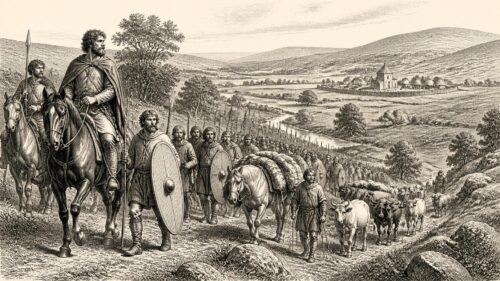
The portage around Doonass was more than a colourful feat of seamanship. It demonstrated the organisational resources of the Connacht kingship. Boats, crews, warriors, draught animals and provisions had to be brought across or around a serious obstruction before the expedition could enter the tidal Shannon. Control of this waterway allowed Tairdelbach to threaten Munster from an unexpected direction and to connect inland Connacht with the western seaboard.
He established a major longphort, or military camp, at Áth Caille. The sources differ slightly in describing its duration, but agree that it was no brief raid. The Annals of the Four Masters place him there from around the feast of St Martin, 11 November, until May, while Tigernach associates the encampment with Easter and the period from Samhain to Bealtaine. The Norse-Irish inhabitants of Limerick joined him there, illustrating how the commercial towns could supply ships and fighting men while negotiating their place between rival Gaelic kings.
Revolt and Retaliation
While Tairdelbach concentrated upon Munster, the Conmaicne, Meath, Leinster and much of southern Ireland turned against him. He responded with two successive raids into Conmaicne and eastern Meath. At Craobh Rois Dá Charn, the forces of Meath and the Conmaicne caught his army and initially killed some of its men. Tairdelbach counter-attacked, defeated them and inflicted substantial losses upon both nobles and ordinary followers. A further raid into Meath carried away numerous captives.
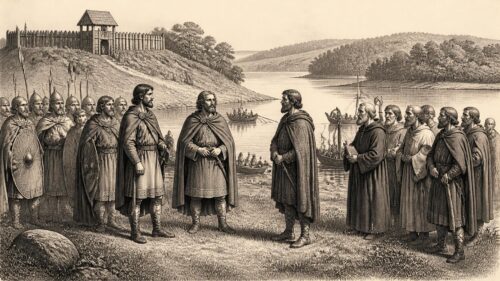
The rebel rulers subsequently gathered at Inneóin in western Meath for an invasion of Connacht. They abandoned the expedition after learning that Tairdelbach awaited them at Athlone with a large force. News also arrived that he had executed his Desmond hostages. The coalition dispersed without battle or hostages of its own, and Cormac Mac Carthaigh returned south mourning the death of his son.
Hostages were not prisoners taken casually in combat. They were usually members of ruling families surrendered as guarantees of submission. Killing them announced that an agreement had been broken and imposed the cost upon the families responsible. The Annals of Ulster name among the victims Máel Sechlain, a Mac Carthaigh prince styled king of Cashel, Ua Ciarmhaic of Áine and Ua Cobthaigh of Uí Chuanach. The sources vary over some identities, but leave no doubt that Tairdelbach deliberately destroyed valuable dynastic guarantees. Other hostages were spared, allowing future negotiation while isolating Desmond.
Three Connacht Castles
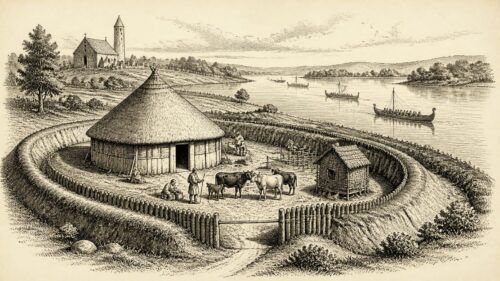
The annals state firmly that the Connachtmen constructed three caisteil in 1124: at Galway, Cúl Maile and Dún Leodha. These should not automatically be imagined as the later stone keeps introduced or rebuilt under Anglo-Norman lordship. They were fortified royal centres, probably employing substantial timber and earthwork defences, positioned to command routes, rivers and neighbouring territories.
Dún Gaillimhe stood near the mouth of the River Corrib. Its construction is the earliest clear annalistic reference to the place that became Galway city. The fort guarded access between Lough Corrib, Galway Bay and the lands of Mag Seóla, while providing a western base for Tairdelbach’s expanding naval power. A settlement may have developed around the stronghold, but the evidence does not support describing Galway in 1124 as the chartered, walled merchant town of later centuries.
Cúl Maile is generally identified with Collooney in County Sligo, near the meeting of important rivers and routes into north Connacht. Dún Leodha, associated with the River Suck near modern Ballinasloe, reinforced the eastern approaches to Tairdelbach’s kingdom. Together the three works represented a coordinated landscape of power rather than isolated construction projects. They protected movement within Connacht and helped concentrate royal authority at strategic crossing points.
Regional Violence
Conflict also continued below the level of the great coalition. Máel Sechlainn Mac Diarmata, lord of Mag Luirg, was killed by the men of Bréifne and Tigernán Ua Ruairc. In apparent continuation of this struggle, Connachtmen killed Ua Ruairc’s son Gilla Bróide and others on Loch Éin. Leinster witnessed further dynastic killings, while Ardgar Ua Máel Sechlainn, heir-designate of Ailech, was slain by the community of Derry “for the honour of Colum Cille”. The annals do not explain his offence, but their wording shows that an ecclesiastical community could defend its saint’s rights through armed action.
A more accidental drama befell the unnamed king of Tara, probably Murchad Ua Máel Sechlainn. On Easter Sunday, 6 April, his “Easter house” collapsed upon him and his household. It may have been a temporary seasonal hall or simply the residence occupied for the feast. The chronicler records a severe shock but not the king’s death, offering a rare glimpse of the physical vulnerability of royal households whose principal buildings were generally constructed from timber.
Church and Craftsmanship
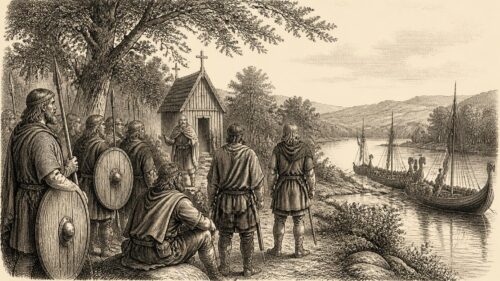
The year also belonged to Ireland’s continuing church reform. Máel Máedóc Ua Morgair, better known as Malachy, became bishop of Connor after consecration by Cellach, successor of Patrick and archbishop of Armagh. A new wooden church associated with Malachy’s community at Bangor was consecrated in the same year. His career formed part of a wider movement towards territorial dioceses, stricter clerical discipline and closer connections with reforming communities elsewhere in western Europe.
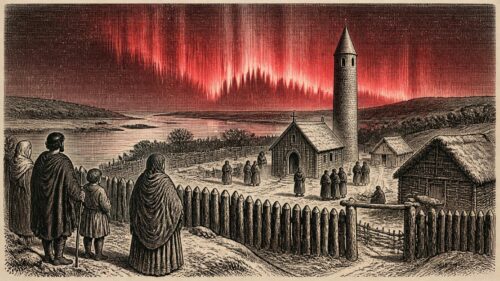
At Clonmacnoise, the annals record the completion of the great round tower by Gilla Críst Ua Máel Eoin, successor of Ciarán; other evidence also associates Tairdelbach with the work. Rising above the Shannon, the tower proclaimed the resources and prestige of one of Ireland’s foremost religious centres. Royal patronage of churches was political as well as devotional, binding kings to saints, clergy, learned communities and places of burial.
The celebrated Cross of Cong belongs to precisely this period. Made for Tairdelbach to enshrine a relic believed to be of the True Cross, it combined Irish, Scandinavian-derived and wider European artistic elements. Although conventionally dated to 1123, it remained a potent expression of the religious culture surrounding the king in 1124: Irish inscriptions named its patron and craftsman, while precious metal, glass, niello and rock crystal displayed the abilities of an exceptionally accomplished workshop.
Fire, Trade and Ordinary Lives
The Annals of Ulster report that Limerick was almost entirely burned, without naming a cause. The destruction must have been severe in a densely occupied riverside settlement where timber buildings, workshops and stored goods stood close together. Yet Limerick remained an important Hiberno-Norse port whose inhabitants participated in Tairdelbach’s campaigns. The sudden death of Torfind son of Torcaill, described as a leading young lord of Ireland’s foreigners, further reflects the continuing prominence of Norse-Irish dynasties within the island’s political and maritime networks.
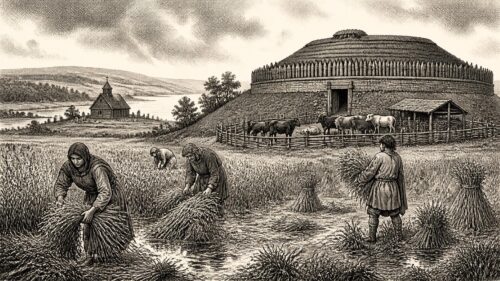
For most people, the year’s politics were experienced as demands for food, transport, labour and military service. Royal camps consumed supplies for months. Raids removed cattle, the chief movable form of agricultural wealth, while captives might be ransomed, exchanged or carried into servitude. Fleets required boatbuilders, crews and knowledge of rivers and coasts. The chronicles concentrate upon kings and nobles, but every hosting crossed cultivated land and drew upon rural households whose names were never recorded.
Tairdelbach emerged from 1124 still dominant, but not universally obeyed. His fleet had penetrated the lower Shannon, his army had broken a coalition in Meath and his new fortifications strengthened Connacht. The violence against hostages, however, revealed the limits as well as the force of his rule. Ireland’s most powerful king could compel submission across much of the island, yet maintaining it demanded continual campaigning, negotiation and the construction of an increasingly ambitious royal infrastructure.
Primary Sources
- The Annals of Ulster: Year U1124
- The Annals of Tigernach: Annal T1124
- Annals of the Four Masters: Annal M1124
- Mac Carthaigh’s Book: Annal MCB1124
- Chronicon Scotorum
- Ua Conchobair, Tairdelbach (O’Conor, Turlough)
- Malachy (Máel-Máedóc) Ua Morgair
- Ua Lochlainn (Mac Lochlainn), Domnall
- The Cross of Cong
- Clonmacnoise Visitor Guide
- Getting to Know Galway
- Tairdelbach Ua Conchobair – the Founder of Gaelic Galway
- Galway Archaeological and Historical Background
- Dunlo Archaeological and Historical Monitoring Report
- Our History: Limerick
- County Limerick and Limerick City Urban Archaeology Survey
- Irish Historic Towns Atlas No. 21: Limerick
- Crisis and Recovery: Church and Society in Twelfth-Century Ireland
- Saint Malachy
- Saint Bernard of Clairvaux’s Life of Saint Malachy of Armagh
- The Origins of the Irish Parish
- Ireland in the Middle Ages
- The Economy of Early Medieval Ireland
- The Archaeology of Early Medieval Ireland, c. 400–1169: Settlement and Economy
- Agriculture, Settlement and Society in Early Medieval Ireland
- Clann Cholmáin and Church Patronage
- From Kingdom to Colony: Framing the English Conquest of Ireland