Fortunes of the North1197 CE
Dateline
In 1197, the sharpest recorded upheavals in Ireland occurred in the north, where John de Courcy’s lordship in eastern Ulster pressed towards the north-western Gaelic dynasties. Yet the year cannot be reduced to a simple contest between incomers and Irish rulers. The annals show a crowded political landscape: regional kings changed, allies and rivals came from both sides of the Irish Sea, churches were plundered and defended, and cattle remained a decisive measure of wealth. In Munster and Connacht, too, local struggles continued to shape the experience of power. At Limerick, meanwhile, a charter assigned to this year marked a different kind of change: the strengthening of an urban community under the lordship of John.
A Northern Offensive
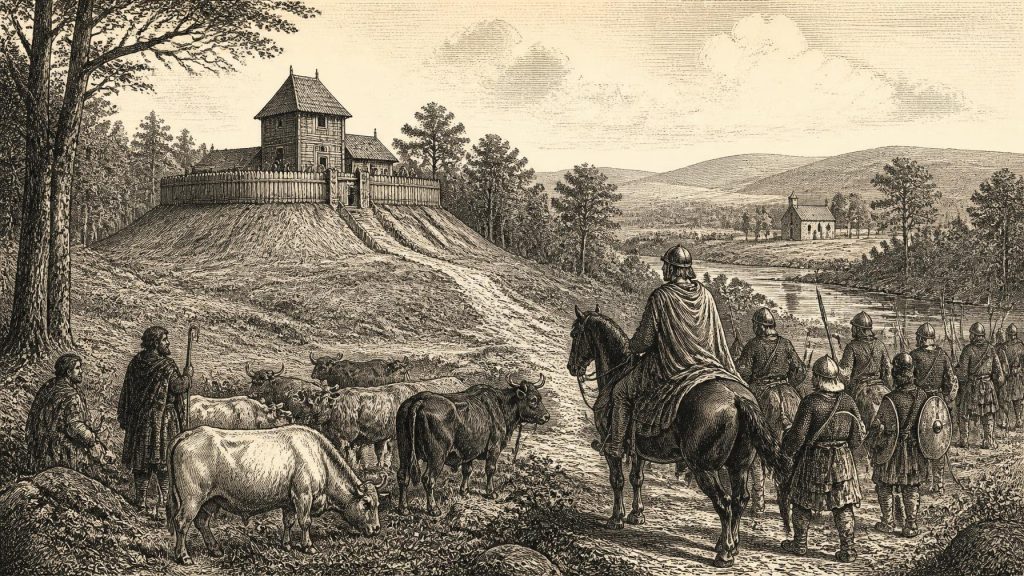
The fullest accounts of 1197 come from the northern annals. They report that John de Courcy led the “Foreigners of Ulidia” on an expedition to Eas Craibhe and built a castle at Cell Santain, usually rendered Kilsanctan. The force devastated the cantred of Ciannachta and left Roitsel Fitton with a garrison in the new stronghold. A castle was not merely a battlefield shelter. It was a durable claim upon land: a base from which troops could operate, a focus for supplies and tribute, and a threat to neighbouring communities. The entry therefore records an attempt to extend, secure and administer de Courcy’s influence rather than a passing raid alone.
“Foreigners” was the Irish annalists’ usual term for the newcomers and their descendants; it should not be read as proof that every man in de Courcy’s following came directly from England. His lordship had grown from the conquest of eastern Ulster begun in 1177 and included settlers, tenants and Irish associates as well as knights and men recruited from across the Irish Sea. Nevertheless, the campaign of 1197 took this military power into districts where the northern Uí Néill dynasties still possessed formidable resources and local legitimacy.
From Kilsanctan, Roitsel Fitton’s men raided towards the port of Derry, plundering Cluain Í, Enach and Derc-bruach. The targets were churches as well as territory. Flaithbertach Ua Máeldoraid, king of Cenél Conaill and Cenél nEógain, intercepted the raiders with what the Annals of Ulster calls a small force drawn from both peoples. At the strand of Nuathchongbháil, identified in the Annals of the Four Masters with Faughanvale, he inflicted a defeat. The narrative attributes the outcome to the intervention of Colum Cille, Cainnech and Brecan, saints associated with the violated churches. That language was devotional rather than detached reportage, but it reveals the political force of sacred protection: an attack on a church could mobilise resistance, confer moral authority on a ruler and be remembered as an offence against its saint.
Death and Vulnerability
The northern balance altered dramatically on 2 February. Flaithbertach Ua Máeldoraid died at Inis Sáimer after a prolonged illness and was buried at Druimtuama, generally identified with Drumhome. The Annals of Ulster gives the date, his age of fifty-nine and the thirtieth year of his lordship. Its extravagant praise—champion, generous host, defender of Tara and royal heir of Ireland—belongs to the formal language of kingship, not to a literal description of authority over the island. Still, it signals how high his standing was among the northern dynasties. His rule had linked Cenél Conaill, Cenél nEógain and Airgialla in the annalist’s political imagination at a moment when no universally effective high kingship existed.
Echmarcach Ua Dochartaig succeeded at once in Cenél Conaill. The annal says he had held the kingship only a fortnight when de Courcy marched with a large force across Toome into Tír Eógain. The route named in the sources ran through Ard Sratha and towards Derry; de Courcy’s troops stayed there for five nights before moving to Cnoc na Sgain, apparently seeking a crossing towards Inis Eógain. The details—river crossings, a five-night halt and the need for transport—make clear that landscape and water determined campaigning. Armies did not move freely across a map; they depended on known routes, boats, food, livestock and local coercion.
Echmarcach and the Cenél Conaill gave battle at Cnoc na Sgain. Both the Annals of Ulster and the later Annals of the Four Masters record a devastating loss for Cenél Conaill: about 200 of their men, including Echmarcach himself and a number of named nobles, were killed. Medieval casualty totals are rarely capable of modern verification, but the agreement that the defeat was grave is unmistakable. De Courcy’s men then harried Inis Eógain and carried away a great cattle-spoil. The episode demonstrated the vulnerability produced by a ruler’s sudden death, but it did not establish permanent control of the north-west. Subsequent annals record further fighting there, a reminder that castles, raids and victories did not automatically translate into settled possession.
Church, Treasure and Justice
The same year brought a striking episode at Derry, one that illuminates religious life and material culture more closely than most battle notices. Mac Gilla-Eidich, described as a man of Ciannachta, robbed the great altar of Derry’s church of Colum Cille. He took its finest goblets—objects remembered individually by names including the “grey son”, the “son of light”, the goblet of Ua Máeldoraid and the twisted goblet of Ua Dochartaig—and stripped their jewels and settings. Such a list is evidence of a major ecclesiastical treasury. Precious liturgical vessels embodied the wealth of a church, but also its patronage, history and status; their names preserved connections with powerful families.
The thief and the objects were found three days later. He was hanged at the Cross of the Executions in reparation for profaning Colum Cille’s altar. This was emphatically not an ordinary property dispute in the annalist’s presentation. It was a sacrilege requiring public punishment and restoration. The entry also cautions against a neat division between religious and secular life. Churches were repositories of portable wealth, centres of local authority and places whose immunity could be invoked in political conflict. Their treasures were tempting, but violation could carry consequences far beyond the value of metal and gems.
Several religious notices elsewhere in Ireland add texture to the year. The Annals of Inisfallen record the death of Ragnall Ua Flainn Chua, bishop and abbot of Imlech Ibuir (Emly), and commemorate Gilla Pátraic Ua hÍmuir, archdeacon and coarb of Fethard. The latter is praised as founder and gatherer of church property, a clerical community, books and utensils. Such formulae are laudatory, but they indicate what contemporaries valued in an ecclesiastical leader: learning, institutional resources, pastoral standing and the ability to assemble a functioning religious household.
Conflict Beyond Ulster
In Thomond, the region north of the Shannon, Conchobar Ruad Ua Briain turned against his kinsman Donnchad Cairbrech Ua Briain and brought a force of foreigners with him. The Annals of Inisfallen says that Thomond was plundered, “both church and lay property”, and names Cú Meda Mac Con Mara and Conchobar Ua Cuinn among those killed. This was a dynastic conflict in which overseas military support became a usable resource, not an outside intervention detached from Irish politics. It also shows that ecclesiastical immunity was no guarantee during campaigning.
The same Munster source records a great hosting by foreigners into Desmond as far as Durrus. It says they did no great harm other than burning churches before turning back. The qualification is revealing: burning churches was serious enough to record, yet the annalist judged the expedition not to have achieved a wider devastation. In a year of local war, the scale, direction and outcome of a raid mattered as much as the fact that it occurred.
Connacht’s entries are quieter but politically significant. Ruaidrí Ua Flaithbertaig, king of western Connacht, was taken prisoner by Cathal Croibderg Ua Conchobair, king of Connacht. The capture points to Cathal’s effort to impose authority within a kingdom whose regional rulers retained real power. Conchobar Ua Máelruanaid, king of Magh Luirg and Magh Ai, also died after entering religious life at the monastery of Boyle. His death joined politics and piety in a familiar medieval pattern: retirement into a monastery could express penitence, but it also affected succession, lordship and the distribution of influence.
Town and Lordship
Not all change in 1197 was recorded in the language of burning and cattle-taking. Limerick received a charter in this year, associated with John, lord of Ireland. The Irish Historic Towns Atlas identifies it as a grant of essential urban liberties. The surviving tradition is clearer about the year than about every detail of its earliest civic officers, so it is safest not to impose later municipal arrangements upon 1197. Its importance lies in the recognition of Limerick as a borough with privileges capable of sustaining trade, dues, local regulation and a corporate urban identity.
This development followed the Anglo-Norman recapture of Limerick in 1195 and occurred while the political future of Munster remained unsettled. It should therefore not be imagined as an instant transformation of the whole surrounding countryside. Rather, it was a legal and economic foothold at a strategic Shannon crossing and port. The charter helped bind a long-established Hiberno-Norse and Irish settlement into the governmental practices of the lordship, while the warfare recorded at Durrus and in Thomond showed how incomplete and contested that process remained.
At the level of lordship administration, Archbishop John Cumin of Dublin also came into open conflict in 1197 with Hamo de Valognes, John’s justiciar in Ireland, over ecclesiastical property. Cumin left for Normandy to seek redress from King Richard I. The quarrel matters because it exposes a limit on governmental cohesion. The archbishop was no opponent of the lordship in principle, but he defended the rights and possessions of his see against its representative. Ireland in 1197 was thus not governed by a single, smoothly operating authority. It was a patchwork of kingdoms, ecclesiastical jurisdictions, seigneurial lordships and growing towns, connected by negotiation as often as by force.
The year’s annals are unusually vivid because they preserve names, objects and routes: a castle and its garrison, churches on the Foyle approaches, a king buried at Drumhome, goblets from Derry’s altar, cattle driven from Inis Eógain, a prisoner in Connacht and a chartered town on the Shannon. Taken together, they show a country in which conquest was real but unfinished, Gaelic political capacity remained potent, and religious institutions were central to both the violence and the ordering of society.
Primary Sources
- The Annals of Ulster: Year U1197
- The Annals of Ulster: CELT Project Record
- Annals of the Four Masters: Annal M1197
- Annals of the Four Masters: CELT Project Record
- Mac Carthaigh's Book: Annals MCB1196–1199
- Mac Carthaigh's Book: CELT Project Record
- Annals of Inisfallen: Annal AI1197
- Annals of Inisfallen: Navigator
- Annals of Loch Cé: Annal LC1197
- Annals of Loch Cé A.D.1014–1590: Part 8
- Cumin (Comyn), John
- Limerick Corporation (Pre-Reform), 1719–1917
- Irish Historic Towns Atlas: Limerick
- Limerick Medieval Trail
- Copies of Charters of the City of Limerick, 1197–1628
- Select Document: A Settlement Between the Canons of St Thomas's Abbey, Dublin, and Walter de Lacy
- From Kingdom to Colony: Framing the English Conquest of Ireland
- A King in All But Name: John dominus Hibernie and frater regis, 1185–1199
- Anglo Norman Ireland
- Anglo-Norman Invasion of Ireland (1169–1171)
- Limerick – Magnet of Liberty
- The History of Limerick