Contest for Connacht1203 CE
In 1203, conflict over Connacht revealed Ireland’s overlapping Gaelic, Anglo-Norman and royal authorities. William de Burgh campaigned from Munster and Meath, fortifying Mílec and ravaging western Connacht, including Clonfert and Clonmacnoise. King John curbed him by removing Limerick from his control; Meiler fitz Henry and Walter de Lacy enforced submission and mediated Connacht’s dynastic disputes. Cathal Crobderg Ua Conchobair retained his kingship despite rivalry with Toirrdelbach, son of Ruaidrí. Elsewhere, dynastic killings and warfare continued. Contemporary annals report famine, worsened by plunder, while churches remained vulnerable targets yet vital centres of learning, shelter, diplomacy and legitimacy. Connacht’s future remained unresolved.
Dateline
In 1203, Ireland’s political map was neither simply Gaelic nor simply Anglo-Norman. Kings, provincial dynasties, marcher lords, churchmen and royal officials worked within overlapping systems of authority, making and breaking agreements according to immediate need. The year is best understood through the struggle for Connacht, where William de Burgh’s attempt to enlarge his power met determined resistance from Cathal Crobderg Ua Conchobair, king of Connacht, and from King John’s own administration in Ireland. This was not a remote border quarrel. It exposed the limits of royal control, the dangers of private conquest, and the devastating human cost of warfare in the Shannon basin.
A Royal Check at Limerick
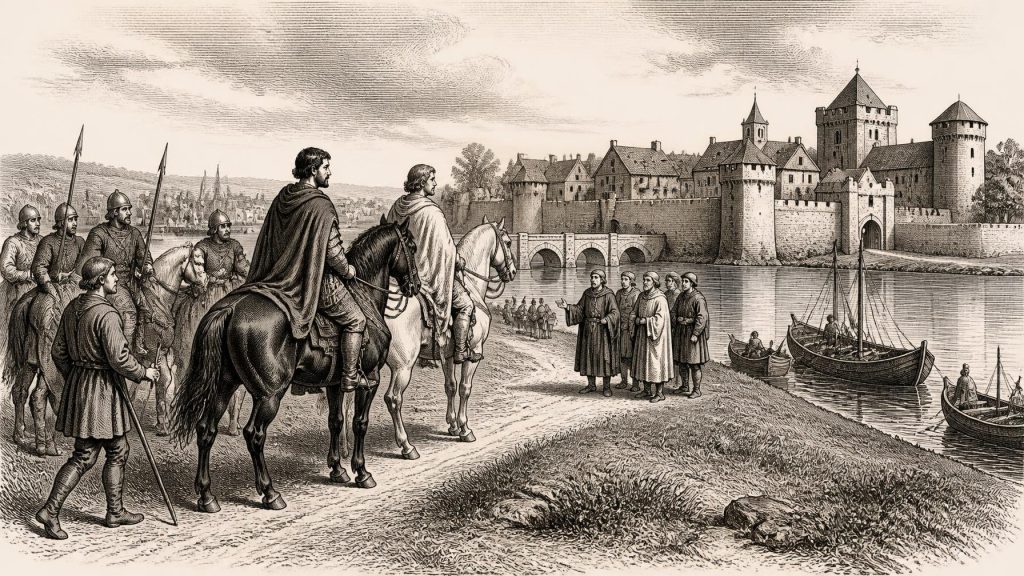
The most securely dated political acts of the year came from King John’s court. On 7 July, William de Burgh was summoned to answer before the king over complaints arising from his activity in Connacht. On the following day, the king removed his control of the city of Limerick and granted it, at farm, to William de Braose, already lord of the honour of Limerick. The distinction mattered. Limerick was not merely a wealthy settlement at the head of the Shannon estuary: it was a strategic river port, a military base and an outlet through which power in Munster and western Ireland could be supplied and financed.
De Braose was abroad in royal service, so the practical custody of Limerick in Ireland fell to his associate Walter de Lacy. Meiler fitz Henry, King John’s justiciar, joined Walter in moving against de Burgh. The Irish annals describe their advance into Munster and de Burgh’s withdrawal from Limerick. They further record that he handed over castles and hostages, including members of his own family, before leaving the city. Such language should not be read as a tidy administrative transfer. It conveys a coercive settlement conducted under armed pressure, with hostages serving as guarantees that a powerful lord would obey the terms imposed upon him.
King John’s intervention did not amount to a rejection of expansion in Ireland. Rather, it was an assertion that expansion was to remain subject to his authority. De Burgh had become exceptionally formidable: he possessed extensive interests in Limerick and Munster, had connections across the Irish Sea world, and sought to turn a previous royal grant of Connacht into practical lordship. John had reason to fear that an overmighty servant could become as troublesome as an Irish rival. By backing de Burgh’s competitors, the crown used division among its own magnates to curb a dangerous concentration of power.
War Across Connacht
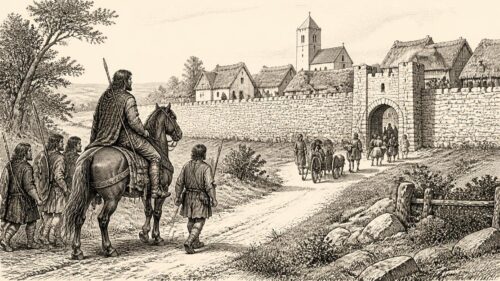
The annalists place a major campaign by William de Burgh in Connacht in 1203. He entered with forces drawn from the English of Munster and Meath, evidence that military enterprise could bring together men from several lordships. His army reached Mílec, in the territory of Síol Anmchadha, where he constructed a castle or fortified enclosure around the principal church. One account states that the church itself was turned into a defensive structure and that de Burgh’s men ate meat there during Lent. Whether every detail is accepted literally or not, the report deliberately presents the campaign as an assault on both territory and sacred protection.
The same cluster of annalistic evidence attributes widespread destruction to de Burgh’s forces. Western Connacht was ravaged, while Clonfert and Clonmacnoise were plundered. Clonmacnoise, standing beside the Shannon, was an eminent ecclesiastical centre as well as a crossing-point and place of exchange. Attacking it was therefore militarily useful and symbolically shocking. Churches held food, livestock, movable wealth and dependants; their lands were productive targets during campaigning. The accounts make clear that warfare was experienced not only in clashes between armed retinues but in burned settlements, disrupted cultivation, seized cattle and violated churches.
De Burgh’s advance was connected to a continuing Connacht succession conflict. Cathal Crobderg had faced rival claimants from within the Ua Conchobair kindred, and ambitious outsiders could exploit those divisions. Yet the events of 1203 show that Cathal was not simply overwhelmed by Anglo-Norman pressure. His political position endured, while de Burgh’s own supporters and resources were cut back by the justiciar’s action. The royal government was not acting out of disinterested concern for Connacht: limiting de Burgh also preserved John’s freedom to bargain with, threaten or reward Cathal at a later date.
Peace, Exile and Mediation
The annals also record the escape of Toirrdelbach, son of Ruaidrí Ua Conchobair, from captivity. Cathal Crobderg made peace with him and gave him land, only later to expel him from Connacht. A further peace followed through the intervention of Meiler fitz Henry and Walter de Lacy. The sequence is revealing. A grant of land was a political settlement, not a charitable act: it could bind a claimant, establish his status and provide the means to support a following. Equally, expulsion did not necessarily end a contest. A dispossessed prince could seek allies, gather retainers and return when circumstances changed.
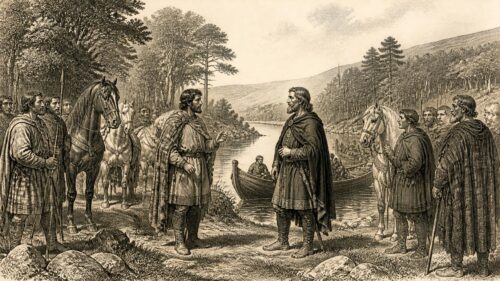
Meiler and Walter’s role as mediators demonstrates the practical reach of the lordship’s officers beyond the areas of close settlement. They could not simply command the king of Connacht, but their military strength, diplomatic usefulness and access to the English king made them important participants in Irish dynastic politics. In 1203, authority in Connacht was negotiated between a Gaelic king, rival members of his dynasty, Anglo-Norman magnates and the king’s justiciar. This was a frontier of contact and conflict, rather than a fixed line dividing two separate societies.
Violence in North and South
Other entries from the year underline how local rivalries continued far from the Shannon. Domnall Carrach Ua Dochartaigh, ruler in Tír Chonaill, was killed by the Muintir Báigill after plundering churches and territories. The record links violence against church property with his downfall, framing the killing in moral as well as political terms. In Thomond, Conchobar Ruadh Ua Briain was killed by his own brother, Muirchertach. Dynastic violence was not unusual, but these notices remind us that no single conflict explains Ireland in 1203. Kingship remained personal and competitive, and kinship could provide both legitimacy and danger.
Later annalistic compilations attach further dramatic events to 1203, including fighting in Ulster and a victory by Domnall Mac Carthaigh’s men over the Galls in Desmond. The chronology of such compilations does not always align with the nearer annalistic tradition or with royal records. It is therefore safer to treat them as evidence for the wider instability of the early thirteenth century, rather than to assign every reported battle firmly to this calendar year. The capture of John de Courcy, for example, belongs more securely to the following years and should not be made a centrepiece of 1203.
Famine, Church and Everyday Survival
The Annals of Loch Cé report a great famine throughout Ireland in 1203, adding the grim observation that clerics ate meat during Lent. Mac Carthaigh’s Book likewise describes a wet, windy summer, famine and wars. Medieval annals seldom supply the measurements needed to reconstruct harvest failure precisely, but their agreement indicates severe scarcity. In a predominantly rural society, a poor harvest quickly endangered households dependent on grain, dairy produce and livestock. War made matters worse by destroying crops, taking cattle and forcing communities to flee or surrender stores. The burden fell most heavily on those with least reserve: labourers, tenants, the poor, travellers and religious communities reliant on local gifts and produce.
Religious life nevertheless retained its wide geographical connections. On 27 April, Domnall Ua Brolcháin, prior of Iona, died after illness and penance. The unusually warm tribute preserved in the Annals of Ulster praises his learning, wisdom, generosity and piety. It points to the continuing prestige of Columban institutions linking Iona, Derry, Tory and the northern mainland. Churches were vulnerable in war, yet they also remained centres of literacy, hospitality, memory and political legitimacy. Their personnel could condemn violence, shelter dependants, preserve records and mediate disputes.
In south-east Leinster, the Cistercian house of Tintern de Voto was already a recent foundation of William Marshal, established around 1200 rather than securely in 1203. Its presence offers useful context for the year. New monastic patronage, Anglo-Norman lordship and Irish landholding were becoming closely connected in parts of Leinster, while older Gaelic ecclesiastical centres remained central elsewhere. Ireland in 1203 was thus a land of regional contrasts: commercial towns and castles alongside dispersed rural communities; new religious houses alongside ancient churches; royal writs alongside negotiated local power.
The year ended without settling Connacht’s future. William de Burgh had been checked, not erased. Cathal Crobderg had retained his kingship, but his dynasty’s disputes remained exploitable. Meiler fitz Henry and Walter de Lacy had shown that King John could still shape events through officials and rival magnates. Yet famine, plundering and political violence had revealed the fragility beneath every settlement. In 1203, the struggle for dominion was fought as much through castles, hostages, food supplies and negotiated peace as through the battlefield.
Primary Sources
- The Annals of Ulster, Year U1203
- The Annals of Loch Cé, Annal LC1203
- The Annals of Inisfallen, Annal AI1203
- Mac Carthaigh’s Book, Annal MCB1203
- Annals of the Four Masters, Annals M1202–M1203
- Calendar of Documents Relating to Ireland, 1171–1251
- Parchment Conquest, 1171–1307
- Burgh, William de
- Ua Conchobair, Cathal Mór Crobderg
- fitz Henry, Meiler
- King and Magnate in Medieval Ireland: Walter de Lacy, King Richard and King John
- ‘Divide and Rule’: Factionalism as Royal Policy in the Lordship of Ireland, 1171–1265
- Notification That the King Has Approved the Will of William Marshal
- Tintern Cistercian Abbey
- Tintern Abbey
- The Origins and Foundation Charter of St. Mary de Voto Tintern County Wexford 1189–1211
- Annals of Connacht
- TEI Header for Annála Connacht
- CELT List of Published Texts
- CELT Translated Texts