Castles and Cattle1214 CE
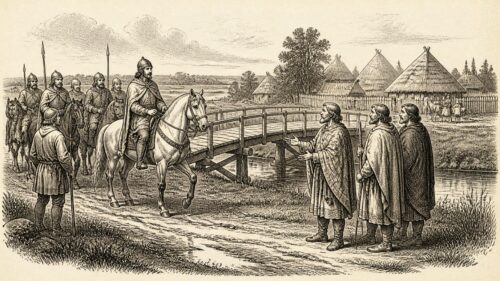
Irish annals portray 1214 as a period of contested lordship rather than national unity. Anglo-Norman castles at Clonmacnoise and Durrow provoked Cormac Ó Máel Sechlainn’s raids, involving cattle seizure, burning and attacks on church resources. Ualgarg Ó Ruairc raided settler-held Carbury, while deaths among Connacht lords and churchmen marked shifting local authority. Ulster records, though chronologically disputed, describe plunder at Derry, castle-building at Coleraine, resistance to settlers and destruction at Carlingford. Ecclesiastical communities remained influential yet vulnerable. Dublin received authority for commercial infrastructure. King John’s papal settlement formally included Ireland, but did not establish uniform control over its competing regions.
Dateline
For Ireland, 1214 is best approached not as a single national story but as a year glimpsed through regional chronicles. The surviving Irish annals record raids, deaths, castle-building and struggles over lordship; they do not offer a complete calendar of public life. Their entries were also copied and organised at different times, and neighbouring annals can assign the same episode to different years. That limitation matters. Yet the material that can securely be connected with 1214 shows an island in which Gaelic rulers, Anglo-Norman settlers, Scandinavian-Gaelic seafarers and church communities met in uneasy, often violent, proximity. The middle Shannon region was especially unsettled, while the north-west and north coast reveal how warfare remade both sacred landscapes and settlements.
A Contested Midland
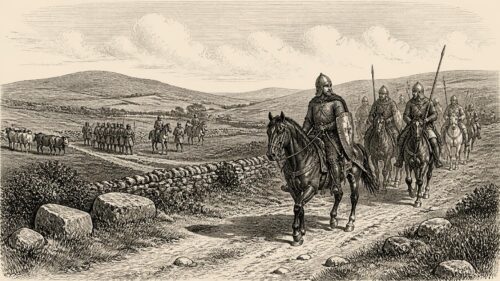
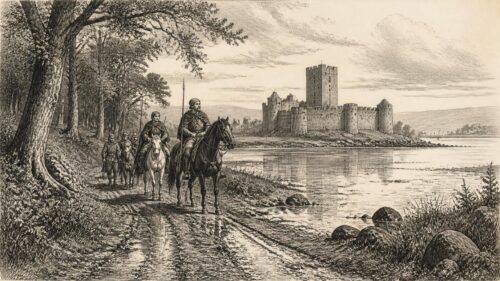
The clearest sequence assigned to 1214 in the Annals of Loch Cé concerns the central plain. It reports that “Foreigners” – the annalists’ usual term for Anglo-Norman settlers and their forces – built castles at Clonmacnoise and Durrow. Neither entry supplies a precise day, construction history or named patron, but their placement together is revealing. Clonmacnoise, on the Shannon, remained a religious centre of exceptional prestige as well as a strategically valuable crossing-point. A castle there was therefore not merely a military building: it announced an attempt to command movement, land and resources around an old ecclesiastical settlement. Durrow likewise lay within a region where control was disputed rather than settled.
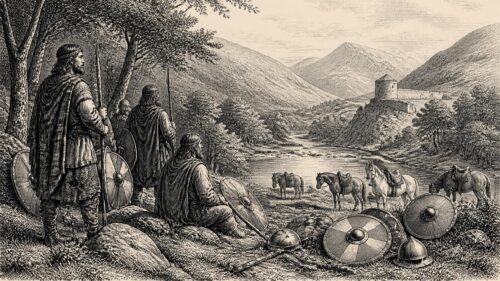
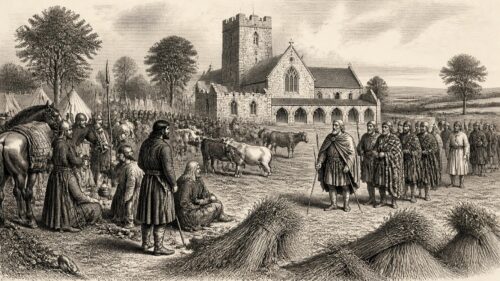
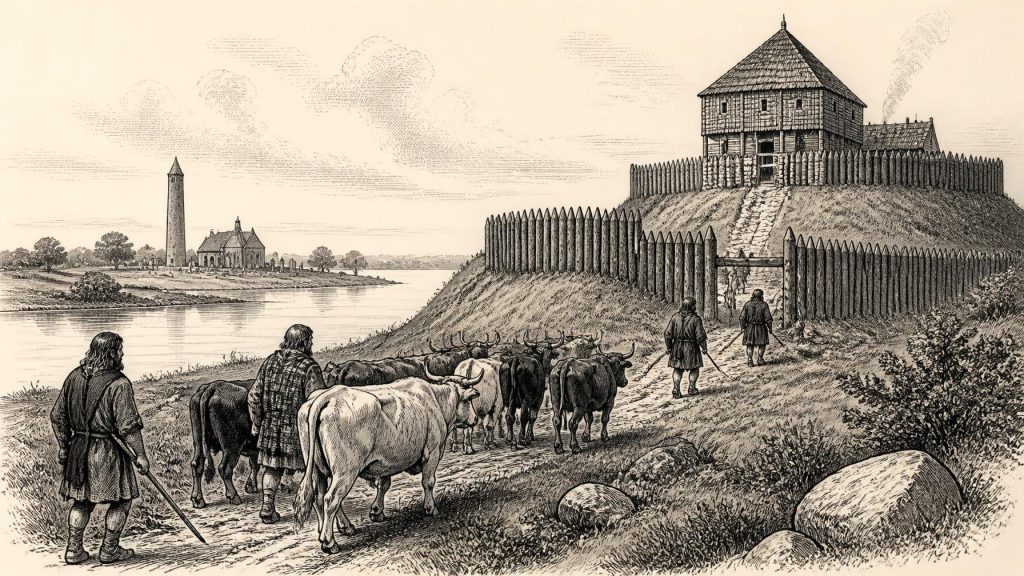
The castle-building formed part of a struggle in Delbhna, or Delvin, in what is now largely County Westmeath. Cormac son of Art Ó Máel Sechlainn had been expelled from the territory by a coalition described as the Foreigners and the Gaels of all Ireland. That grand phrasing should not be read literally as a united island-wide army. Annalists often used broad collective labels. It does, however, show that alliances crossed cultural and linguistic lines: local Gaelic rivals could cooperate with the colonial administration, just as Gaelic rulers elsewhere fought one another independently of it. Cormac returned to Delbhna, drove cattle from the castle of Clonmacnoise and defeated its garrison. Cattle were mobile wealth – food, breeding stock, dairy produce and a visible measure of status – so their seizure was both material damage and a challenge to authority.
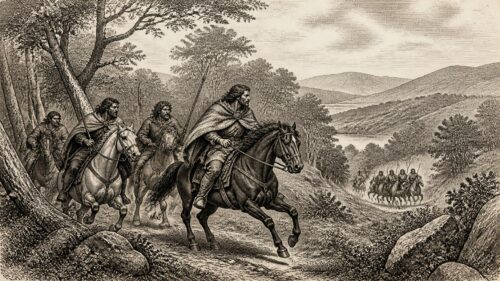
The fighting did not stop there. Cormac’s party struck at Ath Buidhe in Fercal, burning its bawn, killing eight inhabitants and taking many cattle. A bawn was the defended enclosure associated with a castle or manorial centre; burning it damaged protection for people, animals and stores even where the main stronghold remained intact. Later, Cormac again entered Delbhna, expelled Máel Sechlainn Bec Ó Máel Sechlainn and killed the son of William Muilinn. At Birr he burned the bawn and the whole church, removing its food so that the castle’s Foreigners could not use it. The detail is unusually concrete. Warfare was not only a matter of set battles between mounted elites. It was conducted through livestock-raiding, arson, displacement and the denial of provisions, with churches and their dependants exposed when they stood beside contested fortifications.
Lordship, Land and Livelihood
Another 1214 raid reported in both the Loch Cé and Four Masters traditions took place farther north-west. Ualgarg Ó Ruairc, king of Bréifne, entered the territory of Philip Mac Costello in Carbury and carried away many cows before returning safely. The episode was small beside the great campaigns of kings, but it illuminates the practical scale at which power worked. Bréifne, the north Connacht-South Ulster borderlands and the midlands were connected by routes used by raiding parties, herds, messengers and ecclesiastics. Philip Mac Costello belonged to a settler family, while Ó Ruairc headed a Gaelic dynasty. The annal does not reduce the raid to an ethnic confrontation; it records a lord defending and enriching his following at a rival lord’s expense.
Connacht itself was still ruled by Cathal Mór Crobderg Ua Conchobair, whose position rested on political calculation as much as force. He had acknowledged King John’s lordship during the king’s Irish expedition of 1210, but retained substantial room to govern as a client-king. The annals for 1214 do not record a decisive intervention by Cathal. Instead, they note the death of Cathal Mac Diarmata, lord of Magh Luirg, praised as a pillar of Connacht’s glory, and that of Brian son of Ruaidrí Ó Flaitheartaigh, from western Connacht. Such obituaries remind us that provincial authority depended on a hierarchy of local dynasties. Successions, fosterage, marriage ties, church patronage and control of cattle country all mattered alongside royal agreements made with the English crown.
War in the North
The northern material requires particular care over dating. The Annals of Ulster places several dramatic events under 1214: Thomas son of Uchtred, working with Ruaidrí son of Ragnall, plundered Derry and took treasures from the church and the wider community of Colum Cille; Thomas and the Foreigners of Ulidia built a castle at Cúil Rathain, modern Coleraine; and Áed Ó Néill inflicted a defeat on the Foreigners, while Carlingford was burned. The Annals of Loch Cé, however, assigns the Derry, Coleraine and Carlingford episodes to 1213, immediately before its 1214 entries. They can responsibly be treated as developments of the years around 1214, and as firmly present in the Ulster annal’s 1214 record, but not as securely dated calendar events without qualification.
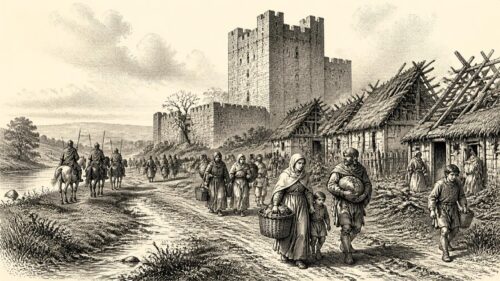
The Coleraine notice nevertheless deserves emphasis. According to the Ulster annalist, construction of the castle required the destruction of cemeteries, fences and buildings of the settlement, with the church alone spared. This was frontier colonisation in a stark form: a defended site was imposed by dismantling an existing landscape of homes, boundaries and burial. The raid on Derry similarly shows that monasteries were wealthy institutions whose portable treasures were attractive in war. A dispute at Derry involving the Uí Catháin and the men of Craebh led to the killing of the monastery’s great manciple, an official concerned with provisions or household management. The annalist explained a subsequent death as the swift retribution of God and Colum Cille. That interpretation is evidence not simply of belief, but of the monastery’s claim to protection and moral authority amid violence.
Churches and Jurisdictions
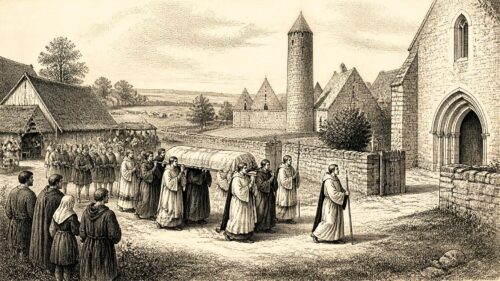
Religious life appears in 1214 chiefly through vulnerability, commemoration and personnel. The annals record the death of Ainmire Ua Cobhthaigh, abbot of Derry, in language that warmly praises his piety, charity and penitence. They also record the deaths of Gilla na Náem Ua Ruadáin, bishop of Luighne – associated with the later diocese of Achonry – and Muiredach Ua Muirecáin, bishop of Clonmacnoise. These notices cannot tell us what ordinary worshippers experienced day by day, but they show the continued importance of Irish ecclesiastical offices and monastic communities in regions where secular control was contested.
In Dublin, meanwhile, the changing structures of the lordship were linked to urban and ecclesiastical administration. Archbishop Henry of London, elected after the death of John Comyn, was a royal servant as well as a churchman, though his most conspicuous institutional reforms belong more securely to later years. A legal measure conventionally dated 1214, now known as the City of Dublin Act 1214, concerns a fair and a bridge at Dublin. The surviving calendared material reflects the crown’s willingness to authorise civic infrastructure and regulated trading privileges, but it should not be mistaken for proof that a particular bridge was completed in that year. Even so, the measure points to Dublin’s distinctive position: a walled port-city whose commerce, river crossings and municipal liberties mattered to the English crown.
Ireland in a Wider Settlement
The Annals of Ulster also places under 1214 King John’s submission of England and Ireland to Pope Innocent III, followed by their return to him as papal fiefs and an annual payment of 1,000 marks: 700 for England and 300 for Ireland. The settlement was actually made in 1213, not newly enacted in 1214. Its inclusion in the annal for this year is still significant. Irish writers understood that an agreement made across the Irish Sea altered the formal language of kingship over Ireland. It did not create direct, uniform royal power across the island; the raids and rivalries recorded in the same year demonstrate the limits of that power. But it placed the English king’s lordship of Ireland within a papal relationship and attached an Irish share to the annual tribute promised to Rome.
Thus 1214 was neither a year of simple conquest nor a quiet interval. In the midlands, castles sought to secure contested ground but became targets for raids and supply warfare. In the north, chroniclers preserved memories of church plunder, settlement destruction and resistance, while disagreeing over the exact year in which some episodes occurred. Across Ireland, bishops, abbots and local lords died, leaving offices, land and loyalties to be renegotiated. The surviving record is partial, but its details reveal a society where a cow herd, a church storehouse, a cemetery, a bridge licence or a castle enclosure could all become instruments in the struggle to command people and place.
Primary Sources
- The Annals of Ulster: Year U1214
- Annals of Loch Cé A.D. 1014–1590: Annal LC1214
- Annals of Loch Cé A.D. 1014–1590 (Irish text): Annal LC1214
- Annals of the Four Masters: Annal M1214
- Annals of the Four Masters (Irish text): Annal M1214
- Annals of Inisfallen: Annal I1214
- CELT Project: Annals of Ulster
- CELT Project: Annals of Loch Cé
- CELT Project: Annals of the Four Masters
- CELT Project: Annals of Inisfallen
- Statute Law Revision Act 2007, Schedule 1
- Calendar of Documents Relating to Ireland, 1171–1307, Volume I
- The Gatehouse: Record of a Grant of Murage for Dublin, 1214
- Calendar of Entries in the Papal Registers Relating to Great Britain and Ireland: Petitions to the Pope
- Magna Carta: The National Archives
- Original Charters of King John, Magna Carta Project
- Ua Conchobair, Cathal Mór Crobderg, Dictionary of Irish Biography
- Henry of London, Dictionary of Irish Biography
- The Church and the Two Nations in Medieval Ireland: The New Order Consolidated
- Dublin City Urban Archaeological Survey: St Patrick’s Cathedral
- The Crusades to 1291 in the Annals of Medieval Ireland
- Exploring the Irish Annals, University of Galway
- Chronology and Synchronisms of the Irish Annals, Trinity College Dublin
- The Burial of King Cormac, CELT