Shifting Lordships1219 CE
In 1219, Ireland’s power remained fragmented among Gaelic kings, Anglo-Norman lordships, churches and Henry III’s wider dominions. William Marshal died, prompting a managed succession in Leinster under Isabel de Clare’s continuing inheritance, supported by officials including seneschal Walter Purcell. In Munster, Diarmait Mac Carthaig captured Henry Butler’s Timoleague castle and its hostages, exposing colonial vulnerabilities. Domnall Mór Ó Domnaill secured submissions in northern borderlands, while Cathal Crobderg Ua Conchobair exercised authority in Connacht amid Richard de Burgh’s competing claims. Ecclesiastical deaths and succession, alongside papal involvement in the Ferns dispute, underscored church influence. Events revealed shifting, contested lordships throughout Ireland.
Dateline
In 1219, Ireland did not experience a single island-wide turning point. Instead, the year exposed how power was exercised through several overlapping worlds: Gaelic kingships, Anglo-Norman lordships, ecclesiastical jurisdictions and the distant but consequential government of the young Henry III. Events securely attached to the year range from a castle seizure in south-west Munster to the death of William Marshal, lord of Leinster, in England. Other notices, especially in later annals, show rulers asserting authority through raids, hostage-taking, submission and punishment. Taken together, they reveal a country whose political map was neither settled nor simply divided between “Irish” and “English”.
A Change at the Centre of Leinster
The most consequential development for the Anglo-Norman colony was William Marshal’s death at Caversham on 14 May 1219. Marshal was an English magnate and regent for Henry III, but he was also directly important to Ireland through his wife Isabel de Clare, daughter of Richard de Clare, or Strongbow, and Aífe, daughter of Diarmait Mac Murchada. Through Isabel, Marshal had acquired the great lordship of Leinster. In the previous two decades he had strengthened its administration, supported borough development and reshaped its defensive landscape around centres including Kilkenny, Carlow, New Ross and Wexford.
It is important, however, not to turn his death into a false instant transfer of a modern-style territorial state. Marshal’s estates were held through a web of hereditary right, marriage, feudal tenure, local lordship and royal authority. His eldest son, William Marshal the younger, succeeded as earl of Pembroke and became the leading Marshal heir. Yet the elder Marshal’s will protected Isabel’s rights in the lands held through her inheritance for her lifetime. Isabel was still alive in 1219 and remained a central figure in the legal and dynastic transition; she died only in 1220. The change was therefore a reorganisation of power within the Marshal family rather than the disappearance of its Leinster lordship.
The practical importance of continuity can be seen in the personnel who served the lordship. Walter Purcell is attested as seneschal of Leinster in 1219. A seneschal was not merely a household officer: he helped translate a lord’s claims into the management of estates, courts, revenues and military obligations. Such officials linked the great lord’s interests to the resident knightly and burgess communities of the colony. Their work also depended on dealings with neighbouring Gaelic rulers and local landholders, who could be allies, tenants, rivals or enemies according to circumstance.
Marshal’s death also had a wider constitutional significance. He had governed England during Henry III’s minority, and his position had given him exceptional standing in the Plantagenet world of which the Irish lordship formed a part. On 9 May, only days before he died, Pope Honorius III issued a mandate protecting him from being called to answer before others over certain feudal complaints, provided that justice was done and the king’s rights preserved. The mandate was connected to the long-running dispute between Marshal and Ailbe Ó Máelmuaid, bishop of Ferns. It illustrates that an Irish land quarrel could reach Rome, while decisions made in England and at the papal court could affect the balance between a Leinster lord and an Irish bishop.
Castle and Hostages in Munster
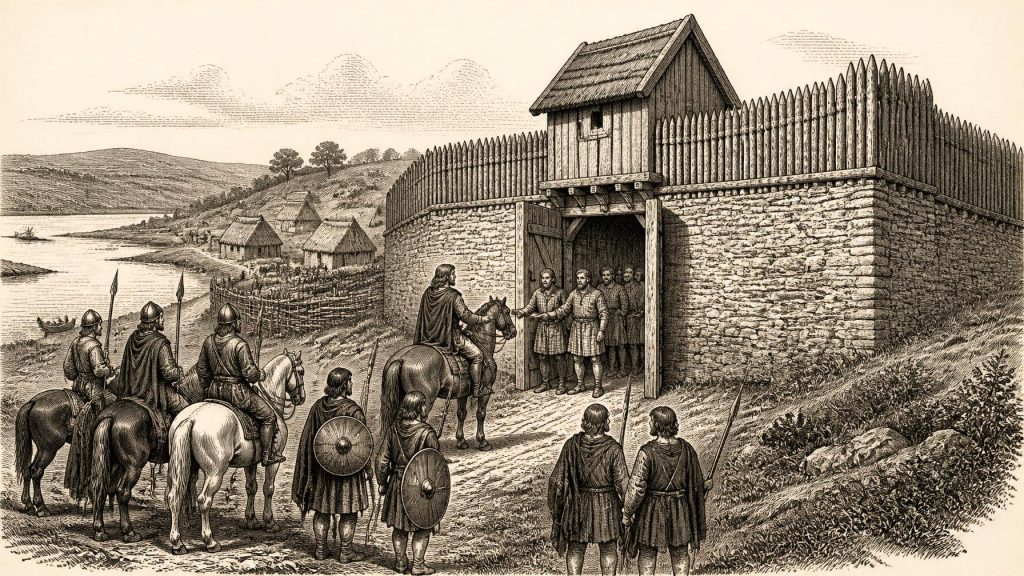
The clearest Irish military event firmly entered under 1219 in the Annals of Inisfallen occurred in Desmond. Diarmait, son of Domnall Mac Carthaig, captured Henry Butler’s castle at Tech Mo-Laga, the place now known as Timoleague in County Cork, and took the hostages held there. The short notice is exceptionally valuable precisely because it is restrained: it does not supply a day, a full battle narrative, or an explanation of every participant’s motive. It does establish that a fortified Anglo-Norman position was overcome and that hostages changed hands.
The episode should not be read as a simple clash of fixed ethnic blocs. Diarmait Mac Carthaig was a claimant within the contested kingship of Desmond and had relationships with Anglo-Norman figures; around this period his marriage connected him to the sheriff of Waterford’s family. His capture of Butler’s castle belonged to a volatile regional struggle in which Gaelic dynastic rivalry and colonial expansion overlapped. The annals and later biographical evidence indicate that he took more than one Butler castle in 1218–19.
Hostages were a central instrument of medieval politics. They might guarantee an agreement, a submission, a payment or future good conduct; they were persons of value, not an abstract legal deposit. Their seizure at Tech Mo-Laga thus mattered beyond the walls of one castle. It threatened Henry Butler’s local leverage and advertised Diarmait’s capacity to challenge a rival’s network. The incident also demonstrates the limits of castle power. A fortress could concentrate armed men, stored supplies and authority over surrounding land, but its security depended upon alliances, garrisons and the political conditions beyond its gate.
Gaelic Power in the North and West
Several further events are recorded under 1219 by the seventeenth-century Annals of the Four Masters. As a later compilation, that source must be used with care, and its chronology should not be treated as equally secure in every detail. Nonetheless, its report that Domnall Mór Ó Domnaill campaigned through parts of Leitrim, Longford and Cavan before entering Fermanagh accords with the broader picture of his expanding authority. The king of Tír Conaill obtained submissions and hostages from the Uí Ruairc, Uí Raghailligh and other groups. This was not the conquest of a unified northern Ireland; it was an assertion of superiority in contested borderlands, achieved through movement, plunder and negotiated submission.
Domnall’s activity matters because it shows that major political initiative was not confined to the English-controlled east and south-east. Tír Conaill possessed its own dynastic ambitions, military following and diplomatic connections. Its rulers could push into Connacht’s northern and eastern approaches while remaining outside the routine reach of the Dublin administration. The year’s evidence therefore cautions against imagining a steadily advancing frontier. Authority varied sharply from one district to another, and even a successful expedition could produce only temporary obedience.
The same annalistic record portrays Cathal Crobderg Ua Conchobair, king of Connacht, ordering the execution of Duvdara, son of Muirchertach Ó Máille, while the prisoner was in fetters in Ua Conchobair’s stronghold. The notice calls the offence “crimes” but supplies no particulars. It should not be expanded into an invented judicial case. What it does show is a ruler claiming the right to detain and punish within his own political sphere. Cathal’s kingship had long involved accommodation with the English crown as well as defence of his dynasty’s interests. In 1219 he remained an ageing but effective client-king, preserving Connacht’s political integrity amid internal competition and the unresolved ambitions of Richard de Burgh.
Richard de Burgh’s position was particularly significant. He had inherited his father’s interests in Connacht and held a royal grant that conflicted with Cathal’s position. In 1219 he attempted, unsuccessfully, to secure approval for a new charter concerning Connacht. The failure did not remove the danger to Cathal, but it helps explain why no wholesale takeover occurred that year. Royal grants, magnate ambition and established Gaelic kingship could coexist in documents while remaining incompatible on the ground.
Church, Office and Memory
Religion in 1219 was inseparable from political and social order. The Annals of the Four Masters records the drowning of Hugh Ó Máeláin, described as bishop of Clonmacnoise, and the death of Fonnachtán Ó Brónáin, coarb of St Columba, followed by the appointment of Flann Ó Brollacháin. The surviving ecclesiastical record is uneven, and later episcopal lists do not always align neatly with annalistic names and dates. The responsible conclusion is therefore limited: the annal records a death at Clonmacnoise and a succession in the Columban church, not a full account of either institution’s internal history.
Even so, the vocabulary is revealing. A coarb was the successor in office to a saint, and such offices could carry religious prestige, landed interests and influence within kin and regional politics. Churches and monasteries were places of worship and learning, but they were also landholders, employers, hosts to travellers and repositories of legal and cultural memory. The succession associated with St Columba therefore had consequences beyond devotional life. It concerned stewardship of an institution embedded in the society of the north-west and north midlands.
There is no securely dated evidence for 1219 that permits a detailed reconstruction of harvests, market prices, shipping or ordinary household routines across Ireland. It would be misleading to invent one. Yet the year’s political events point to the material foundations of everyday life. Castles required food, labour, timber, transport and garrisons. Raids endangered crops, cattle and church property as well as elite reputations. Lordships extracted rents and services; monastic and episcopal communities administered land; and hostages made agreements felt in individual families. For most people, the great changes of 1219 were encountered locally—in the demands of a lord’s officials, the passage of an army, the vulnerability of a road or river crossing, or the continuity of a church community after a leader’s death.
An Uneven Political Landscape
By the end of 1219, no single development had remade Ireland. The Marshal succession preserved a powerful Leinster connection to the English crown while introducing uncertainty over inheritance and leadership. In Timoleague, Diarmait Mac Carthaig’s seizure of a castle demonstrated the fragility of recently asserted colonial power in Munster. Domnall Mór Ó Domnaill’s northern campaigning and Cathal Crobderg’s exercise of authority in Connacht showed enduring Gaelic capacity for action, coercion and negotiation. Church offices changed hands, while a papal intervention reminded contemporaries that Irish disputes could be drawn into the institutions of Latin Christendom.
1219 is consequently best understood not as a quiet interval between famous battles, but as a year of shifting lordships. Its records preserve sharp local flashes rather than a continuous national narrative. Those flashes show a society in which inheritance, fortified places, hostage-taking, ecclesiastical office and royal favour were all practical means by which power was made—and contested.
Primary Sources
- Annals of Inisfallen, Part 74
- Annala Uladh: Annals of Ulster otherwise Annala Senait, Part 3
- Annals of the Four Masters, Part 5
- Marshal, William
- Marshal, Isabella
- Ua Conchobair, Cathal Mór Crobderg
- Burgh, Richard de
- Mac Carthaig (MacCarthy), Domnall Mór
- O'Donnell (Ó Domnaill), Domnall Mór
- Lacy, Hugh de
- Butler (le Botiller, fitz Walter, Pincerna, Walter), Theobald
- O'Melaghlin (Ó Máel Shechlainn), Cormac
- The Pope, a Knight and a Bishop on the Edge of Christendom: the Politics of Exclusion in Thirteenth-Century Ireland
- A Community in Competition: The Barons of Leinster in Thirteenth-Century Ireland
- The Remnants of William Marshal’s Lordship in Leinster Today
- The Partition of Ireland 774 Years Ago
- Notification that the King has Approved the Will of William Marshal
- L’Histoire de Guillaume le Maréchal, comte de Striguil et de Pembroke, régent d’Angleterre de 1216 à 1219, tome troisième
- Tigh Molaige/Timoleague
- The Old Order Changeth
- A History of Walter II de Lacy, 1189–1241
- Chapter 3: The Lordship of Leinster
- William Marshal Died
- Kilkenny Castle