Castlepook Cave Fauna32000 BCE
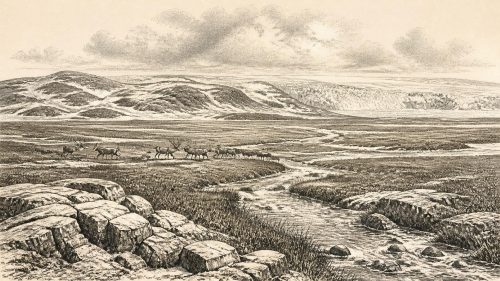
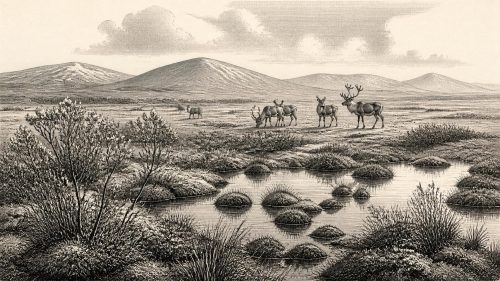
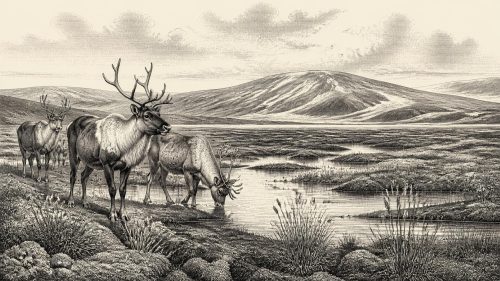
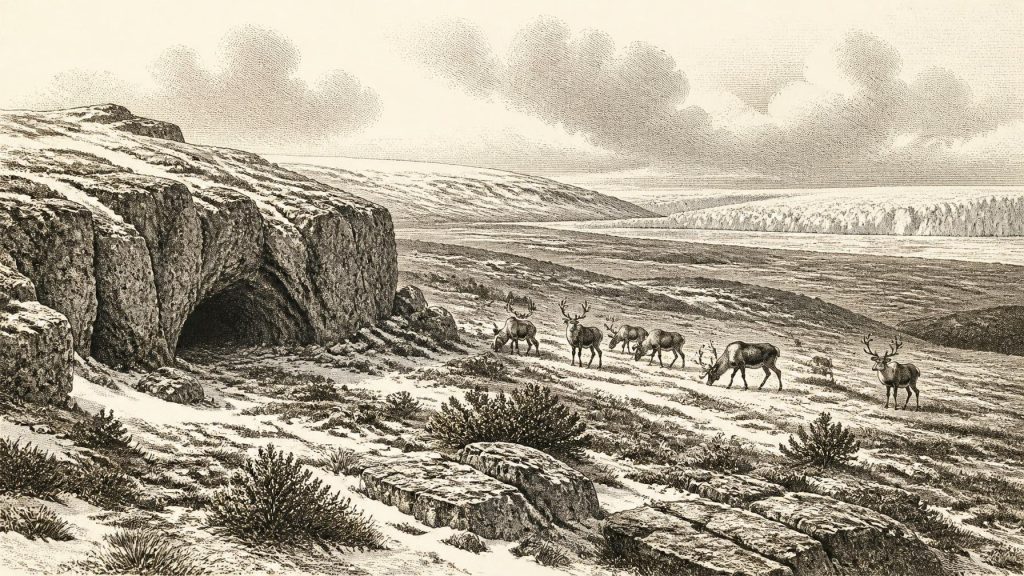
Around 32,000 BCE, Ireland lay within the Late Pleistocene, before the British–Irish Ice Sheet reached its maximum extent. Lower sea levels altered coasts, but any land connection to Britain or Europe remains uncertain. Conditions varied regionally, though open, cold steppe-tundra supported reindeer, mammoth, giant deer, bears, wolves, Arctic foxes and fauna. Castlepook Cave, County Cork, preserves animal remains and a reindeer bone possibly bearing stone-tool butchery marks. This tentative evidence may indicate human activity, not settlement. Later glaciation destroyed or buried landscapes, complicating interpretation. Evidence of people in Ireland dates to about 10,860–10,640 BCE, leaving this earlier period archaeologically uncertain.
Dateline
32,000 BCE is a modern chronological label, not a date that can be matched to an Irish historical year. There are no written records, named individuals, excavated settlements or securely dated events from this point. Indeed, the precision implied by a calendar year is unavailable: radiocarbon results are expressed as ranges and must be calibrated, while geological and archaeological sequences are often resolved only to centuries or millennia. In broad terms, 32,000 BCE falls about 34,000 years before the conventional “present” of 1950, within the Late Pleistocene and the Upper Palaeolithic of north-west Europe.
For Ireland, this is an age of fragmentary environmental evidence and exceptionally tentative traces of human activity. It belongs to the long lead-in to the Last Glacial Maximum, when the British–Irish Ice Sheet reached its greatest known extent, broadly around 27,000–23,000 years ago. The important story for this date is therefore not a kingdom, battle or migration that can be placed in a single year, but an unstable Ice Age landscape: probably still offering ice-free habitats in places, increasingly shaped by colder climate and expanding ice, and inhabited—if humans came at all—only fleetingly.
An Ireland Before Maximum Glaciation
The island’s familiar outline is misleading for this remote period. Sea level was much lower than today because immense volumes of water were locked in global ice sheets, exposing wider continental shelves around Ireland. Yet lower sea level did not automatically create a walkable land bridge from Ireland to Britain or continental Europe. Research on the Irish Sea has long stressed that any late-glacial connection was, at best, limited, temporary and geographically complex; it should not be assumed for 32,000 BCE. Water, sea ice, rugged coasts and changing glaciers were barriers as well as possible routes.
Nor was Ireland simply a white, static ice-cap. The last British–Irish Ice Sheet grew and altered through time. Large-scale reconstructions place its maximum extent later than this article’s focal date, while evidence from land and sea shows that ice margins advanced, merged and retreated in different sectors at different times. Thus it is responsible to say that 32,000 BCE lay in a severe glacial phase before the full Last Glacial Maximum, but not to draw a firm coastline or ice margin for one exact year. Regional conditions could have differed markedly between the Atlantic west, the southern lowlands, upland areas and the Irish Sea basin.
By the maximum, ice had overridden much or all of the island and extended far beyond modern coasts onto the Atlantic and Celtic Sea shelves. Its movement eroded older surfaces and redistributed sediments. That later destruction matters greatly: even if people had visited Ireland before the maximum, campsites on exposed ground would have been vulnerable to removal or burial. The absence of a site is therefore not uncomplicated proof that no person ever arrived. But neither does it justify turning a possibility into a settled population.
Cold Landscapes and Ice Age Animals
Environmental evidence comes chiefly from cave deposits, bones, sediments, landforms and the wider north-west European climatic record. Ireland’s limestone caves are particularly important because they can preserve animal remains where open-air sites have not survived. Late Pleistocene Irish faunas include species associated with cold or open environments: reindeer, woolly mammoth, giant deer (Megaloceros giganteus), brown bear, wolf, Arctic fox, hare and lemmings; spotted hyaena is also known from southern Irish cave material. These animals did not all necessarily live together at every place or moment. Cave collections frequently combine finds accumulated over long periods, and modern redating has shown how necessary it is to reassess old identifications and assumed associations.
For the broad interval surrounding 32,000 BCE, the most defensible picture is of an open, cold landscape, not the dense green woodland of later prehistoric Ireland. Grassland, herb-rich steppe-tundra, low shrubs and exposed ground would have supported grazing and browsing animals, while conditions varied with season, elevation and proximity to ice. Caves were not necessarily homes. They might receive bones brought in by carnivores, animals dying naturally, water action, roof-fall, or human visitors. A bone in a cave proves that an animal was present or transported there; it does not by itself reconstruct a living community outside.
Castlepook Cave near Doneraile, County Cork, is central to this deep history. Its early excavations produced an extensive collection of Pleistocene animal remains, including material which later research has reassessed through radiocarbon dating. Castlepook and other Cork caves demonstrate that Ireland possessed habitats capable of supporting substantial Ice Age fauna before the ice sheet’s maximum advance. They illuminate an Irish environment connected ecologically to wider north-west Europe, even though the precise routes by which animals entered, and the duration of their local populations, remain subjects of research.
The Human Question
There is no securely excavated dwelling, hearth, tool assemblage, grave or human skeleton that permits historians to describe an Irish society in 32,000 BCE. There is consequently no evidence for political organisation, diplomacy, warfare, religion, formal learning, trade networks or permanent settlement on the island at this date. Terms such as “tribe”, “chief”, “Irish people” or “nation” would impose much later ideas on a record that cannot support them.
The question is nevertheless not entirely empty. A reindeer femur from Castlepook Cave has been publicised as approximately 33,000 years old and as carrying marks consistent with stone-tool butchery. If those markings are confirmed as human-made, and if their relationship to the dated bone is securely demonstrated, the find would indicate human handling of an animal in Ireland during the pre-maximum part of the last glacial cycle. It would be immensely important—but it would still represent an episode, not proof of a resident population, a named culture or activity in the exact modern year 32,000 BCE.
Caution is essential because the bone derives from an old cave collection rather than a modern, fully documented excavation context. Natural damage can resemble deliberate modification; collections excavated in the nineteenth and early twentieth centuries may have lost the sedimentary relationships that allow archaeologists to connect an object confidently with a particular occupation surface. The responsible formulation is therefore that Castlepook offers possible evidence of very early human activity in Ireland, not an established narrative of continuous Palaeolithic settlement.
The clearest published direct evidence for Palaeolithic people in Ireland remains much later. At Alice and Gwendoline Cave in County Clare, a brown-bear kneecap bearing cut marks was directly dated to roughly 12,810–12,590 calibrated years before present, or about 10,860–10,640 BCE. Subsequent work has confirmed that bear, reindeer and giant deer were present in the relevant terminal-Pleistocene setting. This provides strong evidence that people processed an animal in Ireland late in the Ice Age. It does not bridge the vast intervening span back to 32,000 BCE.
Life Elsewhere, Not Yet an Irish Society
Across Europe, Upper Palaeolithic hunter-gatherers made sophisticated stone, bone and antler tools, pursued varied subsistence strategies and in some regions produced striking portable and cave art. Such evidence establishes what human communities elsewhere were capable of; it cannot be transferred wholesale to Ireland. No Irish object securely attributable to 32,000 BCE demonstrates a particular tool tradition, language, ritual practice, artistic convention or social structure. Any people reaching the island may have travelled as small mobile groups whose material traces were slight even before glacial erosion took its toll.
If a Castlepook bone was butchered by people, the most modest inference is economic: visitors acquired or processed meat, marrow, hide or other useful animal materials. Reindeer would have been a valuable resource, but a single modified bone cannot tell us whether it was hunted, scavenged, carried from elsewhere, or processed beside the cave. It gives no basis for estimating population size, season of occupation, exchange, property or gendered divisions of labour. Archaeology often advances through such disciplined limits: an interpretation becomes stronger only when several independent lines of evidence agree.
Regional Change and a Broken Record
Ireland’s later glaciation is both the subject of this period and an obstacle to understanding it. Glacial scouring, meltwater, slope processes, peat growth, rising seas and modern development have altered or concealed ancient landscapes. Former coastal plains are now submerged. In contrast, caves may preserve bones but can mix deposits, while acidic soils commonly destroy organic remains. The archaeological map of Ice Age Ireland is therefore uneven by nature, not merely unfinished.
That unevenness explains why this year is best understood as a threshold rather than a beginning. Around 32,000 BCE, Ireland was part of the climatic and ecological world of Upper Palaeolithic Europe, but its human status remains uncertain. In the following millennia, worsening conditions and the expanding British–Irish Ice Sheet transformed the land, extinguishing or displacing animal populations and making enduring occupation improbable. Only after deglaciation, much later, do archaeological traces become sufficient to tell a fuller story of people returning, settling and reshaping the island.
For now, the most honest history of Ireland in 32,000 BCE is one of Ice Age possibility bounded by evidence: cold open country, large mammals, advancing ice, altered coastlines and perhaps brief human encounters whose traces are rare, fragile and still under investigation.
Primary Sources
- Growth and retreat of the last British–Irish Ice Sheet, 31,000 to 15,000 years ago: the BRITICE-CHRONO reconstruction
- Pattern and timing of retreat of the last British-Irish Ice Sheet
- Maximum extent and dynamic behaviour of the last British–Irish Ice Sheet west of Ireland
- Sedimentology and chronology of the advance and retreat of the last British-Irish ice sheet on the continental shelf west of Ireland
- Stratigraphic and palaeo-geomorphological evidence for the glacial-deglacial history of the last British-Irish Ice Sheet in the north-western Irish Sea
- Trimlines, blockfields and the vertical extent of the last ice sheet in southern Ireland
- Ireland: Submerged Prehistoric Sites and Landscapes
- The problem of a late quaternary landbridge between Britain and Ireland
- A reconsideration of the radiocarbon dating of the Marine Isotope Stage 3 fauna from southern Ireland
- First evidence of a Late Upper Palaeolithic human presence in Ireland
- New insights on the fauna of Ireland’s Younger Dryas and Early Holocene from Alice & Gwendoline Cave
- Revisiting Alice and Gwendoline Cave, Co. Clare: New light on the 1902 excavations
- First evidence of a Late Upper Palaeolithic human presence in Ireland
- The Mesolithic in Ireland: when was it?
- Archaeological Heritage of County Cork
- Heritage Artefacts of County Cork
- 32564 – Castlepook Cave, Co. Cork
- Anthropogenic changes to the Holocene nitrogen cycle in Ireland
- Outreach and Education Resources
- Early deglaciation of the British-Irish Ice Sheet on the Atlantic shelf northwest of Ireland driven by glacioisostatic depression and high relative sea level