Cut-Marked Reindeer Bone31999 BCE
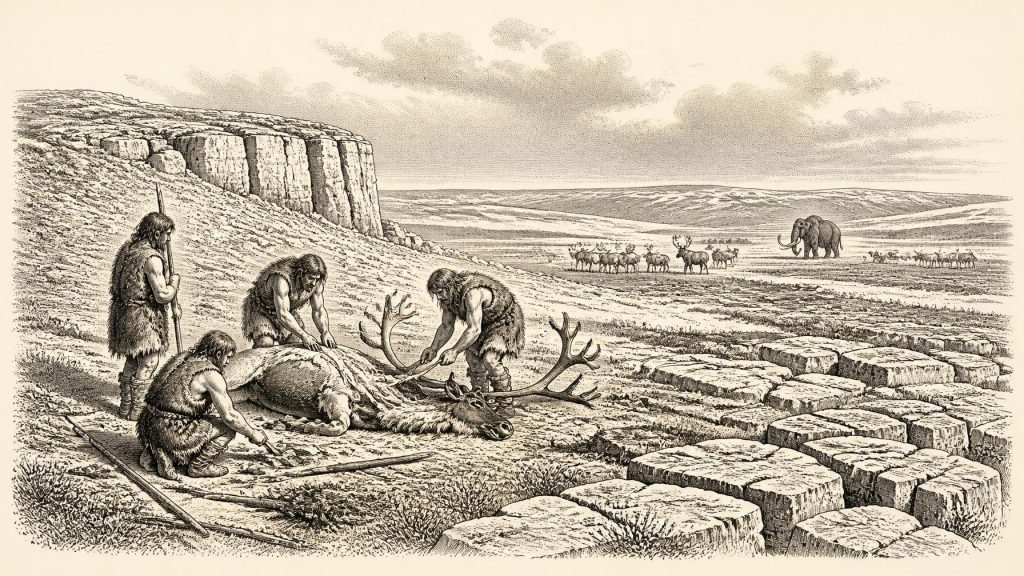
Castlepook Cave, County Cork, contains a reindeer femur reportedly cut with a stone tool about 31,000 BC, potentially Ireland’s earliest evidence of human activity. The date is approximate, and disturbed cave deposits, lacking associated tools, hearths or settlements, prevent firm conclusions beyond a possible brief hunter visit. During Marine Isotope Stage 3, Ireland was cold, seasonal and variably glaciated, supporting open habitats and fauna including reindeer, mammoth, giant deer, bears, wolves and hyaenas. Low sea levels may have aided access, though routes remain unknown. Later glaciation probably destroyed evidence. The find suggests mobile hunter-gatherers, not permanent occupation, culture or organisation.
Dateline
The label 31,999 BCE should not be mistaken for a date that people in Ice Age Ireland could have recognised, or that archaeology can isolate to a single year. This was long before writing, named rulers, states or calendars on the island. It falls broadly within the Late Pleistocene, in Marine Isotope Stage 3, a climatically unstable part of the last Ice Age. The most responsible approach is therefore to describe a span around this notional year using calibrated and radiocarbon date ranges, rather than inventing an event for it. In Irish terms, the period is important precisely because it may preserve the earliest presently claimed trace of human activity, while leaving enormous questions unresolved.
A Date Range, Not a Dated Event
The nearest relevant evidence comes from Castlepook Cave near Doneraile in north County Cork. A reindeer femur from the cave has been described by its researcher, Ruth Carden, and by County Cork heritage publications as bearing a cut mark made when the animal was butchered with a sharp stone tool. The publication places the object at about 31,000 BC. That makes Castlepook unusually pertinent to 31,999 BCE, but it does not licence precision beyond the evidence. A bone’s scientific date is an estimate with an uncertainty range; converting between radiocarbon years, calibrated calendar years and BCE notation introduces further caution. Nor can one cut-marked bone date a particular hunt, season or year.
The find is potentially transformative, but its limits matter as much as its promise. No securely associated stone tool, hearth, dwelling floor, human skeleton, burial or extensive food debris of this age has yet been recovered in Ireland. The femur was found in a cave whose deposits were investigated in the early twentieth century and whose bones were moved, accumulated and disturbed by natural processes over very long periods. The best reading is not that a settled population occupied Ireland in 31,999 BCE, but that a hunter or hunters may have processed a reindeer on the island, perhaps during a brief visit, within a broad period around the early thirties of millennia BCE. Further excavation of undisturbed deposits is needed to test that interpretation.
Ireland in Marine Isotope Stage 3
Around this approximate date Ireland had not yet entered the fullest phase of the Last Glacial Maximum. The peak expansion of the British–Irish Ice Sheet came later, conventionally placed around 26,000–19,000 calibrated years before present, although its timing and extent varied by region and remain actively researched. Evidence from landforms, marine sediments, sea-level records and exposure dating indicates major growth and later retreat of ice over the island. By the glacial maximum, much or perhaps nearly all of Ireland was covered by ice; any earlier traces on the open landscape were vulnerable to erosion, burial and destruction.
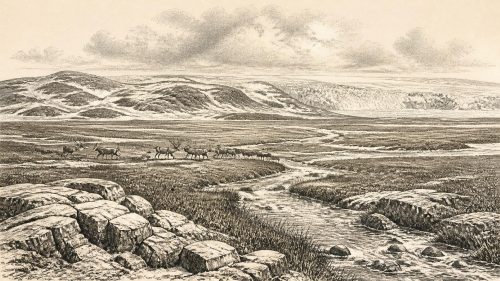
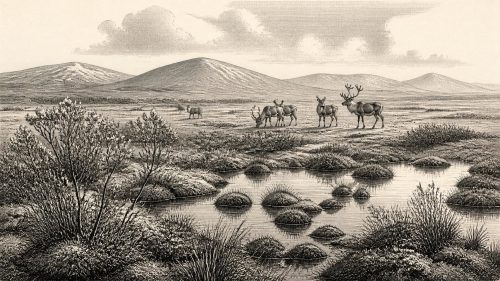
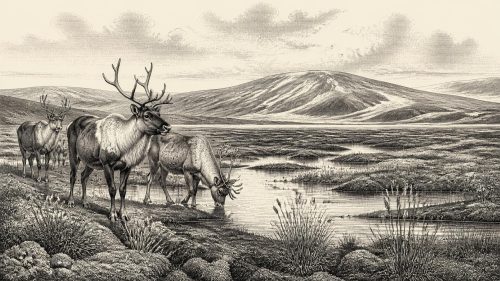
At roughly 32,000 BCE, however, the country should not simply be imagined as an unbroken white ice cap. Castlepook’s mammal assemblage indicates that at least parts of southern Ireland supported terrestrial animal life during the preceding, milder or less glaciated phases of the Ice Age. Conditions would still have been much colder, more seasonal and more changeable than today. The precise pattern of vegetation cannot be reconstructed for every Irish valley, but open grass-and-herb communities, patches of low shrubs and exposed ground are more plausible than the familiar wooded landscape of later millennia. Forests of oak, ash and hazel belonged to a much warmer future.
Sea level was lower globally because water was locked in continental ice sheets. Yet low sea level did not automatically create a simple, permanent dry land bridge between Ireland and Britain. The Irish Sea basin, the shape of the coasts, local ice masses and changing relative sea level all complicate the picture. Large mammals and, if the Castlepook interpretation is correct, people nevertheless reached Ireland. Their routes may have involved exposed coastal plains, narrower water crossings, seasonal ice conditions or combinations of these. The evidence does not yet decide which route applied at the time of the cut-marked reindeer bone.
The Cave’s Animal World
Castlepook Cave is Ireland’s richest known archive for the vertebrate fauna leading up to the Last Glacial Maximum. More than two thousand bones have been recovered there, from deposits representing long and varied periods rather than one single living community. Direct dates from the wider assemblage stretch broadly from about 45,700 to 19,950 radiocarbon years before present, while modern redating has shown that some older determinations required substantial revision. Consequently, animals listed from the cave cannot all be placed together in 31,999 BCE. They do, however, establish the kinds of Ice Age fauna that reached Ireland during the long interval surrounding it.
The assemblage includes reindeer, woolly mammoth, giant deer or ‘Irish elk’, brown bear, wolf, Arctic fox, mountain hare, collared lemming and Norwegian lemming. Most striking is the spotted hyaena, known in Ireland chiefly from Castlepook. Gnawed and broken remains demonstrate why a cave deposit cannot automatically be treated as a human food store: carnivores carried carcass parts into caves, fed there and left bones exposed to later movement by water, sediment and excavation. A mammoth or reindeer bone in the cave proves the animal was present in the wider landscape; it does not by itself prove that people killed it or entered the cave.
This faunal evidence suggests a productive, if demanding, cold-climate landscape rather than an empty wilderness. Herd animals could have exploited grazing and herb-rich ground, while predators and scavengers followed them. Reindeer were especially mobile animals, and their seasonal movements offer a credible reason why human groups might have ranged into Ireland. But a credible scenario remains an interpretation. Archaeology cannot presently identify where a reindeer was killed, whether hunters travelled in a family group or a small task party, how long they stayed, or whether they returned.
People: A Fleeting Possibility
If the Castlepook cut mark is accepted as anthropogenic, it records a very small human footprint: the use of a sharp lithic edge on fresh bone. It supports hunting or carcass processing, not a named culture, a permanent colony or a continuous ancestry leading to later Irish communities. The people involved cannot be assigned securely to an ethnic label, a language or even a particular archaeological tradition from this evidence alone. Modern humans had spread across parts of western Europe in the Upper Palaeolithic, and Gravettian-associated communities were present on the continent during broadly comparable millennia. Yet there is no Irish tool assemblage of this date from which to call the Castlepook visitors Gravettian, and no basis for calling them Gaelic, Celtic or Irish in any later cultural sense.
Everyday life, if people were present, would have depended on portable knowledge rather than permanent monuments: finding fuel and shelter, maintaining cutting tools, reading animal movements and coping with fast-changing weather. Meat, marrow, hide, sinew and bone were valuable products of a large animal, but the Castlepook evidence does not reveal which were taken. There is no reliable evidence for houses, clothing styles, art, musical instruments, formal graves or ceremonial places in Ireland at this date. Such practices existed in various forms among Upper Palaeolithic populations elsewhere in Europe, but transferring them wholesale to Ireland would turn analogy into fact.
No Polities, No Diplomacy
There were no Irish kingdoms, chiefs recorded by name, borders, treaties, taxation systems or diplomatic institutions that can be responsibly placed in 31,999 BCE. Conflict is equally beyond direct observation. Hunting large animals could have involved cooperation, and human groups elsewhere sometimes competed for territory and resources, but neither warfare nor alliance is visible in the Irish record. The only defensible ‘regional politics’ is physical geography: Ireland stood at the north-western edge of the European world, its accessibility repeatedly reshaped by climate, ice and sea.
There is likewise no evidence for farming, herding, metalworking, market exchange or organised long-distance trade within Ireland. Any visitors would have been hunter-gatherers using stone technology. They may have carried useful materials and social connections from places beyond the island, but no imported object of this age has been identified here. The economic story is thus one of subsistence opportunity and mobility, not trade routes or production centres.
What the Evidence Can Say
The deepest significance of this approximate year lies in the distinction between discovery and certainty. The Castlepook reindeer femur offers a plausible and officially recognised indication that people reached Ireland around 31,000 BC, far earlier than the island’s once conventional archaeological starting point in the Mesolithic. Later, better-established evidence includes a butchered brown-bear bone from Alice and Gwendoline Cave in County Clare, independently dated to about 12,810–12,590 calibrated years before present. That later find is stronger because it was directly dated by two laboratories, but it does not answer the question of earlier visits.
Glaciation then intervened. The later ice sheet remodelled much of the country and could have removed or concealed camps, tracks and coastal sites from earlier millennia. This helps explain why Ireland’s Palaeolithic record is so slight, but it cannot be used to fill the gaps with imaginary settlements. Around 31,999 BCE, Ireland was a changing Ice Age landscape inhabited by notable mammals and perhaps visited by small groups of human hunters. Its history survives not in chronicles or monuments, but in one cautiously interpreted cut mark, dated bones, cave sediments and the scars left by ice. That is a slender record, yet it is enough to make this remote threshold one of the most intriguing problems in Irish prehistory.
Primary Sources
- A reconsideration of the radiocarbon dating of the Marine Isotope Stage 3 fauna from southern Ireland
- The Irish Quaternary Fauna Project
- Castlepook Cave, County Geological Site Report
- Heritage Artefacts of County Cork 2021
- 2022:564 – Castlepook Cave, Castlepook South, Cork
- New insights on the fauna of Ireland’s Younger Dryas and Early Holocene from Alice & Gwendoline Cave
- First evidence of a Late Upper Palaeolithic human presence in Ireland
- The colonization of Ireland: A human ecology perspective
- Postglacial relative sea-level observations from Ireland and their role in glacial rebound modelling
- The Island of Ireland: Drowning the Myth of an Irish Land-Bridge?
- Trimlines, blockfields and the vertical extent of the last ice sheet in southern Ireland
- Growth and retreat of the last British-Irish Ice Sheet, 31,000 to 15,000 years ago
- New Data for the Last Glacial Maximum in Great Britain and Ireland
- Dimensions and chronology of the last ice sheet in Western Ireland
- Late Pleistocene chronostratigraphy and ice sheet limits, southern Ireland
- Last Glacial Maximum cirque glaciation in Ireland and implications for reconstructions of the Irish Ice Sheet
- Ireland: Submerged Prehistoric Sites and Landscapes
- Could brown bears have survived in Ireland during the Last Glacial Maximum?
- Stoats provide evidence of natural overland colonization of Ireland
- Ice Age Ireland: Cool Fossils!
- Palaeolithic Ireland – New Evidence Emerges from the Emerald Isle
- Atlas of the Irish Rural Landscape: Archaeological Heritage