Atlantic Ice Sheet Growth31991 BCE
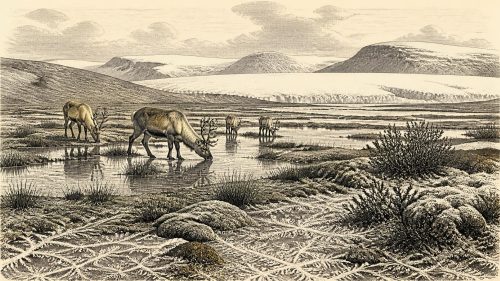
At about 31,991 BCE, Ireland lay within the climatically unstable later Marine Isotope Stage 3, before the Last Glacial Maximum. Growing ice, lower sea levels and changing coastlines transformed habitats and possible access routes, though any land connection with Britain remains uncertain. Castlepook Cave in County Cork preserves key evidence: reindeer, mammoth, giant deer, lemmings, predators and other fauna indicate varied cold open environments. A cut-marked reindeer bone suggests possible Upper Palaeolithic human activity, but cannot prove settlement or continuous occupation. Later glaciation destroyed evidence. Consequently, this period is understood through imprecise dating, cave deposits and reconstruction, not year-specific history.
Dateline
“31,991 BCE” is a modern way of labelling a point unimaginably far beyond written history. It must not be mistaken for a date that anyone then recorded, or for a year to which Irish archaeology can attach an event. In archaeological terms it falls roughly 33,940 calendar years before AD 1950, the conventional reference point for cal BP dates. At this depth of time, radiocarbon results have ranges, are revised as calibration improves, and seldom permit calendar-year precision. The responsible subject, therefore, is Ireland in the later part of Marine Isotope Stage 3 (MIS 3), shortly before the most severe phase of the last glaciation—not an invented episode in a named year.
A Changing Ice-Age Frontier
Ireland at about 32,000 BCE was not the familiar green and wooded island of later millennia. It lay on the north-western edge of Europe during a long cold phase marked by abrupt climatic shifts. The full Last Glacial Maximum, when the British–Irish Ice Sheet reached its greatest extent, lay ahead, conventionally placed around 26,000–19,000 years ago. Yet the ice sheet was already developing, and conditions varied sharply across regions and through time. Modern reconstructions model the growth and retreat of this ice complex from around 31,000 years ago, but their resolution is measured in millennia, not individual seasons or named BCE years.
The best broad inference is that at this date substantial parts of Ireland could still support cold-adapted animal communities, even as glaciers and perennial snow affected uplands and the climate deteriorated. Earlier work has suggested that Ireland remained largely ice-free until around 32,000 cal BP; newer ice-sheet research stresses that the onset, extent and behaviour of ice were regionally complex. It would be unsafe to draw a single, neat boundary across a map for 31,991 BCE. What is secure is that the landscape was heading towards a transformation severe enough to remove or bury much earlier evidence beneath later ice and sediment.
Sea level was much lower than today because water was held in continental ice sheets. The exposed shelves around Ireland altered distances, coastlines and possible routes for animals and people. However, a simple claim that Ireland was joined to Britain by one continuous, easily crossed land bridge is not supported by all reconstructions. Researchers have long debated the nature, timing and usefulness of possible connections across the Irish Sea; some envisage corridors or intermittent links, while others stress marine barriers and ice. For this period, movement into Ireland is best treated as possible within a changing north-west European landscape, not as a certainty that can be mapped precisely.
What the Caves Preserve
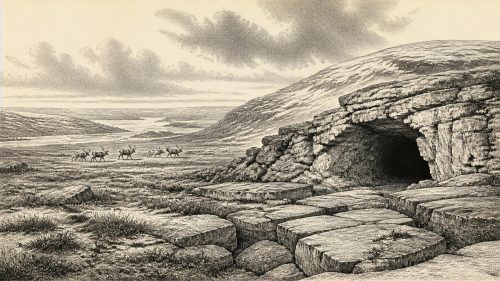
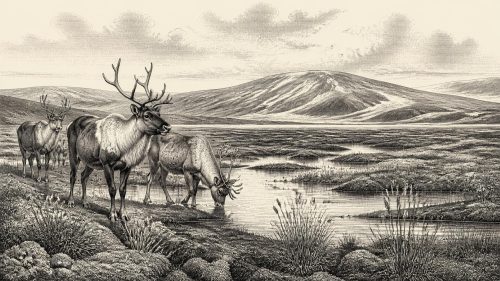
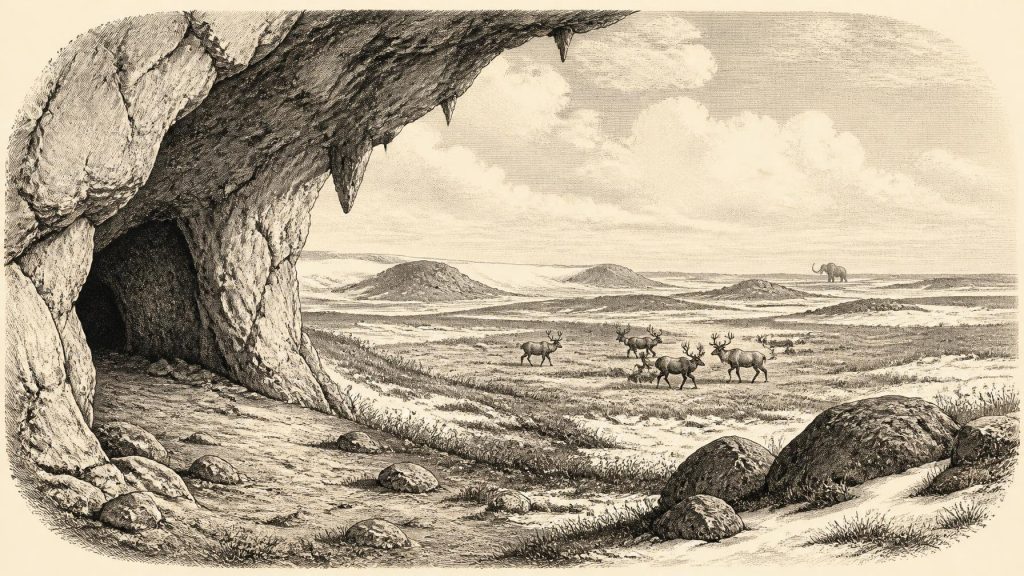
The most important Irish evidence comes not from a village, grave or hearth, but from caves and their fossil collections. Castlepook Cave, near Doneraile in north County Cork, is especially significant. Excavations there recovered a large and mixed Ice-Age fauna, including reindeer, woolly mammoth, giant deer, brown bear, wolf, foxes, hares, lemmings and spotted hyaena. Reassessment of the cave’s radiocarbon chronology places important parts of this fauna in MIS 3, with some animals present in southern Ireland between roughly 45,000 and 33,000 calibrated years ago. That broad range encompasses the archaeological horizon relevant to this article, although it does not date every bone, animal or activity to 31,991 BCE.
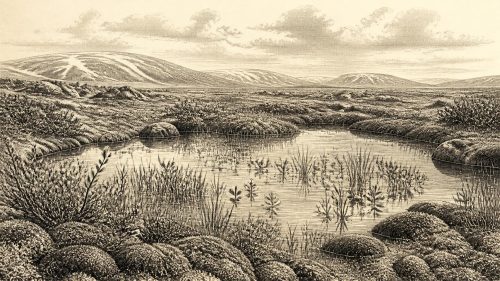
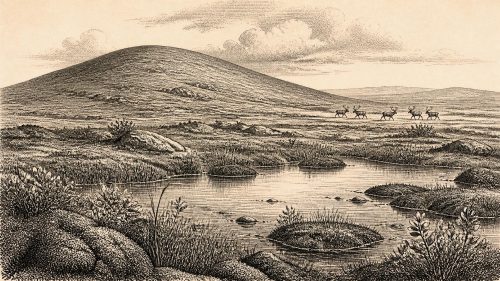
This assemblage gives the strongest picture of Ireland’s environment. Reindeer and lemmings point towards open, cold landscapes; mammoths indicate that at least some habitats could sustain large grazers; hyaenas, wolves and bears reveal a food web with substantial predators and scavengers. The scenery should not be imagined as a uniform, featureless snowfield. A patchwork of grassland, herb-rich tundra, exposed ground, rocky shelter and seasonal snow is more plausible, with local conditions governed by altitude, shelter, drainage and proximity to ice. Caves themselves were not necessarily human homes: they could be dens, traps, scavenging places or repositories into which water, animals and people introduced bones over long periods.
The cave record is both precious and difficult. Much of the material was dug in the late nineteenth and early twentieth centuries, before modern excavation standards. Deposits were often disturbed, their layers incompletely recorded, and bones from different periods could be brought together by geological processes or earlier digging. The Irish Quaternary Fauna Project, later re-dating programmes and renewed excavation have therefore been essential. They do not merely add dates; they test whether an old label, a bone surface or a reported layer can still bear historical weight. The lesson is caution: Ireland’s sparse Palaeolithic archive is real, but it is not a complete census of life or human activity.
The Human Question
There is no securely dated human skeleton, dwelling, hearth, tool-kit or burial from Ireland that can be assigned to 31,991 BCE. Nor is there evidence for a continuously occupied population at this time. The nearest relevant indication is a reindeer femur from Castlepook Cave reported as bearing a cut mark and dated to about 33,000 years ago in public accounts. It raised the possibility that people handled or butchered an animal in Ireland during the Upper Palaeolithic. That possibility is important, but it must not be enlarged into a story of permanent settlement, a named migration or a particular hunting party operating in this calendar year.
Interpretation is especially delicate because cut marks must be distinguished from damage caused by carnivore teeth, trampling, excavation tools, sediment movement or later handling. A single modification on a bone can establish a question, rather than settle it. The direct date concerns the animal bone, not necessarily the moment at which a person cut it; its archaeological context also matters. Ongoing work at Castlepook, including fresh sampling of undisturbed deposits and applications of radiocarbon, luminescence, uranium-series methods and sedimentary ancient DNA, is precisely the kind of research needed to test these early claims. A recent genetic study of cave sediments, currently a preprint rather than a final peer-reviewed article, supports broad faunal connections between Ireland and Eurasia before the Last Glacial Maximum, but it cannot by itself prove human occupation.
For comparison, the more secure direct evidence of Palaeolithic human activity in Ireland belongs much later, at Alice and Gwendoline Cave in County Clare. A brown-bear patella with marks interpreted as butchery produced a calibrated range of about 12,810–12,590 cal BP. This is compelling evidence for a late, brief human incursion, but it is more than twenty millennia after the date considered here. It demonstrates both that Palaeolithic people could reach Ireland and that discoveries once thought impossible can emerge from old museum collections. It does not fill the immense chronological gap between Castlepook’s MIS 3 fauna and the terminal Pleistocene.
Life Without a Recorded Society
If people did enter Ireland around this period, they would have been Upper Palaeolithic hunter-gatherers, arriving in very small, mobile groups rather than members of an Irish nation or settled farming community. They may have followed seasonal animal movements, sought carcasses, hunted when opportunities allowed, or explored unfamiliar ground. Stone tools, wooden implements, clothing, shelters and fires would be expected in a wider Upper Palaeolithic world, but none can responsibly be claimed for Ireland at 31,991 BCE without direct evidence. A cut-marked reindeer bone would demonstrate processing of animal tissue; it would not show whether the animal was hunted, scavenged, shared, traded or encountered by a group staying for days rather than generations.
Accordingly, political affairs, diplomacy and warfare cannot be reconstructed. There were no states, kingdoms, chiefs or borders documented in Ireland, and no evidence from this date for organised conflict. It is reasonable to suppose that mobile groups elsewhere in north-west Europe maintained kin ties, exchanged knowledge and negotiated access to hunting grounds. It is not reasonable to call such relationships Irish diplomacy, or to project later tribal names, languages or identities backwards across more than thirty millennia. The same restraint applies to economy and trade. There is no evidence for markets, exchange networks, farming, herding, metalworking or seaborne commerce in Ireland at this date.
Religion, art and learning are also beyond recovery in specifically Irish form. Upper Palaeolithic peoples elsewhere in Europe made sophisticated art, ornaments and ritualised objects, and possessed detailed practical knowledge of animals, weather, stone and seasonal change. Ireland has yielded no comparable art, sacred site, burial rite or symbolic object securely attributable to about 32,000 BCE. Absence of evidence is not proof that people lacked beliefs or stories; it means that archaeology cannot describe them here. The intellectual achievement visible in the surviving record is instead modern: the painstaking ability to read climate, animal bone, sediments, isotope signals and damaged surfaces without pretending they are a written chronicle.
Disappearance and Deep Time
The central historical development around this date was environmental instability. A land that had supported Ice-Age mammals moved towards far harsher conditions as ice expanded. Later glaciation reshaped valleys, transported sediments and destroyed many open-air traces that might otherwise reveal human visits. Geomorphological research shows how profoundly the eventual ice sheet reached across western and southern Ireland, while the modern Irish landscape still retains its legacy in glacial landforms. The thinness of the early archaeological record is therefore partly a history of loss, not necessarily proof of an empty island.
For Ireland in 31,991 BCE, the soundest conclusion is modest but remarkable. The island formed part of an Ice-Age ecological frontier inhabited by cold-climate mammals, documented most clearly in caves such as Castlepook. There may have been fleeting human contact with that world, perhaps including the processing of reindeer, but no evidence yet supports a settled community or a year-specific historical narrative. The date belongs to prehistory at its most demanding: a period illuminated by calibrated ranges and physical traces, where evidence must remain distinct from the attractive stories it may one day make possible.
Primary Sources
- First Evidence of a Late Upper Palaeolithic Human Presence in Ireland
- A Reconsideration of the Radiocarbon Dating of the Marine Isotope Stage 3 Fauna from Southern Ireland
- The Irish Quaternary Fauna Project
- Radiocarbon Dates from the Oxford AMS System: Archaeometry Datelist 31
- Castlepook Cave, Castlepook South, County Cork: Excavation Report 2022
- Sedimentary Ancient DNA Reveals Late Pleistocene Faunal Connectivity Between Ireland and Eurasia
- Growth and Retreat of the Last British–Irish Ice Sheet, 31,000 to 15,000 Years Ago: The BRITICE-CHRONO Reconstruction
- Dimensions and Chronology of the Last Ice Sheet in Western Ireland
- Trimlines, Blockfields and the Vertical Extent of the Last Ice Sheet in Southern Ireland
- Quaternary
- Ireland Through Geological Time
- The Island of Ireland: Drowning the Myth of an Irish Land-Bridge?
- The Problem of a Late Quaternary Landbridge Between Britain and Ireland
- The IntCal20 Northern Hemisphere Radiocarbon Age Calibration Curve (0–55 cal kBP)
- New Insights on the Fauna of Ireland's Younger Dryas and Early Holocene from Alice & Gwendoline Cave
- Anthropogenic Changes to the Holocene Nitrogen Cycle in Ireland
- Stoats (Mustela erminea) Provide Evidence of Natural Overland Colonization of Ireland
- Pleistocene Vertebrates in the British Isles
- Learn About: The Ice Age
- Prehistoric Details: Mell Flint Flake