Cave Bone Taphonomy31926 BCE
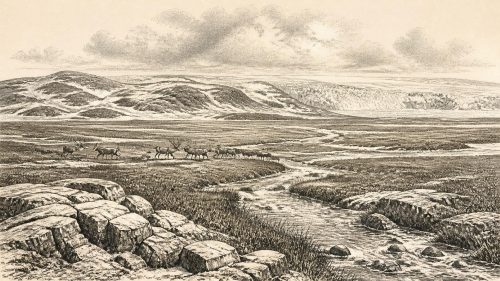
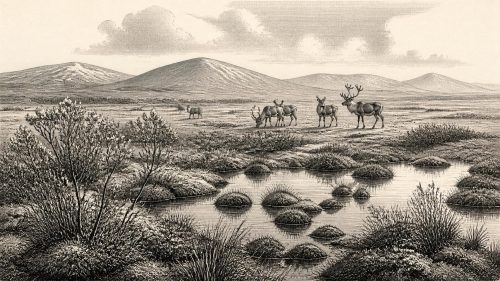
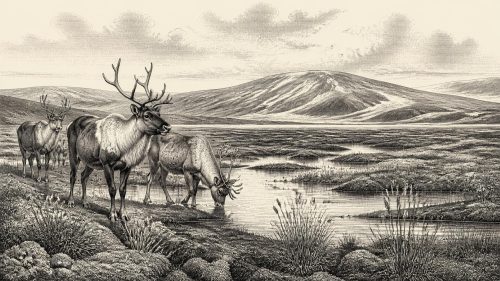
Ireland around 31,926 BCE cannot be reconstructed as a calendar-year history. During later Marine Isotope Stage 3, before the Last Glacial Maximum, a cold, unstable landscape faced expanding and regionally variable ice. Cave deposits, particularly at Castlepook, preserve sparse evidence of mammoth, reindeer, giant deer, bears and hyaenas, indicating intermittently habitable open environments. A marked reindeer femur may record human butchery about 33,000 years ago, but remains contested and proves neither settlement nor continuous occupation. Disturbed early excavations complicate interpretation. No secure evidence exists for communities, artefacts, farming, politics, religion or art. Sustained settlement appears after deglaciation, around 8000 BCE.

Dateline
The label “31,926 BCE” is useful for organising a modern chronology, but it must not be mistaken for a date that prehistoric Ireland’s evidence can resolve. No Irish event, individual, journey or settlement can be assigned to this calendar year. In conventional before-present terms, it falls roughly 33,876 years before 1950; archaeological and environmental dating at this depth works in broad ranges, not annual entries. The responsible subject is therefore Ireland during the later part of Marine Isotope Stage 3, before the fullest advance of the last British–Irish Ice Sheet.
A Landscape Without Annals
There were no states, rulers, written laws or diplomatic relations in Ireland that can be recovered for this time. Nor can archaeologists identify a village, burial ground, hearth or tool-making floor securely belonging to 31,926 BCE. The island’s history is instead approached through geological traces, cave deposits, animal bones and laboratory dating. These sources illuminate changing environments and occasional animal presence far more clearly than they illuminate human lives.
The distinction matters. A radiocarbon date on a bone establishes, within an uncertainty range and after calibration, when the animal lived or died; it does not automatically date a human visit to the same cave. Likewise, a scratch or incision on bone may be consistent with a stone tool, but it must be distinguished from carnivore teeth, trampling, sediment movement, excavation damage and other natural processes. Ireland’s Pleistocene cave collections are especially difficult because many were excavated in the nineteenth and early twentieth centuries, before modern recording standards, and deposits were often mixed or disturbed.
Even the geographical word “Ireland” needs care. The landmass was recognisably the foundation of the modern island, but coastlines, sea levels and ice margins were very different. Lower global sea levels exposed large areas of the continental shelves around north-west Europe. Whether particular routes between Ireland, Britain and the continent were dry, icy, shallow marine or impassable varied through time and remains debated. It is safer not to imagine a modern coastline, nor to assume an easy land crossing.
Before the Last Glacial Maximum
31,926 BCE lay before the global Last Glacial Maximum, usually defined as about 26,500–19,000 calibrated years before present, and before the local maximum of the British–Irish Ice Sheet, which current large-scale reconstructions place broadly around 27,000 years ago. That does not mean Ireland was uniformly mild or ice-free. Ice sheets grow, thin and shift unevenly; individual valleys, uplands, shelves and coasts can have very different histories. The best reconstruction is one of an unstable cold-stage world, in which expanding ice was becoming an ever more powerful force in Ireland’s environmental history.
Later ice would cover most, perhaps nearly all, of Ireland and profoundly rework the terrain. Evidence from glacial landforms, offshore sediments and exposure dating shows ice moving across the mainland and onto the Atlantic and Celtic Sea shelves during the last glaciation. Yet the precise form of the ice sheet at the earlier horizon represented by 31,926 BCE cannot be read as a single map with complete confidence. Recent BRITICE-CHRONO research stresses that the maximum advance and the beginning of retreat were asynchronous across different sectors. Regional variation is therefore more than a technicality: it prevents a false picture of one uniform white cap descending everywhere at once.
The long-term consequence is visible in modern Ireland’s physical geography. Glacial erosion and deposition helped shape basins, valleys, moraines, drumlin fields and meltwater routes. But these familiar features are not snapshots of this year. They are the accumulated legacy of advances and retreats over millennia, often modified by later water, soil formation and human activity.
Animals in a Changing World
Irish cave deposits show that animals occupied parts of the country during the pre-maximum cold stage. The Irish Quaternary Fauna Project found evidence for a wider mammal community between at least about 45,000 and 20,000 years ago, although the record is sparse and heavily dependent on caves. Castlepook Cave, near Doneraile in north County Cork, is particularly important: it has produced remains attributed to animals including woolly mammoth, reindeer, giant deer, brown bear and spotted hyaena. Re-dating work has shown that some earlier measurements from southern Irish caves underestimated the age of specimens, pushing elements of the fauna further back into Marine Isotope Stage 3.
This evidence supports a broad conclusion, not a complete animal census for 31,926 BCE. The creatures represented in cave assemblages did not necessarily live together, in the same numbers, or during the same season. Caves can be carnivore dens, natural traps or channels into which water and sediment carry bones from outside. A hyaena may have accumulated prey; a bone may have been moved long after the animal’s death. Nevertheless, reindeer and other cold-adapted or open-country fauna indicate that at intervals parts of Ireland offered habitable ground rather than permanent, continent-wide ice.
Vegetation must also be reconstructed cautiously. Conditions before the Last Glacial Maximum were generally colder and more variable than today, and woodland of the modern Irish kind would be inappropriate for much of the exposed landscape. Open herb-rich grassland, shrub tundra and patchy vegetation are reasonable regional analogies, but their local mixture would have depended on altitude, soil, drainage, wind exposure and the proximity of ice. Such country could sustain grazing animals, scavengers and predators, while simultaneously offering an exacting, seasonal environment for any people entering it.
A Possible Human Trace
The most consequential, and most tentative, human evidence relevant to this remote period comes from Castlepook Cave. A reindeer femur from the historic collection has been reported as bearing deep marks interpreted as butchery with a broad stone or flint edge, and public reporting placed it at around 33,000 years ago. If that interpretation is sustained, it would push evidence of human activity in Ireland dramatically earlier than the better-established terminal Pleistocene evidence from Alice and Gwendoline Cave, County Clare.
But the claim must be kept in proportion. The dated object is animal bone, not a human skeleton. The reported marks suggest an action on a carcass, not a residence. They do not demonstrate a permanent population, a named people, a camp at Castlepook, a family group, a sea crossing, or uninterrupted occupation of Ireland. A 2022 excavation at the cave recovered faunal material and investigated surviving sediments but identified no cultural artefacts. Its importance lies partly in showing how much still depends on finding undisturbed deposits with securely associated tools, bones and dates.
At the broad European scale, anatomically modern humans had spread into parts of north-west Europe before the Last Glacial Maximum. Their Upper Palaeolithic lifeways involved highly mobile hunting and gathering, sophisticated stone technologies, the use of animal materials and, in some regions, ornaments and figurative art. None of those cultural achievements can be transferred automatically to Ireland. The Irish evidence does not identify a specific Upper Palaeolithic tradition, language, ritual practice or artistic repertoire at this horizon. Comparison may indicate what a brief visiting party could have known elsewhere; it is not proof of what occurred here.
Society, Economy and Belief: What Cannot Be Claimed
If people did reach Ireland around this wider period, a practical encounter with animal resources is the only modest economic inference currently available. Butchery marks, if human-made, could relate to obtaining meat, marrow, hide, sinew or bone. They cannot reveal how food was shared, whether hunters acted alone or in a group, or whether an animal was hunted locally, scavenged or encountered already dead. There is no evidence for farming, herding, pottery, metalworking, managed woodland, exchange networks or settled domestic architecture.
There is equally no direct basis for describing warfare, alliances, leaders, territorial boundaries or diplomacy. In an archaeological sense, conflict could potentially be investigated through weapons, trauma, defended places or patterned destruction; none is available for Ireland at this date. Religion and learning are also beyond recovery. No Irish cave art, formal burial, shrine, inscribed object or symbolic assemblage securely belongs to this phase. Silence in these categories is not evidence that Ice Age people lacked social bonds, beliefs or knowledge; it is evidence that Ireland has not preserved, or has not yet identified, material traces capable of demonstrating them.
The Importance of the Gap
The central fact of Ireland around 31,926 BCE is therefore uncertainty within a changing Ice Age landscape. Faunal evidence makes clear that the country was not simply outside the Pleistocene world of animals. The Castlepook bone offers a potentially momentous sign that people may also have made a fleeting appearance before the great expansion of ice. Yet the interval between such possible visits and the island’s much later, substantial Mesolithic settlement remains immense. Clear evidence for sustained settlement appears only after the post-glacial transformation, by about 8000 BCE.
For this year, then, Ireland has no political narrative and no calendar event. It has a fragile archive: cave bones, contested surface modifications, calibrated ranges, sedimentary histories and the future imprint of ice. That archive is enough to show an island-landmass at Europe’s north-western edge, environmentally connected to a wider Ice Age world, but not enough to populate it confidently with a continuous human society.
Primary Sources
- The Irish Quaternary Fauna Project
- A Reconsideration of the Radiocarbon Dating of the Marine Isotope Stage 3 Fauna from Southern Ireland
- Ancient DNA and the Colonization of Ireland: The Genetic History of Red Deer (Cervus elaphus L.) in Ireland
- 2022:564 – Castlepook Cave, Castlepook South, Cork
- New Insights on the Fauna of Ireland’s Younger Dryas and Early Holocene from Alice & Gwendoline Cave
- The Mesolithic in Ireland: When Was It?
- Growth and Retreat of the Last British–Irish Ice Sheet, 31,000 to 15,000 Years Ago: The BRITICE-CHRONO Reconstruction
- Timing and Pace of Ice-Sheet Withdrawal Across the Marine–Terrestrial Transition West of Ireland During the Last Glaciation
- Dimensions and Chronology of the Last Ice Sheet in Western Ireland
- Last Glacial Maximum Cirque Glaciation in Ireland and Implications for Reconstructions of the Irish Ice Sheet
- Late Pleistocene Chronostratigraphy and Ice Sheet Limits, Southern Ireland
- Trimlines, Blockfields and the Vertical Extent of the Last Ice Sheet in Southern Ireland
- Extent and Deglacial Chronology of the Last British–Irish Ice Sheet: Implications of Exposure Dating Using Cosmogenic Isotopes
- Radiocarbon Constraints on the Age of the Maximum Advance of the British–Irish Ice Sheet in the Celtic Sea
- Maximum Extent and Dynamic Behaviour of the Last British–Irish Ice Sheet West of Ireland
- Ice Sheet Extension to the Celtic Sea Shelf Edge at the Last Glacial Maximum
- The Island of Ireland: Drowning the Myth of an Irish Land-Bridge?
- Terra Incognita: The Palaeolithic Record of Northwest Europe and the Information Potential of the Southern North Sea
- The Southern North Sea and the Human Occupation of Northwest Europe After the Last Glacial Maximum
- Cut Marks on Bone Surfaces: Influences on Variation in the Form of Traces of Ancient Behaviour