Elephant Hall’s Bone Archive31885 BCE
31,885 BCE is a modern calendar equivalent, not a precisely datable Irish event, and belongs to fluctuating cold conditions of Marine Isotope Stage 3. Ireland’s advancing glaciers, exposed terrain and low sea levels created a changing landscape without a continental land route. Castlepook Cave in County Cork preserves Late Pleistocene remains including reindeer, mammoth, giant deer, hyaena and Arctic fox, indicating cold open habitats. A reindeer femur bearing possible stone-tool marks may suggest a human visit around 33,000 years ago, but disturbance, carnivore damage and absent finds prevent confirmation. No evidence establishes settlement, farming or continuous population; further work required.
Dateline
The label “31,885 BCE” should not be mistaken for a dated Irish event. No written record, political chronology or archaeological sequence can resolve a single calendar year this far back. It is a modern calendar conversion, placing the inquiry roughly 33.8 thousand calendar years before the radiocarbon convention’s present of AD 1950. The responsible frame is therefore a span of centuries and millennia within the Late Pleistocene, specifically Marine Isotope Stage 3 (MIS 3), rather than a claim about one year.
For Ireland, this is a period illuminated by a sparse and difficult body of evidence: cave bone assemblages, redeposited sediments, pollen and plant remains preserved between glacial layers, glacial landforms, and scientific dates with substantial uncertainty. The central question is not which kingdom or community held power, but whether people reached Ireland at all during one of the severe cold phases before the Last Glacial Maximum. The answer remains intriguing but provisional.
A Landscape Approaching Greater Cold
At around this point in time, Ireland lay in a changing north Atlantic world of rapid climatic oscillations. The great Last Glacial Maximum, when the British–Irish Ice Sheet reached its fullest late-glacial extent, lay ahead, with maximum ice volume now placed at about 23,000 years before present. Yet cold conditions and expanding glaciers were already reshaping the region. Reconstructions of ice growth between 31,000 and 30,000 years before present show how quickly the British–Irish Ice Sheet could advance, while also recognising wide uncertainty about the exact position of ice margins in particular Irish regions at particular moments.
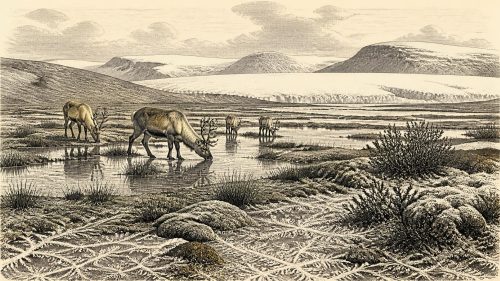
That uncertainty matters. It is no longer responsible to present all Ireland at c. 31,885 BCE as either a single unbroken ice cap or a wholly open tundra landscape. Ice centres, upland glaciers, coastal margins and ice-free ground changed over time, and the evidence does not yield a precise island-wide map for this calendar equivalent. Southern and western areas may at times have contained exposed terrain, while other districts were affected by advancing ice or lay close to glacial margins. The physical geography inherited by later Ireland—scoured rock, drumlins, lake basins and reworked sediments—was being formed or prepared by these processes.
Sea level was far lower than today because so much water was locked in continental ice sheets. Broad parts of the continental shelf were exposed in north-west Europe, but this does not demonstrate an easy, continuous land route from continental Europe to Ireland. The geography of the Irish Sea basin, changing coastlines, local ice and the absence of securely contemporary human camps all mean that a particular route into Ireland cannot be reconstructed. Any people who did arrive would have entered a landscape that was seasonal, exposed and environmentally hazardous.
Castlepook and the Faunal Record
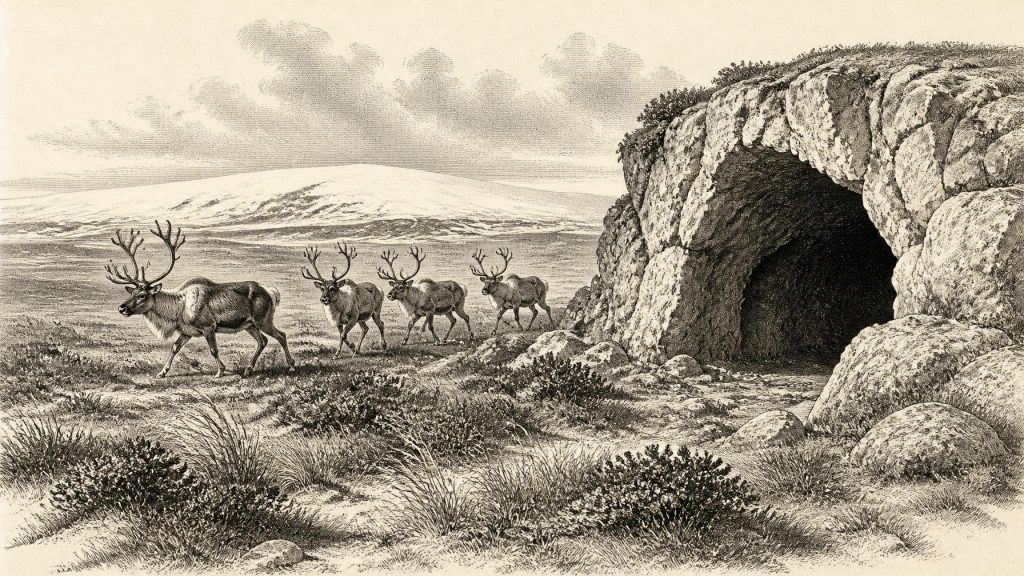
The most important Irish locality for this remote period is Castlepook Cave near Doneraile in north County Cork. Excavations there, especially in the early twentieth century and renewed investigations in the twenty-first, produced a remarkable collection of Late Pleistocene animal remains. The cave’s evocatively named chambers, including Elephant Hall and Hyaena Hall, have yielded bones of reindeer, mammoth, giant deer, brown bear, wolf, fox, Arctic fox, spotted hyaena, hare and lemmings. This is powerful evidence that cold-adapted and open-country animals reached southern Ireland during phases of the last glacial cycle.
It is not, however, a photograph of one living ecosystem. Much of the old material was recovered before modern excavation standards, and cave sediments can be disturbed by water, frost, collapse, scavengers and earlier digging. Bones of different dates may have been mixed, moved or introduced into the cave after death. Modern reassessment has shown why direct dating and careful attention to context are indispensable: some earlier radiocarbon results from Irish cave material have proved unreliable when retested with improved pretreatment methods.
Even so, the Castlepook evidence places substantial fauna in the broad time-depth relevant here. Earlier radiocarbon work dated a mammoth rib from Elephant Hall to 34,100 ± 840 radiocarbon years before present and a reindeer metacarpal to 35,200 ± 950 radiocarbon years before present; other bones from the cave produced different late-Pleistocene results. These are radiocarbon determinations, not calendar dates, and their calibrated equivalents are broader and older. They should demonstrate a long and complex history of animal use of the cave, not be compressed into a claim that mammoths, reindeer, hyaenas and people all stood there together in 31,885 BCE.
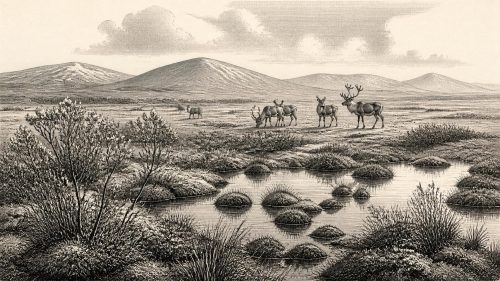
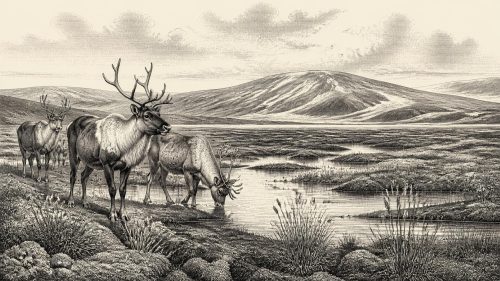
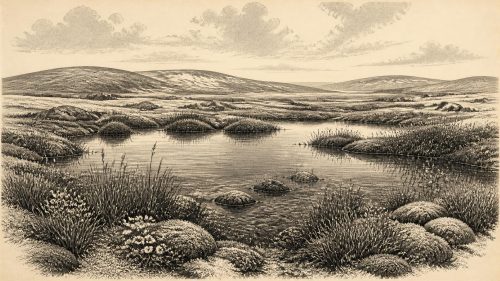
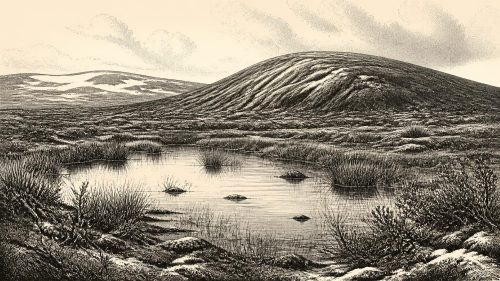
The animal list nevertheless permits cautious environmental interpretation. Reindeer, Arctic fox and lemmings point towards cold, open habitats, while mammoth and giant deer require productive vegetation on at least some ground. The likely landscape was a mosaic of herb-rich tundra, grassland, sedge-rich wet ground, exposed mineral soil and sheltered patches of shrubs, varying with season, altitude and proximity to ice. It was not the familiar green, wooded Ireland of later millennia. Nor was it necessarily a uniform white wilderness: short summers could support plant growth sufficient for large grazing animals, even while winters were long and severe.
The Reindeer Femur Question
A reindeer femur from Castlepook has given this era exceptional historical importance. Publicly reported work identifies marks on the bone as possible evidence of cutting or chopping with a stone tool, and a modern date obtained for the specimen has been presented as indicating activity around 33,000 years ago. If the modifications are confirmed as humanly made on fresh bone, the find would push evidence for human activity in Ireland dramatically earlier than the established post-glacial settlement record.
That conditional language is essential. The bone is not a house floor, hearth or undisturbed kill-site. No securely associated stone-tool assemblage, human burial, built shelter or repeated occupation surface has yet been demonstrated for this time at Castlepook. Carnivores also modified the cave assemblage: spotted hyaenas could drag in carcass parts, break bone and leave tooth damage; natural abrasion and old excavation histories complicate microscopic diagnosis. A mark may be suggestive, but it must be assessed against those alternatives and against the bone’s depositional history.
The most defensible conclusion for c. 31,885 BCE is consequently modest but significant. Ireland may have been visited by very small numbers of Upper Palaeolithic hunter-gatherers during a favourable interval or season, perhaps following animal movements or exploiting a carcass. It is not yet possible to demonstrate a permanent population, a named culture or a continuous ancestry connecting such visitors to later inhabitants. The evidence supports the possibility of brief human presence, not a settled Ice Age Ireland.
Life Without a Political Record
There can be no meaningful account of Irish government, diplomacy or warfare for this date. No inscriptions, settlements, weapons caches, boundaries or graves establish political institutions or conflict. Equally, it would be misleading to fill the silence with projected tribes, chiefs or clans. The social scale most compatible with the evidence, if humans were present, is a mobile hunting party rather than a village community: people able to move through exposed country, read animal tracks and use portable equipment. This is an inference from environmental conditions and wider Upper Palaeolithic lifeways, not a fact directly recovered from an Irish camp.
Economy, in the later sense of farming, livestock ownership, markets and long-distance trade, did not exist in demonstrable form in Ireland. There is no evidence of crops, domestic animals, pottery, metalworking or exchange networks on the island at this date. A possible worked reindeer bone would instead concern subsistence: obtaining meat, marrow, fat, hide or sinew from a large animal. Whether the animal was hunted, scavenged or encountered already dead cannot be inferred from a single bone. Reindeer could have offered a mobile food resource; mammoth and giant deer, if exploited at all, would have provided exceptional quantities of material, but no Irish evidence proves organised hunting of either species.
Religion, art, language and learning are likewise beyond recovery here. European Upper Palaeolithic societies elsewhere made sophisticated tools, ornaments and images, but Ireland has yielded no securely contemporary art, ornament or symbolic object. It is reasonable to recognise that any human visitors were fully capable people with knowledge, communication and social traditions; it is not reasonable to assign them Irish rituals, myths or artistic practices. The absence of evidence is especially acute because advancing ice, erosion, sea-level change and later disturbance have destroyed or buried much of the landscape in which camps might once have stood.
What the Evidence Can Say
The most important development around this notional year was environmental, not political: Ireland stood near the threshold of greater glaciation, with habitable ground and ice margins shifting across a cold-stage landscape. The Castlepook archive shows that Ice Age mammals occupied or passed through southern Ireland over a lengthy interval. Its reindeer femur raises the serious possibility that humans also made a short-lived visit. But the cave’s mixed deposits make it a research problem rather than a final answer.
Future work—new excavation in intact deposits, direct ultrafiltered radiocarbon dating, sediment micromorphology, ancient DNA, stable-isotope analysis and detailed study of surface modifications—may sharpen the picture. For now, 31,885 BCE belongs not to the history of Irish states, but to the deeper prehistory of changing ice, mobile animals and a tantalising human trace at the western edge of Upper Palaeolithic Europe.
Primary Sources
- New insights on the fauna of Ireland’s Younger Dryas and Early Holocene
- Preliminary Assessment of the Archive of Faunal Remains from Excavated Irish Cave Sites
- The Irish Quaternary Fauna Project
- 2022:564 – Castlepook Cave, Castlepook South, Cork
- Occurrence of mammalia relicts at site Castlepook Cave
- Pleistocene Vertebrates in the British Isles
- Introduction to the Late Quaternary and Holocene of Northern Ireland
- Palaeoecology: Fermanagh and South Tyrone
- Growth and Retreat of the Last British–Irish Ice Sheet, 31,000 to 15,000 Years Ago: the BRITICE-CHRONO Reconstruction
- BRITICE-CHRONO Maps and GIS Data of the Last British-Irish Ice Sheet 31 to 15 ka
- Dimensions and Chronology of the Last Ice Sheet in Western Ireland
- Trimlines, Blockfields and the Vertical Extent of the Last Ice Sheet in Southern Ireland
- Maximum Extent and Dynamic Behaviour of the Last British–Irish Ice Sheet West of Ireland
- The Timing and Magnitude of the British–Irish Ice Sheet Between Marine Isotope Stages 5d and 2
- Pattern and Timing of Retreat of the Last British-Irish Ice Sheet
- Early Deglaciation of the British-Irish Ice Sheet on the Atlantic Shelf Northwest of Ireland
- Stratigraphic and Palaeo-Geomorphological Evidence for the Glacial-Deglacial History of the Last British-Irish Ice Sheet in the North-Western Irish Sea
- Timing, Pace and Controls on Ice Sheet Retreat: an Introduction to the BRITICE-CHRONO Transect Reconstructions of the British–Irish Ice Sheet
- The IntCal20 Northern Hemisphere Radiocarbon Age Calibration Curve (0–55 cal kBP)
- The IntCal20 Approach to Radiocarbon Calibration Curve Construction: a New Methodology Using Bayesian Splines and Errors-in-Variables
- Marine20—the Marine Radiocarbon Age Calibration Curve (0–55,000 cal BP)
- What Was on the Menu in Prehistoric Ireland?
- Heritage Artefacts of County Cork