Crag Cave’s Interstadial Drips31873 BCE
Around 31,873 BCE, Ireland lay within the unstable MIS 3 phase of the last Ice Age, not a precisely recoverable calendar year. Ice, sea levels, rivers and vegetation changed repeatedly as conditions alternated between milder interstadials and severe stadials. Fermanagh sediments indicate treeless, cold freshwater wetlands with mosses, sedges and northern insects, while southern caves preserve remains of reindeer, giant deer, bears, hyaenas, foxes and hares. Crag Cave speleothems record episodic milder conditions permitting calcite growth. Human presence remains unproven: a possibly cut-marked Castlepook reindeer bone suggests a contested brief visit, whereas later secure evidence does not establish permanent settlement.
Dateline
Modern calendar-year precision is not available for Ireland in 31,873 BCE. The label is a present-day convention, not a date that any contemporary person could have known, and no archaeological deposit can be assigned responsibly to that single year. In calibrated terms it corresponds roughly to 33,823 years before 1950, within the Late Pleistocene and Marine Isotope Stage 3 (MIS 3), a long, unstable cold phase of the last Ice Age. The appropriate history is therefore one of ranges, landscapes and fragmentary evidence rather than an annual chronicle.
A useful comparison comes from Derryvree, near Maguiresbridge in County Fermanagh. Organic-rich freshwater sediments there produced a radiocarbon result of about 30,500 radiocarbon years before present; calibration gives a broad calendar range extending approximately from 36,900 to 31,700 years before present. The nominal year considered here falls within that wide span, but it cannot be equated with a particular layer, season or event at Derryvree. What the site can show is that, during at least one interval in this part of the Ice Age, freshwater mosses, sedges and cold-adapted insects occupied an unglaciated landscape later buried beneath ice deposits.
A Date Within a Moving Ice Age
At this distance in time, Ireland was not a fixed physical stage. Ice sheets expanded and contracted, sea level changed, river systems altered course, and vegetation responded rapidly to shifts in temperature and moisture. MIS 3 was colder than the present but was not one uninterrupted freeze. Greenland ice-core records, cave mineral deposits and sediments across north-west Europe reveal abrupt alternations between comparatively milder interstadials and harsher stadials. Irish evidence preserves parts of that changing pattern, although rarely with enough resolution to reconstruct a particular decade, let alone a year.
The year 31,873 BCE preceded the Last Glacial Maximum, when ice later covered most or all of Ireland. Reconstructions of the British–Irish Ice Sheet suggest that, by about 31,000 years ago, ice was already growing rapidly across the wider region; ice masses existed over northern and upland parts of Ireland and expanded greatly in the following millennia. Yet those reconstructions are models built from landforms, sediment sequences and dates with their own uncertainties. They should not be turned into a deceptively exact map for 31,873 BCE. At roughly 33,800 calibrated years before present, some Irish districts may have been open, cold country while others lay under, beside or downwind of ice.
Sea level was substantially lower than today because immense quantities of water were locked in global ice sheets. That altered the outlines of coasts and enlarged parts of the continental shelf. It did not automatically make Ireland a simple overland extension of Britain or continental Europe: local sea level, glacial loading and the depth of the Irish Sea all mattered. The responsible conclusion is more modest. Connections between Ireland, Britain and the exposed shelves were geographically different and may sometimes have been easier for animals and people to traverse than in later millennia, but the exact routes available at this point remain uncertain.
Fermanagh’s Cold Wetlands
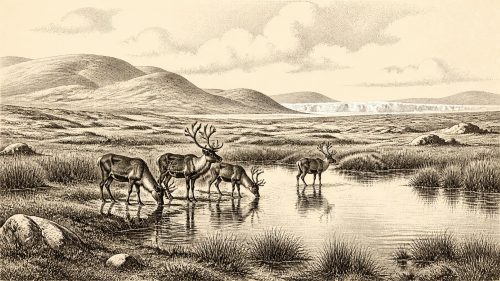
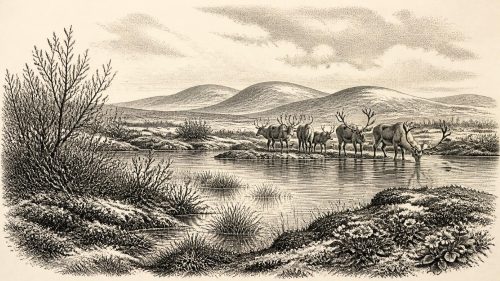
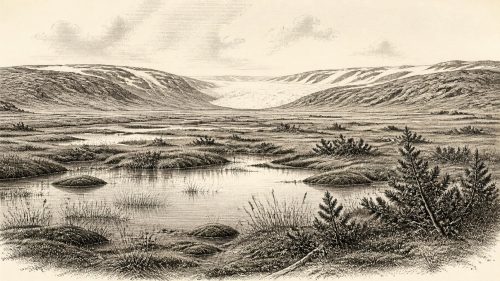
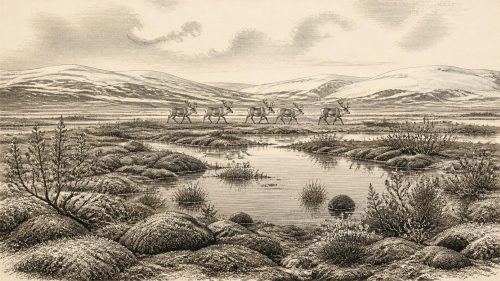
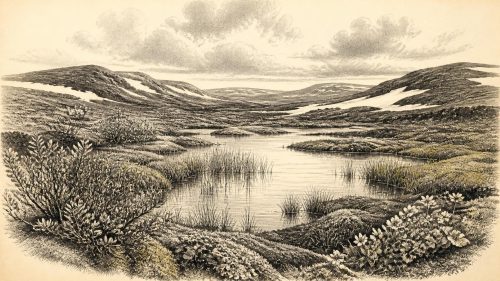
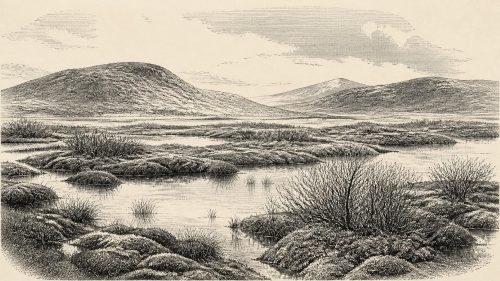
Derryvree is especially important because it preserves a sequence between two tills: evidence of a freshwater phase sandwiched between episodes of glaciation. Its plant remains indicate mosses and sedges rather than woodland; its insect fauna has a cold, northern character. The landscape inferred from these traces was a treeless wetland or muskeg, with shallow water, organic mud and patches of low vegetation. This is evidence for local environmental conditions, not a complete portrait of Ireland. It does not prove that every valley looked alike, nor does it establish which animals were present on the same day as any particular plant fragment entered the sediment.
Nearby sites reinforce the point that environmental archives must be handled individually. Hollymount has pollen evidence for open country and a minimum radiocarbon age exceeding 41,500 years. Greenagho, near Belcoo, produced an age of 32,460 radiocarbon years before present, but geologists have warned that this is only a minimum date and should be treated cautiously. At Aghnadarragh in County Antrim, a much longer succession records earlier glacial, deglacial and interstadial conditions. Together these localities show that northern Ireland retained pockets of valuable evidence for changing cold-stage environments; they do not provide a single, island-wide timetable.
For people living in a modern temperate Ireland, the most striking feature would have been the absence of familiar forest. There is no basis for imagining oak woods, enclosed fields, peat-cutting or a settled rural landscape. Instead, the available evidence supports open, exposed terrain shaped by frost, wind, water and ice. Ground conditions may have ranged from saturated basin floors to stony slopes affected by periglacial processes. Summer growth could have been brief but significant, supplying forage for herbivores; winter imposed a very different set of constraints.
Caves and the Animal Record
The clearest evidence for Irish animal life of this broad period comes from caves, particularly in limestone country in the south. Castlepook Cave near Doneraile in County Cork has yielded remains associated with an Ice Age fauna including reindeer, giant deer, brown bear, spotted hyaena, hare and fox, while other Irish cave assemblages add further fragments to the picture. Such caves were not necessarily places where all these animals lived together. Bone accumulations may result from carnivore activity, animals dying in or near cave entrances, water movement, and nineteenth- or early twentieth-century excavation methods that did not always preserve modern standards of stratigraphic record.
Recent re-dating has made the Castlepook material both more important and more difficult to interpret. Improved pretreatment and radiocarbon methods showed that several formerly accepted cave dates were too young, moving some southern Irish fauna much further back into MIS 3. The broader conclusion is sound: a range of mammals reached Ireland between at least about 45,000 and 20,000 years ago. But individual bones, especially from old excavations, must not be casually combined into a single living ecosystem or treated as proof of continuous animal occupation.
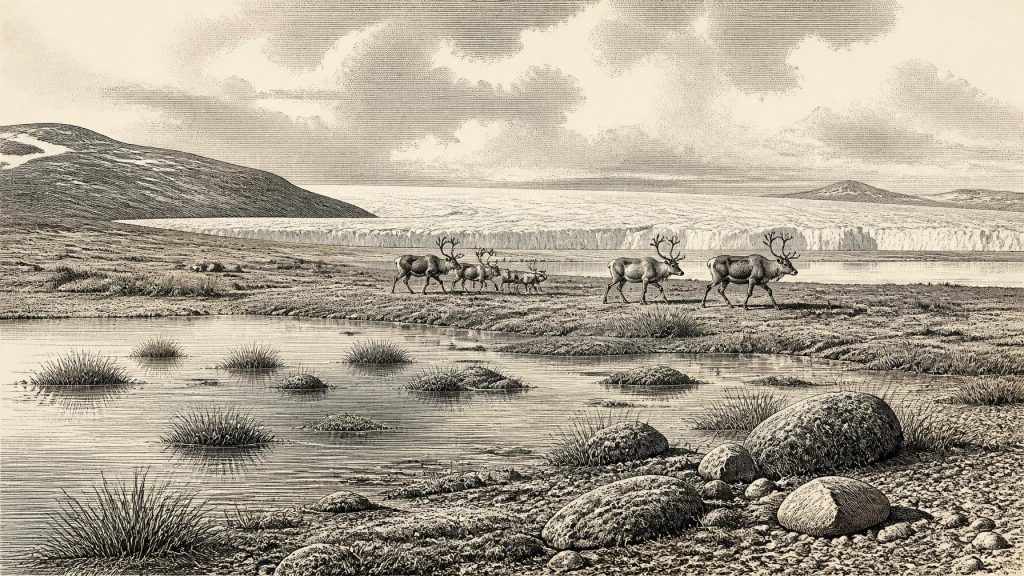
Reindeer are particularly evocative, but they should not become shorthand for a uniform “Arctic Ireland”. Their presence indicates that cold-adapted grazing animals could use parts of the island during suitable phases. Giant deer, often misleadingly called the Irish elk, were neither exclusive to Ireland nor relatives of modern elk. Spotted hyaena remains point towards a predator and scavenger capable of using caves, while bears, foxes and smaller mammals occupied different ecological niches. The balance among these species probably shifted repeatedly as vegetation, snow cover, ice margins and access routes changed.
The Human Question
No securely dated dwelling, hearth, stone-tool scatter, burial or repeated settlement is known in Ireland for 31,873 BCE. Consequently there is no basis for describing an Irish population, naming a community, or assigning a language, identity, religion or political system. There were no recorded rulers, treaties, raids, diplomatic exchanges or institutions. Nor can the absence of such evidence be converted into absolute proof that no person ever entered Ireland: later ice action, acidic soils, coastal change and the rarity of systematic Palaeolithic investigation have all reduced the chance of survival and discovery.
The principal reason this question remains open is a reindeer femur from Castlepook. Ruth Carden has interpreted a mark on it as damage made by a sharp stone tool while the bone was fresh, suggesting possible butchery by people around this general part of MIS 3. This is a potentially momentous observation, but it is not equivalent to an excavated camp. The bone derives from an old cave collection rather than a newly excavated, tightly controlled archaeological context; the animal’s radiocarbon age and the identification of a surface mark as a human cut are separate evidential questions. It should therefore be described as a contested indication of a brief human visit, not as proof of permanent occupation.
The contrast with later evidence is instructive. At Alice and Gwendoline Cave in County Clare, a brown-bear kneecap bearing distinctive cut marks has been dated to about 10,800–10,500 BCE, and is the earliest published evidence generally presented by the Heritage Council for human activity in Ireland. That much later find does not validate an earlier Castlepook visit; rather, it demonstrates the degree of analytical care required when interpreting rare modified bones.
Life, Culture and Connection
If people did reach Ireland during the broad interval embracing 31,873 BCE, the likeliest interpretation is not a village or colony but small, mobile parties using a changing frontier. They might have followed herds, exploited carcasses, sheltered briefly in caves or travelled seasonally between Ireland and neighbouring lands. That is an inference from ecology and Upper Palaeolithic practice elsewhere in north-west Europe, not direct Irish evidence. We cannot responsibly reconstruct their clothing, family arrangements, beliefs, art, spoken language or rituals. No Irish object from this date demonstrates ornament, image-making, ceremonial practice or formal teaching.
The same restraint applies to economy and trade. There was no agriculture, livestock keeping, metalworking, market town or documented exchange network. Wild animals and plants would have been the available resources; stone, bone, hide, sinew and wood could have been useful materials if people were present. Yet no securely associated toolkit establishes which resources were used in Ireland at this time. Any movement of people would itself have depended on regional knowledge—of ice-free corridors, weather, animal movements and crossings—but knowledge is not archaeologically visible unless tools, camps or modified remains survive.
The most important development around this nominal year was thus environmental, not political: Ireland stood within a volatile pre-maximum Ice Age world. Freshwater sediments in Fermanagh, calcite growth episodes in Crag Cave in County Kerry, and animal bones in southern caves show that the island was not simply an unchanging white void before the great ice advance. Crag Cave’s speleothems grew episodically during milder last-glacial intervals, because liquid water and unfrozen ground conditions were needed for calcite deposition. Their chronology supports a picture of climatic pulses rather than permanence.
For 31,873 BCE, then, Ireland’s recoverable story is deliberately incomplete. It is a story of sedges rooted in cold mud, cave passages preserving bones, low seas remaking geography and ice gathering strength across the region. Beyond that lies possibility rather than record. The discipline of prehistoric history is not to fill the silence with imagined chiefs or settlements, but to let the surviving evidence define both what can be said and what must remain unknown.
Primary Sources
- A Reconsideration of the Radiocarbon Dating of the Marine Isotope Stage 3 Fauna from Southern Ireland
- Growth and Retreat of the Last British–Irish Ice Sheet, 31,000 to 15,000 Years Ago: The BRITICE-CHRONO Reconstruction
- New Insights on the Fauna of Ireland's Younger Dryas and Early Holocene from Alice & Gwendoline Cave
- The Irish Quaternary Fauna Project
- Early Midlandian–Middle Midlandian, Pleistocene, Northern Ireland
- Episodic Speleothem Deposition Tracks the Terrestrial Impact of Millennial-Scale Last Glacial Climate Variability in SW Ireland
- Spatio-Temporal Dynamics of Speleothem Growth and Glaciation in the British Isles
- The Deglaciation of the Western Sector of the Irish Ice Sheet from the Inner Continental Shelf to Its Terrestrial Margin
- Trimlines, Blockfields and the Vertical Extent of the Last Ice Sheet in Southern Ireland
- The Last Eurasian Ice Sheets – A Chronological Database and Time-Slice Reconstruction, DATED-1
- The IntCal20 Northern Hemisphere Radiocarbon Age Calibration Curve (0–55 cal kBP)
- OxCal Radiocarbon Calibration and Analysis
- The Exploration of Castlepook Cave, Co. Cork. With 3 Plates
- 2022:564 – Castlepook Cave, Castlepook South, Cork
- Our Ancient Landscapes: Hunter-Gatherers in Ireland
- Aghnadarragh
- Figure 6: The Subdivision of the Quaternary Period in Ireland
- Freshwater Organic Deposits and Stratified Sediments Between Early and Late Midlandian (Devensian) Till Sheets, at Aghnadarragh, County Antrim, Northern Ireland
- The Geological Heritage of County Leitrim
- Red Deer in Ireland: A Palaeoecological and Genetic Study