Castlepook Mammoth31828 BCE
Thirty-one thousand, eight hundred and twenty-eight BCE is a modern label approximating early MIS 3, not a precisely datable Irish event. Ireland’s unstable Late Pleistocene environment included intermittently ice-free, cold open habitats. Derryvree sediments in Fermanagh record wet tundra-like vegetation, while Castlepook Cave in Cork preserves diverse fauna, including mammoth, reindeer, giant deer and predators, although cave deposits are chronologically mixed. A cut-marked reindeer femur may indicate Palaeolithic butchery, but remains unconfirmed evidence of human visitation rather than settlement. No contemporary Irish camps, artefacts, institutions or cultural practices are securely known. These records reveal ecological complexity while leaving visitation unresolved.
Dateline
“31,828 BCE” is a modern calendar label, not a year that can be isolated in Ireland’s archaeological record. Converted simply into the convention used by archaeologists, it lies about 33,778 calendar years before present, with “present” fixed at 1950. That conversion is only a chronological aid: it does not mean that a dated Irish deposit can be assigned to this exact year. At this depth in time, radiocarbon measurements have wide uncertainties and require calibration against changing atmospheric carbon levels; environmental sequences and cave finds commonly represent intervals of centuries or millennia. The responsible subject, therefore, is Ireland in the broad vicinity of the early thirty-fourth millennium years ago, during the Late Pleistocene and Marine Isotope Stage 3 (MIS 3), rather than an imagined event in one numbered year.
A Cold Landscape, Not a Frozen Blank
Ireland was in the last Ice Age, but it should not be pictured automatically as a uniform white wilderness or as an island continuously buried beneath ice. MIS 3 was climatically unstable. Ice margins, sea level, vegetation and animal ranges altered repeatedly over long timescales. The later Last Glacial Maximum, when ice became far more extensive over Ireland, lay in the future. Modern reconstructions of the British–Irish Ice Sheet begin their detailed sequence at 31,000 years ago and demonstrate a dynamic history of growth and retreat rather than a single, unchanging advance. For the earlier point represented by 31,828 BCE, local conditions remain less securely resolved.
What can be said is that some parts of Ireland supported cold-adapted life during the Middle Midlandian, the Irish name often applied to this portion of the last glacial period. The physical landscape was already deeply shaped by older glacial episodes, while later ice would erode, bury and rearrange much of the evidence. This is a central reason why the record is so sparse. Absence of excavated campsites is not proof that no person ever arrived; equally, the survival of a few bones cannot demonstrate that people occupied the island continuously. The archaeological archive is both small and severely filtered by ice, water, soil processes, carnivores and nineteenth- and early twentieth-century excavation.
Derryvree’s Open Ground
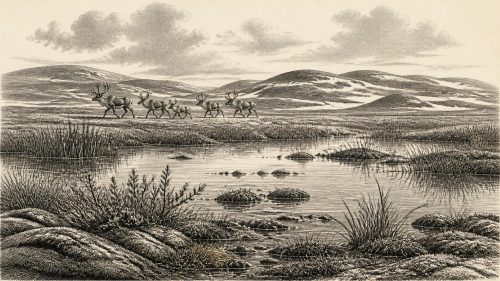
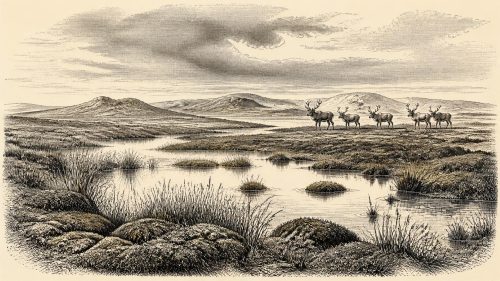
The most informative environmental evidence comes not from a settlement but from buried sediments. At Derryvree near Maguiresbridge in County Fermanagh, organic freshwater deposits were found between two tills within a drumlin. Their position shows that, at some point between episodes of ice deposition, local water, plants and animals occupied the site. The sediments include pollen, mosses, plant remains and beetles. Together they point to a cold, open environment with sedges, grasses, herbs, dwarf shrubs and juniper rather than a closed forest. Pools and wet ground formed part of what researchers describe as a muskeg or tundra-like landscape.
The Derryvree evidence is immensely valuable, but it must not be made more precise than it is. A historic radiocarbon determination of roughly 30,500 radiocarbon years before present was obtained from the sequence, with a substantial error range; calibration places material of that broad age in the later part of MIS 3, but does not pin its vegetation to 31,828 BCE. Nor does one Fermanagh wetland describe every coast, valley or upland across Ireland. It does, however, overturn the idea that all of Ireland was lifeless beneath ice at all times before the Last Glacial Maximum. In favourable intervals, open ground, freshwater habitats and a limited but resilient flora existed.
Such a setting would have been demanding. Winters were severe, growing seasons short and tree cover restricted or absent in many places. Wind exposure would have been important across open terrain. Yet sparse vegetation was not no vegetation. Sedges, grasses and herbs could sustain herbivores; mosses and wetland plants recorded in the sediments show ecological niches at ground level that a sweeping image of “ice desert” misses. The evidence also reminds us that regional change mattered. Northern inland deposits and southern limestone caves preserve different kinds of information, from different places and perhaps different moments within a long climatic interval.
Castlepook’s Animal Archive
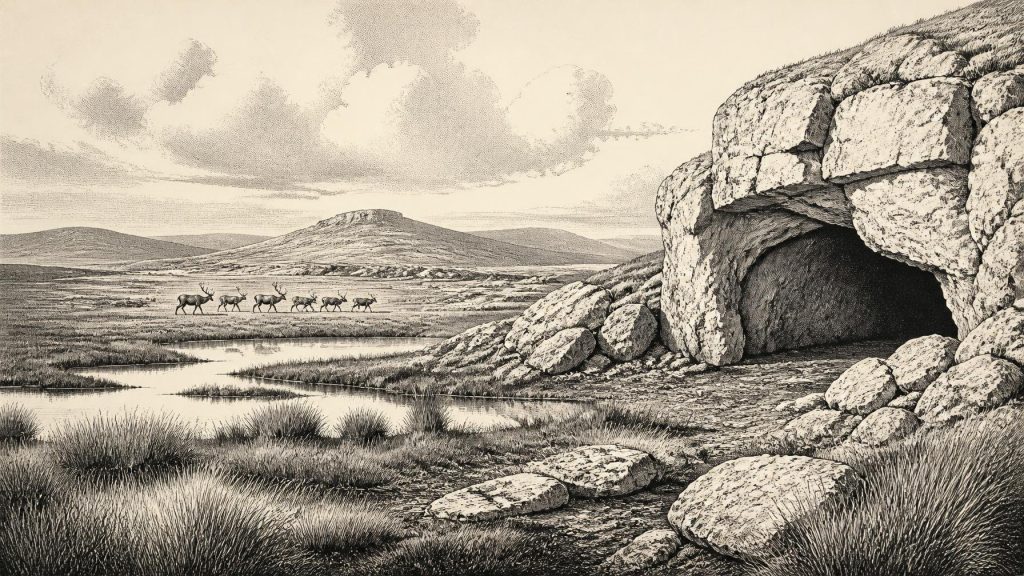
The principal southern archive is Castlepook Cave, near Doneraile in north County Cork. Its passages acquired evocative names during early exploration, including Elephant Hall and Hyaena Hall. Excavators recovered a striking Pleistocene fauna: mammoth, reindeer, giant deer, brown bear, wolf, fox, mountain hare, lemmings and spotted hyaena. A mammoth rib from Elephant Hall was among bones dated by the Irish Quaternary Fauna Project; other Castlepook specimens produced radiocarbon ages extending across much of MIS 3. The collection establishes that Ireland was connected ecologically, at least intermittently, to the wider north-west European cold-stage world.
This assemblage should be read with care. Castlepook was not a neatly sealed time capsule. Carnivores used caves; bones could be dragged in, gnawed, broken, redeposited or exposed to water. Stalagmite floors, sands and later material complicated the deposits, and much of the original excavation occurred before modern standards of stratigraphic recording. The presence of a mammoth bone in Elephant Hall proves neither that a mammoth died there nor that all the associated species lived together in one season. It does show that these animals reached Ireland during the broader pre-maximum glacial period and that caves can preserve fragments of their history. The original 1918 report and later reassessments remain essential precisely because they document both the richness and the limitations of the old collection.
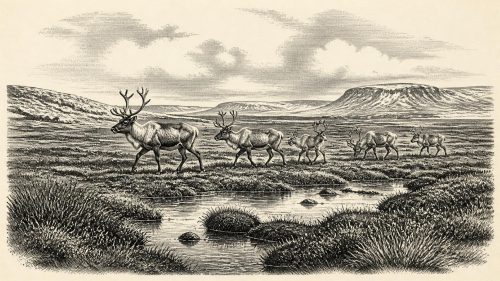
Reindeer are especially relevant to the world around this notional year. They fit an open, cold landscape and may have moved seasonally across extensive ranges. Mammoths and giant deer suggest more varied grazing opportunities than a barren icefield would allow; hyaenas, wolves and foxes indicate predators and scavengers operating within that food web. Still, it is unsafe to turn the species list into a complete local census. Some finds may be separated by thousands of years. The safest conclusion is modest but important: during portions of MIS 3, Ireland could support a cold-stage mammal community of considerable diversity.
The Reindeer Femur Question
One Castlepook specimen raises the possibility that humans were part of this landscape. A reindeer femur in the National Museum of Ireland’s natural-history collection bears a deep mark interpreted by the zooarchaeologist Ruth Carden as having been made by a sharp stone tool during butchery. Cork County heritage publications consequently present it as potential evidence that Palaeolithic hunters handled a reindeer in the Doneraile area around 31,000 BCE. If that interpretation is upheld, it would move evidence for human activity in Ireland far earlier than the long-established Mesolithic record.
Potential is the crucial word. The bone came from an old cave collection, not from a modern excavation of an undisturbed camp floor. Its date is the age of the animal’s death, not automatically the date of the mark, and it cannot identify the location of the kill or the length of any visit. No securely associated hearth, stone-tool assemblage, dwelling, burial or occupation layer of comparable antiquity has yet been recovered in Ireland. Caves were also hyaena dens and natural traps. A cut-mark identification is a specialist interpretation that must be tested against trampling, carnivore damage, breakage and excavation history. The femur is therefore a serious and exciting clue to human butchery, not proof of a settled population.
If people did reach Ireland near this period, the most defensible picture is of a small, mobile party rather than a named people or a permanent community. They would have belonged to the wider Upper Palaeolithic human world of north-west Europe, but no Irish artefacts allow their particular technology, language, ancestry, clothing or social identity to be identified. Lower sea levels altered coastlines substantially, and submerged landscapes may once have offered different routes and resources. Yet the precise geography of crossings, and whether any journey used exposed ground, boats or a mixture of both, cannot be recovered from the present evidence.
No Politics, No Kingdoms
There is no evidence for political institutions, territories, chiefs, diplomacy, formal warfare or trade networks in Ireland at this date. There are no names, written records, monuments, farms or villages. To impose later Irish ideas of kingship, clan, parish or province on this world would be anachronistic. Nor can the Castlepook femur sustain claims about an organised hunting economy. At most, if the mark is human-made, it indicates the practical processing of animal tissue or bone by visitors equipped with a sharp stone edge.
Everyday life is similarly beyond direct recovery. A short hunting visit might have involved watching herds, approaching prey, sharing meat, maintaining stone tools and taking shelter from weather; these are plausible behaviours for Palaeolithic foragers elsewhere, not documented events in Ireland. We cannot tell whether people camped in the cave, whether they encountered hyaenas, or whether the reindeer was killed locally. A dramatic encounter between hunters and mammoths would make an attractive illustration, but archaeology does not justify it. The animal remains provide evidence for an ecosystem, not a story with a cast of identifiable individuals.
Belief and Memory Beyond Reach
Nothing from Ireland around 31,828 BCE can responsibly be identified as religious practice, art, burial ritual, music, teaching or formal learning. Across Europe, Upper Palaeolithic communities made images, ornaments and complex tools, but no equivalent Irish assemblage belongs securely to this time. It is reasonable to assume that any humans who reached the island possessed knowledge, social relationships and traditions; it is not reasonable to specify their beliefs or to claim that they made Irish cave art. Silence in the record is especially significant here: cultural interpretation requires cultural objects or contexts, not simply animal bones.
The most important historical development at this point is thus not a battle, ruler or foundation, but the emergence of a more complicated prehistoric Ireland. Environmental deposits at Derryvree show that cold-phase Ireland could contain wet, open habitats. Castlepook reveals that a varied Ice Age fauna entered the island. The marked reindeer femur raises, without settling, the prospect of a human visit. Together, these traces replace an older, simpler image of an entirely empty land before the post-glacial settlers. They do not yet reveal an Irish society. Their value lies in preserving the question: in a harsh, changing landscape before the great ice advance, how often did people reach Ireland, and what evidence of them has since been erased?
Source References
Hover over a number to see the source. Select it to open the source.

- [1] A reconsideration of the radiocarbon dating of the Marine Isotope Stage 3 fauna from southern Ireland
- [2] The Irish quaternary fauna project
- [3] The Irish Quaternary Fauna Project
- [4] Growth and retreat of the last British–Irish Ice Sheet, 31,000 to 15,000 years ago: the BRITICE-CHRONO reconstruction
- [5] The timing and magnitude of the British–Irish Ice Sheet between Marine Isotope Stages 5d and 2
- [6] The IntCal20 Northern Hemisphere Radiocarbon Age Calibration Curve (0–55 cal kBP)
- [7] Discussion: Reporting of 14C Data
- [8] The Exploration of Castlepook Cave, County Cork, Being the Third Report from the Committee Appointed to Explore Irish Caves
- [9] The Exploration of Castlepook Cave, Co. Cork. With 3 plates
- [10] Archaeological Heritage of County Cork
- [11] Heritage Artefacts of County Cork
- [12] Castlepook Cave, Co. Cork, 2022
- [13] Ireland’s Palaeolithic Archaeology – Fleeting Footprints in a Frozen Land
- [14] Landscapes and environments of the last glacial-interglacial transition: a time of amazingly rapid change in Ireland
- [15] A Middle Midlandian Freshwater Series at Derryvree, Maguiresbridge, County Fermanagh, Northern Ireland
- [16] Palaeoecology
- [17] Figure 6.— The subdivision of the Quaternary Period in Ireland
- [18] Pleistocene vertebrates in the British Isles
- [19] New insights on the fauna of Ireland's Younger Dryas and Early Holocene from Alice & Gwendoline Cave
- [20] Quaternary
- [21] Geology of Ireland
- [22] Calculations and Reporting of Results
Primary Sources
- A reconsideration of the radiocarbon dating of the Marine Isotope Stage 3 fauna from southern Ireland
- The Irish quaternary fauna project
- The Irish Quaternary Fauna Project
- Growth and retreat of the last British–Irish Ice Sheet, 31,000 to 15,000 years ago: the BRITICE-CHRONO reconstruction
- The timing and magnitude of the British–Irish Ice Sheet between Marine Isotope Stages 5d and 2
- The IntCal20 Northern Hemisphere Radiocarbon Age Calibration Curve (0–55 cal kBP)
- Discussion: Reporting of 14C Data
- The Exploration of Castlepook Cave, County Cork, Being the Third Report from the Committee Appointed to Explore Irish Caves
- The Exploration of Castlepook Cave, Co. Cork. With 3 plates
- Archaeological Heritage of County Cork
- Heritage Artefacts of County Cork
- Castlepook Cave, Co. Cork, 2022
- Ireland’s Palaeolithic Archaeology – Fleeting Footprints in a Frozen Land
- Landscapes and environments of the last glacial-interglacial transition: a time of amazingly rapid change in Ireland
- A Middle Midlandian Freshwater Series at Derryvree, Maguiresbridge, County Fermanagh, Northern Ireland
- Palaeoecology
- Figure 6.— The subdivision of the Quaternary Period in Ireland
- Pleistocene vertebrates in the British Isles
- New insights on the fauna of Ireland's Younger Dryas and Early Holocene from Alice & Gwendoline Cave
- Quaternary
- Geology of Ireland
- Calculations and Reporting of Results