Maguirebridge’s Inter-Till Waters31737 BCE
31,737 BCE is a modern label for a Late Pleistocene, MIS 3 interval, not a documented Irish year. Inter-till freshwater sediments at Derryvree, County Fermanagh, reveal an ice-free phase with cold, periglacial wetlands, plants and insects between glacial advances. Southern caves, especially Castlepook in County Cork, preserve evidence of mammoth, reindeer, giant deer, predators and other cold-stage fauna, though deposits span multiple periods. A marked reindeer bone may indicate early human butchery, yet lacks secure context or associated artefacts. Lower sea levels altered routes, while advancing ice created a volatile ecological frontier. Permanent occupation, polities and Irish identities remain unproven.
Dateline
A date without a diary
31,737 BCE is a modern calendar label, not a year from which Ireland preserves a record of events. There were no written calendars, named rulers, states or documentary traditions on the island, and archaeology cannot identify something that happened in that particular twelve-month interval. In the archaeological convention that counts backwards from AD 1950, the date is roughly 33,700 years before present. It belongs to the Late Pleistocene, within Marine Isotope Stage 3 (MIS 3), a long and climatically unstable phase of the last Ice Age.
The responsible picture is therefore a broad one. Evidence from caves, buried wetland sediments, pollen, insects, animal bones, geological landforms and isotope dating can illuminate Ireland around this part of the Ice Age. It cannot supply a political chronology or a biography of “the Irish” in 31,737 BCE. The most important conclusion is also the most restrained: parts of Ireland supported animal life and freshwater environments during portions of this era, but a permanent human population at this date has not been demonstrated.
Freshwater Between the Tills
The most revealing Irish environmental archive for this general period was exposed at Derryvree near Maguiresbridge, County Fermanagh. Roadworks cut through a drumlin and revealed organic freshwater sediments and fine sands sealed between two deposits of glacial till. The sequence matters more than any single specimen. Ice had laid down the lower till; an interval followed in which freshwater sediment accumulated; then a later ice advance covered the deposits beneath another till. This is powerful evidence that glacial conditions changed markedly through time in northern Ireland.
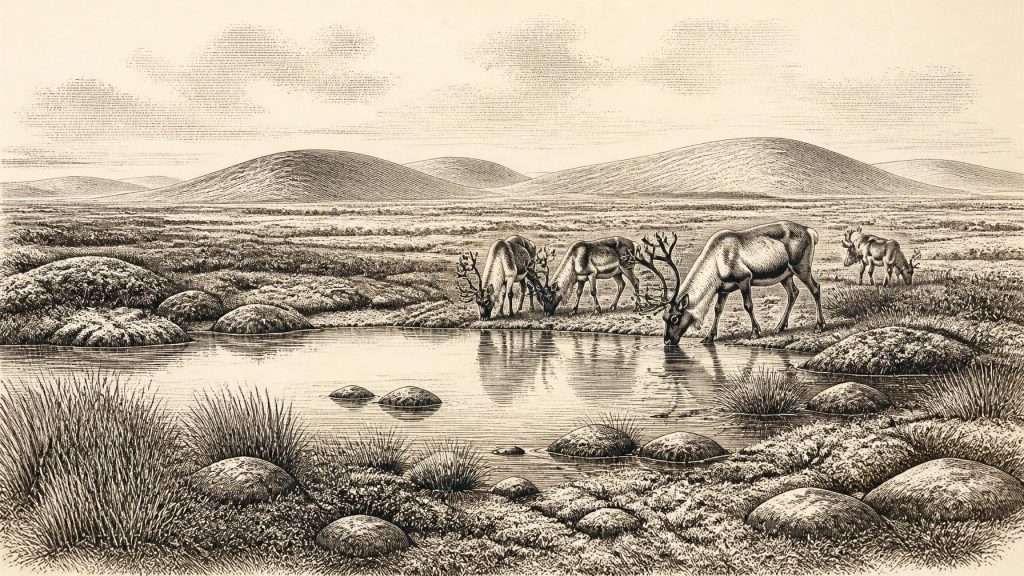
Plant remains, pollen and insect evidence from the Derryvree succession point to a cold, open, periglacial landscape rather than the familiar wooded island of later prehistory. Mosses, sedges and other wet-ground plants could grow beside shallow water. Such evidence does not turn Derryvree into a pleasant lakeside setting: summers may have been brief, winters severe, and frozen ground a major influence on drainage and vegetation. Yet the deposits show that this was not simply a featureless waste of permanent ice. Water, mud, plants and invertebrates formed a small but functioning ecosystem during an ice-free interval.
The chronology has unavoidable margins of error. Older radiocarbon determinations, stratigraphic correlations and changing calibration methods produce ranges rather than a single date for the Derryvree inter-till deposits. They are generally assigned to the Middle Midlandian, broadly MIS 3. That makes them highly relevant to the world denoted by 31,737 BCE, but not proof that a particular pool, plant or animal existed there in that exact calendar year. The distinction is essential: sedimentary sequences register phases of landscape history, not annual chronicles.
A Cold-Stage Animal World
Southern Irish caves provide another, richer but complicated line of evidence. Castlepook Cave, also called Mammoth Cave, near Doneraile in north County Cork, yielded a remarkable assemblage during excavations conducted in the early twentieth century. Museum collections and later reassessments identify animals associated with cold-stage Europe, including woolly mammoth, reindeer, giant deer, brown bear, fox, wolf, hare and spotted hyaena. The National Museum of Ireland’s Castlepook hyaena skull is a tangible reminder that Ireland’s Pleistocene fauna was once far different from its modern wildlife.
These animals did not necessarily belong to one moment or one ecological community. Cave deposits can be mixed by water, digging animals, collapse, carnivore activity and early excavation methods. Re-dating has shown that material in the southern Irish cave record can derive from more than one period. Nevertheless, the broader conclusion is firm: during parts of MIS 3, large mammals reached and lived in Ireland. Reindeer and mammoth imply open feeding grounds; predators and scavengers, including hyaena, indicate a food web capable of sustaining large carnivores. The bones are evidence for animals moving through the landscape, and sometimes using caves, not evidence for an Ice Age zoo confined underground.
Some dated Irish red-deer remains from County Waterford caves have calibrated ranges of approximately 32,930–31,280 and 30,297–29,594 cal BP. Those ranges show that large deer occupied southern Ireland close to the broad time under discussion. They also illustrate why calendar precision is misleading: even excellent scientific dating normally locates a specimen within a range of centuries or more at this depth of time. A fauna may be dated; the day, season and circumstances of its arrival ordinarily cannot.
Castlepook’s Human Question
Castlepook is important for one further, unresolved reason. A reindeer femur from the cave has been reported as carrying a deep linear mark interpreted by zoologist Ruth Carden as damage made by a sharp stone implement during carcass processing. The bone has been publicised as approximately 33,000 years old. If the mark is confirmed as an anthropogenic cut or chopping mark made when the bone was fresh, it would be potentially significant evidence that Upper Palaeolithic people reached Ireland many millennia earlier than the island’s previously accepted late-glacial human record.
Potentially is the vital word. The specimen comes from an old collection rather than a modern excavation of a sealed occupation floor. Its date concerns the animal, not independently the mark, the location where it died, or the length of any human visit. No securely associated stone-tool assemblage, hearth, dwelling surface, burial, art or repeated occupation sequence of comparable antiquity has yet established a 32nd-millennium BCE community at Castlepook. Natural breakage, carnivore damage, trampling and recovery damage must be carefully excluded whenever marks on bone are assessed.
Recent research excavations at Castlepook have located surviving deposits and recovered faunal material, but reported no cultural artefacts from the 2022 work. This is not a negative verdict on the femur; it is a reminder that archaeology progresses through testing, context and replication. At present, the reindeer bone can responsibly be described as a provocative possible trace of human activity in the wider period, not as proof of a settled population, a named culture or an unbroken ancestry leading to later inhabitants of Ireland.
Land, Sea and Moving Ice
Ireland’s geography was also unlike that of today. Global sea level was far lower during the Ice Age, exposing extensive shelf landscapes around the island. But exposed land did not automatically provide a simple, dry land bridge or an easy route for people and animals. Coastlines, river systems, marshes, marine inlets and the margins of expanding ice varied through time. The British–Irish Ice Sheet was growing and changing, with local ice caps and glaciers already present in parts of Ireland by about 31,000 years ago; its later maximum, around 27,000–23,000 cal BP, covered the island and surrounding shelf extensively.
For a time around 31,737 BCE, the island should thus be imagined as a geographically connected but environmentally demanding north-western edge of Europe. The open habitats indicated by the fauna may have allowed grazing mammals to range widely when routes were available. This creates a plausible context for short human incursions from western Britain or continental Europe, where Upper Palaeolithic hunter-gatherers are well evidenced. It does not demonstrate that such groups regularly crossed into Ireland. Possibility supplied by geography is not the same as archaeological proof of travel.
No Polities, but an Ecological Frontier
Political affairs, diplomacy, organised warfare, formal religion, trade systems and learning cannot be recovered for Ireland at this date. There is no evidence for chiefs, tribes, territories, ritual monuments, exchange networks, farms, villages or graves. Nor should later Irish identities, languages or traditions be projected backwards across more than thirty millennia. If people did visit, comparisons with Upper Palaeolithic communities elsewhere suggest small mobile groups able to use stone tools, fire, clothing and animal resources. But that is an inference from wider European evidence, not a description of a known Irish camp.
The material record does support a narrower account of everyday possibility. Reindeer, deer and other large mammals could offer meat, fat, marrow, hide, sinew and bone; carnivores made carcasses and caves contested resources. Freshwater basins such as Derryvree supported plant and insect life in cold conditions. Caves such as Castlepook could preserve bones over immense periods, although their role as shelters for people remains unproven for this time. Economy, in the only defensible sense, was ecological: survival depended on movement through a volatile landscape of grazing, predation, water, frost and advancing ice.
That volatility is the central development around 31,737 BCE. Ireland was not yet the fully ice-covered landscape of the Last Glacial Maximum, nor was it the forested island later settled by Mesolithic hunter-gatherers. It was a changing cold-stage frontier. Its evidence survives fragmentarily beneath drumlins, in cave chambers and in museum drawers. Those traces reveal a country of sedge-fringed water and roaming Ice Age animals, while leaving open—deliberately and scientifically—the question of whether any people stood among them.
Primary Sources
- A Middle Midlandian Freshwater Series at Derryvree, Maguiresbridge, County Fermanagh, Northern Ireland
- The Irish Quaternary Fauna Project
- A Reconsideration of the Radiocarbon Dating of the Marine Isotope Stage 3 Fauna from Southern Ireland
- Irish Pleistocene Biostratigraphy
- Spotted Hyena Skull
- 2022:564 – Castlepook Cave, Castlepook South, Cork
- Growth and Retreat of the Last British–Irish Ice Sheet, 31,000 to 15,000 Years Ago: the BRITICE-CHRONO Reconstruction
- Late Pleistocene Chronostratigraphy and Ice Sheet Limits, Southern Ireland
- Episodic Speleothem Deposition Tracks the Terrestrial Impact of Millennial-Scale Last Glacial Climate Variability in SW Ireland
- Ireland: Submerged Prehistoric Sites and Landscapes
- A Late Pleistocene Channelized Subglacial Meltwater System on the Atlantic Continental Shelf South of Ireland
- Marine Geophysical Evidence for Late Pleistocene Ice Sheet Extent and Recession off Northwest Ireland
- Late Pleistocene Chronostratigraphy and Ice Sheet Limits, Southern Ireland
- First Evidence of a Late Upper Palaeolithic Human Presence in Ireland
- First Evidence of a Late Upper Palaeolithic Human Presence in Ireland
- New Insights on the Fauna of Ireland’s Younger Dryas and Early Holocene from Alice & Gwendoline Cave
- The Archaeology of Caves in Ireland
- Irish Cave Exploration
- Occurrence of Mammalia Relicts at Site Castlepook Cave
- Pleistocene Vertebrates in the British Isles
- Exhibition Galleries: Natural History Museum
- Ice Age Ireland