Derryvree and Castlepook31738 BCE
About 31,738 BCE, Ireland was a climatically unstable Late Pleistocene landmass, not a modern island with documented annual history. Derryvree, County Fermanagh, preserves freshwater sediments between glacial tills, showing an ice-free, cold wetland interval with open, treeless vegetation. Crag Cave, Kerry, records milder episodes through stalagmite growth. Castlepook Cave, Cork, contains a long, disturbed faunal archive including mammoth, giant deer, reindeer, bear, wolf, Arctic fox, lemmings and hyaena. A cut-marked reindeer femur may indicate early human carcass processing, but lacks secure context. Evidence demonstrates changing environments and animals, not settled communities, politics or culture at that precise nominal date, however.
Dateline
31,738 BCE is not a date at which Ireland can be described year by year in the modern sense. No written record, settlement sequence or annual archaeological horizon permits that precision. The numbered year is best treated as an approximate point roughly 33,700 years before AD 1950, within the Late Pleistocene and Marine Isotope Stage 3. Radiocarbon results from this remote period must be calibrated, and their ranges commonly span centuries or millennia. What can responsibly be said is that the date falls within a cold and highly variable phase of the last glacial cycle, when Ireland’s landscapes, animal populations and ice margins changed repeatedly.
A Landscape Between Ice Advances
Modern political Ireland did not exist, nor did an island with fixed modern coastlines. “Ireland” here means the landmass that would become the island, together with its changing coastal and shelf environments. Lower global sea levels altered shorelines, but the exact arrangement of sea, seasonal ice, exposed ground and possible animal routes cannot be reconstructed for a single moment. The Irish Sea basin was not simply a dependable land corridor, and the movement of animals or people into Ireland remains a problem of shifting geography rather than a settled fact.
The broad climatic context was the Midlandian, Ireland’s name for the last glacial stage. Around this time the British–Irish Ice Sheet had not yet reached its later maximum extent. Major reconstructions place the build-up of the ice sheet after roughly 35,000–32,000 years ago, with its maximum phase substantially later, broadly between about 27,000 and 21,000 years ago. That does not mean that all Ireland was comfortably ice-free in 31,738 BCE. Ice sheets are dynamic: lobes advance and retreat, while local conditions differ sharply by elevation, exposure and proximity to the sea. The reliable conclusion is one of instability, with non-glacial environments surviving or developing in some places before later ice buried, eroded or rearranged much of the evidence.
Derryvree’s Buried Wetland
The clearest Irish environmental window relevant to this date lies at Derryvree near Maguiresbridge, County Fermanagh. Roadworks exposed freshwater silts and fine sands enclosed between two deposits of till, the unsorted sediment left by glacier ice. This order of layers is important. It shows an earlier glaciation, then an interval in which freshwater sediment and organic matter accumulated without ice over the site, followed by a later ice advance that sealed the deposit beneath another till.
Organic material from Derryvree produced a determination of about 30,500 radiocarbon years before present. When calibrated using modern curves, this is commonly expressed as an interval of approximately 36,900–31,700 calibrated years BP. The nominal year 31,738 BCE, roughly 33,688 years BP, lies within that broad range. Yet this does not date a particular season, generation or event at Derryvree. Nor does it prove that each part of Ireland had the same conditions. It establishes that, during part of this long interval, north-eastern Ireland contained an ice-free freshwater and periglacial environment.
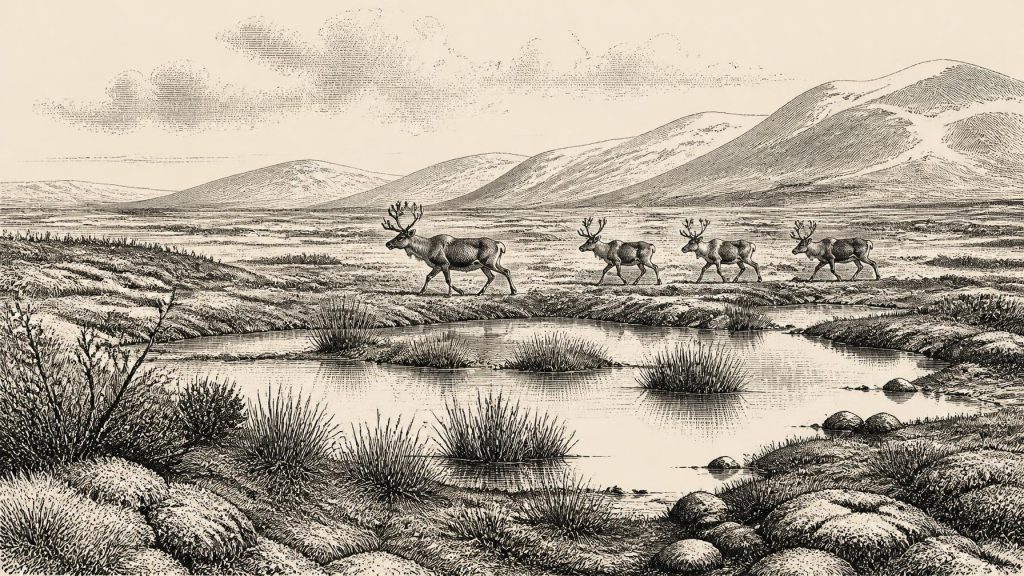
Pollen, plant remains and other environmental traces indicate open, treeless ground rather than the wooded island familiar from later prehistory. The older description of this setting as muskeg conveys its wet, moss-rich character: sedges, herbs, low shrubs, shallow pools and waterlogged channels occupied a landscape subject to severe cold and short growing seasons. Such a place was not necessarily a featureless snow desert. Summer growth around wetlands could sustain insects and grazing animals, while winter frost and seasonal freezing imposed hard limits on both plants and animals.
Derryvree therefore corrects two misleading extremes. Ireland was not continuously temperate and forested, but neither should it be imagined as uniformly entombed beneath permanent ice throughout the entire glacial period. It was a marginal North Atlantic landscape responsive to abrupt climatic oscillations. The fragmentary survival of the Derryvree bed is itself exceptional: subsequent glaciation destroyed or disturbed many comparable deposits.
Crag Cave and Climatic Change
Evidence from Crag Cave in County Kerry adds a second, quite different record. Uranium-series dating of cave calcite shows episodic speleothem growth during Marine Isotope Stage 3. Stalagmites grow only when water can infiltrate the cave and conditions permit soil-derived carbon dioxide and dissolved limestone to circulate. Their growth in intervals of the last glacial therefore signals episodes milder than the coldest phases, rather than a permanently frozen south-west.
Crag Cave cannot supply a weather report for 31,738 BCE, and its broken and reworked speleothems do not preserve a domestic landscape. Nevertheless, it supports the larger interpretation drawn from Derryvree: Irish climates during this period changed on millennial scales. Warmer interludes and colder reversals mattered profoundly. They affected vegetation, soil development, water flow, the availability of grazing and the extent to which animals, and perhaps people, could use particular areas.
Castlepook’s Animal Archive
For animal life, the most important Irish site is Castlepook Cave, also called Mammoth Cave or Doneraile Cave, in the Awbeg Valley of north County Cork. Excavations in the early twentieth century recovered an extraordinary Pleistocene bone assemblage. The cave has yielded evidence of woolly mammoth, giant deer, reindeer, brown bear, wolf, Arctic fox, lemmings and spotted hyaena. Geological Survey Ireland describes it as the country’s richest vertebrate-fauna site for the period leading towards the Last Glacial Maximum.
These finds demonstrate that parts of Ireland could support a striking cold-stage fauna over a long span. Reindeer imply open grazing country; lemmings and Arctic fox point to cold conditions; mammoth and giant deer underline the ecological productivity that open herb-rich landscapes could sometimes attain. Spotted hyaena is especially significant. Its remains show that Ireland’s fauna included a large social carnivore now absent from Europe, and that caves could serve as carnivore dens or bone accumulators as well as geological shelters.
But Castlepook must not be turned into a neatly dated snapshot. Its bones derive largely from antiquarian excavations, from deposits affected by water movement and by the activities of carnivores. Individual bones have radiocarbon dates, but they do not all belong to one animal community or one occupation episode. A bone in a cave need not mark the spot where its animal died: it may have been dragged in, scavenged, washed in or redeposited. The cave’s value lies in its long faunal archive, not in a claim that every listed species stood together in the Awbeg Valley in 31,738 BCE.
The Reindeer Femur Question
One Castlepook object has particular relevance to human history: a reindeer femur carrying a deep incision that zooarchaeologist Ruth Carden has interpreted as a cut made by a sharp stone tool during carcass processing. County Cork heritage material presents the bone as dating to about 31,000 BC, while renewed work at Castlepook has sought stratified deposits and fresh material that may test the earlier collections more fully. If the modification is confirmed as human-made and securely related to the bone’s age, it would be potentially the earliest evidence for people in Ireland.
That possibility is important, but it remains narrower than popular retellings can suggest. The date of the animal’s death is not automatically the date of a cut; the mark is an expert taphonomic interpretation; and the old collection lacks a securely excavated occupation floor linking tools, hearth, people and food waste. No contemporary house, camp, human burial, lithic assemblage, artwork or hearth has yet established a settled human community in Ireland at this time. Nor can the femur reveal whether a person killed the reindeer, found a carcass, removed meat, hide or sinew, or processed the limb elsewhere before carnivores carried it into the cave.
No Politics, but Possible Passage
Accordingly, political affairs, diplomacy, organised conflict, religion and formal learning are beyond the evidence for Ireland around this date. There are no named communities, territories, leaders, monuments or ritual deposits. It would be wrong to invent an Ice Age tribe, assign a language, or imagine a religion from the silence of the record. The absence of evidence does not prove that no person ever crossed this northern Atlantic margin; it means that archaeology has not yet demonstrated a sustained population or its social institutions.
If the Castlepook incision ultimately proves anthropogenic, the most that can be inferred is a brief episode of human contact with an animal carcass in a cold landscape. Such people, if present, would have belonged to wider Upper Palaeolithic worlds documented in Britain and continental Europe. Their practical economy would have depended on mobility, knowledge of animal behaviour, seasonal conditions and stone technology. Those are reasonable comparative possibilities, not demonstrated details of an Irish society.
The principal history of Ireland around 31,738 BCE is therefore environmental and evidential. Wetland silts beneath a Fermanagh drumlin record an interval without glacier cover. Calcite in a Kerry cave records climatic amelioration within a generally cold age. Bones in a Cork cave show that large mammals and carnivores used Irish landscapes before the ice sheet’s later maximum. One marked reindeer bone raises the possibility of human activity. Together these remains offer not a calendar-year narrative, but a disciplined glimpse of Ireland at the edge of habitable Ice Age Europe.
Primary Sources
- The Irish Quaternary Fauna Project
- Castlepook Cave: Cork County Geological Site Report
- Spotted Hyena Skull
- Heritage Artefacts of County Cork
- Archaeology Research Excavation Grant 2022: Castlepook Cave Final Report
- 2022:564 – Castlepook Cave, Castlepook South, Cork
- Quaternary
- Quaternary Site Descriptions
- Figure 6: The Subdivision of the Quaternary Period in Ireland
- Extent and Timing of the Last Glacial Maximum (LGM) in Britain and Ireland: A Review
- Growth and Retreat of the Last British-Irish Ice Sheet, 31,000 to 15,000 Years Ago: The BRITICE-CHRONO Reconstruction
- Pattern and Timing of Retreat of the Last British-Irish Ice Sheet
- Stratigraphic and Palaeo-Geomorphological Evidence for the Glacial-Deglacial History of the Last British-Irish Ice Sheet in the North-Western Irish Sea
- Britain and Ireland: Glacial Landforms from the Last Glacial Maximum
- Episodic Speleothem Deposition Tracks the Terrestrial Impact of Millennial-Scale Last Glacial Climate Variability in SW Ireland
- Exploring Controls on the Growth and Retreat of the Donegal Bay Ice Stream, North-West Ireland
- The IntCal20 Northern Hemisphere Radiocarbon Age Calibration Curve (0–55 cal kBP)
- IntCal History
- Ireland: Submerged Prehistoric Sites and Landscapes
- The Archaeology of Caves in Ireland
- New Insights on the Fauna of Ireland’s Younger Dryas and Early Holocene from Alice & Gwendoline Cave
- Deposits of the Last Glaciation
- Castlepook Caves
- Mammoth Cave