Cork’s Palaeolithic Cutmark31718 BCE
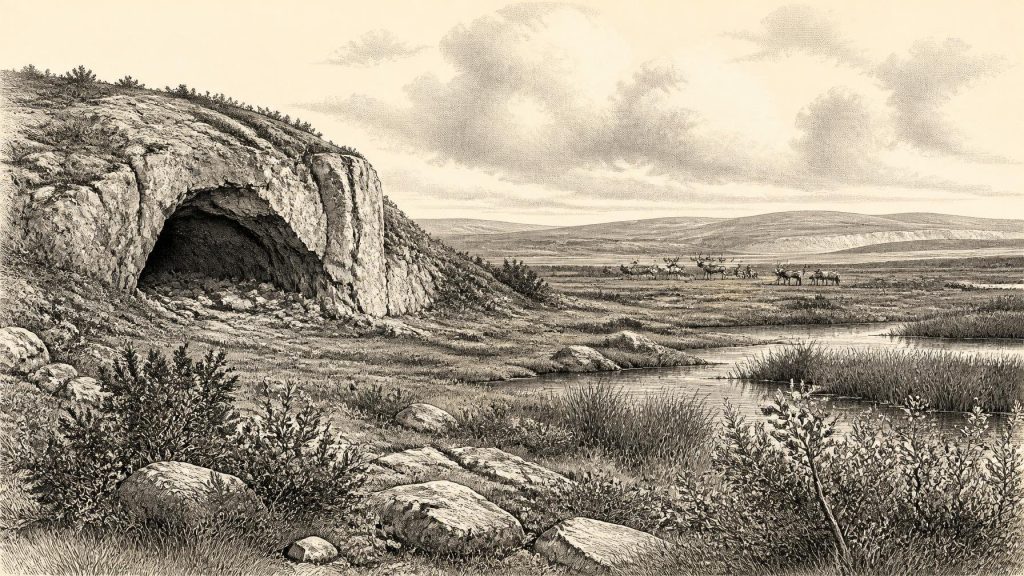
Around 33,700 years before present, during the volatile later Marine Isotope Stage 3, Ireland contained open tundra, grassland, wetlands and changing ice margins. Castlepook Cave near Doneraile, County Cork, yielded over 2,000 bones, documenting reindeer, mammoth, giant deer, bears, hyaenas and other Ice-Age fauna. A reindeer femur, dated to roughly 33,000 years ago, bears an incision possibly made by a stone tool during butchery. This may represent Ireland’s earliest human activity, but remains contested. The bone neither proves permanent settlement nor identifies routes of arrival. Glacial erosion and disturbed cave deposits limit certainty, requiring further dating, microscopy and associated artefacts.
Dateline
31,718 BCE is not a year to which Irish prehistory can be dated with calendar-like precision. The label is a modern conversion, roughly placing the horizon around 33,700 years before present (where “present” is conventionally AD 1950). No document, settlement layer or event can be assigned to this individual year. The responsible historical setting is the later part of Marine Isotope Stage 3 (MIS 3), a climatically volatile interval of the last Ice Age, before the fullest development of the last British–Irish Ice Sheet. Evidence for Ireland at this depth of time is sparse, uneven and often recovered from old cave excavations; calibrated date ranges and broad environmental phases are more meaningful than a numbered year.
A Landscape Before Maximum Ice
Ireland was not the green, wooded island familiar today. Across north-west Europe, long cold phases were interrupted by comparatively milder interstadials, sometimes with striking rapidity. In Ireland, the surviving evidence suggests a patchwork rather than a single uniform “ice-age landscape”: open grassland and herb-rich tundra, bare or stony ground, low shrubs, wet hollows, streams and sedge-rich marshes. Conditions varied greatly with altitude, exposure, season and the changing proximity of ice. Pollen, plant macrofossils, insects, cave deposits and glacial sediments can all illuminate parts of that world, but none supplies a weather report for a particular day in 31,718 BCE.
The larger direction of change was ominous. Reconstructions of the last British–Irish Ice Sheet place its build-up after roughly 35–32 thousand years ago, with extensive growth continuing towards a maximum reached much later, around 27–21 thousand years ago. This does not mean that all Ireland was simultaneously swallowed by ice at the date represented here. Ice-sheet growth was regionally uneven, and southern Irish cave faunas show that animals had occupied at least some Irish landscapes during MIS 3. Yet the eventual advance and erosion of ice help explain why the island retains so little direct evidence of early people: camps, surfaces and shallow deposits were vulnerable to destruction or burial.
Castlepook’s Extraordinary Archive
The most important evidence close to this horizon comes from Castlepook Cave, also called Mammoth Cave, near Doneraile in north County Cork. Its limestone passages, including galleries given names such as Hyaena Hall and Elephant Hall by early investigators, produced more than 2,000 animal bones during excavations between 1904 and 1918. The cave is Ireland’s richest known archive of vertebrate life from the period leading towards the Last Glacial Maximum. It is therefore central not because it proves a complete story of Irish settlement, but because it shows that a remarkable Ice-Age fauna reached the island.
That fauna includes reindeer, woolly mammoth, giant deer, brown bear and spotted hyaena, alongside wolf, Arctic fox, mountain hare and lemmings in the wider cave record. A species list should not be mistaken for a snapshot of one community living together in one season. Individual bones carry different ages; carnivores accumulated some remains; water and sediment shifted others; and early excavators could not apply the fine stratigraphic recording expected today. Nevertheless, the assemblage strongly indicates that open-country grazing animals and their predators could move through parts of Ireland during the later Pleistocene. The presence of spotted hyaena is especially revealing: Castlepook is Ireland’s sole known site for this formidable scavenger and predator.
The Reindeer Femur
One bone gives this date its particular historical interest. A reindeer femur from Castlepook has been reported as dating to about 33,000 years ago and bears a deep incision interpreted by zooarchaeologist Ruth Carden as consistent with cutting by a sharp stone edge during carcass processing. If that reading is sustained, it would be potentially the earliest evidence of human activity in Ireland, far earlier than the better-established terminal Pleistocene and Mesolithic record. It would show that at least one person, or a small party, had contact with a reindeer in Ireland or brought a butchered portion of that animal into the cave’s wider setting.
But the distinction between evidence and interpretation is crucial. The radiocarbon result dates the animal bone, not a named human visitor or a permanent occupation. Identifying a mark as a cut made by a stone tool is a taphonomic judgement: it must be weighed against carnivore damage, trampling, breakage, weathering and damage incurred during excavation and storage. Nor does a modified bone establish where the animal was killed, where it was processed, or whether the bone entered the cave immediately afterwards. Castlepook has not yet yielded a securely associated lithic assemblage, hearth, dwelling floor, burial, art or intact occupation surface of this age. It is a major clue to possible Upper Palaeolithic activity, not proof of an Irish village or continuous population.
People, If Present
If humans did visit Ireland around this broad period, they would have belonged to mobile Upper Palaeolithic hunter-gatherer societies within the wider north-west European world. Their economy would have depended on knowledge of animal movement, seasonal resources, shelter, fire and sharp stone tools. Reindeer could provide meat, fat, hide, sinew and bone, but it would be unsafe to reconstruct a specialised reindeer-hunting culture from one Irish femur. Woolly mammoth and giant deer were also present in the regional faunal record, while hyaenas and wolves made encounters with carcasses and caves complicated and potentially dangerous. A cave may have been a den, a refuge, a place where remains accumulated naturally, or only an occasional human stopping-place; it need not have been a home.
There is no evidence from Ireland for political communities, named leaders, warfare, diplomacy, territorial states, formal trade institutions, farming, pottery, monuments, writing or organised religion at this horizon. Those are not gaps waiting to be filled by imaginative storytelling; they are matters beyond the reach of the evidence. Small groups may have maintained social ties across sea channels and adjacent lands, but even the route into Ireland cannot be described confidently. Low global sea level altered coastlines and exposed areas of seabed, yet whether dry connections, ice routes, short crossings or combinations of these enabled movements remains debated and depended on changing local topography and ice.
Insularity and Movement
For animals as for people, Ireland was not simply either an island or a peninsula. Glacial loading, lowered sea level, crustal movement, sea ice and shifting ice margins created a changing geographical problem. Some reconstructions have proposed connections between Britain and Ireland during glacial lowstands, while other work stresses the depth and complexity of the Irish Sea and rejects a straightforward, enduring southern land bridge. The prudent conclusion is that mammal colonisation demonstrably occurred at intervals between at least about 45,000 and 20,000 years ago, but the precise pathways, duration and frequency of crossings remain uncertain.
This uncertainty matters for the human question. The well-supported later evidence from Alice and Gwendoline Cave in County Clare concerns a butchered brown-bear patella calibrated to the terminal Pleistocene, many millennia after the Castlepook reindeer. That find was based on modern analysis of old collections and demonstrates both the promise and the limits of Irish cave archaeology. Recent reassessment of the Clare cave also warns that cave sediments may be redeposited and that human action cannot automatically be inferred from every bone-bearing context. Castlepook’s reindeer therefore deserves neither dismissal nor exaggeration: it directs research towards undisturbed deposits, repeat dating, microscopic analysis and the search for associated artefacts.
What Can Be Said Responsibly
Around the broad interval represented by 31,718 BCE, Ireland was an Ice-Age land of open habitats, wet ground and changing cold conditions, inhabited at least intermittently by large herbivores and carnivores now absent from the island. Castlepook Cave in north Cork preserves the strongest faunal window onto that lost world. Its reindeer femur raises the serious possibility that Upper Palaeolithic people processed animals in Ireland before the last ice sheet reached its greatest extent. Yet the evidence does not permit claims for a permanent settlement, an Irish population, a political landscape or a calendar-year event. The history of this moment is not one of kings or chronicles, but of bones, sediment, climate and a single contested mark that has made Ireland’s deep past newly important.
Primary Sources
- A Reconsideration of the Radiocarbon Dating of the Marine Isotope Stage 3 Fauna from Southern Ireland
- The Irish Quaternary Fauna Project
- Castlepook Cave, County Geological Site Report
- Spotted Hyena Skull
- Extent and Timing of the Last Glacial Maximum (LGM) in Britain and Ireland: A Review
- Growth and Retreat of the Last British–Irish Ice Sheet, 31,000 to 15,000 Years Ago: The BRITICE-CHRONO Reconstruction
- The Timing and Magnitude of the British–Irish Ice Sheet Between Marine Isotope Stages 5d and 2
- Maximum Extent and Dynamic Behaviour of the Last British–Irish Ice Sheet West of Ireland
- Pattern and Timing of Retreat of the Last British-Irish Ice Sheet
- New Age Constraints for the Maximum Extent of the Last British-Irish Ice Sheet (NW Sector)
- New Data for the Last Glacial Maximum in Great Britain and Ireland
- The Problem of a Late Quaternary Landbridge Between Britain and Ireland
- Deglaciation, Earth Crustal Behaviour and Sea-Level Changes in the Determination of Insularity: A Perspective from Ireland
- The Island of Ireland: Drowning the Myth of an Irish Land-Bridge?
- Sea-Level Change in the Irish Sea Since the Last Glacial Maximum: Constraints from Isostatic Modelling
- First Evidence of a Late Upper Palaeolithic Human Presence in Ireland
- New Insights on the Fauna of Ireland's Younger Dryas and Early Holocene from Alice & Gwendoline Cave
- The Archaeology of Caves in Ireland
- Ireland: Submerged Prehistoric Sites and Landscapes
- Archaeological Heritage of County Cork
- Archaeology Research Excavation Grant 2022: Final Report