Derryvree’s Sedge Muskeg31699 BCE
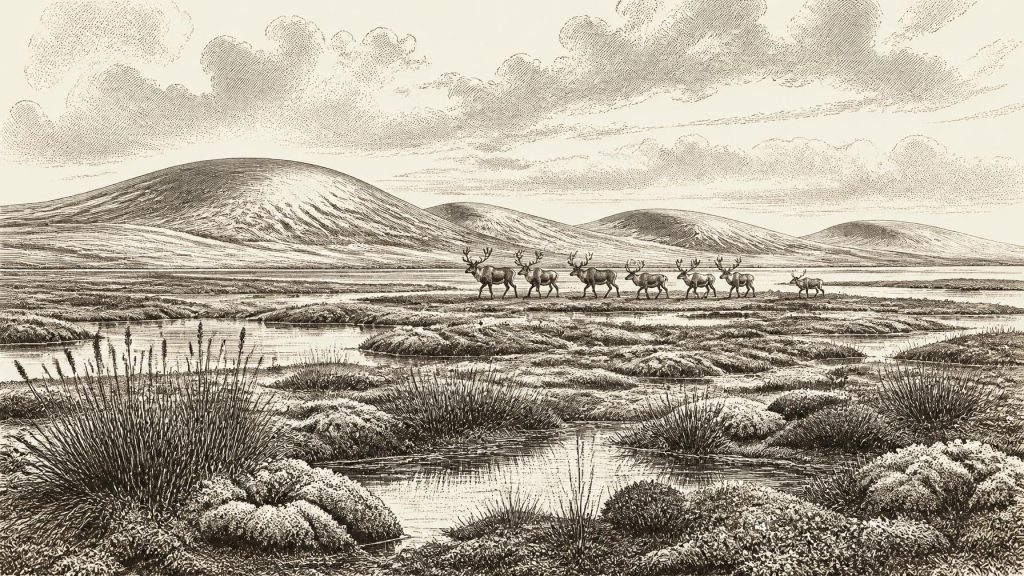
Around 31,699 BCE, Ireland lay in the unstable cold of Marine Isotope Stage 3. Derryvree, County Fermanagh, preserves freshwater deposits beneath later glacial till, revealing treeless, sedge-rich, mossy wetlands and open tundra-like ground. Other northern sites indicate that some regions remained ice-free, though conditions varied and later ice advances reshaped the island. Castlepook Cave in County Cork contains remains of Ice Age mammals, including reindeer, mammoth and predators, but its mixed deposits cannot date species precisely. A marked reindeer bone may indicate brief human butchery, yet provides no proof of permanent settlement. Environmental evidence is stronger than evidence for people.
Dateline
“31,699 BCE” is a modern chronological label, not a year that anyone in prehistoric Ireland could have recognised or recorded. At this depth of time, calendar-year precision is unavailable. The responsible approach is to place the date within broad, calibrated ranges and to distinguish what survives as evidence from what archaeologists infer. Around this point—roughly 33,650 calendar years before present, counting “present” as 1950—Ireland lay within Marine Isotope Stage 3, a cold and unstable part of the last Ice Age. It was not yet the uniformly ice-covered Ireland of the Last Glacial Maximum, but neither was it a familiar green island.
A Date Within a Range
The most useful Irish environmental evidence comes from Derryvree near Maguiresbridge in County Fermanagh. Road works in 1969 exposed freshwater silts and fine sands trapped between two layers of glacial till within a drumlin. The organic deposits produced a radiocarbon determination of 30,500 ± c.1,100 radiocarbon years before present. When calibrated, that determination has been expressed as a wide range of approximately 36.9–31.7 thousand calendar years before present. The modern date 31,699 BCE falls near the younger end of that range, but it cannot be narrowed to a season, generation or individual year.
This is more than a technical warning. Radiocarbon years are not calendar years, because atmospheric carbon-14 levels have varied over time. For periods older than the last tree-ring sequence, calibration relies on combined evidence from floating tree rings, cave deposits, lake and marine sediments, and corals. The resulting ranges remain substantial. Derryvree therefore offers a window onto an interval around the requested date, rather than a snapshot taken in 31,699 BCE itself.
Freshwater Beneath the Drumlin
Derryvree’s significance lies in its unlikely survival. A later ice advance covered and sealed the freshwater deposits, preserving plant remains, pollen, mosses and insect evidence beneath glacial sediment. These remains indicate a cold, open, periglacial landscape: one shaped by severe seasonal conditions around ice margins, rather than necessarily by permanent frozen ground everywhere. The deposits have often been described as a muskeg, a wet, moss-rich mire with shallow pools and waterlogged ground.
The vegetation was treeless or nearly so. Grasses and sedges were important, while the broader fossil assemblage includes mosses and hardy plants suited to exposed, wet and cold ground. Such evidence does not support a continuous forest, settled farmland or the blanket bogs that now form part of Ireland’s visual identity. It instead suggests patchy tundra-like vegetation, damp hollows and freshwater channels amid open ground. The precise mixture would have shifted with local drainage, slope, snow cover and short-lived climatic fluctuations.
Regional evidence reinforces this picture while also showing why no single site should stand for the whole island. Organic deposits at Greenagho, also in Fermanagh, have yielded a radiocarbon age of 32,500 ± 300 radiocarbon years before present, calibrated to roughly 37.2–35.7 thousand calendar years ago. At Hollymount and Aghnadarragh, fossil pollen and beetles likewise point to cold, open environments during earlier parts of the Midlandian glacial stage. Together, these sites demonstrate that parts of northern Ireland retained ice-free landscapes during phases of the last glacial cycle. They do not prove that every valley, coast or upland was simultaneously free of ice.
An Uneven Ice Age Island
In later millennia, the British–Irish Ice Sheet expanded dramatically. Its maximum extent and later retreat were not synchronous across Ireland, Britain and the surrounding continental shelf. Modern reconstructions emphasise advancing and retreating ice margins, shifting ice divides and substantial regional variation, rather than a simple image of an island suddenly swallowed by one static sheet. Around the Derryvree interval, the evidence is consistent with at least parts of north-central Ireland remaining ice-free, although glaciers and ice sheets were important nearby forces and would later overrun the landscape.
The land itself was also physically different. Global sea level was lower than today because immense quantities of water were locked in continental ice. Wider coastal plains and sections of the continental shelf were exposed in the north-west European region. Yet lower sea level should not be turned into an automatic “land bridge” to Ireland. The form, timing and passability of routes across the Irish Sea and North Channel remain complicated questions. Any people or animals reaching Ireland may have moved through changing mosaics of land, estuary, river, sea ice and water crossings; the evidence does not permit a single confident route.
The Nadd Valley Fauna
The principal animal archive for this broad era is Castlepook Cave—historically called Mammoth Cave—near Doneraile in north County Cork. Excavations undertaken in the early twentieth century produced an extraordinary cave collection, including remains attributed to woolly mammoth, reindeer, giant deer, brown bear, wolf, fox, Arctic fox, spotted hyaena and lemmings. The cave is therefore essential evidence that Ice Age mammals reached Ireland during the Middle and Late Pleistocene.
But a cave collection is not a census of one moment. Bones may have been brought in by hyaenas and other carnivores, washed through passages, mixed by burrowing and erosion, or disturbed by excavation long before modern recording standards. Later research has also shown that some older radiocarbon results require reassessment: improved pretreatment and accelerator dating can produce significantly older ages. Ruth Carden and colleagues concluded that several southern Irish MIS 3 animal dates were older than previously thought, and suggested that some species, including giant deer and spotted hyaena, may have disappeared locally before about 40,000 calibrated years ago.
That caution matters at 31,699 BCE. Mammoth, hyaena and giant deer are part of Ireland’s wider Ice Age record, but it cannot safely be claimed that all stood together on the same Cork hillside in this specific notional year. Reindeer, however, are particularly relevant to the open, cold environments indicated by Derryvree. Their presence implies a landscape capable of supporting mobile grazing herds, though the size, seasonality and routes of those herds cannot be recovered from the surviving bones.
The Marked Reindeer Bone
One Castlepook object has transformed discussion of early human activity. A reindeer femur in the National Museum of Ireland’s natural-history collections bears a deep linear modification interpreted by zooarchaeologist Ruth Carden as a mark made with a sharp stone implement during carcass processing. County Cork heritage material has presented it as evidence of Stone Age hunters in the region around 31,000 BCE. If that interpretation is confirmed, it would be a remarkable indication that people reached Ireland far earlier than the island’s long-established post-glacial archaeological record.
Its limitations must be stated equally clearly. The bone derives from an old cave collection, not a modern excavation of an intact occupation surface. The date obtained from a bone establishes when the animal died within a radiocarbon range; it does not directly date the mark, identify its maker, prove where the animal was killed or show how long people stayed. No securely associated hearth, stone-tool assemblage, dwelling floor, burial, art or repeated sequence of human occupation of comparable age has yet been published from Castlepook. Carnivore activity and cave processes make interpretation especially demanding.
The marked femur is therefore best treated as possible, highly important evidence of a brief Upper Palaeolithic human visit or episode of butchery. It is not proof of a permanent population, a village, continuous settlement or a direct ancestral community behind later Irish prehistory. The more securely documented humanly modified bear bone from Alice and Gwendoline Cave in County Clare belongs much later, in the terminal Pleistocene, around 12,800–12,600 calendar years before present.
What Society Cannot Yet Be Seen
No political affairs, diplomacy, named leaders, territories or warfare can be responsibly assigned to Ireland at this date. Nor is there evidence for religion, formal ritual, language, trade networks, houses, clothing or teaching. These absences are not proof that no people ever arrived; they reflect the exceptional thinness of the archaeological record and the destructive power of subsequent glaciation, coastal change and cave disturbance.
If the Castlepook mark was made by people, the minimum inference is modest: one or more individuals possessed and used a sharp stone edge on a reindeer carcass. In the wider Upper Palaeolithic world, hunter-gatherers organised their lives around mobility, shared knowledge, kin connections and seasonal resources. It is reasonable to regard any Irish visitors as part of those wider north-west European worlds, but it is not evidence that their particular social practices, beliefs or origins can be identified here. Even the activity represented by the mark—meat removal, hide working, tendon collection or access to marrow—cannot be fixed with certainty.
Before the Great Advance
The strongest story for Ireland around 31,699 BCE is environmental, not political. Derryvree preserves a cold wetland of sedges, mosses and open water in a landscape later sealed beneath ice. Castlepook preserves a scattered, time-averaged record of Ice Age animals and one provocative possible trace of human butchery. Together they show that Ireland was neither empty geological abstraction nor recognisably modern country: it was an ecologically connected but unstable western edge of Ice Age Europe.
That distinction is the period’s central lesson. Evidence supports ice-free ground in some Irish regions, freshwater habitats in Fermanagh and the arrival of cold-adapted mammals in the island’s wider landscape. Interpretation allows the possibility of fleeting human movement alongside or behind reindeer herds. It does not licence a settled prehistoric Ireland in this year. Future excavation of undisturbed cave deposits, improved microscopic study of modified bones and further dating may alter the balance of evidence. For now, Derryvree’s buried sedge muskeg remains the clearest local witness to the world around this remote date.
Primary Sources
- A reconsideration of the radiocarbon dating of the Marine Isotope Stage 3 fauna from southern Ireland
- The Irish Quaternary Fauna Project
- Growth and retreat of the last British–Irish Ice Sheet, 31,000 to 15,000 years ago: the BRITICE-CHRONO reconstruction
- Trimlines, blockfields and the vertical extent of the last ice sheet in southern Ireland
- Pattern and timing of retreat of the last British–Irish Ice Sheet
- New insights on the fauna of Ireland's Younger Dryas and Early Holocene from Alice & Gwendoline Cave
- Ireland: Submerged Prehistoric Sites and Landscapes
- The IntCal20 Northern Hemisphere Radiocarbon Age Calibration Curve (0–55 cal kBP)
- The IntCal20 Approach to Radiocarbon Calibration Curve Construction: A New Methodology Using Bayesian Splines and Errors-in-Variables
- Marine20—The Marine Radiocarbon Age Calibration Curve (0–55,000 cal BP)
- Palaeoecology: Irish Quaternary Association Field Guide
- Figure 6—The Subdivision of the Quaternary Period in Ireland
- Castlepook Cave, County Cork: Geological Heritage Site Audit Report
- Heritage Artefacts of County Cork
- The Archaeological Heritage of County Cork
- 2022:564 – Castlepook Cave, Castlepook South, Cork
- Growth and Retreat of the Last British–Irish Ice Sheet, 31,000 to 15,000 Years Ago: the BRITICE-CHRONO Reconstruction
- Occurrence of Mammalia Relicts at Site Castlepook Cave
- Pleistocene Vertebrates in the British Isles
- The Mammoth Caves of Castlepook, Near Doneraile
- The Exploration of Castlepook Cave, County Cork
- Pattern and Timing of Retreat of the Last British-Irish Ice Sheet