Derryvree’s Trifoliate Seed31692 BCE
At roughly 31,692 BCE, Ireland lay within the fluctuating cold conditions of Marine Isotope Stage 3, although dating cannot identify a single-year event. Derryvree, County Fermanagh, preserves freshwater organic beds between glacial tills, indicating local ice-free or ice-marginal intervals amid changing ice-sheet conditions. Pollen, plants and insects reveal treeless wetlands of mosses, sedges, herbs and dwarf shrubs. Castlepook Cave fauna demonstrates cold-stage animal presence, including reindeer, mammoth and hyaena, but its deposits are chronologically complex. A modified reindeer femur may suggest brief Upper Palaeolithic human activity, yet no settlement evidence exists. Ireland’s record reveals dynamic environments, not recoverable political history.
Dateline
The modern label “31,692 BCE” cannot identify an event in Ireland in the way that it can for a medieval battle or a parliamentary vote. No calendar, writing system or dated human record existed on the island. In archaeological terms, it is best treated as a point within a much wider span: approximately 33,641 calendar years before AD 1950, within Marine Isotope Stage 3 (MIS 3), a fluctuating cold interval of the Late Pleistocene. Precision at the level of a single year is unavailable. Radiocarbon determinations must be calibrated, and their results are probability ranges rather than exact anniversaries.
The closest Irish evidence comes from a freshwater deposit at Derryvree, near Maguiresbridge in County Fermanagh. Organic silts and sands there lay between two tills: sediments left by separate advances of glacial ice. A conventional radiocarbon determination of 30,500 years BP, with a substantial error range, has been calibrated broadly to c.36,900–31,700 cal BP. The nominal year considered here falls within that wide interval. It cannot be assigned to a particular layer, season, generation or individual animal, but Derryvree offers a responsible window onto parts of Ireland at roughly this depth of time.
Ice, Water and Uncertain Chronology
Ireland was in an Ice Age, but it was not simply a white, unchanging land buried beneath ice. The British–Irish Ice Sheet repeatedly altered its shape, size and flow during the last glacial cycle. At Derryvree, the lower till records an earlier episode when ice affected the locality. The organic-rich freshwater beds above it demonstrate that, for a time, the site was not beneath actively moving ice. An upper till subsequently sealed the deposit, preserving an interval of cold, ice-free or ice-marginal ground between glacial episodes.
That sequence matters because it corrects two tempting but misleading simplifications. First, the whole island cannot be assumed to have been continuously ice-covered at this time. Secondly, an ice-free patch in Fermanagh cannot be made to stand for every Irish region. Conditions differed between uplands, lowlands, coasts and the changing margins of ice. The Derryvree deposit is local evidence, while wider reconstructions of the Irish Ice Sheet remain necessarily regional and provisional. The maximum expansion of the last ice sheet belongs later, mainly after c.29,000 cal BP, with different sectors reaching their greatest extent at different times.
For this reason, older Irish regional terms such as the Midlandian and the Derryvree Cold Phase remain useful descriptions of sediment sequences, but should not be mistaken for globally synchronous weather events. The evidence supports a cold landscape with freshwater habitats and periglacial processes; it does not provide a nationwide forecast for 31,692 BCE. Climate in MIS 3 was capable of sharp shifts over periods far longer than a human lifetime but far shorter than geological eras.
A Treeless Freshwater Landscape
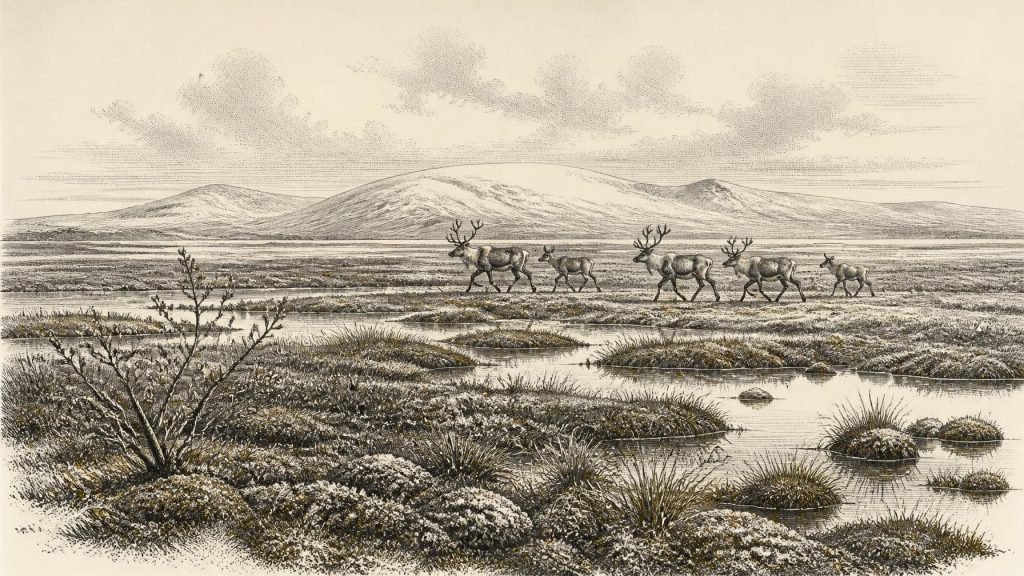
Derryvree’s organic beds preserve more than mud. Pollen, plant macrofossils and insect remains point to a cold northern environment. Mosses and sedges grew in wet ground; the record includes species associated with shallow freshwater and marshy margins. Fossil evidence for bogbean, water-milfoil, mountain avens and dwarf willow is especially revealing. Together these plants indicate a mosaic rather than a featureless wasteland: pools and wet hollows, saturated moss-and-sedge ground, low herbaceous vegetation and scattered dwarf shrubs.
“Muskeg”, often used for this sort of waterlogged terrain, conveys the character of the place better than either forest or desert. It was a wet, uneven country in which organic matter accumulated slowly in cold waterlogged conditions. Trees did not form woodland at Derryvree. The absence of forest is important for how the landscape looked and functioned: wind could sweep across exposed ground, winter conditions could be severe, and plant cover would have been low, seasonal and spatially patchy. Yet freshwater plants and peat-forming vegetation show that life persisted where water, soil and local shelter allowed it.
This was not the later familiar Ireland of oak woods, enclosed fields and bog-fringed farms. Nor was it necessarily identical to the high Arctic of today. Palaeoecological reconstruction works by comparison, not by perfect analogy. The responsible conclusion is that parts of north-central Ireland supported open, cold-adapted vegetation around the relevant broad interval. It is an interpretation grounded in biological remains; it cannot tell us the colour of a particular hillside on a particular day.
Animals at the Edge of the Ice
Cave deposits, especially in the limestone country of southern Ireland, add an animal dimension. Castlepook Cave near Doneraile in north Cork has produced one of Ireland’s most important Pleistocene faunal collections. Its finds include remains attributed to reindeer, woolly mammoth, giant deer, brown bear, wolf, foxes, spotted hyaena and lemmings. Such a list demonstrates that Ireland was visited or inhabited by a far richer cold-stage fauna than its modern mammal community suggests.
It must nevertheless be handled with care. Much of the Castlepook material came from early twentieth-century excavation, before modern recovery methods and stratigraphic recording. A cave is not a simple census of a single living landscape: carnivores may drag prey inside, water can move bones, later disturbance can mix deposits, and separate occupations of the cave can become combined in a collection drawer. Improved radiocarbon pretreatment has also shown that some older Irish cave dates require reassessment. It is therefore unsafe to picture every listed species standing together outside the cave in 31,692 BCE.
What can be said is more modest and more valuable. The fauna establishes that cold-stage mammals reached Ireland during MIS 3, and that suitable habitats existed at intervals before the Last Glacial Maximum. Reindeer would have been well suited to open ground; hyaenas indicate carnivore activity and the capacity of caves to become dens or bone accumulators; mammoth and giant deer evoke a landscape with substantial grazing resources. Their presence says nothing by itself about human settlement, but it makes an ecologically empty Ireland implausible for every part of this long period.
The Castlepook Human Question
A reindeer femur from Castlepook has made this period especially significant. It has been reported as roughly 33,000 years old and bears a deep linear modification interpreted by Ruth Carden as a cut or chopping mark made with a sharp stone implement during butchery. If that interpretation is upheld, it may represent evidence that Upper Palaeolithic people reached Ireland far earlier than the formerly accepted post-glacial record.
The conditional language is essential. The bone does not establish a village, a camp, a hearth, a stone-tool assemblage, a burial ground or an enduring population. It was recovered from an old cave collection rather than a securely excavated occupation surface. A radiocarbon date identifies the age of the animal’s death within a range; it does not automatically date the mark, locate the killing place or reveal how long people remained in the region. Whether a mark was made by a stone edge, carnivore activity, sediment movement or later damage is a specialist taphonomic judgement. Ongoing work at Castlepook has sought surviving undisturbed Pleistocene deposits, but no comparable settlement evidence has yet transformed the case.
Accordingly, the femur should be treated as a potentially momentous clue rather than a licence to invent a Palaeolithic Irish society. At most, it may hint at a brief encounter between people and reindeer in a cold, open landscape. Any visitors would have belonged to mobile Upper Palaeolithic communities whose wider European world included skilled stone technology, hunting knowledge, clothing and social traditions. None of those wider facts can be transferred automatically to Ireland without an Irish archaeological context.
No Kingdoms, No Trade Routes
There is no evidence for political affairs in Ireland around this time: no named communities, leaders, territories, alliances, warfare, diplomacy or institutions. There is likewise no direct Irish evidence for religion, formal learning, art, language or ritual. The silence is not proof that people everywhere lacked beliefs or social relationships; it is a limit of the surviving Irish record. If humans did make short visits, their beliefs and speech remain wholly unknown.
Economy and trade must be described with the same restraint. There were no farms, fields, domesticated herds, metalworking communities or markets. A possible butchered reindeer bone would imply the procurement and processing of animal food, but not a local economy in the later sense. Lower sea levels changed the outlines of the continental shelf and may have narrowed or exposed parts of surrounding seaways, yet the routes by which animals, and perhaps people, reached Ireland are unresolved. A dry land bridge should not be assumed merely because fauna crossed at some point; swimming, ice, temporary exposed ground and changing coastal configurations complicate the question.
The most important Irish development around 31,692 BCE was therefore environmental rather than political: a changing cold-stage landscape in which ice advances alternated with local windows of open ground, freshwater wetlands and animal movement. Derryvree’s tiny preserved plants and Castlepook’s cave bones make that world visible, but only in fragments. Their proper lesson is not that Ireland already possessed a recoverable national prehistory in the usual sense. It is that the island’s deep past was dynamic, inhabited by resilient ecosystems, and still capable of revising what later generations think they know.
Primary Sources
- A Middle Midlandian Freshwater Series at Derryvree, Maguiresbridge, County Fermanagh, Northern Ireland
- A Reconsideration of the Radiocarbon Dating of the Marine Isotope Stage 3 Fauna from Southern Ireland
- The Irish Quaternary Fauna Project
- New Insights on the Fauna of Ireland’s Younger Dryas
- First Evidence of a Late Upper Palaeolithic Human Presence in Ireland
- Freshwater Organic Deposits and Stratified Sediments Between Early and Late Midlandian (Devensian) Till Sheets, at Aghnadarragh, County Antrim, Northern Ireland
- Middle Midlandian Interstadial Deposits at Greenagho, Near Belcoo, County Fermanagh, Northern Ireland
- Early Midlandian–Middle Midlandian, Pleistocene, Northern Ireland
- Aghnadarragh
- Figure 6.— The Subdivision of the Quaternary Period in Ireland
- The Geology of Ireland
- Growth and Retreat of the Last British–Irish Ice Sheet, 31,000 to 15,000 Years Ago: the BRITICE-CHRONO Reconstruction
- Pattern and Timing of Retreat of the Last British–Irish Ice Sheet
- Exploring Controls of the Early and Stepped Deglaciation on the Western Margin of the British Irish Ice Sheet
- Maximum Extent and Dynamic Behaviour of the Last British–Irish Ice Sheet West of Ireland
- The IntCal20 Northern Hemisphere Radiocarbon Age Calibration Curve (0–55 cal kBP)
- The Exploration of Castlepook Cave, County Cork
- 2022:564 — Castlepook Cave, Castlepook South, Cork
- Mammoth Cave, Castlepook
- Heritage Artefacts of County Cork
- The Exploration of the Caves of Kesh, County Sligo
- Pleistocene to Holocene Extinction Dynamics in Giant Deer and Woolly Mammoth
- Ancient Hybridization and an Irish Origin for the Modern Polar Bear Matriline
- European Vegetation During Marine Oxygen Isotope Stage 3