
Derryvree’s Sedgebound Interval31639 BCE
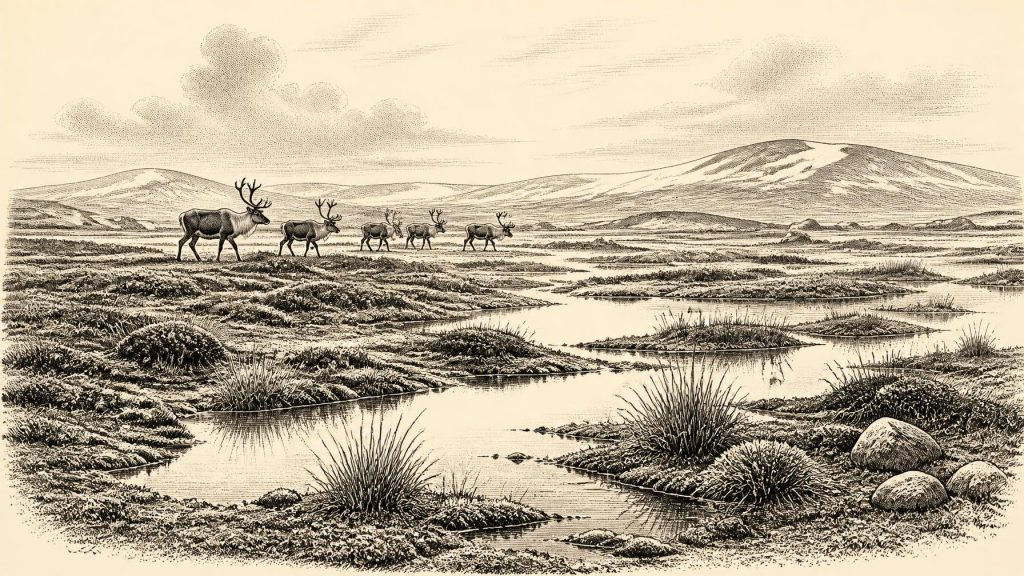
Circa 31,639 BCE, Ireland was not a historical society but a cold Late Pleistocene landscape subject to rapid climatic change. Derryvree, County Fermanagh, preserves freshwater silts between glacial tills, indicating locally ice-free tundra wetlands with sedges, mosses and cold-adapted insects roughly 36,900–31,700 years BP. Castlepook Cave, County Cork, accumulated bones over millennia, documenting mammoth, giant deer, reindeer, bears, hyenas and later cold fauna. These finds demonstrate changing habitats and connections with north-west Europe, but not settled human communities. A possibly cut-marked reindeer bone may indicate brief human activity, whereas secure evidence dates only to about 12,800 BP. Later ice advanced.
Dateline
The label 31,639 BCE is a modern way of locating a point deep in prehistory, not a year that anyone in Ireland could have named or recorded. No archaeological method can isolate events in a single calendar year so far back. It is better treated as a notional point about 33,600 calendar years before 1950, within Marine Isotope Stage 3 of the Late Pleistocene. Radiocarbon measurements from this depth of time calibrate to broad probability ranges, rather than yielding anniversary-like precision. The responsible history of Ireland at this point is therefore a history of sediments, fossil plants, animal bones, changing ice and carefully limited inferences—not a chronicle of rulers, battles or settlements.
At the broad scale, the evidence indicates that parts of Ireland were still ice-free around this horizon, before the great expansion of the last Irish ice sheet. This did not make the country mild, wooded or densely inhabited. It was a cold, exposed landscape in a period of abrupt North Atlantic climatic change. Later glaciers would reshape much of it and remove or bury many traces. That destructive history explains both why the surviving evidence is precious and why it cannot bear more narrative weight than it possesses.
Time Measured in Ranges
The most useful chronological anchor is Derryvree, near Maguiresbridge in County Fermanagh. Road works exposed a sequence inside a drumlin: glacial till below, organic-rich freshwater silts and fine sands in the middle, and a later till above. Till is debris deposited directly by glacier ice. The arrangement proves that there was an interval between two glacial episodes when water, plants and small animals occupied this spot. A conventional radiocarbon determination from the organic material was 30,500 radiocarbon years BP, with a substantial uncertainty. Subsequent calibration has been expressed as an approximate range of 36,900–31,700 calendar years BP.
That range encompasses the modern label 31,639 BCE only in the loosest chronological sense. It cannot show that the Derryvree pool existed continuously throughout that span, nor that every specimen from its layers belonged to the same season or generation. The date is nevertheless important: alongside comparable deposits at Greenagho and other Fermanagh sites, it supports the conclusion that north-central Ireland retained ice-free ground until at least roughly 34,000 years ago. The later Last Glacial Maximum, when ice covered Ireland and extended across much of its continental shelf, lay ahead.
A Wetland Beneath the Drumlins
Derryvree is the clearest local window onto the environment. Its fossil flora included freshwater mosses and sedges, while other identified remains include bogbean and water-milfoil. Insect evidence was of cold northern aspect. Together these remains support an interpretation of shallow freshwater, wet ground and treeless tundra or muskeg vegetation under periglacial conditions: a climate in which seasonal freezing and thawing were fundamental landscape processes. The scene was not an empty sheet of snow. It included pools, saturated margins, low plants and patches of exposed mineral ground, all changing with water level and season.
Yet this reconstruction must remain local. A sediment-filled hollow in Fermanagh is not a complete map of Ireland. Conditions varied with altitude, drainage, distance from the sea, the presence of local ice and the rapid climatic oscillations characteristic of the period. Nor does ‘tundra’ imply one uniform plant community. It is a useful ecological description for an open, cold landscape with little or no tree cover, rather than a claim that every modern Irish county looked identical. The organic silts preserve a rare surviving habitat; much of the wider evidence has either been eroded by later ice or now lies beneath sea and younger deposits.
Castlepook’s Animal Record
In north County Cork, Castlepook Cave—historically called Mammoth Cave, near Doneraile—offers a different kind of archive. More than 2,000 bones have been recovered from its passages and chambers. Geological Survey Ireland describes it as Ireland’s richest site for vertebrate fauna in the period leading towards the Last Glacial Maximum. Individual bones range widely in age, roughly from 45,700 to 19,950 years BP, so the cave was a repository accumulating material over a long interval, not a frozen snapshot of one living community.
The fauna associated with its older Ice Age deposits includes woolly mammoth, giant deer, reindeer, brown bear and spotted hyena; later cold-stage material includes Arctic fox, wolf and lemmings. This is strong evidence that Ireland could at times sustain a varied large-mammal fauna, including predators as well as herbivores, during the Late Pleistocene. The remains also suggest that Ireland was not ecologically isolated in the modern sense. Animals had reached it from the wider north-west European landmass when changing sea level, ice and exposed shelf landscapes permitted movement. Precisely where dry routes, shallow waters, coastal corridors or ice barriers lay at any moment remains uncertain.
Cave assemblages require especial caution. Many Castlepook deposits were excavated in the early twentieth century, water has disturbed material, and carnivores themselves could carry, gnaw and redistribute bones. A hyena den is not a hunting camp, and a mammoth bone in a cave does not automatically mean mammoths lived at its entrance. The scientifically secure conclusion is that these species occurred in Ireland within overlapping broad time ranges. Claims about direct predator-prey encounters, seasonal migration routes or the precise composition of a local herd go beyond the evidence.
The Human Question
There is no accepted settlement, hearth, house floor, stone-tool assemblage, burial or human skeletal remain securely dated to around 31,639 BCE in Ireland. Accordingly, there is no basis for describing a resident population’s social organisation, language, kinship, religious practice or territory. Political affairs, diplomacy and warfare leave no identifiable record here because there is no demonstrated polity or community to which such terms can responsibly be applied.
A reindeer femur from Castlepook has been publicly presented as bearing a deep mark consistent with cutting by a sharp stone tool, and its age has been reported as about 33,000 years ago. If the surface modification is confirmed as human-made and contemporary with the death of the animal, it would be an exceptionally early sign that a person processed a reindeer carcass in Ireland. It would not, by itself, establish a camp, permanent settlement, named archaeological culture or population continuity. The distinction matters. A single modified bone records, at most, a brief action at a carcass; it cannot reveal how many people were involved, whether they travelled repeatedly, or whether they left descendants.
The more securely published evidence for a human presence is much later: a butchered brown-bear kneecap from Alice and Gwendoline Cave in County Clare, independently dated to about 12,810–12,590 calibrated BP. That discovery demonstrates why close study of old cave collections can change the story of Irish prehistory. It should not, however, be used to fill the much earlier interval with imagined hunters, camps or rituals.
Life, Economy and Culture: What Cannot Be Claimed
If people did visit Ireland in this broad period, they would have required knowledge, cooperation and practical skill to survive a cold, highly seasonal world. Across north-west Europe, Upper Palaeolithic groups made sophisticated stone and organic tools, used fire, shared food and maintained social links across considerable distances. But those are continental comparisons, not direct Irish finds. No Irish evidence of this age supports assertions about clothing, dwellings, food-sharing arrangements, exchange networks, artistic traditions, belief or learning. Equally, there is no evidence for farming, herding, cultivated crops, metals, pottery, monuments, trade goods or formal religion.
Economy at Derryvree was ecological rather than human: wetland vegetation fixing carbon, insects inhabiting cold ground, herbivores feeding across open country and carnivores exploiting animal carcasses. At Castlepook, the co-occurrence of large herbivores and predators points to food webs capable of supporting both. It does not show a human hunting economy. The crucial regional change was environmental. Ice-free but severe habitats were being overtaken within millennia by the growing British-Irish Ice Sheet, which eventually transformed Ireland’s terrain and erased or sealed much of what came before.
An Ireland Before Historical Ireland
This is therefore not yet Ireland of kingdoms, saints, languages or even demonstrable villages. It is Ireland as a shifting part of the north-west European Pleistocene world: a landscape of cold pools and sedges at Derryvree, caves accumulating the remains of mammoth, reindeer and hyena in Cork, and an ice sheet whose later advance would redraw the island. The evidence permits a vivid environmental history, but it also imposes discipline. Around this nominal date, Ireland’s best-documented inhabitants are plants and animals. Human history remains a question, not a settled fact.
Primary Sources
- A Middle Midlandian Freshwater Series at Derryvree, Maguiresbridge, County Fermanagh, Northern Ireland
- Early Midlandian–Middle Midlandian, Pleistocene, Northern Ireland
- Trimlines, blockfields and the vertical extent of the last ice sheet in southern Ireland
- The Irish Quaternary Fauna Project
- Castlepook Cave, County Geological Site Report CK032
- Spotted Hyena Skull
- Phylogeographic, Ancient DNA, Fossil and Morphometric Analyses Reveal Ancient and Modern Introductions of a Large Mammal: The Complex Case of Red Deer (Cervus elaphus) in Ireland
- First Evidence of a Late Upper Palaeolithic Human Presence in Ireland
- Ireland: Submerged Prehistoric Sites and Landscapes
- Early Deglaciation of the British-Irish Ice Sheet on the Atlantic Shelf Northwest of Ireland Driven by Glacioisostatic Depression and High Relative Sea Level
- Maximum Extent and Dynamic Behaviour of the Last British–Irish Ice Sheet West of Ireland
- Stratigraphic and Palaeo-Geomorphological Evidence for the Glacial-Deglacial History of the Last British-Irish Ice Sheet in the North-Western Irish Sea
- Late Pleistocene Chronostratigraphy and Ice Sheet Limits, Southern Ireland
- New Data for the Last Glacial Maximum in Great Britain and Ireland
- Pleistocene Glacial History of the NW European Continental Margin
- The Tolsta Interstadial, Scotland: Correlation with D–O Cycles GI-8 to GI-5?
- The Subdivision of the Quaternary Period in Ireland
- Introduction to Irish Quaternary Research
- Heritage Artefacts of County Cork
- Reindeer Bone Found in Cork Cave Shows Human Activity in Ireland 33,000 Years Ago