Castlepook’s Faunal Clock31468 BCE
Around 31,468 BCE, Ireland lay within the climatically unstable later Marine Isotope Stage 3, not a historically identifiable year. Castlepook Cave in County Cork preserves faunal evidence for cold, open habitats, including mammoth, reindeer, giant deer, bear, wolf, Arctic fox and spotted hyaena. These remains show episodic links with wider Pleistocene Europe, though cave deposits accumulated through varied processes. A marked reindeer femur may record human butchery, potentially indicating a brief visit by mobile foragers, but lacks secure archaeological context. Derryvree wetland sediments in Fermanagh document treeless periglacial vegetation between glacial phases. Evidence supports neither permanent ice cover nor settlement.

Dateline
Modern calendar-year precision cannot responsibly be claimed for Ireland in 31,468 BCE. That numbered year is a modern retrospective label, roughly 33.4 thousand years before AD 1950, rather than a date at which any Irish occurrence can be identified. The relevant evidence belongs to the later part of Marine Isotope Stage 3, an unstable interval of the last Ice Age. Radiocarbon determinations, even after calibration, produce ranges rather than an annual chronology at this depth of time. The best approach is therefore to ask what archaeology, palaeontology and glacial science can illuminate about Ireland in the broad period around c. 34,000–33,000 calibrated years BP, while distinguishing securely observed evidence from inference.
An Island Not Yet Knowable
Ireland at this horizon was not a country, polity or cultural unit in any sense familiar from later history. There were no recorded peoples, rulers, boundaries, settlements, languages or institutions. Nothing supports discussion of Irish political affairs, diplomacy, law or organised conflict. Nor can religion, art, learning or social identity be reconstructed for an Irish population, because no securely stratified human camp, hearth, tool assemblage, burial or dwelling from this age has been published from the island.
That absence is significant, but it is not simple proof that no person ever entered Ireland. Later ice advances eroded, buried and rearranged many deposits, while changing coastlines have submerged former lowlands and possible travel routes. The archaeological record is therefore exceptionally thin. Around 31,468 BCE, Ireland should be understood first as a changing north-western European landscape whose animal, plant and sediment records have survived only in fragments.
The wider setting was cold but not uniformly frozen. Marine Isotope Stage 3 contained abrupt climatic oscillations rather than one unchanging Ice Age climate. Glaciers had affected parts of the Irish region before this time, yet the evidence does not justify portraying every part of Ireland as continuously covered by a single ice sheet in this particular year. The great Last Glacial Maximum, when the British–Irish Ice Sheet was at or near its largest extent, came later, broadly c. 27,000–23,000 years BP. At the earlier horizon considered here, open ground, wetlands, caves and animal corridors could exist alongside expanding or retreating ice margins.
Castlepook and the Cave Record
The strongest Irish evidence for this broad interval comes from Castlepook Cave near Doneraile, County Cork, in the limestone foothills of the Ballyhoura Mountains. Early twentieth-century excavations recovered a remarkable collection of Ice Age animal remains from its chambers, including Elephant Hall and Hyaena Hall. More recent redating has shown that several specimens are substantially older than earlier radiocarbon programmes suggested. Castlepook is consequently one of the most important windows into Ireland before the Last Glacial Maximum.
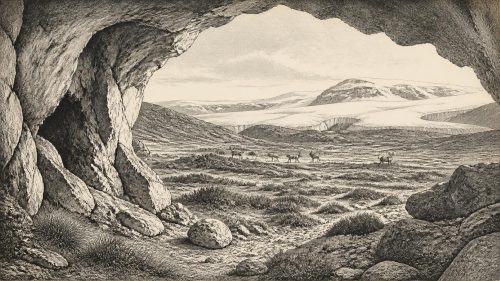
The fauna records an open, cold-country community. Woolly mammoth, reindeer, giant deer, brown bear, wolf, Arctic fox, hare, lemmings and spotted hyaena are among the animals represented in the cave assemblage. They were not necessarily all present in the same season, generation or micro-environment; a cave collection accumulates over long periods and through several processes. Animals may have died naturally, been brought in by carnivores, washed or dragged into passages, or been disturbed by excavation. Nevertheless, directly dated bones establish that some of this distinctive fauna lived in southern Ireland during MIS 3.
Spotted hyaena is especially revealing. Castlepook has yielded the only secure Irish evidence for this powerful scavenger and predator. Its presence, alongside mammoth and reindeer, evokes a productive but severe mosaic rather than a barren white wilderness: grass- and herb-rich open ground capable of supporting large herbivores, with caves usable as dens and places where bones accumulated. It does not prove a stable local food web in every part of Ireland, but it demonstrates that the south could sustain, at least episodically, a fauna now associated with the mammoth-steppe environments of Pleistocene Europe.
For everyday animal life, seasonality mattered. Reindeer and horse-like open-country grazers, small mammals, carnivores and scavengers would have responded to snow cover, forage, shelter and migration. Yet archaeology cannot recover an exact herd route across the Awbeg valley, an exact hunting season, or a view from Castlepook in 31,468 BCE. Such details would be imaginative reconstructions, not history. What the bones responsibly provide is a time-averaged indication of habitat, climatic stress and biological connection with Britain and continental Europe.
The Reindeer Femur Question
One Castlepook object makes this period unusually important for Irish human history: a reindeer femur with a deep linear mark interpreted by zooarchaeologist Ruth Carden as damage from a sharp stone implement made while the bone was fresh. County Cork heritage material has associated the specimen with about 31,000 BCE, and its reported radiocarbon age falls within the wider MIS 3 faunal sequence. If the modification is confirmed as a human butchery mark contemporary with the animal’s death, it would be evidence that people processed a reindeer in Ireland tens of millennia before the traditionally accepted post-glacial settlement record.
The qualification is essential. The bone derives from an old collection, not from a modern excavation of a sealed occupation surface. It has no securely associated stone tools, charcoal hearth, shelter structure, human remains or cluster of butchered bones that would demonstrate a camp. Radiocarbon dates the death of the reindeer, not the precise moment of cutting; nor does a single mark establish where the animal was killed, how much of it was used, or whether the people concerned stayed for hours, days or longer. Damage from carnivores, sediment movement, breakage and recovery must be excluded through detailed comparison.
The most cautious interpretation is therefore neither that Ireland possessed a settled Upper Palaeolithic society nor that the object is unimportant. It is a serious, potentially transformative indication of a brief human encounter with an animal in Ireland. At most, it suggests a small mobile party equipped with a cutting edge and knowledge of carcass processing. It cannot identify their language, ancestry, kinship system, beliefs, artistic practices or political organisation. Nor can it establish continuity between any such visitors and Ireland’s much later, securely documented hunter-gatherer populations.
Derryvree’s Cold Wetland
County Fermanagh provides a different sort of evidence. At Derryvree near Maguiresbridge, roadworks exposed organic silts and fine sands trapped between two till sheets within a drumlin. The deposit, known through the radiocarbon determination BIRM-166, produced an uncalibrated age of about 30,500 radiocarbon years BP, with a substantial uncertainty. When considered through later calibration and chronological modelling, it belongs broadly around the mid-30,000s calibrated years BP. It is close enough to 31,468 BCE to illuminate the character of Irish environments, but it must not be treated as a precisely contemporary annual record.
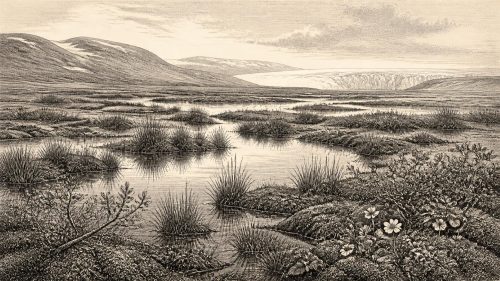
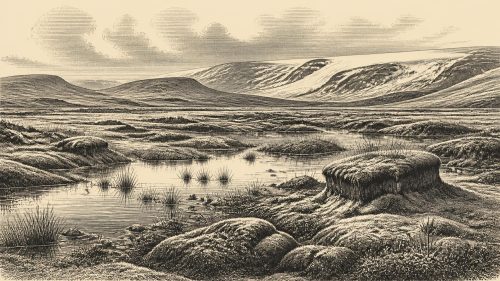
Its plant and insect evidence indicates treeless, periglacial wetland: sedges, grasses, herbs, mosses and small freshwater pools in a muskeg-like landscape. Finds including dwarf shrubs and arctic-alpine plants show that water and vegetation persisted despite cold conditions. This was not forested Ireland. Trees that define later Irish landscapes were absent or extremely limited locally; exposure, frost, wind and short growing seasons shaped a terrain of open vegetation, saturated ground and seasonal change.
Derryvree also warns against turning climate labels into simple pictures. An inter-till organic deposit means that a biologically active landscape existed between phases of ice deposition at that location. It does not prove that all Ireland was ice-free at once, nor that its entire climate was mild. The evidence instead captures a local freshwater and wetland interval under periglacial conditions, preserved before later ice or sediment sealed it. Its value lies in the survival of pollen, plant macrofossils and insects that ordinary archaeological sites rarely retain.
Connections Without Countries
Sea level was far lower than today during the Ice Age, and the outlines of Ireland, Britain and the surrounding shelves differed greatly from modern maps. The Irish Sea basin was not necessarily the permanent maritime barrier familiar today. Depending on the timing, ice extent and local topography, animals and perhaps people could have moved through exposed or ice-influenced landscapes linking the western edge of Europe. The precise routes remain debated, and no evidence permits an exact crossing narrative for this year.
Across nearby Britain, Upper Palaeolithic groups are attested by stone artefacts, animal processing and caves, though occupation was episodic and shaped by climate. Paviland Cave in south Wales, for example, has evidence for repeated activity over a broad span from about 30,000 to 21,000 years ago. That neighbouring record makes a short-lived Irish visit plausible in principle, not proven in fact. Ireland has not yielded a comparable assemblage for c. 33,000–34,000 calibrated years BP.
Economy and trade must likewise be handled carefully. If people made the Castlepook mark, their immediate economy involved the use of wild animal resources, not farming, herding, metalworking, markets or long-distance commercial exchange. A stone edge could have cut meat, hide, sinew or tissue around the bone, but the surviving mark cannot specify which. There is no Irish evidence at this horizon for cultivated plants, domestic animals, pottery, built monuments or exchange networks. The relevant economy was ecological: the movement of animals, the availability of forage, and the capacity of mobile foragers—if present—to use a difficult, open landscape.
A Record of Possibility
The most important development around 31,468 BCE is thus not an event but a research problem. Castlepook’s reindeer, mammoth and hyaena remains demonstrate that Ireland participated in the shifting faunal worlds of MIS 3. Derryvree’s buried wetland shows that cold, treeless but living environments existed between glacial episodes. The marked reindeer femur raises the possibility of human activity, but does not yet document settlement. Ongoing work in Castlepook’s less-disturbed deposits may clarify how bones entered the cave and whether artefacts, charcoal or further modified remains survive.
For this remote point in Irish history, restraint is more informative than false certainty. Ireland was a landscape of tundra-like wet ground, open grazing country, caves and powerful carnivores; it may also have been visited by people. It was not yet a historical Ireland of communities whose names, beliefs or conflicts can be recovered. The surviving evidence is sparse, local and often reworked, but it is enough to show that the island’s deep past was neither empty nor simple.
Primary Sources
- A Middle Midlandian Freshwater Series at Derryvree, Maguiresbridge, County Fermanagh, Northern Ireland
- A Reconsideration of the Radiocarbon Dating of the Marine Isotope Stage 3 Fauna from Southern Ireland
- Heritage Artefacts of County Cork
- 2022:564 – Castlepook Cave, Castlepook South, Cork
- Archaeology Research Excavation Grant 2022: Final Report
- Figure 6.— The Subdivision of the Quaternary Period in Ireland
- Exploring the Growth and Decay of the Last British–Irish Ice Sheet and Associated Palaeoglaciology
- Growth and Retreat of the Last British–Irish Ice Sheet, 31,000 to 15,000 Years Ago: the BRITICE-CHRONO Reconstruction
- The Timing and Magnitude of the British–Irish Ice Sheet Between Marine Isotope Stages 5d and 2
- Pattern and Timing of Retreat of the Last British-Irish Ice Sheet
- Stratigraphic and Palaeo-Geomorphological Evidence for the Glacial-Deglacial History of the Last British-Irish Ice Sheet in the North-Western Irish Sea
- Oscillating Retreat of the Last British-Irish Ice Sheet on the Continental Shelf Offshore Galway Bay, Western Ireland
- The IntCal20 Northern Hemisphere Radiocarbon Age Calibration Curve (0–55 cal kBP)
- First Evidence of a Late Upper Palaeolithic Human Presence in Ireland
- New Insights on the Fauna of Ireland's Younger Dryas and Early Holocene from Alice & Gwendoline Cave
- Assessing Ancient DNA Through Radiocarbon Dates: A Case Study from the Irish Pleistocene
- Paviland Cave: Contextualizing the ‘Red Lady’
- MNA132642: Paviland Cave, Gower
- The Archaeology of Britain’s First Modern Humans
- The Age and Context of the KC4 Maxilla, Kent's Cavern, UK
- Introduction to Prehistoric England
- Ireland’s Palaeolithic Archaeology – Fleeting Footprints in a Frozen Land