
Castlepook’s Bone Horizon31374 BCE
31,374 BCE cannot be treated as a precisely datable Irish event, but belongs to the unstable, cold later Marine Isotope Stage 3, before the Last Glacial Maximum. Castlepook Cave, County Cork, preserves re-dated remains of mammoth, giant deer, reindeer, carnivores and lemmings, demonstrating varied open, wetland and tundra-like habitats. Deposits elsewhere confirm ecological diversity, although ice, erosion and rising seas have fragmented evidence. A possibly cut-marked reindeer femur may indicate fleeting human activity, but its old collection context prevents certainty. Ireland has no secure evidence then for settlement, society or continuous occupation; caves chiefly record animal communities and environmental change.
Dateline
The label 31,374 BCE gives a useful point of entry, but it must not be mistaken for a date that prehistoric evidence can match. In modern counting it lies roughly 33,300 calendar years before AD 1950, the conventional “present” of radiocarbon dating. No excavation, animal bone, sediment layer or human trace from Ireland can be assigned responsibly to that individual calendar year. The appropriate setting is the Late Pleistocene, broadly Marine Isotope Stage 3 (MIS 3), and any conclusions must be expressed as ranges, sequences and probabilities rather than as a diary of one year.
For Ireland, this is a period known far better through geology and animal remains than through human archaeology. The island’s record is unusually fragmentary: later ice sheets repeatedly eroded landscapes, while rising seas later drowned many low-lying coastal areas where evidence of movement or settlement might once have survived. Yet caves and sediments preserve a striking, if uneven, picture of cold-stage Ireland. Around the wider period represented by this nominal year, Ireland was not the wooded, settled island of later prehistory but part of a rapidly changing north-west European glacial world.
A Date Beyond Annual History
Calendar dates so remote from the present are translations, not contemporary records. Radiocarbon laboratories measure the remaining carbon-14 in organic material and report an age in radiocarbon years before present; calibration then converts that result into one or more calendar-age ranges using records of past atmospheric carbon. The uncertainty widens markedly at this depth of time. A date on an animal bone records when that animal died, not necessarily when a cave deposit formed, a carcass was moved, or a possible human mark was made.
This distinction matters especially at Castlepook Cave, near Doneraile in north County Cork. Early twentieth-century digging recovered a large and diverse animal assemblage from a complex of passages and chambers. Later scientific reassessment showed that the cave contains material of different ages, and that improved methods for extracting and purifying bone collagen could make some original radiocarbon determinations thousands of years too young. The re-dated evidence firmly places important elements of Castlepook’s fauna in MIS 3, with some animals probably gone from Ireland by about 40,000 calibrated years ago. It therefore illuminates the long environmental world before the Last Glacial Maximum, but cannot supply a secure snapshot of 31,374 BCE.
Before the Greatest Ice Advance
The nominal date also predates the fullest growth of the last British–Irish Ice Sheet. The most comprehensive modern reconstruction identifies major growth and changing sectoral limits between about 31,000 and 22,000 years ago, with the ice sheet’s greatest overall volume around 23,000 years ago. Those are broad reconstructions, not a claim that every Irish valley or cave experienced identical conditions at the same moment. Ice expanded and retreated unevenly, controlled by topography, snowfall, ocean conditions and fast-flowing ice streams.
At roughly 33,300 calendar years before present, Ireland belonged to the colder, unstable later part of MIS 3. Conditions across the region alternated between severe stadials and somewhat milder interstadials on timescales much longer than a human lifetime but sometimes abrupt in climatic terms. It would be misleading to identify a precise temperature, snowfall total or coastline for the numbered year. The safer conclusion is that the island’s landscapes were exposed to an intensely seasonal climate, with open ground, frost action and shifting habitats rather than continuous forest.
The extent to which Ireland was joined to neighbouring lands at particular moments remains an important question. Global sea levels were much lower during glacial phases, exposing areas now beneath the Irish Sea and Atlantic shelf, but exposure did not automatically create an easy, continuous corridor. Channels, estuaries, ice margins, rugged uplands and changing coastlines all affected access. For animals and any people who may have travelled through this region, Ireland was a far-western edge of the European landmass: reachable at some times more readily than today, but never simply an extension of the continental plain.
The Cave Fauna of North Cork
Castlepook is the central Irish archive for imagining the biological possibilities of this wider interval. Its Pleistocene fauna includes woolly mammoth, giant deer, reindeer, wolf, red fox, arctic fox, brown bear, spotted hyaena and both collared and Norwegian lemmings. Not all individuals belonged to one event or even one climatic phase, and the cave itself was a collecting place rather than a neat natural census. Hyaenas and other carnivores could drag carcass parts underground; water, roof falls and earlier excavation could disturb their positions. Nevertheless, the assemblage demonstrates that parts of southern Ireland could support, or at least be visited by, a distinctive cold-stage animal community.
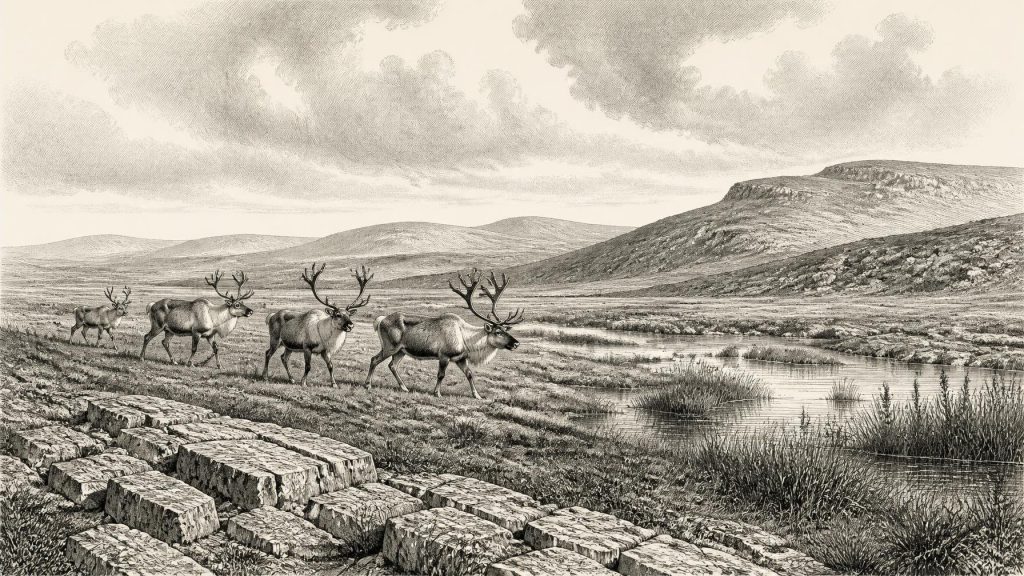
That community should not be reduced to a single image of featureless snow. Reindeer and lemmings point to open, cold habitats, while mammoth, giant deer and carnivores indicate a varied mosaic able to sustain grazing, browsing and predation. The likely landscape included grass-rich or herb-rich open ground, dwarf shrubs, patches of sedge and wet ground, sparse woodland or scrub in more favourable places, and exposed stony terrain. Such reconstructions are interpretations drawn from species’ ecological tolerances, fossils and wider palaeoenvironmental records. They do not establish precisely what stood outside Castlepook Cave in the particular year named here.
Other Irish deposits make the wider environmental picture richer. Organic sediments beneath glacial deposits at Derryvree and Maguiresbridge in County Fermanagh preserve plant macrofossils, pollen and insect evidence from earlier cold-stage intervals. Finds such as bogbean, water-milfoil, sedges, mosses and arctic-alpine plants show that even harsh glacial environments could contain ponds, marshy hollows and productive wetland margins. Those deposits are not an annual record for 31,374 BCE, nor necessarily exactly contemporary with the Castlepook fauna. Their value lies in demonstrating that Irish cold-stage landscapes could be ecologically varied rather than uniformly lifeless or permanently ice-covered.
Hyaenas, Herds and Moving Landscapes
The cave’s animals also reveal something of ecological relationships. Spotted hyaenas were formidable social scavengers and hunters, and caves could serve as dens where bones accumulated through repeated activity. Tooth marks, gnawed ends and broken bones can therefore be evidence of carnivore behaviour rather than human consumption. Wolves and foxes added further pressure to herbivore populations. Reindeer may have travelled seasonally over broad ranges; giant deer, mammoth and other large herbivores would have required substantial feeding grounds. Yet the Irish fossil record is too incomplete to map migration routes, herd sizes or breeding seasons with confidence.
There is no basis for describing political communities, leaders, diplomacy, warfare, religious rites, languages, artistic traditions or trade systems in Ireland at this date. Nor can archaeologists identify villages, houses, hearths, cemeteries or cultivated fields of comparable age. Agriculture lay many millennia in the future. If humans entered Ireland during the wider MIS 3 period, they would have been mobile hunter-gatherers using perishable clothing, shelters and equipment that rarely survive. But that is a conditional comparison with Upper Palaeolithic Europe, not evidence for a known Irish society.
The Reindeer Femur Question
A single object has made Castlepook especially important to debates about Ireland’s earliest possible human past: a reindeer femur reported by County Cork heritage researchers as bearing a deep linear mark made on fresh bone, interpreted as the result of a sharp stone tool during butchery. The associated public account places the bone at about 31,000 BC. If the mark is correctly identified and if the bone’s age and modification are genuinely related, it could indicate a fleeting Upper Palaeolithic human encounter with reindeer in Ireland far earlier than the island’s previously secure evidence of human activity.
That possibility deserves attention, but not exaggeration. The femur came from an old cave collection rather than a sealed modern excavation with associated stone tools, hearths, occupation surfaces or human remains. A radiocarbon measurement dates the animal, while interpreting a groove requires separate microscopic and taphonomic analysis. Carnivore damage, sediment abrasion, breakage, handling and excavation can all complicate the reading of bone surfaces. The 2022 Castlepook research excavation was undertaken precisely because surviving deposits might test such questions through new stratigraphy, environmental sampling and dating; it did not establish a Palaeolithic settlement.
The contrast with the later brown-bear kneecap from Alice and Gwendoline Cave, County Clare, is instructive. That patella bears cut marks and was independently radiocarbon dated to calibrated ranges of 12,810–12,590 and 12,810–12,685 years before present. It is widely treated as evidence of Late Upper Palaeolithic human activity, though it too comes from a cave assemblage requiring careful contextual assessment. It is approximately twenty millennia later than the nominal year considered here. The comparison shows why Irish prehistory advances through cautious testing rather than bold claims of continuous settlement.
What Can Be Said Responsibly
For 31,374 BCE, the strongest historical statement is environmental. Ireland was within a Late Pleistocene world approaching the major glacial expansion that would remodel much of the island. In at least some phases of MIS 3, cold-adapted mammals occupied southern Ireland, and wetlands and open vegetation existed elsewhere in the island’s changing landscape. Caves such as Castlepook preserve the remains of animals, carnivores and ecological processes, not a settled human community.
The possible cut-marked reindeer femur offers an intriguing prospect of human presence, perhaps a short visit by people exploiting a carcass or moving along the far-western fringes of Upper Palaeolithic Europe. It does not demonstrate that Ireland had a permanent population, political order, trade network or inherited cultural tradition at this precise point. The real importance of the period lies in its deep-time evidence: a landscape of ice, tundra-like habitats, wetlands and large mammals whose fragmentary remains set the limits of what can honestly be known.
Primary Sources
- A Reconsideration of the Radiocarbon Dating of the Marine Isotope Stage 3 Fauna from Southern Ireland
- Growth and Retreat of the Last British–Irish Ice Sheet, 31,000 to 15,000 Years Ago: The BRITICE-CHRONO Reconstruction
- Pattern and Timing of Retreat of the Last British-Irish Ice Sheet
- Trimlines, Blockfields and the Vertical Extent of the Last Ice Sheet in Southern Ireland
- First Evidence of a Late Upper Palaeolithic Human Presence in Ireland
- First Evidence of a Late Upper Palaeolithic Human Presence in Ireland
- Palaeolithic Ireland – New Evidence Emerges from the Emerald Isle
- New Insights on the Fauna of Ireland’s Younger Dryas and Early Holocene from Alice & Gwendoline Cave
- The Irish Quaternary Fauna Project
- Occurrence of Mammalia Relicts at Site Castlepook Cave
- Pleistocene Vertebrates in the British Isles
- Archaeology Research Excavation Grant 2022
- 2022:564 – Castlepook Cave, Castlepook South, Cork
- Heritage Artefacts of County Cork
- Ireland: Submerged Prehistoric Sites and Landscapes
- Ireland Through Geological Time
- Geology of Ireland
- The Last Glacial Termination in Northern Ireland
- The IntCal20 Northern Hemisphere Radiocarbon Age Calibration Curve (0–55 cal kBP)
- Niche Construction and Plant Use in the Mesolithic: A Review of Archaeological and Ethnographic Evidence