Derryvree’s Sub-Till Bogbean31357 BCE
31,357 BCE is an imprecise label for a Late Pleistocene interval, not a date for a recoverable Irish event. At Derryvree, County Fermanagh, organic freshwater silts between two glacial tills document an ice-free phase during MIS 3. Radiocarbon evidence broadly places them between 36,900 and 31,700 calibrated years BP. Mosses, sedges, bogbean and cold-adapted insects indicate a wet, treeless tundra-like wetland, while conditions elsewhere remained uncertain amid shifting ice and sea levels. Castlepook Cave’s reindeer femur may bear a butchery cut, suggesting possible human presence, but cannot prove settlement. No evidence supports Irish polity, society, economy, ritual or sustained occupation.
Dateline
Modern calendar precision cannot responsibly be projected into Ireland’s deep Ice Age. “31,357 BCE” is therefore a useful label, not a recoverable year in which an Irish event can be placed. It corresponds very approximately to 33,300 calendar years before AD 1950, within the Late Pleistocene and Marine Isotope Stage 3 (MIS 3). The closest evidence is not an inscription, settlement or dated human grave, but a buried freshwater deposit at Derryvree near Maguiresbridge, County Fermanagh. Its scientific value lies precisely in showing what can be known: an interval of cold, non-glacial local conditions, preserved between episodes of ice advance.
The relevant record is broad. Organic material from Derryvree produced the conventional radiocarbon determination BIRM-166, approximately 30,500 radiocarbon years BP, with a substantial laboratory uncertainty. Radiocarbon years are not calendar years: atmospheric carbon levels changed through time, and calibration converts a laboratory measurement into a probability range rather than a single historical date. Published treatment places the Derryvree material broadly within about 36,900–31,700 calibrated years BP, or roughly 34,950–29,750 BCE. The nominal year falls within that span, but cannot be assigned to a particular season, layer or generation.
A Freshwater Interval
Derryvree was exposed during roadworks in 1969, when a cutting through a drumlin revealed fine sands and organic-rich freshwater silts enclosed between two tills. Till is the poorly sorted sediment left directly by moving glacier ice. The sequence supplies a firm relative order even where absolute dating is imprecise: ice deposited the lower till; the locality later supported water, plants and accumulating sediment; a renewed advance laid down the upper till and sealed the earlier landscape. The deposit is consequently a rare survival from a period normally erased by later glacial erosion.
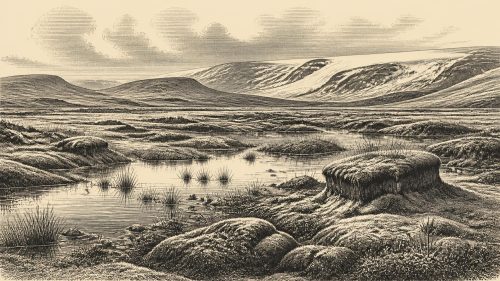
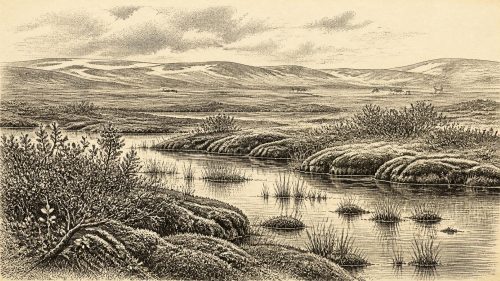
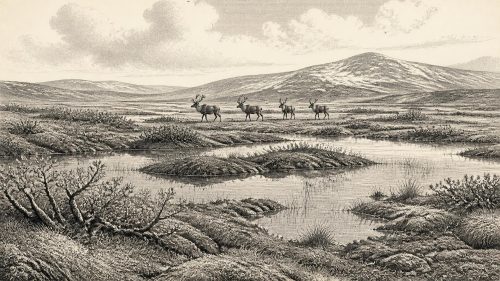
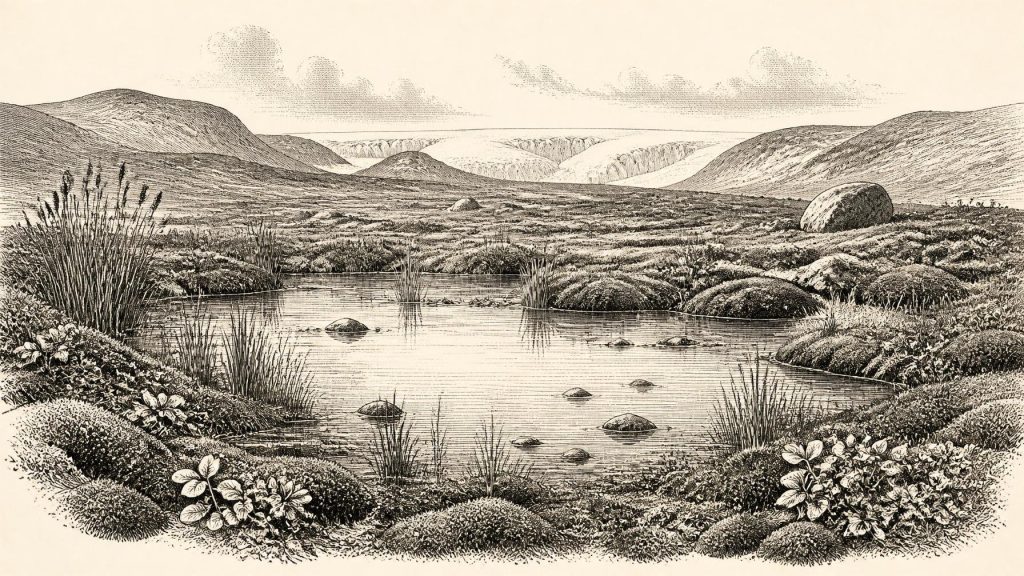
This was not the green, wooded Ireland familiar today. Mosses, sedges and other plant remains, together with an insect fauna of cold northern character, indicate open ground in a severe climate. The evidence supports a wet, treeless setting with shallow water, saturated margins and surrounding tundra-like vegetation. It does not support a uniform reconstruction of all Ireland. A small freshwater basin in Fermanagh was shaped by local relief, drainage and shelter; conditions in the uplands, on western coasts or farther south may have differed substantially.
One particularly vivid botanical find is a seed of bogbean, Menyanthes trifoliata. The plant grows in shallow fresh water and on the margins of fens, pools and lakes. Its presence does not make Derryvree a warm refuge. Rather, it demonstrates that liquid freshwater and a functioning wetland community existed during at least part of this cold interval. Mosses and sedges would have stabilised muddy edges; insects inhabited the available niches; seasonal thaw and refreezing probably repeatedly altered the ground. Such details give the distant landscape a physical reality without pretending to know its daily weather.
Between Ice Advances
Ireland at this time belonged to the unstable North Atlantic borderlands of the last glacial cycle. MIS 3 was marked by abrupt climatic oscillations, while the British–Irish Ice Sheet did not simply grow in one uninterrupted sweep. Research increasingly indicates earlier phases of glaciation and retreat before the Last Glacial Maximum, but the exact extent, thickness and timing of pre-maximum ice over Ireland remain debated. Derryvree is important because it proves that this part of Fermanagh experienced an ice-free phase between two glacial episodes; it cannot establish that the entire island was ice-free at the same moment.
The great maximum of the last British–Irish Ice Sheet came later, broadly during the period from about 27,000 to 21,000 years ago, with some sectors reaching their maximum extent around 25,000–23,000 years ago. At approximately 33,300 calendar years BP, the future island was thus approaching a more sustained and extensive phase of glaciation, not yet in the familiar climax landscape of ice across almost all low ground. This distinction matters. It is misleading either to picture an entirely ice-covered island in 31,357 BCE or to imagine a permanently open land awaiting settlement.
The coastline also cannot be drawn with modern confidence. Global sea level was considerably lower than today during much of the last glacial period, exposing portions of the continental shelf and moving shorelines outward. Yet local relative sea level was affected by the weight, growth and retreat of nearby ice, while seasonal sea ice and changing glacier margins altered access around the coasts. Ireland was not automatically joined to Britain merely because sea level was lower. The precise routes available to animals or people varied through time and remain a matter for geological reconstruction, not historical certainty.
Animals and the Human Question
Fermanagh’s silts are principally an environmental archive, not a faunal census. For a broader picture of Ice Age animals in Ireland, cave deposits in County Cork are relevant but must be handled with care. Castlepook Cave near Doneraile has produced remains attributed to cold-period species including reindeer, hare, fox, brown bear, spotted hyaena and woolly mammoth. Cave collections are often mixtures accumulated by carnivores, water, natural deaths and early excavators, however. Bones demonstrate that animals were present in a region or had entered a cave; they do not, by themselves, date every species to one moment or reveal a complete living ecosystem.
A reindeer femur from Castlepook has attracted exceptional attention because County Cork heritage publications report an age of about 33,000 years and describe a deep mark interpreted by zooarchaeologist Ruth Carden as a cut made with a sharp stone tool during butchery. If that interpretation is confirmed through continuing analysis, it would be a very early indication that people handled a reindeer in Ireland during the broad period represented by this article. It would not prove a permanent population, a named group or a settlement at Castlepook.
The evidential limits are crucial. No securely associated hearth, stone-tool assemblage, dwelling floor, burial or repeated camp of this age has yet established a sustained Upper Palaeolithic occupation of Ireland. The Castlepook bone was recovered from an old cave collection whose original context was disturbed long ago. A single proposed cut mark can raise an important question, but it cannot furnish a full narrative of migration. Further excavation, direct dating, microscopic study and discovery of stratified artefacts are needed before a fleeting visit can be distinguished from a stronger case for occupation.
Society Beyond Recovery
For that reason, political affairs, diplomacy and organised conflict cannot be reconstructed for Ireland around this date. There is no evidence for chiefs, territories, alliances, warfare, law or institutions. Nor is there evidence for Irish religious practice, ritual sites, art or formal learning. Caves can acquire ritual significance in later societies, but their use by animals, their shelter and their capacity to trap sediment are sufficient explanations for their Pleistocene importance. Projecting later Celtic, medieval or even Neolithic beliefs backwards over more than thirty millennia would replace evidence with fantasy.
Economy and trade are similarly beyond the record. If people briefly reached Ireland, they may plausibly have belonged to mobile Upper Palaeolithic hunter-gatherer communities known elsewhere in north-west Europe, equipped to exploit seasonal animal resources. That is an interpretation based on wider European comparison, not a demonstrated Irish economy. There are no Irish finds of this age that securely identify tools, food-processing places, exchange networks, boats, clothing, shelters or social organisation. The possible reindeer-processing evidence permits only the narrowest conclusion: one animal may have been handled with a stone edge.
Yet absence of human evidence is not absence of history. Derryvree records ecological change at a scale that profoundly conditioned every later human possibility. Ice reshaped drainage, deposited sediments and ultimately helped create the drumlin landscape above the buried wetland. Cold-adapted plants and insects persisted wherever water, exposed ground and brief growing seasons allowed. Animal movement would have followed shifting habitats and routes. The landscapes later entered by Mesolithic settlers were in part products of these far older cycles of advance, thaw, deposition and erosion.
The Responsible Picture
The strongest account of Ireland around 31,357 BCE is therefore deliberately modest. In County Fermanagh, a freshwater wetland occupied ground that had been glaciated earlier and would later be overridden again. Its organic silts preserve sedges, mosses, bogbean and cold-environment insects, indicating open, wet, treeless country rather than woodland. Elsewhere, ice, sea and terrain were changing across a climatically volatile island-edge. In County Cork, a reindeer bone raises the possibility of human butchery, but not yet the certainty of a settled community.
This is a history written beneath a drumlin rather than in chronicles: a short-lived ecological interval sealed by ice, dated in wide calibrated ranges and interpreted through sediment, fossils and careful comparison. Its lesson is not that Ireland possessed a hidden polity in 31,357 BCE. It is that the island’s deep past contains episodes of life between glaciers, and that each newly examined seed, insect or bone can sharpen—while also complicating—the boundary between what is known and what is merely possible.
Primary Sources
- A Middle Midlandian Fresh-Water Series at Derryvree, Maguiresbridge, County Fermanagh, Northern Ireland
- Early Midlandian–Middle Midlandian, Pleistocene, Northern Ireland
- Exploring controls of the early and stepped deglaciation on the western margin of the British Irish Ice Sheet
- Section 1: Introduction, IQUA Guide 16
- Menyanthes trifoliata L., Bogbean
- The Timing and Magnitude of the British–Irish Ice Sheet Between Marine Isotope Stages 5d and 2
- Growth and Retreat of the Last British–Irish Ice Sheet, 31,000 to 15,000 Years Ago: the BRITICE-CHRONO Reconstruction
- Extent and Deglacial Chronology of the Last British–Irish Ice Sheet: Implications of Exposure Dating Using Cosmogenic Isotopes
- Sedimentology and Chronology of the Advance and Retreat of the Last British-Irish Ice Sheet on the Continental Shelf West of Ireland
- Stratigraphic and Palaeo-Geomorphological Evidence for the Glacial-Deglacial History of the Last British-Irish Ice Sheet in the North-Western Irish Sea
- Character of Advance and Retreat of the Southwest Sector of the British-Irish Ice Sheet During the Last Glaciation
- Early Deglaciation of the British-Irish Ice Sheet on the Atlantic Shelf Northwest of Ireland Driven by Glacioisostatic Depression and High Relative Sea Level
- Maximum Extent and Dynamic Behaviour of the Last British–Irish Ice Sheet West of Ireland
- Dimensions and Chronology of the Last Ice Sheet in Western Ireland
- Trimlines, Blockfields and the Vertical Extent of the Last Ice Sheet in Southern Ireland
- The IntCal20 Northern Hemisphere Radiocarbon Age Calibration Curve (0–55 kcal BP)
- Heritage Artefacts of County Cork
- Ireland's Palaeolithic Archaeology – Fleeting Footprints in a Frozen Land
- Occurrence of Mammalia Relicts at Site Castlepook Cave
- New Insights on the Fauna of Ireland's Younger Dryas and Early Holocene from Alice & Gwendoline Cave
- First Evidence of a Late Upper Palaeolithic Human Presence in Ireland
- The Exploration of Castlepook Cave, County Cork