Hollymount’s Frozen Fen31348 BCE
31,348 BCE is a modern label for an uncertain MIS 3 horizon, not a recoverable Irish event. Between glacial advances, Fermanagh deposits at Derryvree, Hollymount and Greenagho preserve evidence of treeless, cold freshwater wetlands, with mosses, sedges, specialised plants and beetles. Ireland’s ice extent then remains uncertain, while frost, meltwater and later glaciation destroyed much evidence. Castlepook Cave bones demonstrate pre-Last Glacial Maximum large mammals, including reindeer, mammoth and predators, within open habitats. A possibly cut-marked reindeer femur may indicate brief human butchery, but cannot prove settlement. Ireland’s deep past is reconstructed cautiously from fragmentary sediments, fossils, stratigraphy and dating.
Dateline
31,348 BCE is a modern numerical label, not a date that people in Ice Age Ireland could have known or that archaeology can isolate to a single calendar year. It falls approximately 33,300 years before the conventional radiocarbon reference year of AD 1950, within Marine Isotope Stage 3 (MIS 3), a long and climatically unstable portion of the last cold stage. For Ireland, the responsible approach is therefore to describe a broad archaeological and environmental horizon rather than invent an event for this particular year. The surviving evidence is sparse, difficult to date and often disturbed by later ice. It nevertheless shows that Ireland was not simply an empty white expanse: in at least some intervals it contained cold, open habitats, freshwater wetlands and large mammals, while its caves and buried sediments preserve fragments of a much larger lost landscape.
A Date Beyond Calendar Precision
At this depth of time, radiocarbon dates must be distinguished from calendar dates. A laboratory result is expressed in radiocarbon years before present (BP), with “present” conventionally fixed at 1950; it then requires calibration against independently dated records such as tree rings, cave deposits, corals and lake sediments. The modern IntCal20 calibration curve reaches back to 55,000 calibrated years BP, but the uncertainty remains substantial in the age range relevant here. A date from one organic deposit cannot establish what occurred across all Ireland, still less in one named year.
Older Irish terminology calls this period part of the Midlandian cold stage, broadly equivalent to the British Devensian. MIS 3, conventionally placed between about 57,000 and 29,000 years ago, was neither a single uniform freeze nor a straightforward prelude to the Last Glacial Maximum. North Atlantic climate swung repeatedly between relatively milder interstadials and severe stadials on millennial scales. Irish evidence is too fragmentary to match each local deposit securely to a particular Greenland climate oscillation. The most that can be said firmly is that the notional year 31,348 BCE belongs to this variable pre-maximum phase, before the later British–Irish Ice Sheet reached its best-established maximum extent.
Wet Ground Between Ice Advances
The strongest direct evidence for Ireland’s environmental conditions around this broad horizon comes from buried sequences in County Fermanagh. At Derryvree, near Maguiresbridge, organic-rich freshwater layers lie between two tills: sediment deposited by an earlier glacier beneath, and sediment laid down by a later ice advance above. The organic material yielded a conventional radiocarbon age of 30,500 BP, with an unusually large uncertainty of roughly a thousand years. It should not be converted into a spurious exact BC date. Its calibrated position is broad, but it makes Derryvree especially relevant to an early-thirty-third-millennium-BCE setting.
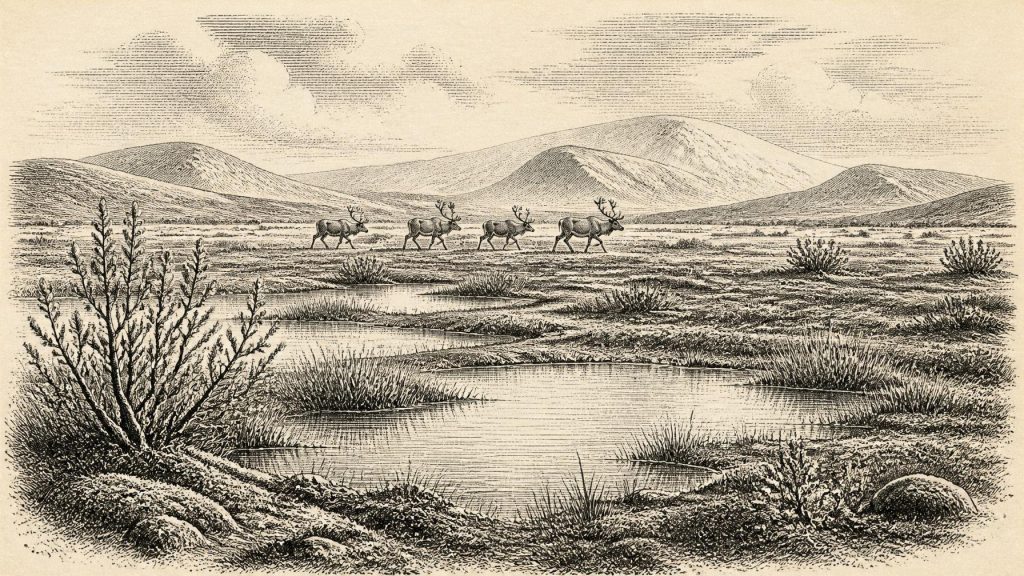
The Derryvree layers contain freshwater mosses and sedges, along with plant remains including bogbean, water-milfoil, mountain avens, arctic willow and other cold-tolerant species reported from the deposit. Fossil beetles also indicate a northern, cold-climate fauna. Taken together, these remains demonstrate the existence of standing or slow-moving freshwater and wet ground in a treeless landscape. “Muskeg” has sometimes been used for this mosaic of saturated mossy ground, shallow pools and sedge-rich vegetation. It was not a modern peat bog, nor proof of a benign climate. Rather, it was a low, damp landscape where short growing seasons could nevertheless sustain specialised plants and insects.
Nearby sites broaden, but do not duplicate, the picture. Hollymount, also near Maguiresbridge, produced an inter-till freshwater deposit whose pollen points to open countryside of northern aspect; its reported age is greater than 41,500 radiocarbon years BP, making it appreciably older than the Derryvree sample. Greenagho near Belcoo yielded organic deposits with a cautious minimum age of 32,460 radiocarbon years BP, because the date and lack of pollen leave correlation uncertain. These sites should not be treated as a single simultaneous wetland. Their importance is comparative: they show that cold, non-glacial landscapes and freshwater habitats occurred in Fermanagh between episodes of glaciation.
Ice, Water and a Changing Island
The larger geographical setting was dynamic. Earlier Midlandian glaciation had affected northern Ireland, and evidence from Ireland and its surrounding shelves increasingly suggests that ice masses could advance, retreat and calve into marine basins before the global Last Glacial Maximum. Yet the most securely dated island-wide maximum belongs later, broadly after 31,000 years ago and especially around 26,500–19,000 years ago. Around the notional date considered here, it is unsafe to draw a single firm ice margin around Ireland. Some areas may have been ice-covered or influenced by nearby ice, while others supported open terrain, watercourses and wetland vegetation.
Permafrost processes, seasonal freezing and meltwater mattered as much as glacier fronts. Frost could fracture exposed rock; water flowing over frozen or compacted ground could rearrange sediment rapidly; later ice could erode whole surfaces and redeposit material far from its original setting. This destructive history helps explain why evidence for people is so rare. Campsites on exposed ground are particularly unlikely to have survived intact. Caves, sinkholes and sediments protected beneath later till provide the unusual windows through which the period is seen.
The Animals of Open Country
Irish cave assemblages show that large mammals reached the island in MIS 3. Castlepook Cave, near Doneraile in north County Cork, has yielded remains attributed to reindeer, giant deer, woolly mammoth, spotted hyaena, wolf, Arctic fox and lemmings, alongside other fauna. Improved radiocarbon pretreatment and re-dating have altered the chronology substantially: some Castlepook specimens proved between about 5,000 and 12,000 radiocarbon years older than earlier results indicated. The resulting evidence places important parts of the fauna before the Last Glacial Maximum, and research has suggested that giant deer and spotted hyaena may have disappeared locally before about 40,000 calibrated years BP.
This is evidence for animal presence, not a complete list of creatures living together on one day or in one exact valley. Cave bone collections can be mixtures accumulated over thousands of years. Carnivores may drag prey or scavenged pieces into dens; water can move bones; excavations undertaken long ago may remove specimens without preserving modern standards of stratigraphic information. Nonetheless, the assemblage is consistent with an open, productive, cold-adapted landscape rather than continuous forest. Reindeer could exploit seasonal tundra and grassland resources, while the presence of mammoth, giant deer and large predators points to food webs able to support substantial herbivores and scavengers.
The Castlepook Human Question
One object gives this period exceptional archaeological importance: a reindeer femur from Castlepook. County Cork’s heritage publication identifies it as Palaeolithic and approximately 31,000 BC, while zooarchaeologist Ruth Carden has interpreted a deep mark on the bone as having been made by a sharp stone tool during butchery. If that interpretation is sustained, it would indicate that a person, or people, processed a reindeer in Ireland during MIS 3—far earlier than the island’s formerly accepted post-glacial human record.
But the conclusion must remain carefully framed. The radiocarbon result dates the death of the animal, not automatically the making of the mark; identifying a surface scar as a human cut requires taphonomic judgement. More importantly, there is no securely associated stone-tool assemblage, hearth, dwelling, burial, human bone, occupation floor or stratified campsite of comparable age at Castlepook. The cave’s early excavations recovered a rich but complicated collection, and recent fieldwork has sought intact deposits capable of testing the old material in context. The femur is compelling evidence of a possible human episode, not proof of a settled Ice Age population across Ireland.
What Cannot Be Reconstructed
There is no basis for political history at 31,348 BCE. No names, communities, territories, chiefs, diplomatic exchanges or organised conflicts can be recovered. Nor is there evidence for farming, permanent villages, boats, exchange networks, formal religious institutions, monuments or artistic traditions within Ireland at this time. The absence of such evidence should not be mistaken for proof that no social relationships existed among any visitors. It means only that the Irish record cannot responsibly describe them.
If people did enter Ireland during a favourable MIS 3 interval, the most cautious interpretation is one of brief, highly mobile foraging or hunting activity. Reindeer and other large animals would have offered meat, fat, hide, sinew, bone and antler; wetlands and open ground could offer seasonal plant and bird resources. Such possibilities are ecological inferences, however, not excavated evidence for a local economy. There is no warrant for imagining a permanent camp beside the Doneraile caves, a regular reindeer-hunting route through Fermanagh, or trade with Britain and continental Europe.
Learning from a Fragmentary Record
The chief historical development illuminated by this date is therefore methodological as well as environmental. Ireland’s deep past is reconstructed from pollen grains, seeds, insect parts, bone chemistry, cave sediments, glacial stratigraphy and revised laboratory techniques. Each category answers a different question. Wetland fossils reveal local habitat; cave bones show animals reached particular places; a cut-mark interpretation may signal human action; till above and below a deposit establishes that the landscape stood between ice advances. None alone can supply a conventional narrative of society.
For the broad era represented by 31,348 BCE, Ireland emerges as a shifting north-western margin of Ice Age Europe: cold, generally open and environmentally demanding, yet capable at times of sustaining freshwater ecosystems and herds of large mammals. Derryvree’s buried wetland and Castlepook’s cave bones are not scenes frozen in one year. They are time-averaged traces, preserved by chance and read with caution. Their value lies precisely in what they securely establish: long before farms, tombs and written history, Ireland had landscapes, animals and perhaps fleeting human visitors whose stories survive only in sediment and bone.
Primary Sources
- Early Midlandian–Middle Midlandian, Pleistocene, Northern Ireland
- A Reconsideration of the Radiocarbon Dating of the Marine Isotope Stage 3 Fauna from Southern Ireland
- Heritage Artefacts of County Cork
- Middle Midlandian Interstadial Deposits at Greenagho, Near Belcoo, County Fermanagh, Northern Ireland
- Freshwater Organic Deposits and Stratified Sediments Between Early and Late Midlandian (Devensian) Till Sheets, at Aghnadarragh, County Antrim, Northern Ireland
- Irish Pleistocene Biostratigraphy
- Landscapes and Environments of the Last Glacial-Interglacial Transition: A Time of Amazingly Rapid Change in Ireland
- The Irish Quaternary Fauna Project
- Archaeological Excavations at Killuragh Cave, Co. Limerick: A Persistent Place in the Landscape from the Early Mesolithic to the Late Bronze Age
- New Insights on the Fauna of Ireland’s Younger Dryas and Early Holocene from Alice and Gwendoline Cave, County Clare
- Castlepook Cave, Castlepook South, Cork: 2022 Excavation Report
- Late Pleistocene Chronostratigraphy and Ice Sheet Limits, Southern Ireland
- Growth and Retreat of the Last British–Irish Ice Sheet, 31,000 to 15,000 Years Ago: The BRITICE-CHRONO Reconstruction
- The Timing and Magnitude of the British–Irish Ice Sheet Between Marine Isotope Stages 5d and 2
- Deglaciation Chronology of the Donegal Ice Centre, North-West Ireland
- Timing and Pace of Ice-Sheet Withdrawal Across the Marine–Terrestrial Transition West of Ireland During the Last Glaciation
- Maximum Extent and Readvance Dynamics of the Irish Sea Ice Stream and Irish Sea Glacier Since the Last Glacial Maximum
- Trimlines, Blockfields and the Vertical Extent of the Last Ice Sheet in Southern Ireland
- Radiocarbon Constraints on the History of the Western Irish Ice Sheet Prior to the Last Glacial Maximum
- The IntCal20 Northern Hemisphere Radiocarbon Age Calibration Curve (0–55 cal kBP)
- OxCal: Radiocarbon Calibration and Analysis