Revised Fauna31213 BCE
Castlepook Cave in County Cork preserves evidence for Ireland in Marine Isotope Stage 3, before the Last Glacial Maximum. Re-dated animal bones show that mammoth, reindeer, giant deer, brown bear, spotted hyaena and other cold-adapted mammals occupied parts of a variable, open landscape. Improved radiocarbon methods corrected overly recent dates, placing finds further back in time. A marked reindeer femur, about 33,000 years old, may indicate butchery by people, yet cannot prove settlement, identity or culture. Disturbed cave deposits, glacial erosion and missing habitation evidence require caution. Castlepook reveals animal dispersal and possible human visits, not a documented Palaeolithic community.
Dateline
“31,213 BCE” is a modern calendar label, not a year that can be isolated in Ireland’s archaeological record. There are no written dates, events or named people at this depth of time, and even scientific dating cannot distinguish one season from the next. In conventional calendar arithmetic the label lies about 33,162 years before AD 1950, the reference point used for “before present” dating, but that conversion must not be mistaken for an exact archaeological age. Radiocarbon determinations require calibration and carry statistical ranges; old cave collections also have difficult histories of excavation and disturbance. The responsible subject is therefore Ireland during the later part of Marine Isotope Stage 3, broadly c.57,000–29,000 calibrated years before present, rather than an imagined occurrence in one numbered year.
A Landscape Before Maximum Ice
This was Late Pleistocene Ireland, several millennia before the Last Glacial Maximum. The British–Irish Ice Sheet reached its fullest known extent later, around 27,000–23,000 calibrated years before present, when ice covered Ireland and much of its continental shelf. At the notional date represented by 31,213 BCE, conditions were cold and variable rather than simply a featureless island-wide ice sheet. Marine Isotope Stage 3 contained abrupt climatic oscillations, and the extent of glaciers, open ground, vegetation and coastlines changed over long spans rather than according to a single Irish timetable.
Southern Ireland preserves important clues because caves protected some bones and sediments from the erosion that later glaciation inflicted on much of the landscape. Coastal and glacial research shows that parts of southern Ireland experienced marine and terrestrial conditions during Marine Isotope Stages 4–3 before the later advance of the last ice sheet. That does not provide a detailed map for 31,213 BCE, nor does it mean every region was equally habitable. It does establish that the island’s pre-maximum history included intervals in which substantial mammals occupied at least some landscapes now within Ireland.
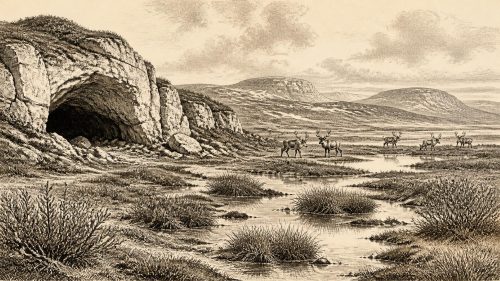
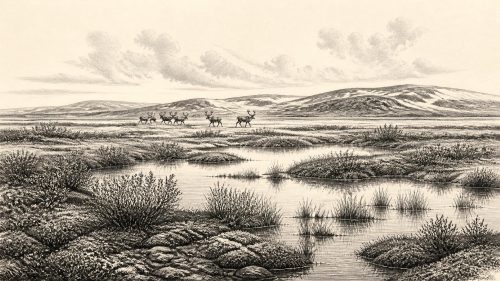
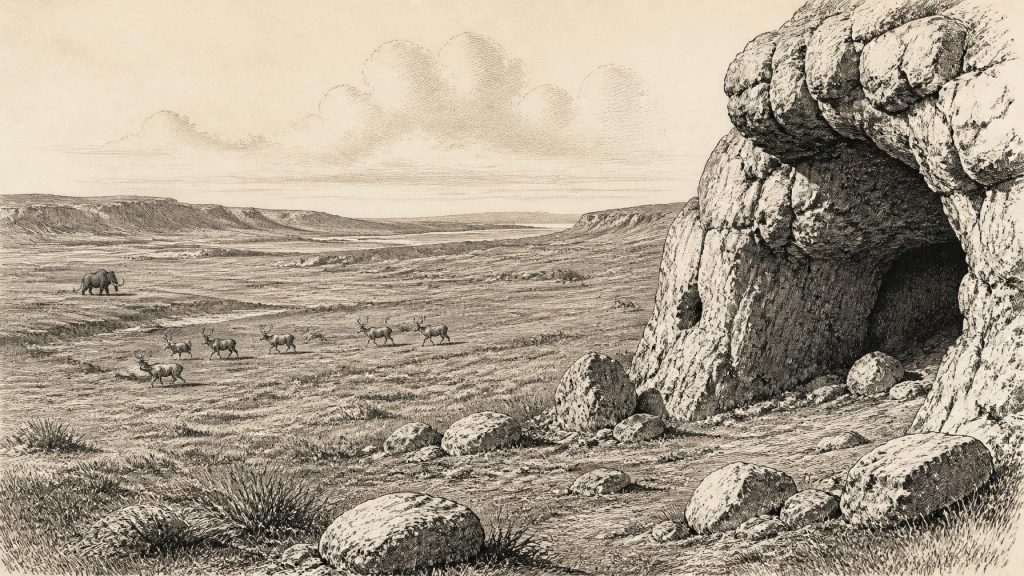
The best image is of a cold, open and changeable environment: grassland, herb-rich ground, exposed mineral soils, scattered low vegetation and sheltered limestone caves, rather than the dense woodland familiar from later prehistory. This was not the green, settled Ireland of popular imagination. Trees were limited or absent over wide areas, though local plant cover responded rapidly to temperature, moisture and the proximity of ice. Wind, frost, seasonal snow, meltwater and bare ground all shaped the resources available to animals.
The Castlepook Evidence
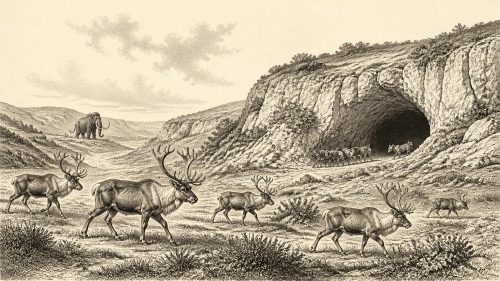
Castlepook Cave near Doneraile in north County Cork is central to any account of this period. Excavated principally in the early twentieth century, its chambers yielded a remarkable collection of animal remains. Subsequent radiocarbon work has identified a pre-Last Glacial Maximum fauna that includes woolly mammoth, reindeer, giant deer, brown bear and spotted hyaena, as well as evidence from other phases for wolf, Arctic fox and lemmings. These animals should not be pictured as one perfectly synchronous herd or as an intact food web observed on a particular day. Cave collections can accumulate over thousands of years, while predators, water, sediment movement and older excavation techniques can mix materials.
Even so, the assemblage is powerful evidence. Mammoth, reindeer and giant deer point to open, productive grazing landscapes capable of supporting large herbivores. Spotted hyaena is particularly revealing: Castlepook is Ireland’s key site for the species, and hyenas may have used caves as dens or places to carry and consume carcasses. Their presence, together with bones bearing carnivore damage, warns against treating every broken or marked bone as human work. Brown bears, wolves and smaller cold-adapted mammals add further depth to a landscape in which predation, scavenging and seasonal movement mattered.
Modern re-dating has changed the significance of the collection. Improved pretreatment of ancient bone collagen, including ultrafiltration, showed that a number of earlier Irish Pleistocene radiocarbon measurements were too young. The 2020 reassessment of Castlepook and other southern Irish caves pushed several faunal results substantially further back into Marine Isotope Stage 3. Its principal historical consequence is clear: mammals commonly associated with Ice Age north-west Europe had reached Ireland well before the later maximum of glaciation. It also demonstrates why inherited dates must be checked rather than repeated as settled fact.
The Reindeer Bone and Human Possibility
A reindeer femur fragment from Castlepook has made this period especially important for Irish archaeology. It has been reported as dating to roughly 33,000 years ago and as carrying a deep mark interpreted as fresh-bone butchery by a sharp stone implement. If that interpretation is sustained through detailed study, it would be extraordinarily early evidence that a person handled an animal in Ireland during Marine Isotope Stage 3. The claim deserves attention precisely because Ireland has long lacked an accepted archaeological occupation of comparable antiquity.
Its limits are equally important. The date is the age of the animal bone, not a timestamp for the incision. The find comes from an older collection, not from a newly excavated occupation surface with unbroken stratigraphy. No securely associated hearth, stone-tool assemblage, dwelling, human burial, art object or repeated butchery floor of this age has been published from Castlepook. A single potentially anthropogenic modification cannot establish whether people hunted the reindeer, scavenged it after a predator kill, briefly visited the cave, or lived nearby. Nor can it identify a population size, language, ancestry or cultural tradition.
Accordingly, it is not responsible to state that Ireland possessed a permanent human settlement in 31,213 BCE. Nor can the evidence be assigned to Neanderthals or to Homo sapiens. In wider north-west Europe, modern humans were present by this broad period and Upper Palaeolithic societies made sophisticated stone tools and art. But continental and British evidence cannot be imported wholesale into Ireland. Castlepook offers a serious question about a possible fleeting human presence, not a demonstrated Irish Palaeolithic community.
Life, Mobility and Resources
If people did reach Ireland during a favourable interval of Marine Isotope Stage 3, their lives would have depended on mobility and detailed environmental knowledge. Reindeer could yield meat, marrow, fat, hide, sinew, antler and bone; large herbivores were valuable but also unpredictable resources in a cold landscape. Caves offered shelter from weather and may have attracted people, carnivores and scavengers alike. Yet this is a conditional reconstruction based on better-documented hunter-gatherer worlds elsewhere, not direct proof of an Irish camp.
The animal record does demonstrate movement on a larger scale. Mammals reached Ireland from neighbouring landmasses at some point during the Late Pleistocene, when lower sea levels and changing ice margins repeatedly altered the geography of the Irish Sea region. Precisely how each species crossed remains unresolved. Faunal presence proves successful dispersal, but not a permanent land bridge, a single migration route or human travel alongside the animals. Likewise, there is no evidence for trade, exchange networks or boats in Ireland at this date.
What Cannot Be Recovered
There were no states, chiefs, borders or diplomatic relations that archaeology can identify for Ireland around this point. There is no evidence of organised conflict between human groups, and predator activity cannot be converted into a story of warfare. Nothing from this period supports claims about religion, ritual, language, kinship systems, social rank, teaching or artistic traditions on the island. The absence of such evidence is not proof that no people ever entered Ireland; it is a statement about what the surviving record can bear.
Settlement evidence is similarly absent. There are no known houses, campsites, middens, cemeteries or fields attributable to c.33,000 years ago in Ireland. This scarcity partly reflects genuine uncertainty about human presence, but it also reflects preservation. Later ice sheets eroded, buried and reworked older ground surfaces, while sea-level change submerged former coastal landscapes. Cave deposits are therefore disproportionately important, although they are not straightforward archives. The early excavators at Castlepook recovered extraordinary fossils, but their methods predated modern stratigraphic excavation and many deposits had already been disturbed.
A Small but Transformative Archive
The history of Ireland around 31,213 BCE is consequently not a national origin story. It is the history of a fragmentary archive: cave bones, changing sediments, ice-sheet reconstructions and increasingly exact laboratory methods. Castlepook shows that Late Pleistocene Ireland was at times part of a wider north-west European world of large herbivores and formidable carnivores. Its reindeer femur raises the possibility that people, too, made a brief appearance. But the distinction between a provocative clue and a secure settlement record must remain firm. At this remote point in the Irish past, caution is not a failure of imagination; it is the most accurate form of history.
Source References
Hover over a number to see the source. Select it to open the source.

- [1] A Reconsideration of the Radiocarbon Dating of the Marine Isotope Stage 3 Fauna from Southern Ireland
- [2] The Irish Quaternary Fauna Project
- [3] New Insights on the Fauna of Ireland’s Younger Dryas and Early Holocene from Alice & Gwendoline Cave
- [4] The Exploration of Castlepook Cave, County Cork
- [5] Heritage Artefacts of County Cork
- [6] Spotted Hyena Skull
- [7] Growth and Retreat of the Last British–Irish Ice Sheet, 31,000 to 15,000 Years Ago: the BRITICE-CHRONO Reconstruction
- [8] Late Pleistocene Chronostratigraphy and Ice Sheet Limits, Southern Ireland
- [9] Maximum Extent and Dynamic Behaviour of the Last British–Irish Ice Sheet West of Ireland
- [10] Dimensions and Chronology of the Last Ice Sheet in Western Ireland
- [11] Response of the Irish Ice Sheet to Abrupt Climate Change During the Last Deglaciation
- [12] Ireland: Submerged Prehistoric Sites and Landscapes
- [13] Our Ancient Landscapes: Hunter-Gatherers in Ireland
- [14] The Colonization of Ireland: A Human Ecology Perspective
- [15] The IntCal20 Northern Hemisphere Radiocarbon Age Calibration Curve (0–55 cal kBP)
- [16] European Middle and Upper Palaeolithic Radiocarbon Dates Are Often Older Than They Look: the Problems with Previous Dates and Some Remedies
- [17] AMS Radiocarbon Dating of Ancient Bone Using Ultrafiltration
- [18] Investigating Seasonal Mobility in Irish Giant Deer (Megaloceros giganteus) Through Strontium Isotope Analysis
- [19] The Timing and Magnitude of the British–Irish Ice Sheet Between Marine Isotope Stages 5d and 2
- [20] Exploring Controls of the Early and Stepped Deglaciation on the Western Margin of the British Irish Ice Sheet
- [21] Occurrence of Mammalia Relicts at Site Castlepook Cave
- [22] The Earliest Evidence for Anatomically Modern Humans in Northwestern Europe
Primary Sources
- A Reconsideration of the Radiocarbon Dating of the Marine Isotope Stage 3 Fauna from Southern Ireland
- The Irish Quaternary Fauna Project
- New Insights on the Fauna of Ireland’s Younger Dryas and Early Holocene from Alice & Gwendoline Cave
- The Exploration of Castlepook Cave, County Cork
- Heritage Artefacts of County Cork
- Spotted Hyena Skull
- Growth and Retreat of the Last British–Irish Ice Sheet, 31,000 to 15,000 Years Ago: the BRITICE-CHRONO Reconstruction
- Late Pleistocene Chronostratigraphy and Ice Sheet Limits, Southern Ireland
- Maximum Extent and Dynamic Behaviour of the Last British–Irish Ice Sheet West of Ireland
- Dimensions and Chronology of the Last Ice Sheet in Western Ireland
- Response of the Irish Ice Sheet to Abrupt Climate Change During the Last Deglaciation
- Ireland: Submerged Prehistoric Sites and Landscapes
- Our Ancient Landscapes: Hunter-Gatherers in Ireland
- The Colonization of Ireland: A Human Ecology Perspective
- The IntCal20 Northern Hemisphere Radiocarbon Age Calibration Curve (0–55 cal kBP)
- European Middle and Upper Palaeolithic Radiocarbon Dates Are Often Older Than They Look: the Problems with Previous Dates and Some Remedies
- AMS Radiocarbon Dating of Ancient Bone Using Ultrafiltration
- Investigating Seasonal Mobility in Irish Giant Deer (Megaloceros giganteus) Through Strontium Isotope Analysis
- The Timing and Magnitude of the British–Irish Ice Sheet Between Marine Isotope Stages 5d and 2
- Exploring Controls of the Early and Stepped Deglaciation on the Western Margin of the British Irish Ice Sheet
- Occurrence of Mammalia Relicts at Site Castlepook Cave
- The Earliest Evidence for Anatomically Modern Humans in Northwestern Europe